In fertilizer production, evaporation and crystallization equipment sits at two very different points in the flowsheet, and conflating them causes most selection errors. On the product side, evaporators concentrate nutrient liquors to market-grade specs – ammonium nitrate to roughly 95% solids before prilling, phosphoric acid from about 30% to 54% P2O5 – and crystallizers turn dissolved salts into premium solid products such as sulfate of potash (SOP). On the water side, the same unit operations solve the industry’s hardest compliance problem: fertilizer wastewater carries ammonia nitrogen at industry-reported levels of 2,000-5,000 mg/L (spiking above 10,000), high salinity, and refractory organics that overwhelm biological treatment, so the end-of-pipe answer increasingly combines ammonia recovery as ammonium sulfate with evaporation-crystallization for zero liquid discharge. This guide walks both sides with the numbers that drive the equipment choices.
Where the Duty Sits: Product Side Versus Water Side
| Location | Objective | Representative Duty | Governing Spec |
|---|---|---|---|
| Product concentration | Raise nutrient content to saleable/processable grade | Ammonium nitrate to ~95% solids; phosphoric acid 30% to 54% P2O5 | Product concentration and purity |
| Product crystallization | Convert dissolved nutrients to solid products | SOP from potassium-rich brine; MOP from solution-mined KCl | Crystal size and grade |
| By-product recovery | Recover ammonium sulfate from synthesis and refinery side streams | Nickel and caprolactam plant by-product streams | Fertilizer-grade salt spec |
| Wastewater treatment | Meet discharge or ZLD targets while recovering value | Ammonia stripping plus salt and ammonium sulfate recovery | Effluent TN, TDS, discharge permit |
Product-Side Applications by Nutrient Family
Nitrogen Fertilizers
Evaporators concentrate urea and ammonium nitrate liquors after synthesis; for ammonium nitrate the concentration target is on the order of 95% solids ahead of prilling or granulation, which places the duty at the viscous, high-boiling-point-rise end of the evaporation spectrum and pushes selection toward forced-circulation and special-alloy equipment. Crystallizers appear on the nitrogen side mainly as by-product recovery: ammonium sulfate crystallized from nickel smelting and caprolactam production streams is a fertilizer-grade product, and these metallurgical and chemical by-product duties are frequently as large as dedicated fertilizer plant crystallizers.
Phosphate Fertilizers
Phosphoric acid concentration – from about 30% to 54% P2O5 – is the signature evaporation duty of the phosphate chain, run in forced-circulation concentrators with aggressive materials selection against the corrosive, scaling liquor. Downstream, MAP and DAP production combines ammonia and phosphoric acid in controlled reaction and granulation, where concentration control of the acid feed directly sets product nutrient ratios.
Potassium Fertilizers
The potassium family is where crystallization technique differentiates product value most visibly. SOP (potassium sulfate) produced from potassium-rich brine via crystallization avoids furnace-based processes entirely and commands a chloride-sensitive premium market. On the MOP (potassium chloride) side, cooling crystallization of solution-mined KCl yields high-purity product from the mined liquor. Both duties are cooling-crystallization problems at heart – the phase behavior of the potassium salts does the separation work, and equipment selection is about crystal size control and heat-removal efficiency rather than evaporation economics.
Organic and Bio-Based Fertilizers
Digestate from anaerobic digestion is evaporated to reduce slurry volume and concentrate nutrients into a transportable solid fraction, and crystallization steps recover solid NPK components from liquid organics. These duties are milder chemically but fouling-prone, and they reward evaporator designs with cleanable surfaces and tolerant residence times.
Why Fertilizer Wastewater Breaks Biological Treatment
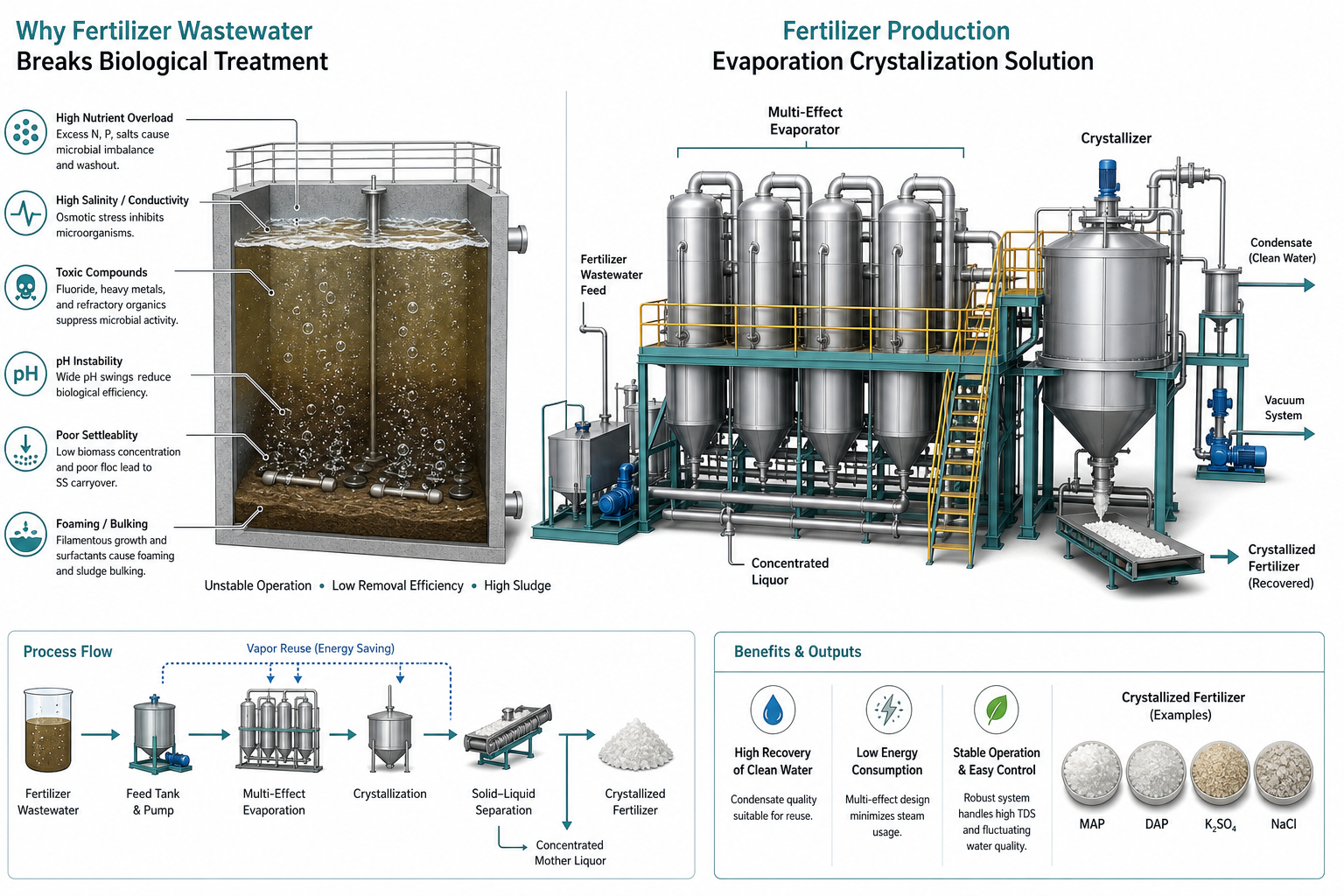
Treat the wastewater figures quoted on this page (ammonia nitrogen 2,000-5,000 mg/L with spikes above 10,000, high salinity and COD) as an illustrative feed envelope drawn from published industry analyses – not customer or project data. The problem itself is unusually well documented: effluents from ammonia production, phosphate processing, and compound fertilizer manufacturing combine high ammonia nitrogen with high salinity, high COD, and refractory organics such as amines and surfactants. Three mechanisms defeat conventional activated sludge: free ammonia inhibits the nitrifying bacteria that convert ammonia to nitrate; dissolved salts dehydrate microbial cells and trigger sludge bulking; and refractory organics resist biodegradation even at extended retention times. Load fluctuation – seasonal fertilizer demand, cleaning cycles, production switches – then finishes the job, because systems without buffering capacity go from marginally compliant to collapsed.
Industry-reported analyses attribute more than 60% of persistent total-nitrogen (TN) exceedance cases directly to system design and operation issues rather than to untreatable chemistry – which is the encouraging part, because it means the fix is process engineering, not miracle biology.
The Recovery Route: Ammonia First, Then Salt
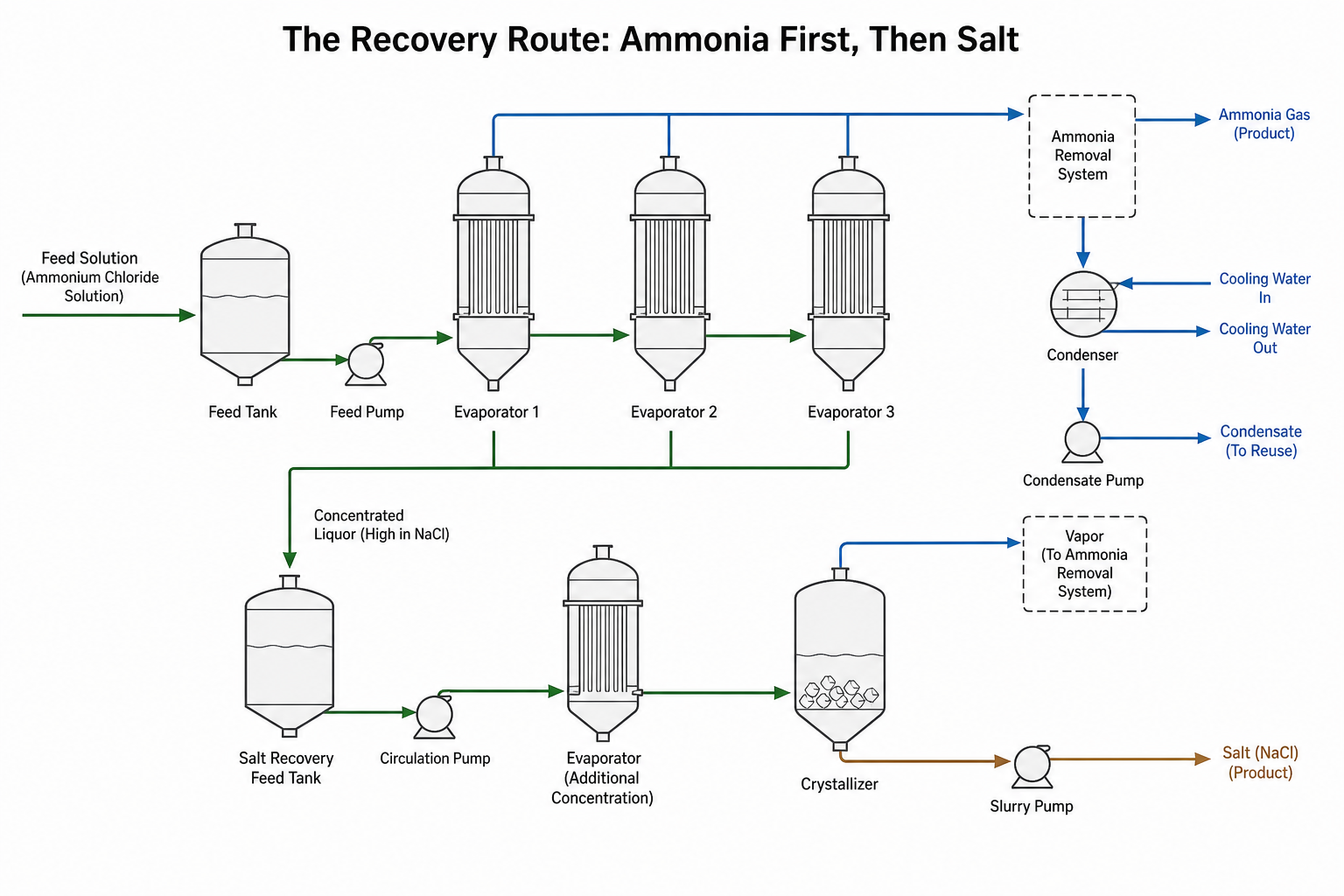
The modern treatment train attacks nitrogen where it is most concentrated and recovers it as a product:
- Pretreatment and load leveling. Equalization buffers the fluctuation; pH adjustment and breaking agents condition refractory compounds.
- Ammonia stripping with acid absorption. Air or steam stripping removes ammonia ahead of the biological stage, with industry-reported removal efficiencies of 80-95%, and the stripped ammonia is captured in acid absorption as ammonium sulfate – a fertilizer product, not a waste.
- Polished biological treatment. Operating in a greatly reduced load, the biological stage finally performs: enhanced nitrification-denitrification with controlled carbon dosing, and in low-C/N cases anaerobic ammonium oxidation to cut energy and chemical demand.
- Deep treatment and ZLD. Membrane filtration and reverse osmosis recycle water; the concentrated brine goes to multi-effect evaporation and crystallization, recovering salts and further ammonium sulfate as solids and returning clean condensate.
| Process Module | Candidate Equipment Types | Selection Basis | Module Function |
|---|---|---|---|
| Load leveling & pretreatment | Equalization basin, pH adjustment, breaking-agent dosing | Fluctuation profile, refractory load | Buffers swings and conditions organics for downstream stages |
| Ammonia stripping & absorption | Air or steam stripper with acid absorption column | Ammonia concentration, steam availability | Removes nitrogen as ammonium sulfate product |
| Biological polishing | Nitrification-denitrification; anammox for low C/N | Residual load, carbon ratio | Hits TN targets at reduced load and cost |
| Deep treatment & ZLD | RO membranes, multi-effect or MVR evaporation, crystallizers | Permit target, salt recovery value | Recovers water and mixed salts; closes the discharge loop |
Configuration, materials and operating envelopes above are potential considerations; actual selections depend on feed composition, temperature, pressure, corrosion review, fouling behavior, utilities and project capacity.
The strategic insight is that steps 2 and 4 turn the two pollutants into the two products. Ammonia becomes ammonium sulfate; dissolved salt becomes crystalline salt. A plant designed around that loop treats compliance as a by-product of revenue rather than as a cost center.
Evaporator and Crystallizer Selection for Fertilizer Duty
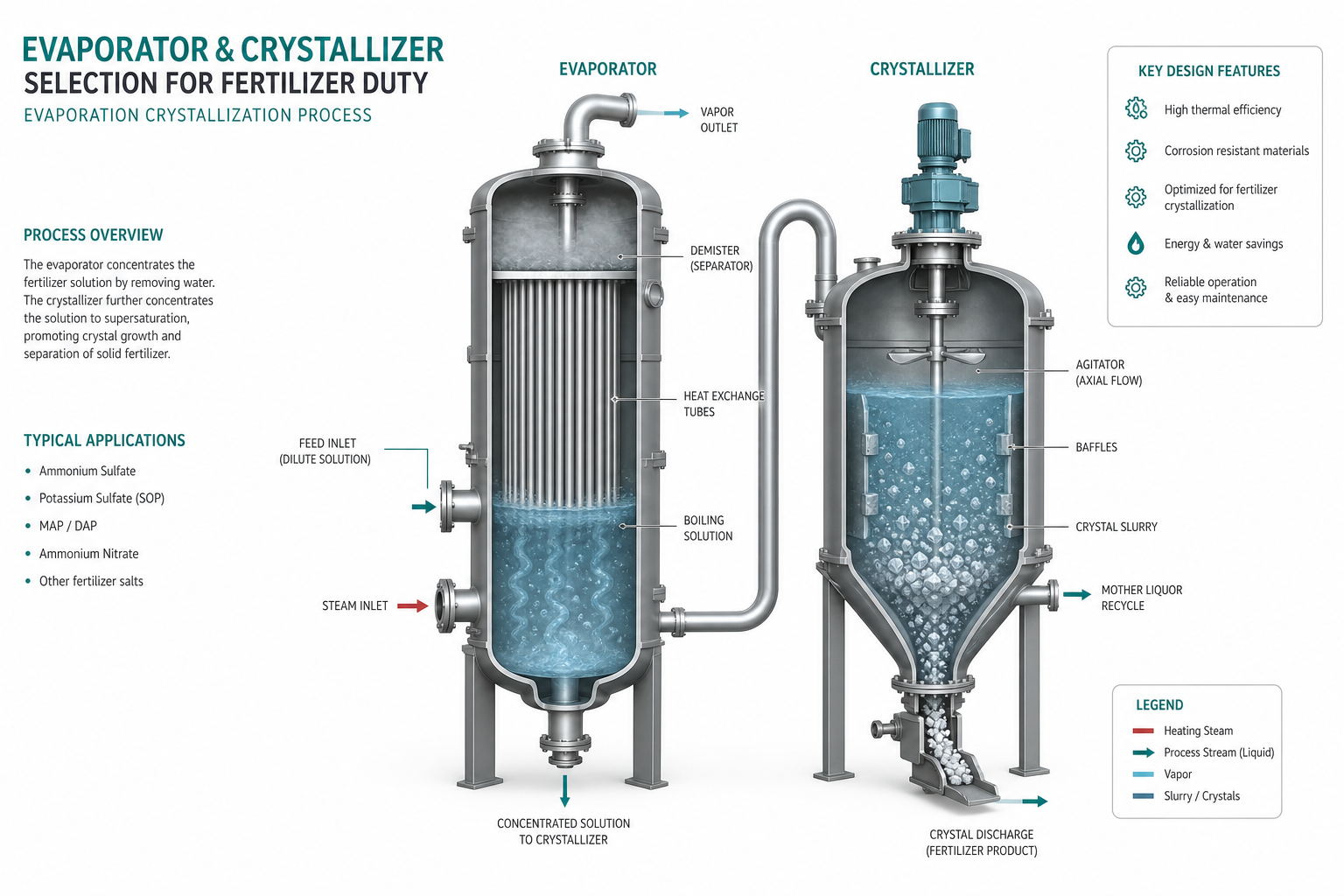
Across both the product and water sides, three configurations cover the fertilizer industry’s needs. Multiple-effect evaporation remains the default for high-tonnage concentration where steam is available at good rates, and it is the standard choice for brine concentration feeding salt crystallization. MVR evaporation trades steam for electricity and, per supplier-published figures, cuts energy use by as much as 90% versus single-effect thermal evaporation (indicative, not a project guarantee), which is most attractive on dilute, low-boiling-point-rise streams and on retrofit projects where existing vessels are retained. Forced-circulation evaporator-crystallizers handle the scaling, high-concentration duties – ammonium nitrate, phosphoric acid, and the final crystallization of sulfate salts – where robustness against fouling matters more than elegance. Selection mechanics for each are on our MVR evaporation, multiple-effect, and forced-circulation technology pages.
Crystal Quality and Downstream Handling Decide Market Grade
On the product side, the crystallizer’s discharge is not the finished fertilizer – the drying and handling chain that follows decides whether the crystal survives to the customer as a free-flowing product. Fertilizer salts are hygroscopic to varying degrees, and three practices separate premium product from caked complaints: controlled centrifuge or filter washing that sets the surface moisture entering the dryer; a drying stage (fluidized bed or flash drying) tuned to bring crystal moisture into the product spec without driving dust generation through over-attrition; and conditioning – anti-caking coating for potassium and ammonium salts, or screened sizing – matched to the destination market’s handling chain. The SOP market sharpens the point: chloride content is the grade-defining impurity, and it is fixed by the crystallization route and mother-liquor control chosen upstream, not by anything the dryer can repair. Our approach treats crystallizer, dewatering, and drying as one spec chain from the first proposal – the equipment logic is summarized on the drying and packing systems page.
Closing the Loop: ZLD for the Fertilizer Industry
Where permits tighten toward zero discharge, the treatment train above extends into a full ZLD flowsheet: brine concentration, then mixed-salt crystallization, then salt separation where sodium sulfate, sodium chloride, and ammonium sulfate can be split into individually sellable streams – the methods are covered in our salt separation systems overview. Cooling and freezing crystallization earn a specific place in fertilizer ZLD because several fertilizer-relevant salts (sodium sulfate in particular) have steep solubility-temperature curves, letting refrigeration replace part of the evaporation duty at lower energy cost – a trade-off explored in our cooling and freezing crystallization article. Project-level context for the water side sits with high-salinity ZLD systems and the chemical and agrochemical industry page.
How We Scope Fertilizer Evaporation-Crystallization Projects
Our engineering sequence is the same whether the duty is product concentration, by-product recovery, or wastewater ZLD: characterize the real liquor or waste stream, fix the product spec first, then work backward through crystallizer selection, evaporation configuration, and utility integration. For fertilizer projects this typically means an early decision on the ammonia-recovery-versus-biological-treatment boundary, because that single line decides both the wastewater flowsheet and the ammonium sulfate crystallization capacity. Deliverables range from single-train concentrators and crystallizers to integrated recovery islands combining stripping, absorption, evaporation, and drying, with condensate quality and salt purity specified against the applicable fertilizer and discharge standards.
When This Route May Not Fit
Recovery-and-crystallization scope assumes pollutants worth recovering and products with a market. It may not fit when: ammonia nitrogen is modest and stable, so a conventional biological stage meets the permit without stripping, absorption and crystallization capital; the recovered ammonium sulfate or mixed salts have no buyer in the region, turning “recovery” into expensive drying of a liability; the duty is small-batch organic-fertilizer production where simple evaporation ponds or tolling suffice; the product side is blending and bagging only, with no liquor concentration step to engineer; or SOP-grade premiums do not exist in the target market, so MOP and furnace routes remain adequate. Where discharge permits stay lenient and energy is cheap, the recovery loop is an optimization, not a necessity – and forcing it inflates cost without benefit.
What Must Be Verified
Before either side of this scope is fixed, verify: a complete wastewater characterization – ammonia nitrogen, salinity, COD, refractory organics and their swing across production and cleaning cycles; a biological inhibition assessment on the real stream, confirming whether nitrification can survive after stripping; stripping pilot data confirming the 80-95% removal band applies to your matrix; salt offtake agreements and grade specifications, because the ammonium sulfate and mixed-salt revenues carry the economics; crystallization phase behavior of your salt matrix (sodium sulfate, chloride and ammonium sulfate splits); and site utility prices – steam versus electricity – for the evaporator configuration choice. Figures quoted on this page are industry-reported and illustrative-envelope values, not a project guarantee.
FAQ
What are the key concentration targets in fertilizer production?
Two anchor numbers: ammonium nitrate is concentrated to roughly 95% solids ahead of prilling, and phosphoric acid is upgraded from about 30% to 54% P2O5 before downstream MAP/DAP production. Potash products are crystallized rather than evaporated – SOP from potassium-rich brine and MOP from solution-mined KCl liquor.
Why does biological treatment fail on fertilizer wastewater?
The combination of ammonia nitrogen at 2,000-5,000 mg/L (sometimes above 10,000), high salinity, and refractory organics overwhelms conventional biology: free ammonia inhibits nitrifiers, salts dehydrate microbial cells and cause sludge bulking, and amines and surfactants resist biodegradation. Industry-reported analyses attribute more than 60% of persistent TN exceedance cases to design and operation issues, not chemistry.
How is ammonia in fertilizer wastewater recovered as a product?
Air or steam stripping with acid absorption: industry-reported performance shows stripping removes 80-95% of the ammonia ahead of biological treatment, and the absorbed ammonia is recovered as ammonium sulfate, which is itself a fertilizer-grade product suitable for sale.
Is MVR worthwhile in fertilizer evaporation duty?
On dilute, low-boiling-point-rise streams and retrofit projects, yes – supplier-published figures indicate MVR can cut evaporation energy by as much as 90% versus single-effect thermal operation (indicative, not a project guarantee) and lets existing vessels be retained in revamps. On viscous, high-concentration duties such as ammonium nitrate and phosphoric acid, forced-circulation thermal systems remain the robust choice.
What does ZLD look like for a fertilizer plant?
Membrane concentration of the brine, followed by multi-effect evaporation and crystallization to recover mixed salts and ammonium sulfate as solids, with clean condensate recycled. Where sodium sulfate dominates, cooling or freezing crystallization can replace part of the evaporation duty at lower energy cost.
To see which side of this scope your project sits on, share your liquor or wastewater analysis, throughput and target – EvapCryst returns a first-pass process-direction screening for your case.