
Lithium chloride is concentrated and crystallized most economically in a mechanical vapor recompression (MVR) forced-circulation system that runs on electricity instead of boiler steam. Vendor-published LiCl plants evaporate water in an indicative 30-60 kWh-per-ton range, survive the chloride corrosion and high boiling-point rise that destroy standard stainless equipment, and convert feeds from salt-lake brine, spodumene leach liquor, or battery-recycling streams into LiCl crystal plus distillate clean enough to reuse inside the plant. This page explains how the process works, which materials of construction hold up, and what to specify before ordering a system.
Why LiCl Is a Demanding Evaporation Duty

Three properties of lithium chloride solutions drive every design decision. Ignoring any one of them produces an evaporator that loses capacity within weeks or corrodes through within a year.
High boiling-point rise
At 40 wt% concentration, LiCl solution boils roughly 20 °C higher than pure water at atmospheric pressure (literature BPE value at 40 wt%). Every degree of boiling-point rise (BPR) steals effective temperature difference from the heat exchanger and increases the compression work the vapor compressor must supply. A LiCl MVR system is therefore specified with a compressor delivering an 8-12 °C temperature lift (engineering-practice range), so a usable driving force remains across the heating surface even at the top of the concentration range. Standard evaporators sized for low-BPR salts are systematically undersized here.
Hot chloride corrosion
Hot, concentrated LiCl attacks common austenitic stainless steel rapidly. Material selection is zoned by temperature and chloride level rather than applied uniformly: modest alloys serve the cold, dilute front end of the train, while titanium or super duplex protects the hot, concentrated back end. This zoning keeps capital cost defensible without sacrificing service life, and it is the single largest cost lever in a LiCl plant quote.
Scaling and foaming near saturation
As the liquor approaches saturation, LiCl nucleates preferentially on hot tube walls, forming an insulating scale layer that collapses heat-transfer performance. Forced circulation with a tube-side velocity of 1.5-3 m/s (engineering-practice envelope) keeps the wall swept and maintains heat-transfer coefficients over long campaigns. LiCl solutions also foam; the vapor-liquid separator is sized with a generous disengagement zone and a chevron demister so that liquid carryover never reaches the compressor, where it would cause imbalance and erosion.
How the LiCl MVR Evaporation-Crystallization Process Works
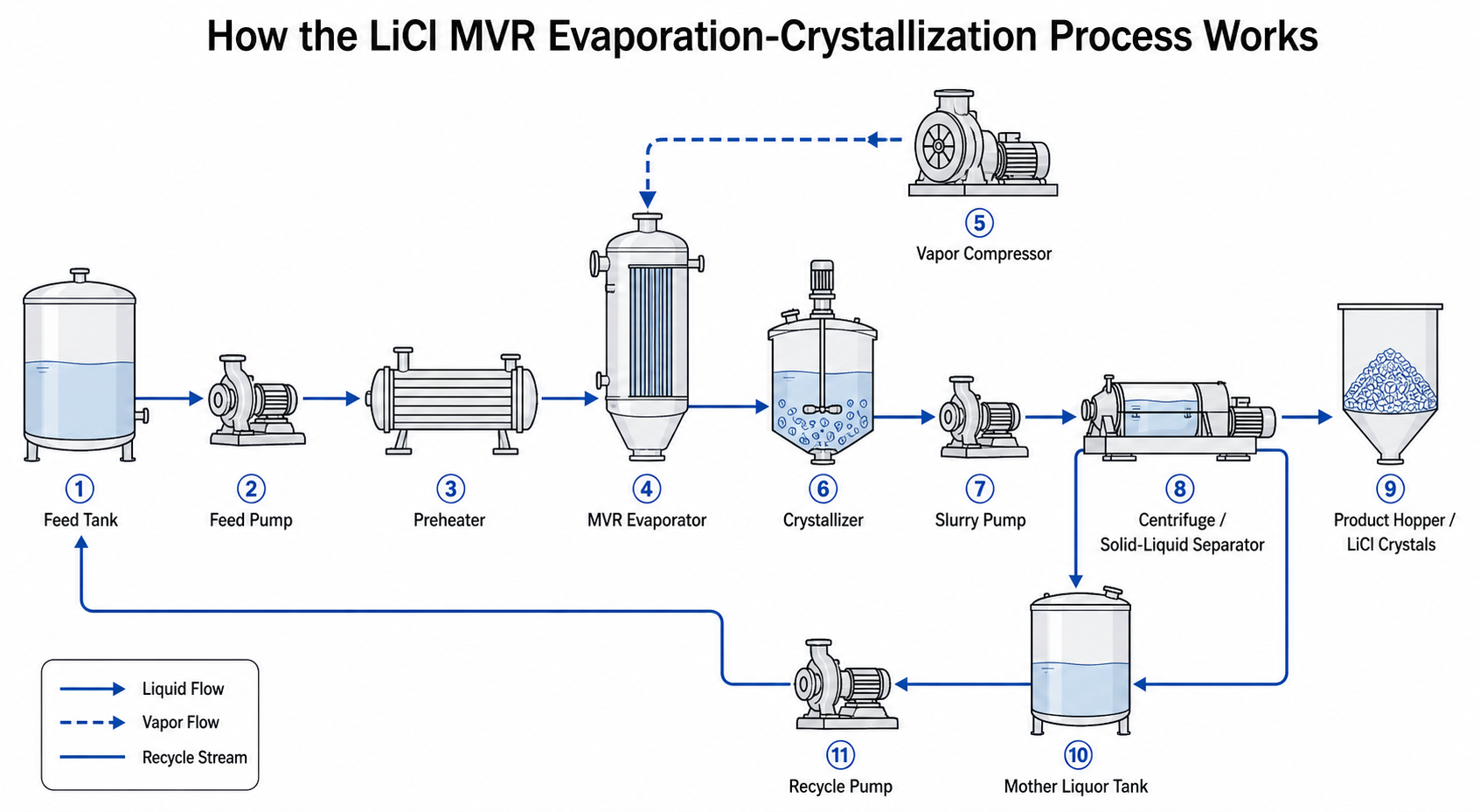
A complete train consists of a preheater, evaporator body with forced-circulation heat exchanger, steam compressor, circulation pump, thickener, and centrifuge, all coordinated by a PLC. The cycle runs in five steps:
- Preheating. Feed at 15-35% LiCl recovers heat from the hot condensate stream in the preheater, cutting the heat the compressor loop must supply.
- Evaporation. The liquor flashes and boils in the evaporator body, which typically operates at 70-90 °C under mild vacuum. The circulation pump drives liquid through the heating tubes at high velocity.
- Vapor compression. Secondary vapor leaves the separator and enters the compressor, which raises its temperature by 8-12 °C. This single step is the core of the energy saving: electricity upgrades low-grade vapor into heating steam.
- Condensation. Compressed vapor condenses on the shell side of the heat exchanger, releasing its latent heat to evaporate more LiCl solution inside the tubes. The condensate is drawn off as process water, typically above 99.9% purity and below 50 µS/cm (vendor-published indicative figures).
- Crystallization and separation. Once concentration reaches supersaturation, crystal slurry overflows to a thickener and centrifuge. LiCl crystal is collected as product; mother liquor returns to the evaporator for further recovery.
| Process Module | Candidate Equipment Types | Selection Basis | Module Function |
|---|---|---|---|
| Preheat | Condensate-fed preheater | Feed tenor and temperature | Recovers sensible heat, cuts compressor duty |
| Evaporation | Forced-circulation body (potential material considerations per zoning below) | BPR, scaling tendency | Boils liquor at velocity high enough to sweep walls |
| Vapor compression | Centrifugal MVR compressor | Required temperature lift vs BPR | Upgrades secondary vapor to heating steam on electricity |
| Condensation / heat recovery | Shell-side condenser, distillate draw | Distillate reuse value | Returns latent heat to the cycle; produces clean process water |
| Crystallization and separation | Thickener plus centrifuge, mother-liquor return | Product form and crystal size target | Harvests LiCl crystal; recycles mother liquor |
Configuration, materials and operating envelopes above are potential considerations and indicative envelopes; actual selections depend on feed composition, temperature, pressure, corrosion review, fouling behavior, utilities and project capacity.
The entire sequence runs unattended under PLC control, with temperature, pressure, flow, level, and density monitored continuously and full remote access from the control room or a mobile HMI. For the underlying thermodynamics, see our MVR evaporation technology overview.
Materials of Construction for LiCl Service
Alloy selection follows the temperature-concentration zone each component occupies. The table below summarizes the standard hierarchy used across published LiCl project references:
| Material | Typical max service temp | Chloride resistance | Relative cost | Typical application |
|---|---|---|---|---|
| SS316L | 60 °C | Poor | Low | Preheater, low-temperature piping on dilute feed |
| Duplex 2205 | 100 °C | Good | Medium | Evaporator body at moderate concentration |
| Super duplex 2507 | 120 °C | Very good | High | Transition sections into high-concentration zones |
| Titanium TA2 | 150 °C+ | Excellent | Very high | Heating tubes in contact with hot concentrated LiCl |
| Titanium TA10 | 150 °C+ | Excellent, crevice-resistant | Very high | Crystallizer body and other aggressive zones |
TA10 carries a palladium addition that resists crevice corrosion in reducing chloride environments, which is why it is preferred for the crystallizer rather than plain TA2 wherever the budget allows. Specifying titanium only where the duty demands it – and duplex elsewhere – is usually the difference between a competitive quote and an unnecessarily expensive one.
MVR versus Triple-Effect Evaporation for LiCl
Both routes are proven for LiCl. The choice usually comes down to the relative price of electricity and steam at the site, the availability of boiler capacity, and how much automation the operating team can support.
| Parameter | Triple-effect evaporator | MVR evaporative crystallizer |
|---|---|---|
| Energy source | Steam (boiler required) | Electricity |
| Specific consumption | 0.25-0.35 t steam per t water, design-dependent | 30-60 kWh per t water |
| Operating cost driver | Steam price | Electricity price |
| Capital cost | Lower | Higher (compressor) |
| Footprint | Larger | More compact |
| Suitability at high BPR | Moderate | Excellent |
| Automation | Basic | Full PLC, unattended operation |
In practice, industry-reported comparisons show MVR cutting operating cost by 50-80% versus a triple-effect baseline wherever electricity is competitively priced or steam must be generated specifically for the evaporator. Where waste steam already exists at the right pressure, multi-effect evaporation remains a legitimate lower-CAPEX choice. Many LiCl plants ultimately combine both: multi-effect or falling-film pre-concentration on dilute feed, MVR forced circulation for the final crystallization stretch where BPR is highest.
Matching Crystallizer Type to Target Crystal Size
Crystal size determines filtration speed, drying behavior, and how the product handles downstream, so the crystallizer is selected around a particle-size target rather than chosen generically. Typical, project-dependent ranges are:
- Forced circulation (FC), roughly 0.2-0.6 mm: small, uniform crystals from high-circulation, rapid-crystallization duties; the default for salt MVR systems including LiCl.
- Draft tube baffle (DTB), roughly 0.5-1.5 mm: medium crystals with a narrow size distribution, using internal circulation and a classified fines-removal zone; chosen when downstream filtration or product specification rewards uniformity.
- Oslo (fluidized-bed growth), above roughly 1.5 mm: coarse crystals from a large suspended growth zone; selected when fast filtration and low mother-liquor retention matter more than vessel cost.
If the deliverable is concentrated solution rather than solid crystal, a falling-film evaporator without a crystallization section is the right tool – it concentrates without pursuing nucleation. For mixed-salt systems where several salts must leave the circuit as separate products, see our salt separation and fractional crystallization capability page.
Where LiCl Concentration Sits in the Battery-Material Chain
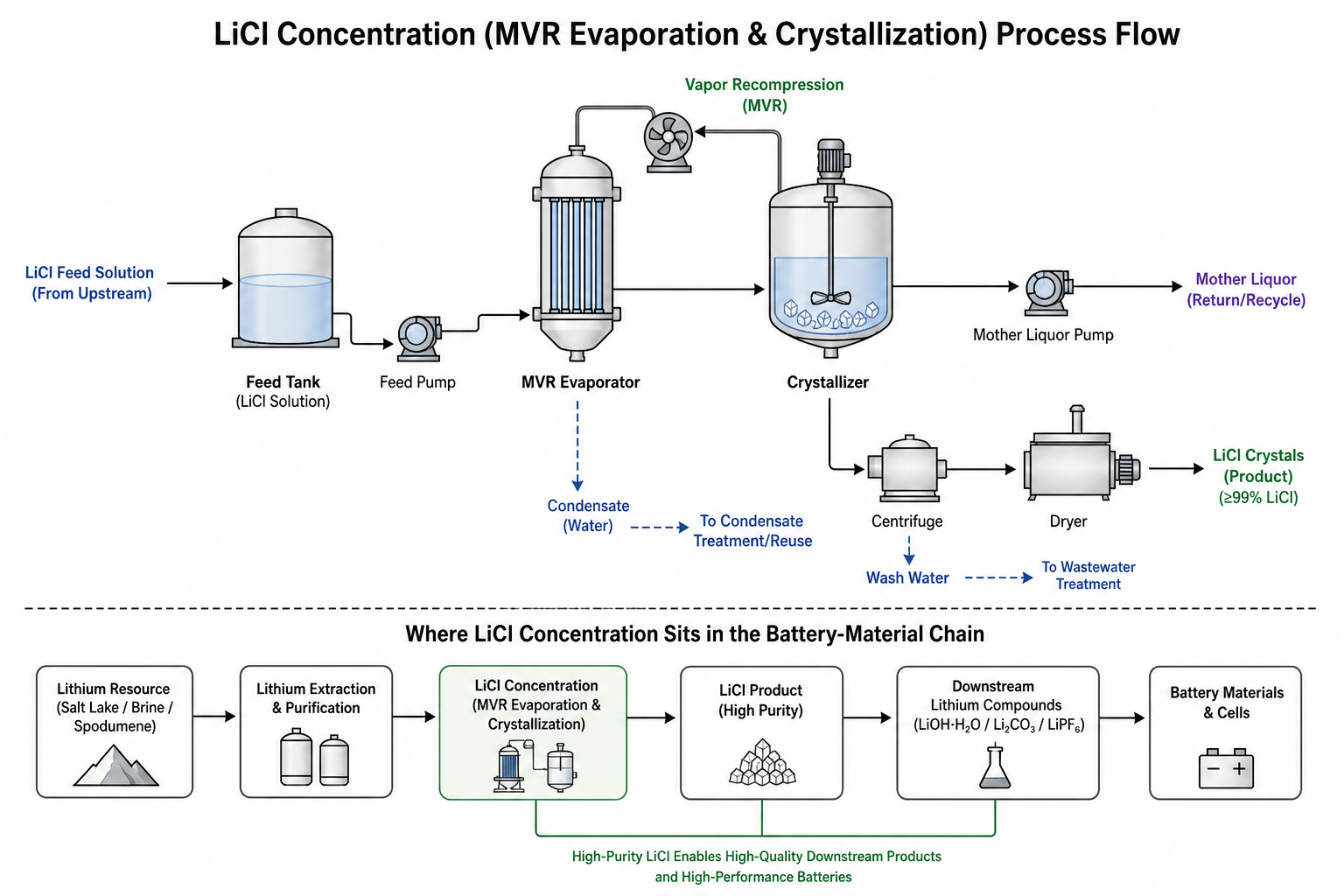
LiCl evaporation-crystallization appears at three points in the lithium flowsheet, and the feed origin changes the design emphasis:
- Salt-lake brine. Dilute LiCl is recovered from boron- and magnesium-bearing brines; the evaporator must tolerate impurities and deliver tight concentration control ahead of carbonate precipitation.
- Spodumene conversion. Sulfate-process streams are converted toward chloride circuits in some routes; the evaporation train concentrates leach and mother liquors for recycle.
- Battery recycling. Black-mass hydrometallurgy generates lithium-bearing chloride liquors after Ni/Co/Mn recovery. Crystallizing LiCl (or concentrating ahead of carbonate conversion) closes the loop and keeps lithium value on site.
Mother-liquor management is the common thread: purging impurities while recycling lithium is what separates a high-yield plant from one that bleeds product. The same logic applies to other battery-chain salts – our manganese sulfate evaporation-crystallization solutions cover the analogous duty for LMFP and NMC precursor chains, and full-loop designs are described under zero liquid discharge solutions. Treat the feed tenors quoted across this page (15-35% LiCl, and the 18% in the external case below) as an illustrative feed envelope constructed from published process data – not customer or project data; actual tenor and impurities must be confirmed by analysis.
Reference Project: Salt-Lake LiCl, Qinghai

An externally published vendor case from a salt-lake lithium plant in Qinghai Province – an external industry reference, not an EvapCryst delivery; figures indicative, not a project guarantee – shows the numbers a well-matched system can target:
- Feed: 5,500 kg/h LiCl solution at 18% concentration
- Configuration: falling-film pre-concentrator plus forced-circulation crystallizer; titanium TA2 heating tubes; 120 kW centrifugal compressor; PLC automatic control
- Output: 1,300 kg/h LiCl crystals
- Specific energy: 52 kWh per ton of water evaporated
- Uptime: above 7,500 hours per year
- Payback: approximately 22 months against the steam-based baseline
According to the same vendor publication, the operator subsequently ordered a second unit for an expansion line – an external reference point, not an EvapCryst delivery record.
What to Prepare Before Requesting a Design
A vendor can turn a serious inquiry into a defensible proposal only when six inputs are on the table:
- Feed flow rate (kg/h or tons/day)
- Feed LiCl concentration (%)
- Target output – crystal rate or final liquor concentration
- Feed temperature and any upstream impurity data
- Local electricity price, for the operating-cost model
- Required product form: concentrated solution or solid crystal
With these, an engineering team typically returns a heat and material balance, equipment list with materials of construction, compressor power estimate, preliminary layout, and budgetary quote within 7-10 working days. Delivery after order confirmation generally runs 90-120 days depending on material availability. Because these trains are frequently shop-assembled, also review our notes on skid-mounted modular delivery – it compresses site construction schedules considerably.
When This Route May Not Fit
MVR forced circulation assumes electricity is the better utility and that crystalline LiCl is the target. It may not fit when: waste steam at usable pressure already exists on site, so a multi-effect train wins on capital and operating cost together; electricity is priced so high that recompression erodes its advantage; the product strategy is lithium carbonate direct from liquor, where deep LiCl crystallization adds a redissolution step the flowsheet does not need; the feed is very dilute brine that membrane or pond concentration should pre-lift before any thermal duty; or the project scale is too small to amortize titanium-zoned metallurgy and a compressor train. In those cases the honest route is falling-film concentration only, multi-effect steam design, or no thermal step at all.
What Must Be Verified
Before this route is committed, verify against your own case: a full feed analysis – LiCl tenor plus magnesium, boron, sulfate, sodium, potassium and calcium, with swing, since these set the zoning and the purge; measured boiling-point rise of your liquor at target concentration, because it sizes the compressor lift; foaming behavior under vacuum, which sizes the separator; a corrosion zoning review mapping your temperature-concentration profile onto the alloy hierarchy above; an on-site pilot run in the 100-500 kg/h class confirming scaling rates and crystal quality on real feed; and confirmed electricity tariff plus annual hours for the operating-cost model. The Qinghai figures on this page are an external vendor-published reference – indicative, not a project guarantee.
Frequently Asked Questions
What is the minimum economical capacity for a LiCl MVR crystallizer?
Systems from roughly 500 kg/h of water evaporation can be economical where electricity is reasonably priced and steam is expensive. Laboratory and pilot units of 100-500 kg/h feed are available for on-site testing before full-scale commitment.
How pure is the recovered distillate?
Vendor-published figures indicate typically above 99.9% purity with conductivity below 50 µS/cm, clean enough for reuse as process water in most plants – indicative, not a project guarantee.
Can one train both concentrate and crystallize?
Yes. A common arrangement pairs a falling-film pre-concentrator for the dilute stage with a forced-circulation crystallizer for the final stretch, exactly as in the externally published Qinghai vendor case. This keeps each section operating in its most efficient regime.
How long does delivery take?
Typically 90-120 days after order confirmation, driven mainly by titanium material lead time and the degree of custom engineering.
Does the system need boiler steam at all?
Only a small quantity for start-up and to trim heat losses during steady operation. Normal production runs on electricity alone.
For lithium producers, the case for MVR is ultimately arithmetic: 30-60 kWh per ton of water against 0.25-0.35 tons of steam per ton, design-dependent, on a feed whose boiling-point rise punishes every alternative. Couple that with titanium-zoned materials, a crystallizer matched to the product specification, and distillate that returns to the plant, and the LiCl evaporation step stops being a cost center and starts being a yield lever. Downstream drying and packing completes the product train. To put that arithmetic to work, send the six inputs listed above — EvapCryst returns a first-pass process-direction screening for your case.


