Project Parameters
| Parameter | Value |
|---|---|
| Process route | Fermentation broth concentration + evaporative crystallization refining |
| Industry | Food & fermentation / amino acids — feed-grade L-threonine |
| Feed type & key components | L-threonine fermentation broth: amino acid, residual sugars, biomass, sulfate salts |
| Plant scale | 70,000 tpy L-threonine; comparable 80,000 tpy plant operates a 10 tph evaporative crystallization system |
| Construction materials | SS316L wetted parts (food/feed-grade) |
Representative process configuration compiled from published industry project data. Indicative values, not a process guarantee.
Project Description
L-threonine is the second-largest feed amino acid after lysine, fermented at industrial scale from corn-derived glucose and crystallized to feed-grade purity. The 70,000 tpy plant behind this configuration — in Northeast China’s corn-and-fermentation belt — is among the largest single-product threonine plants operating, and its evaporator system is the plant’s core utility: every tonne of threonine passes through broth concentration and crystallization before it ships.
The published record of the same engineering family fixes the scale relationship: a comparable 80,000 tpy threonine project operates a 10 tph evaporative crystallization system — meaning the refining crystallizer alone evaporates ten tonnes of water per hour around the clock, with broth concentration trains upstream of it several times larger. Sizing within the 70,000 tpy plant follows the same logic, scaled to its fermentation output.
Process Technology

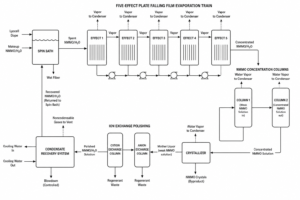
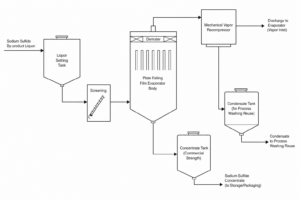
Threonine broth from fermentation is separated from biomass — typically by filtration or centrifugation after cell removal — leaving an amino-acid liquor carrying residual sugars, soluble proteins and sulfate from the fermentation salts. The liquor concentrates in multi-effect falling-film service: short-contact film evaporation protects the amino acid from color degradation, vapor reuse between effects holds the steam bill to a fraction of single-effect operation, and oversized separators handle the foam that protein-bearing broths always generate.
Refining crystallization is the heart of product quality. The concentrated liquor feeds an evaporative crystallizer operating under vacuum, where water is boiled off under controlled supersaturation and L-threonine grows as a well-formed crystal. Classified withdrawal takes the grown crystal to centrifuging, where wash water displaces mother liquor from the crystal surface — the step that decides feed-grade purity. Mother liquor returns to the front of the train with a controlled purge, because impurities that cycle too long co-precipitate with the product.
The centrifuged crystal dries in a fluid-bed or flash dryer to the moisture specification of feed-grade threonine and packs. Condensate from the trains — the water tonnage behind every product tonne — is segregated by cleanliness and returned where the site water balance can use it, and CIP cycles wash the film surfaces between service campaigns.
Plants of this class increasingly run broth concentration in MVR service as well, using electricity to drive vapor recompression instead of steam — the selection turns on the site’s energy prices, and the multi-effect arrangement described here is the published configuration for this plant family.
Equipment Configuration
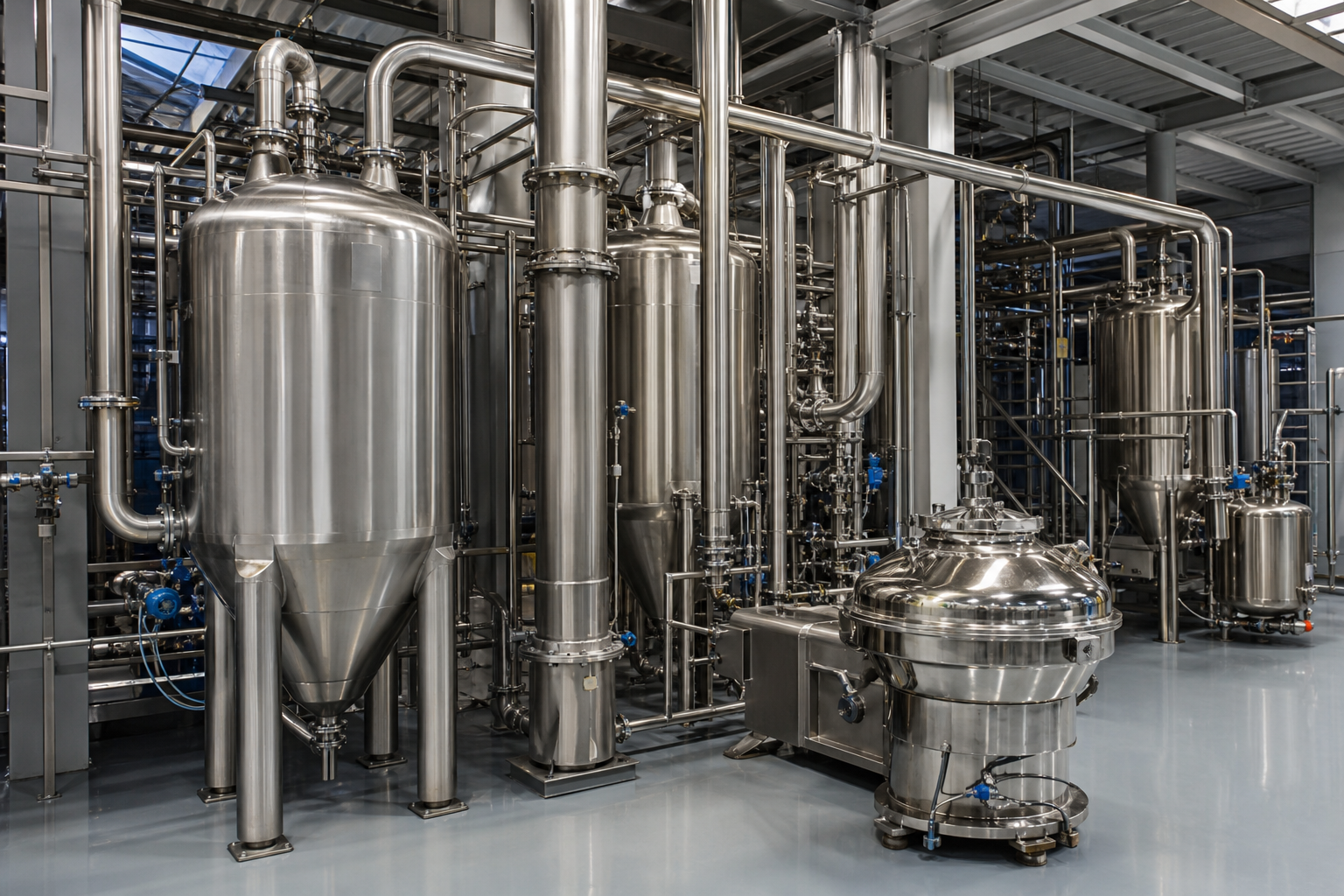
One set of the following equipment is typical for this duty:
- Broth storage and cell-removal filtration / centrifugation
- Multi-effect falling-film broth concentrator with foam-tolerant separators
- Vacuum evaporative crystallizer with classified crystal withdrawal (10 tph class at 80,000 tpy scale)
- Centrifuge with wash control, fluid-bed / flash dryer and feed-grade packing
- Mother-liquor return with controlled impurity purge
- SS316L construction; DCS control of solids profile, supersaturation and CIP
Performance & Outcome
Compiled from published industry project data, indicative: evaporator systems of this class support 70,000–80,000 tpy threonine plants with broth concentration trains and a 10 tph-class evaporative crystallization system producing feed-grade crystal. Purity, steam rates and yields are quoted per project.
Readers comparing technologies may also find Threonine Fermentation Broth Evaporation & Crystallization useful.