Sodium sulfate is the unavoidable mass-balance consequence of battery cathode production: the sodium hydroxide used in co-precipitation and the sulfate carried by raw materials all exit the plant as Na2SO4 in mother liquor and wash water. The industrial answer is a sequenced train — heavy-metal recovery, ammonia removal, then MVR evaporation crystallization that discharges the sodium load as crystalline sodium sulfate and returns clean condensate — and it runs at scale in external industry references: vendor-published project descriptions include a 60 t/h sodium sulfate crystallizer serving an LFP precursor plant, a 2.5 t/h MVR forced-circulation system in Europe producing a lithium-rich sulfate solution, and multi-salt evaporation systems covering Na2SO4, NiSO4, CoSO4, MnSO4, MgSO4, and ZnSO4 on a single cathode production line — external references, not EvapCryst deliveries, and indicative rather than a project guarantee. Stream and capacity figures here form an illustrative envelope from those published references, not a project datasheet.
Why Sodium Sulfate Dominates Cathode Wastewater
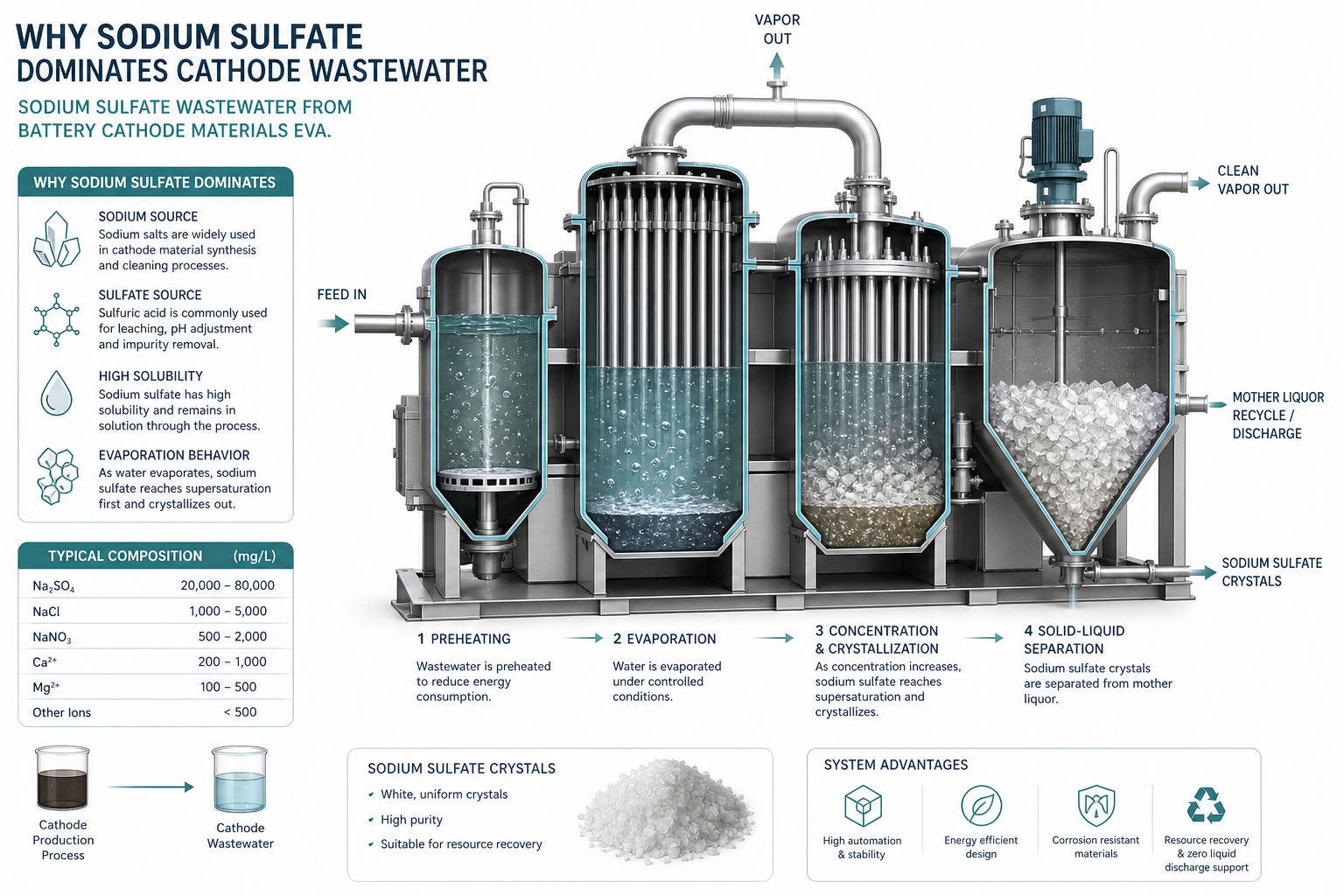
Every mainstream cathode chemistry manufactures sodium sulfate as a by-product. In NCM (nickel-cobalt-manganese) precursor co-precipitation, metal sulfate solutions are precipitated with sodium hydroxide, leaving sodium and sulfate in the mother liquor in near-stoichiometric proportion to precursor output. In lithium salt production, sodium carbonate or sulfate reagents complete the same transfer. In the sodium route to iron phosphate, sodium hydroxide neutralization produces sodium sulfate wash water directly. The result across the industry is a single dominant salt stream — sodium sulfate — contaminated by the chemistry of whichever cathode is being made.
For NCM precursor plants specifically, the wastewater profile is well characterized: mother liquor plus wash water, with sodium sulfate and free ammonia as the main constituents, trace nickel, cobalt, and manganese, complex composition, high salinity, heavy-metal content, strong acidity or alkalinity depending on the stage, and poor biodegradability. That combination defeats conventional biological treatment outright and sets the specification for everything downstream.
The Treatment Train: Recover Metals First, Then Ammonia, Then Salt
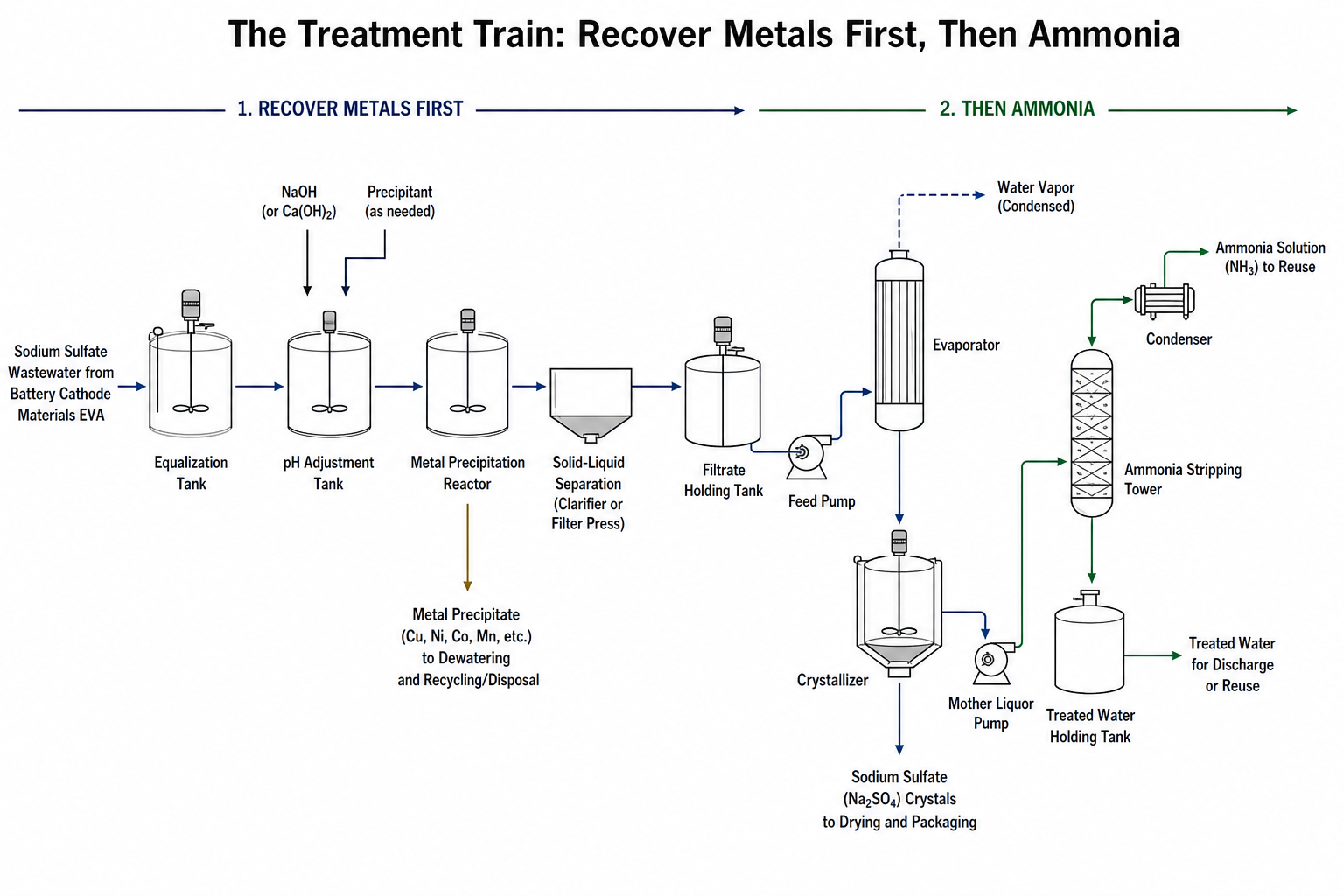
Attempting to crystallize sodium sulfate from raw cathode wastewater fails three times over — valuable metals report to the salt, ammonia contaminates the condensate, and impurities poison the crystal. Full-scale plants therefore run a strict sequence:
1. Heavy-metal recovery
Nickel, cobalt, and manganese are recovered upstream by precipitation (typically hydroxide or sulfide routes, with pH control and flocculant dosing), returning them to the production loop. These metals carry the stream’s economic value; letting them pass to the salt stage converts revenue into contamination. Precipitation handles large throughputs economically, and where tighter specifications apply, ion-exchange polishing follows before the evaporation stage.
2. Ammonia removal
Free ammonia in the mother liquor must be stripped or otherwise removed before crystallization. Ammonia left in the feed ends up in the vapor and condensate, destroying condensate quality for reuse, and it interferes with crystal growth in the sodium sulfate circuit. Deamination is therefore scheduled between metal recovery and evaporation.
3. Evaporation crystallization for the sodium salt
With metals recovered and ammonia gone, what remains is a comparatively clean sodium sulfate solution. MVR evaporation crystallization concentrates it to saturation and discharges sodium sulfate crystal continuously. The condensate is clean hot water, recycled to washing. This is the stage that achieves the “comprehensive utilization of all components” endpoint that Chinese battery-material permits increasingly require: metal values back to product, ammonia managed, salt as a by-product, water in a closed loop, zero liquid discharge.
Evaporation and Crystallization Equipment Selection
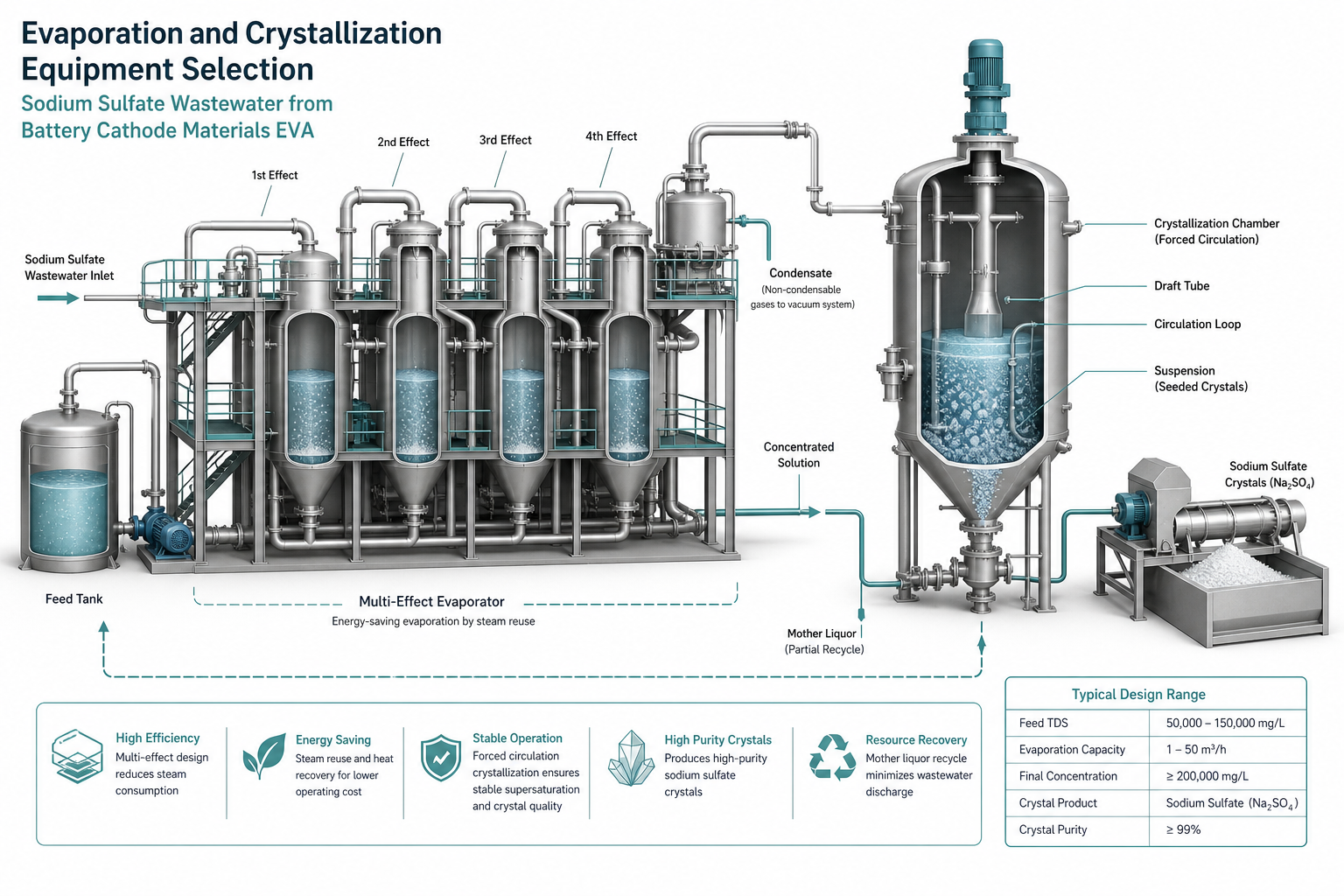
MVR forced-circulation crystallization
The core machine set for sodium sulfate service is the MVR forced-circulation evaporating crystallizer. Secondary vapor from the boiling liquor is compressed to higher pressure and saturation temperature, then returned to the heating chamber as the heat source — replacing fresh steam entirely and eliminating the cooling duty that a conventional condensing system would require. Operating cost falls to compressor electricity plus auxiliaries, which is the decisive advantage on the large evaporative duties typical of cathode plants.
Plate-type FC evaporators
Where plot space is tight or fouling service demands easy access, plate forced-circulation evaporators offer three documented advantages: plate heat exchangers achieve the same heat-transfer duty with a smaller heat-exchange area; the package footprint shrinks accordingly; and the plate pack is demountable, so cleaning and maintenance — even replacement of individual plates — can be done without scrapping the exchanger.
Mother-liquor-circulation crystallizers for sulfate salts
For sulfate salts whose solubility falls significantly with temperature (copper sulfate and nickel sulfate are the classic cases, and the same hardware family serves sodium sulfate polishing duties), mother-liquor-circulation crystallizers are applied. Supersaturated liquor circulates from bottom to top in continuous contact with suspended crystals, which grow until they reach target size, settle by gravity, and discharge from the bottom. The design reduces secondary nucleation and limits short-circuit temperature losses, protecting crystal size distribution — the property that determines whether the salt filters and dries cleanly or becomes a sticky fines problem.
At procurement level the train resolves into four core modules:
| Module | Candidate Equipment Types | Selection Rationale | Indicative Operating Envelope |
|---|---|---|---|
| Heavy-metal recovery | Precipitation reactors; ion-exchange polishing | Metal values return to the product loop; protects salt purity | Hydroxide or sulfide routes with pH control |
| Ammonia removal | Stripping column or deamination unit | Protects condensate reuse and crystal growth | Scheduled between recovery and evaporation |
| MVR evaporation crystallization | Forced-circulation crystallizer; plate-type FC option | Compressor replaces steam; plate packs aid cleaning | Continuous crystal discharge; electricity-driven |
| Salt polishing and finishing | Mother-liquor-circulation crystallizer | Protects crystal size distribution for filtering | Gravity-classified discharge at target size |
Configuration, materials, and ranges depend on actual feed, corrosion review, fouling behavior, utilities, and project capacity.
Reference Projects at a Glance
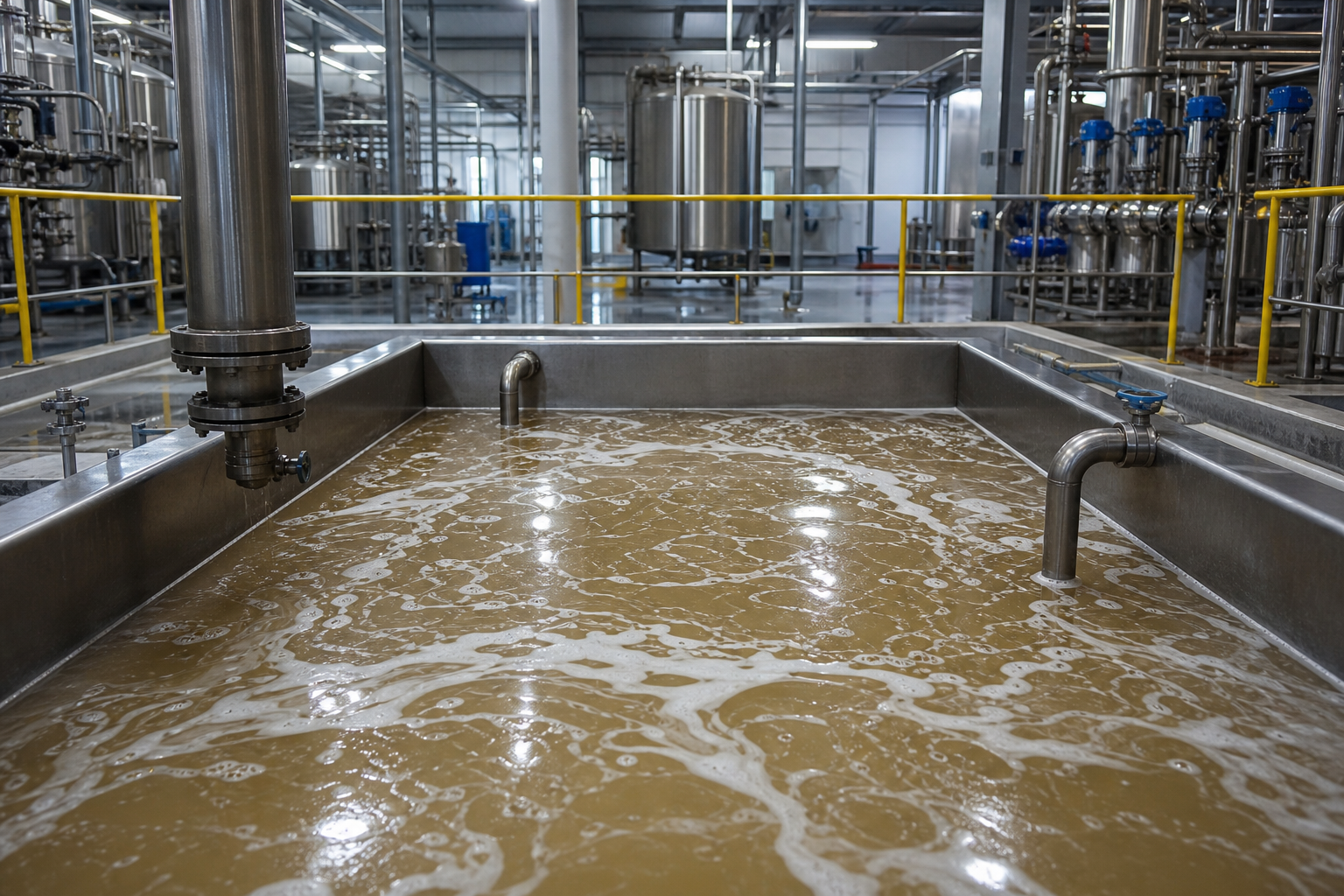
The table below collects external industry references from equipment-supplier published project descriptions; none is an EvapCryst delivery, and capacities are indicative reference points, not a performance guarantee.
| Project | Capacity | Process | Product | Standards |
|---|---|---|---|---|
| NCM battery production, MLD system (Europe) | 2.5 t/h evaporation | MVR forced-circulation evaporation crystallization | Lithium-rich sulfate solution | CE; ASME design |
| LFP precursor plant, sodium sulfate circuit | 60 t/h evaporation | Falling-film + MVR forced-circulation crystallization | Sodium sulfate crystal | GB |
| Positive-electrode production line, multi-salt system | Multi-train | Evaporation system spanning six sulfate salts (Na, Ni, Co, Mn, Mg, Zn) | Separate sulfate products | — |
The European NCM case in that vendor literature deserves note for what it recovers instead of salt: the MVR system concentrates acidified lithium sulfate solution and crystallized-lithium mother liquor derived from spodumene and lithium mica processing, enabling continuous production while cutting energy cost — minimal liquid discharge with lithium as the product, not sodium sulfate.
Positioning Against Alternative Technologies
Three alternatives are regularly evaluated against evaporation crystallization for cathode wastewater, each with a documented limitation:
- Precipitation alone: handles large flows at low cost and process complexity, but its removal precision is limited; the effluent typically needs ion-exchange polishing downstream to guarantee compliance.
- Reverse osmosis: simple to operate and useful as a pre-concentrator, but membranes cannot separate and purify individual species for recovery — lithium recovery in particular is beyond RO — and energy and membrane costs mount at high salinity.
- Outsourced disposal: transfers rather than solves the sodium load, at rising cost per tonne as battery capacity grows.
Evaporation crystallization is the only option in the set that simultaneously recovers metal values, produces a saleable salt, and delivers condensate clean enough for process reuse — which is why it anchors the zero-discharge architecture of essentially every large cathode plant.
Operating Discipline: Automation and Fouling Control
Two operating practices separate cathode evaporators that run 8,000 hours a year from those that tube-foul quarterly. The first is circulation-flow management: forced-circulation loops are run at velocities that keep heat-transfer surfaces scrubbed, with evaporation rate matched to the crystal-growth rate rather than pushed to nameplate, because local over-concentration on a tube wall is where scale is born. The second is automation: full DCS or PLC control of the concentration loop — feed rate, discharge density, compressor operation, crystallizer temperature — holds the train inside its designed window through feed swings without operator intervention, which matters on cathode plants where mother-liquor strength follows the production campaign. Discharge density control in particular decides crystal yield per hour, and on nickel and cobalt sulfate services the same control layer feeds the downstream cooling crystallizer that converts concentrate into product crystals.
Sodium Sulfate Product and Market Outlets
Crystalline sodium sulfate (thenardite or Glauber’s salt feedstock) moves into established commodity markets: detergent and cleaning-product formulation, glass and paper manufacture, textile dyeing auxiliaries, and feedstock for sodium sulfide and other chemicals. Cathode-plant sulfate qualifies for these outlets when heavy-metal recovery upstream is thorough and crystal washing is disciplined; the two product-quality levers worth engineering explicitly are mother-liquor impurity control (via purge strategy) and crystal size distribution (via crystallizer hydraulics). Plants without local offtake can still crystallize for landfill at far lower volume and cost than liquid disposal, but the margin is in the by-product sale.
Lithium: The Valuable Minority Species
Although sodium sulfate dominates by mass, trace lithium is frequently the most valuable species in cathode wastewater. The European 2.5 t/h vendor-published reference shows the pattern: rather than crystallizing everything, the MVR train concentrates the lithium-bearing sulfate stream to a lithium-rich solution, keeping lithium in a recoverable liquid form while water leaves as condensate. Downstream lithium recovery — carbonate precipitation, selective adsorption, or purification to battery-grade hydroxide by recrystallization — is then fed by a compact, concentrated stream instead of a dilute plant effluent. Published industry references report battery-grade lithium hydroxide production from industrial wastewater streams at 99.9% purity, underlining how far wastewater-derived lithium has progressed from curiosity to offtake-grade product.
When This Route May Not Fit
Evaporation crystallization is the wrong emphasis where the sodium load is small or the plant has genuine biological headroom: a modest sulfate stream from a pilot or specialty line may be cheaper to polish and dispose than to crystallize, and bolting a salt circuit onto it converts a utility bill into a capital project. The route also misfits feeds whose metal and ammonia removal cannot be made reliable, because the crystallizer inherits every upstream failure as impurity in the salt or the condensate. Sites without any sodium sulfate offtake — and no realistic prospect of one — should compare crystallize-and-landfill honestly against liquid disposal before committing. And a plant whose lithium values dominate the economics may belong on a lithium-recovery flowsheet instead, with sodium sulfate as the by-product rather than the design center.
What Must Be Verified
Before a cathode-wastewater crystallization project is committed, the following must be verified against site data rather than the vendor-published references above. A full water analysis — sodium sulfate strength, free ammonia, and trace Ni, Co, Mn, Li, Mg, Zn — because the recovery sequence and salt purity target both follow from it. Metal-removal performance to the level the intended salt outlet requires, demonstrated on the actual liquor. Ammonia behavior under the chosen stripping or deamination method. Fouling tendency of the liquor on forced-circulation duty, from laboratory concentration trials. Condensate reuse targets against washing requirements. A sodium sulfate offtake assessment — detergent, glass, paper outlets or stabilized disposal — and, where lithium is present in value, a lithium-recovery route fixed before the evaporator duty is specified.
Frequently Asked Questions
Why is sodium sulfate the main salt in battery cathode wastewater?
Stoichiometry. Co-precipitation of NCM precursors uses sodium hydroxide against metal sulfate feeds; lithium salt production uses sodium reagents; the sodium-route to iron phosphate uses sodium hydroxide neutralization. In every case the sodium exits as sulfate in mother liquor and wash water, making Na2SO4 the dominant dissolved solid.
Can sodium sulfate from cathode plants be sold?
Yes, into detergent, glass, paper, and textile-chemical markets, provided upstream heavy-metal recovery is thorough and the crystal is washed. Product quality is governed by mother-liquor impurity control and crystal size distribution — both are design variables, not afterthoughts.
What capacity ranges are these systems built at?
Vendor-published systems span from 2.5 t/h MVR forced-circulation trains (European NCM service, lithium-rich product) to 60 t/h sodium sulfate circuits on LFP precursor plants, with multi-train evaporation systems covering six sulfate salts on a single positive-electrode production line — external references, not EvapCryst deliveries.
Why remove ammonia before evaporation?
Free ammonia strips with the vapor and contaminates the condensate, disqualifying it for wash-water reuse, and it disturbs crystal growth in the sodium sulfate circuit. Deamination therefore sits between heavy-metal recovery and evaporation crystallization in the standard sequence.
Is MVR economical at small cathode-plant scale?
MVR forced-circulation crystallization scales down efficiently because it is a packaged electrically driven cycle rather than a steam-infrastructure project; the vendor-published 2.5 t/h European unit was built to CE and ASME standards in modular form. Economics turn on electricity price versus steam price at the site, and on how much the by-product salt and recycled water offset operating cost.