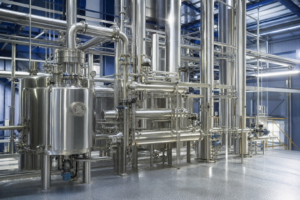
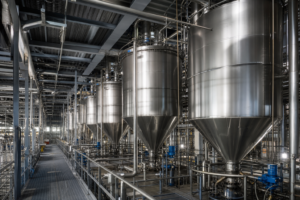
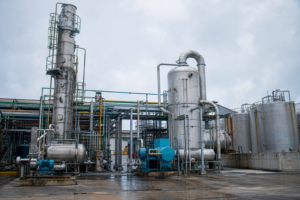
PMIDA — N-(phosphonomethyl) iminodiacetic acid — is the key intermediate of the IDA-route glyphosate process, and its production is an evaporation business in disguise: both the product and its wastewater are concentration-and-crystallization problems. The modern answer is continuous MVR evaporation crystallization: PMIDA crystallizes directly out of its sodium chloride and IDA-bearing mother solution in a closed vapor loop with supplier-reported energy savings above 80% versus traditional evaporation crystallization (indicative figure, not a project guarantee), while the 5–6 tons of wastewater per ton of product are concentrated for compliant discharge or by-product salt recovery. Versus the batch pans many plants still run, a continuous MVR train delivers higher purity, more stable quality and fully automated operation.
What PMIDA Is and Where It Sits in the Glyphosate Route
PMIDA is the crucial intermediate in glyphosate synthesis by the IDA process: iminodiacetic acid (IDA) is condensed with formaldehyde and phosphorous sources to form PMIDA, then oxidized — classically with hydrogen peroxide or oxygen over a catalyst — to glyphosate. PMIDA quality propagates straight into the active ingredient: oxidizing a contaminated intermediate produces by-products hard to remove downstream, failing farm-grade specifications.
The commercial logic of the IDA route is cost per ton of glyphosate, split roughly between raw materials, oxidation yield and utilities — and utilities is where evaporation enters. The liquor arriving at the crystallizer is a warm solution of PMIDA, sodium chloride (from neutralization), residual IDA and formaldehyde traces. Reaching dry, free-flowing PMIDA crystal at the lowest energy cost is the production duty; handling mother liquor and wash waters is the environmental one.
The Two Evaporation Duties in a PMIDA Plant
Duty 1: Continuous Product Crystallization from NaCl/IDA Solution
In the reference process, the feed to the crystallization train is a sodium chloride solution together with IDA solution, entering above ambient temperature at a solids-free concentration set by upstream condensation. Water must be removed — a lot of it — before the liquor reaches PMIDA saturation, and salt co-crystallization must be managed so sodium chloride reports to the right stream rather than contaminating the product.
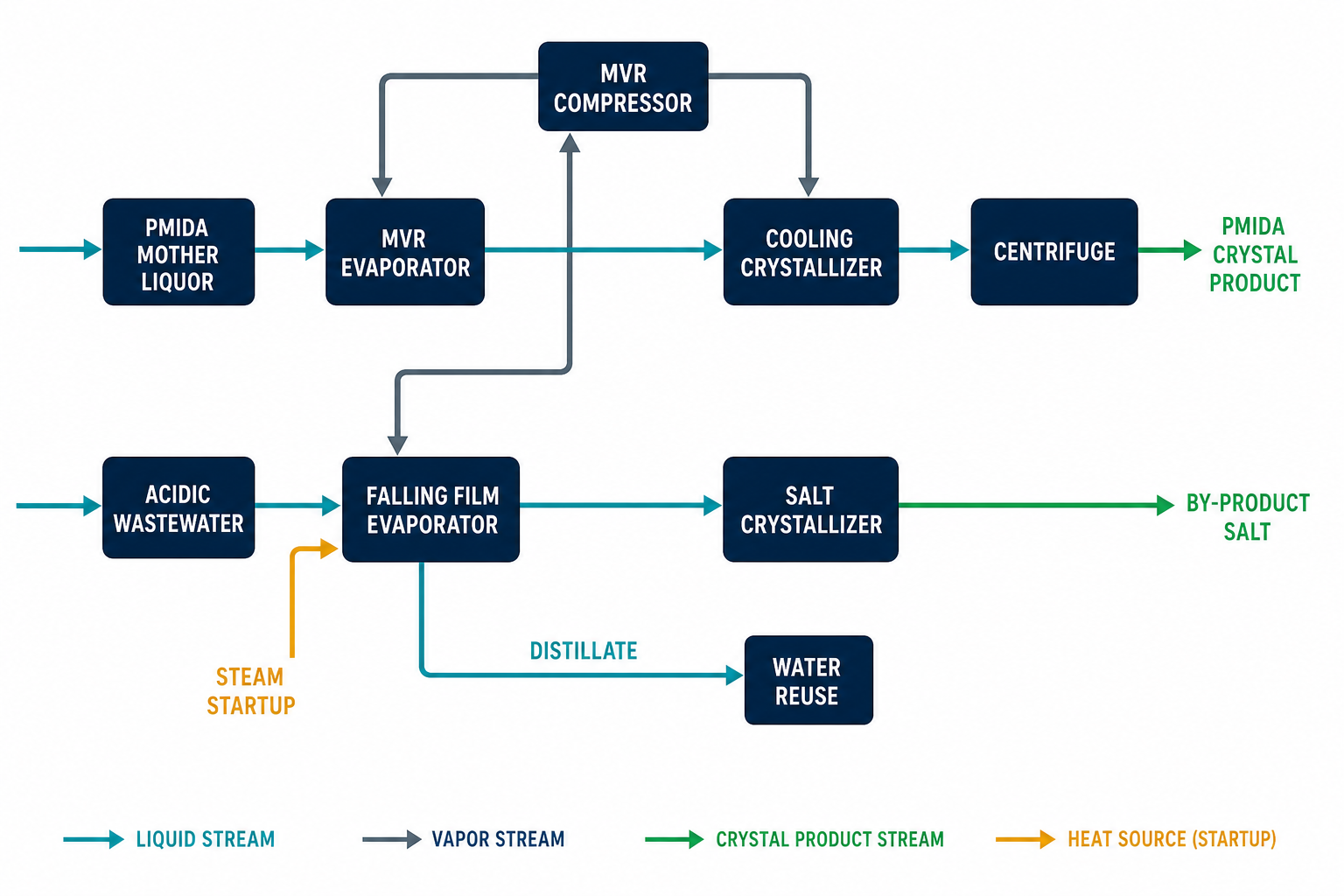
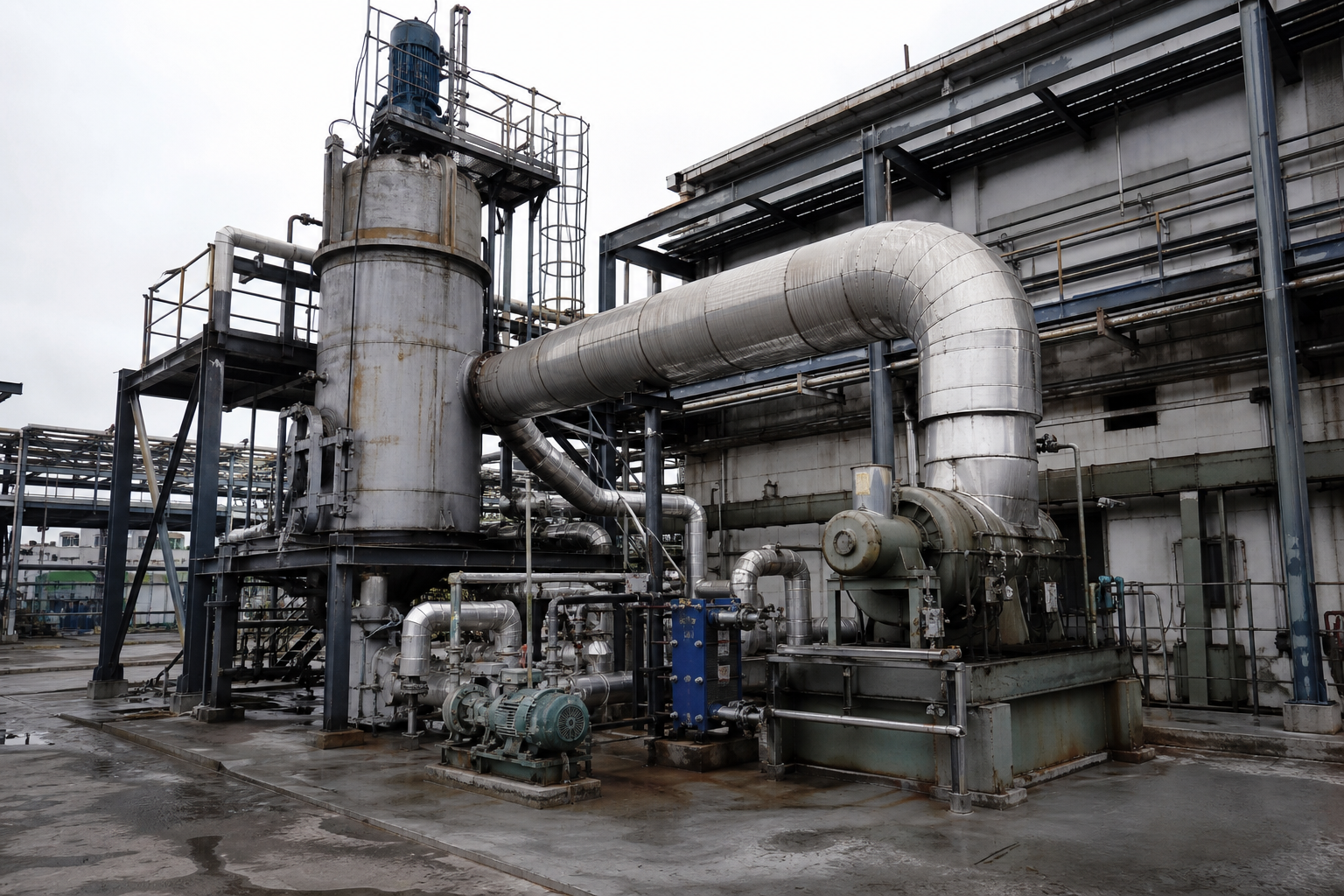
An MVR evaporation crystallizer handles both tasks in one circuit: the liquor circulates through a forced-circulation crystallizer body; boiled-off water is compressed and returned as heating steam; crystal slurry is drawn continuously, centrifuged and dried. Because the vapor loop is closed, the only significant energy input after start-up is compressor electricity. The reference case — a supplier-published pilot-scale MVR unit built in China for the agrochemical industry under GB standards, an external industry reference rather than an EvapCryst delivery — demonstrated exactly this duty: continuous PMIDA crystal production from NaCl and IDA solutions with full automation.
Duty 2: PMIDA Wastewater Concentration and Salt Recovery
The mainstream PMIDA process generates a significant wastewater volume — approximately 5–6 tons per ton of product in published process accounts. Its composition is challenging:
| Wastewater constituent | Origin in the process | Concentration consequence |
|---|---|---|
| High COD | Formaldehyde residues, IDA traces and condensation by-products | Organics load on condensate quality; foaming tendency in the evaporator |
| Ammonia nitrogen | Amination chemistry and pH adjustment | Stripping risk into the vapor; condensate polishing required |
| Formaldehyde | Excess reagent from the condensation step | Volatile; needs condensate treatment or upstream destruction |
| Organic phosphorus and phosphate | Phosphorous reagents and oxidation precursors | Scaling and eutrophication liability |
| Ammonium chloride | Neutralization salts | Corrosive chloride-ammonium brine; recoverable as fertilizer-grade salt |
MVR evaporation is well suited to this mixed brine. Concentrating it reduces volume by an order of magnitude, crystallizes ammonium chloride as a by-product stream, and produces condensate that — after polishing for ammonia and formaldehyde — can recycle to the plant. The ammonium chloride evaporation, crystallization and drying application page covers the salt side in detail.
| Process module | Equipment candidates | Selection basis | Indicative envelope |
|---|---|---|---|
| Product crystallization | MVR forced-circulation crystallizer | Closed vapor loop, continuous crystal | PMIDA from NaCl/IDA liquor |
| Dewatering and drying | Centrifuge; dryer | Product moisture, crystal integrity | Free-flowing product crystal |
| Wastewater concentration | MVR evaporator on mixed brine | Volume reduction, salt recovery | Order-of-magnitude volume cut |
| Salt recovery and polish | NH4Cl crystallizer; condensate polishing | By-product value, condensate reuse | Fertilizer-grade salt stream |
Configuration, materials and envelopes depend on the actual liquor analysis, co-crystallization behavior, utilities and capacity.
Why MVR Replaces Traditional Evaporation Crystallization Here
Over 80% Energy Savings
Against the traditional evaporation crystallization mode, supplier-reported figures credit MVR with over 80% energy savings in this service — a supplier-published indicative range, not a project guarantee. The mechanism is latent-heat recycling: instead of letting boiled-off vapor escape to a condenser, a mechanical compressor lifts its temperature and pressure and sends it back as the heating medium. Each kilogram of water evaporated is heated, essentially, by the previous kilogram’s condensation. For a plant evaporating tens of tons of water per hour around the clock, that delta converts directly into margin.
Continuous Operation Instead of Batch Cycles
Traditional PMIDA crystallization is often batch pan work: fill, evaporate, crash out, discharge, wash, refill. Batch cycles impose thermal swings, variable residence time and quality drift between first and last crystal. A continuous MVR crystallizer holds steady state — constant supersaturation, residence time and crystal size distribution — enhancing the purity and stability glyphosate buyers audit.
Automation and Labor Reduction
An MVR train automates completely: compressor speed, circulation flow, slurry withdrawal and mother-liquor inventory are regulated continuously, raising production efficiency and stability while trimming labor. Start-up and shutdown are the only phases needing live steam.
Reference Project Parameters
The parameters below describe the published reference case — an external industry reference documented by the system supplier, not an EvapCryst project.
| Item | Value |
|---|---|
| Project | PMIDA continuous production |
| Location | China |
| Evaporator capacity | Pilot-scale experiment equipment |
| Process | MVR evaporation crystallization |
| Raw material liquor | Sodium chloride solution and IDA solution |
| Product | PMIDA crystal |
| Industry | Agrochemical |
| Design standard | GB |
Pilot demonstration before full deployment is the right sequence: the co-crystallization window, formaldehyde foaming and purge rate are feed-specific, and a pilot run locks them into the design basis.
Design Considerations Specific to PMIDA Service
Chloride-ammonium corrosion. The wastewater brine couples ammonium chloride with a mildly acidic pH — an aggressive pair for standard stainless steel. Heat exchanger tubes and vapor piping need upgraded metallurgy, and chloride stress-corrosion boundaries must be respected in the selection.
Foaming and entrainment. Formaldehyde and surface-active organics stabilize foam in the evaporator separator. Demisters, controlled vapor velocities and, where necessary, antifoam dosing protect the compressor from liquid carry-over — the single most expensive failure mode in an MVR plant.
Phosphate scaling. Organic phosphorus species can convert to sparingly soluble phosphates on hot surfaces. Pretreatment (precipitation or adsorption) plus forced-circulation design keeps the heat transfer coefficient from decaying mid-campaign.
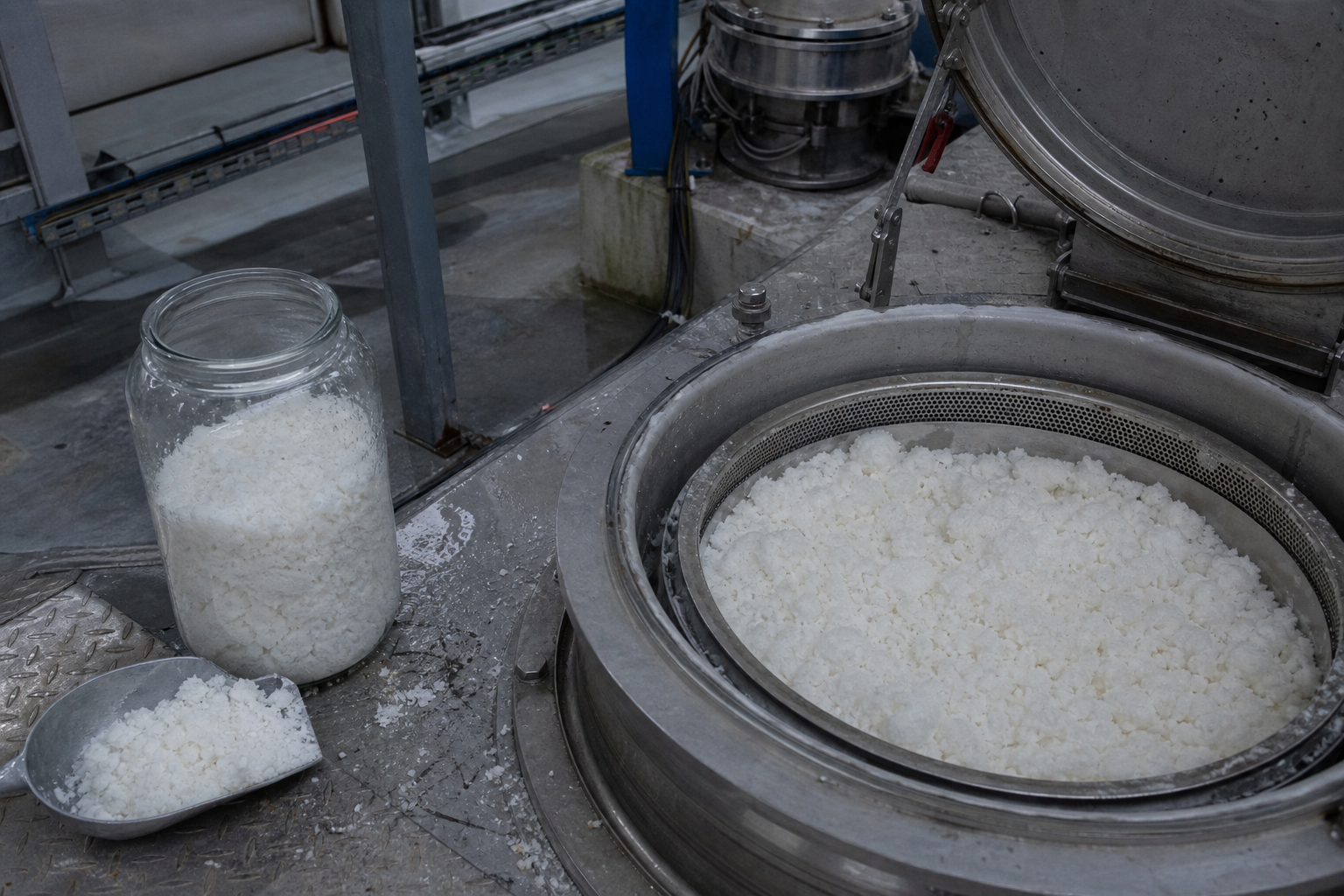
Product crystal integrity. PMIDA crystal size and morphology affect the downstream oxidation step’s kinetics and the final filtration behavior after oxidation. Crystallizer hydrodynamics — circulation rate, agitation profile, slurry density — are tuned to hit the crystal size distribution the oxidizer expects, which is why DTB-type crystallizers are frequently specified when the product fraction, not just the salt, must be controlled. Compare configurations on our DTB crystallizer and crystallization technology pages.
From Pilot to Full Scale: The Project Delivery Path
The reference unit’s pilot-scale execution defines the sensible delivery path: prove the mass and energy balance on real feed liquor, then scale the validated flowsheet. The pilot answers four questions no simulation resolves — the co-crystallization behavior of PMIDA against sodium chloride (how much salt the product stream tolerates before purity slips, where the mother-liquor purge belongs); the true boiling point elevation of the organic-laden liquor, which sizes the compressor pressure ratio; the foaming and entrainment tendency that sets demister and vessel design; and the cleaning frequency before phosphate scale and organic fouling call for CIP.
With those four numbers, full-scale engineering becomes replication: heat-transfer area scales from measured coefficients, crystallizer volume from validated residence time, and the automation package — compressor train, circulation control, slurry withdrawal, purge logic — transfers directly on the same control philosophy. This de-risking step is inexpensive against the cost of discovering a crystallization mismatch inside a production vessel.
Where This Fits in an Agrochemical Site Strategy
PMIDA is one node in a family of agrochemical concentration duties. Mother liquors from pesticide formulation carry their own salt and organics load — see the pesticide mother liquor treatment and salt recovery solution; fertilizer-grade salt lines from ammonium streams are covered under fertilizer production evaporation and crystallization. For a parallel case of intermediate-production brines turned into by-product value, read about dye intermediate (H-acid) wastewater salt recovery, and the Chemical and Agrochemical evaporation systems program page frames the full vertical.
When This Route May Not Fit
This route serves IDA-route glyphosate plants crystallizing PMIDA from salt-bearing mother solution. It may not fit a glycine-route plant, which produces no PMIDA at all. It may not fit a plant whose batch pans already hold stable product quality at acceptable energy cost — there, incremental automation may pay back better than a crystallizer replacement. It may not fit where electricity is expensive or unreliable while low-cost steam exists, because the MVR economics invert. It may not fit where the wastewater volume is small and regional disposal is cheap, leaving too little to recover. And if oxidation yield rather than crystallization is the plant’s binding constraint, this train does not touch the real bottleneck.
What Must Be Verified
Before the route is fixed, the validation focus is: a full feed-liquor analysis — PMIDA tenor, sodium chloride load, residual IDA, formaldehyde, phosphorus species — since the co-crystallization window depends on all of them. Then the salt tolerance of the product specification: how much sodium chloride the crystal stream can carry before glyphosate buyers push back. Then the boiling point elevation of the real liquor, which sizes the compressor pressure ratio. Then foaming tendency in the separator, which sets demister design and antifoam strategy. Then chloride-ammonium corrosion data for metallurgy selection, and the mother-liquor purge rate. A pilot run on real feed — the sequence the reference case itself followed — is the evidence base.
Required inputs: the feed liquor analysis, production capacity and product specification — in exchange, an initial process direction covering crystallizer configuration, the energy system and the pilot plan.
Frequently Asked Questions
What is PMIDA and why does it matter for glyphosate production?
PMIDA (N-(phosphonomethyl) iminodiacetic acid) is the key intermediate in glyphosate synthesis by the IDA process. It is produced from IDA solution and formaldehyde/phosphorous chemistry — in the reference MVR process, directly crystallized from a sodium chloride and IDA solution — and then oxidized to glyphosate. Its purity determines downstream glyphosate quality.
How much wastewater does PMIDA production generate?
Approximately 5–6 tons of wastewater per ton of PMIDA in the current mainstream process. The stream carries high COD, ammonia nitrogen, formaldehyde, organic phosphorus, phosphate and ammonium chloride — a combination well matched to MVR concentration and salt recovery.
How much energy does MVR save compared with traditional evaporation crystallization?
Supplier-reported savings above 80% in this service — an indicative figure, not a project guarantee — because the closed vapor loop recycles latent heat mechanically instead of consuming fresh steam per kilogram of water. Only start-up requires live steam.
Can PMIDA crystallization really run continuously instead of in batches?
Yes. Continuous MVR evaporation crystallization holds constant supersaturation and residence time, which stabilizes crystal size distribution and purity compared with batch pans that swing thermally through each cycle. The published reference case demonstrated continuous PMIDA crystal production with full automation at pilot scale before scale-up.
What happens to the salt in the wastewater?
Ammonium chloride concentrates and crystallizes as a discrete salt stream that can be upgraded to fertilizer-grade by-product, subject to local acceptance. Volume reduction of the residual mother liquor brings the waste stream down to a small, manageable purge.