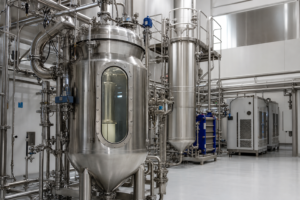
Gelatin and donkey-hide gelatin (ejiao) concentration is a heat-sensitive evaporation duty where temperature is product quality: every degree above the thermal budget costs gel strength, and every hour of excess residence time costs color and clarity. MVR low-temperature evaporation answers with a compact electrically driven system — and the economics are illustrated by an external reference. In a vendor-published case study, a Shandong ejiao plant expanding capacity replaced an old double-effect evaporator with a 4 t/h MVR climbing-film system, cutting evaporation cost from 129 RMB to 37 RMB per ton of water — a 70% saving worth roughly 2.9 million RMB per year at 8,000 operating hours — an external industry reference, not an EvapCryst delivery, indicative and not a project guarantee. This page explains the process requirements of gelatin concentration, how the MVR system is configured for low-temperature duty, and what the operating cost arithmetic looks like in practice.
The Product Defines the Process: Heat Sensitivity First
Gelatin is a hydrolyzed collagen protein whose commercial value is measured in gel strength (Bloom), viscosity, and color. It thermally degrades: prolonged exposure to temperatures above the gelatin comfort zone hydrolyzes peptide chains, cutting Bloom value and viscosity — the two properties customers pay for. Concentration must therefore happen under vacuum at the lowest practical boiling temperature, with the shortest practical residence time, before the liquor moves to gelation, drying and finishing.
Ejiao (donkey-hide gelatin) production adds scale and tradition to the same physics. Hide extract arrives as a dilute liquor that must be concentrated for casting into the familiar gel blocks. Historically this was done in open pans or steam evaporators; modern plants use continuous vacuum evaporation, and the retrofit question they face is which evaporator type — and which energy source — should carry the duty.
Where Evaporation Sits in the Gelatin Flowsheet
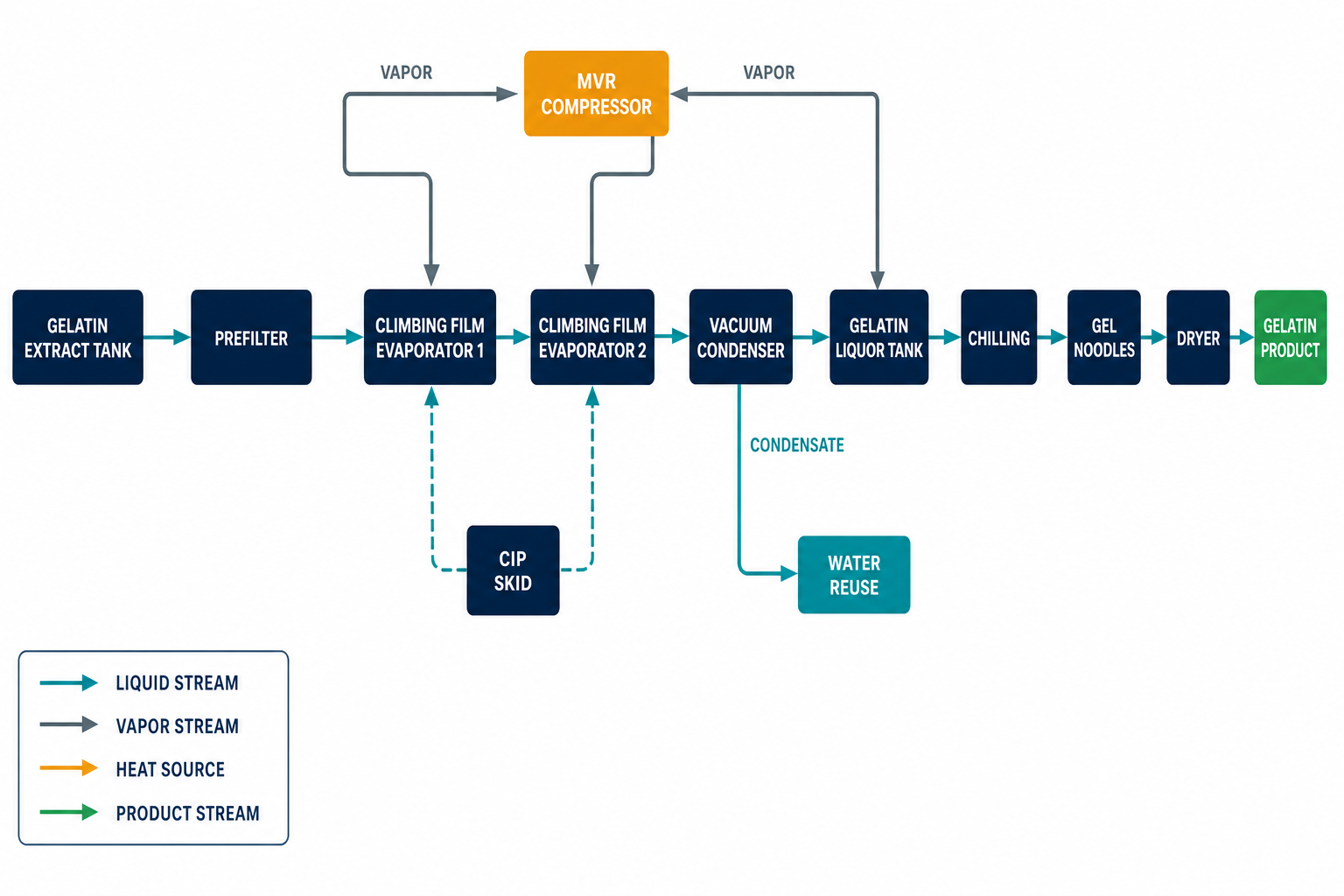
Understanding the duty starts from its position in the process. Hide or bone collagen is first pretreated — acid or alkaline hydrolysis releases gelatin into aqueous extraction liquors that run dilute, typically a few percent solids for early extractions and richer for later ones. The extraction liquor is filtered and deionized to remove minerals and turbidity, and then concentrated: this is the evaporation step, raising solids from feed levels toward the gelation range while the liquor is still pumpable and heat damage is still avoidable. The concentrated liquor is then cast or gelled, chilled, dried, and milled or blocked into the final product form. Two consequences follow for the evaporator designer. First, feed composition varies with extraction stage — the unit must tolerate swings in solids, viscosity and foaming without recalibration. Second, everything upstream is batch-scheduled, so the evaporator either follows the batch rhythm with fast startup and shutdown, or the plant installs liquor buffering to let it run continuously; both patterns are operated successfully, and the MVR package handles either with the same control scheme.
The Reference Case: Ejiao Capacity Expansion in Shandong
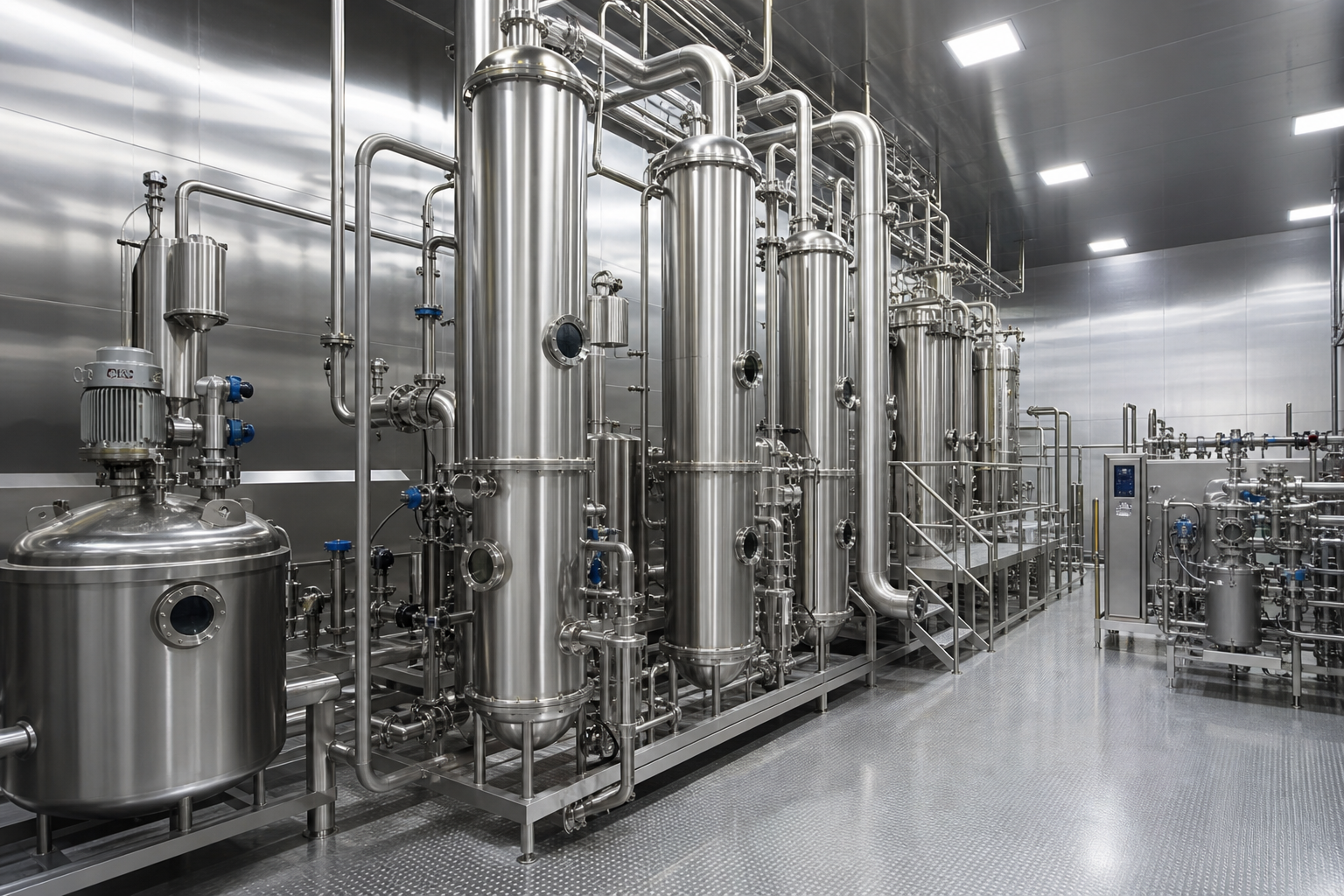
The figures in this section come from a supplier-published project report — an external industry reference, not an EvapCryst delivery, indicative rather than a project guarantee. In that report, a Shandong ejiao producer facing capacity expansion ran an original double-effect evaporator whose energy waste was serious and whose automation level was poor. The upgrade selected an MVR climbing-film (rising-film) evaporator with a high-speed direct-drive centrifugal steam compressor. The published process specification for the project:
| Parameter | Value |
|---|---|
| Evaporation rate | 4 t/h |
| Feed | Gelatin liquor, 7.76% solids |
| Feed density | 1.025 kg/L |
| Outlet liquor density | 1.050 kg/L |
| Boiling point elevation | 2°C |
| Compressor temperature rise | 10°C |
| Evaporation temperature | 70°C |
Two numbers in this table carry the engineering story. The boiling point elevation of only 2°C means the compressor needs just a small temperature lift — ideal territory for mechanical vapor recompression. And the 70°C evaporation temperature keeps the product inside its thermal budget while the climbing-film geometry moves liquor through the heated tubes in a single fast pass — a shorter residence time than recirculating or kettle-type duty, though longer than an equivalent falling-film pass.
Why Climbing-Film Geometry Suits Gelatin Liquor
Gelatin liquor is viscous, foaming-prone and fouling-prone — a combination that punishes the wrong tube geometry. In a climbing-film evaporator, vapor generated in the tubes drags a thin annular film of liquor upward at high velocity. The benefits stack up for this duty: high tube-wall velocity scrubs fouling, the thin film gives short heat exposure per pass, high velocity preserves heat transfer coefficient despite viscosity, and the vapor-liquid mixture discharges into a separator with demisting sized for protein foaming. Falling-film MVR units also serve gelatin duty where liquor viscosity at the feed end is moderate; the climbing-film selection shines when viscosity climbs with concentration and self-cleaning velocity is wanted inside the tubes.
The Energy Comparison: MVR versus Double-Effect, in Numbers
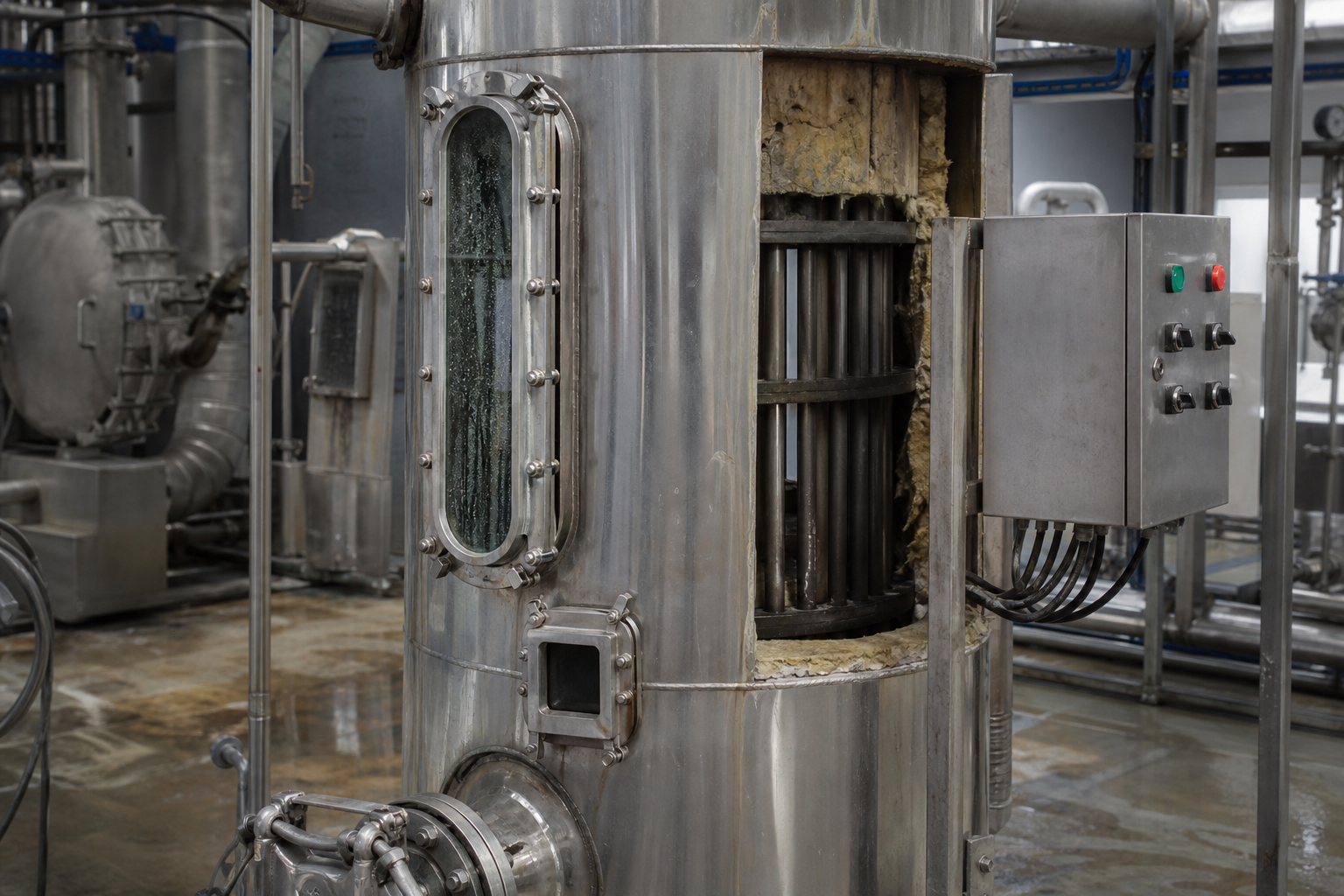
The same supplier-published report gives a full operating cost comparison against the replaced double-effect unit — indicative figures, not a project guarantee — at 200 RMB/t steam, 1 RMB/kWh electricity, 1 RMB/m³ cooling water and 8,000 operating hours per year:
| Cost Item | MVR Evaporator | Double-Effect Evaporator |
|---|---|---|
| Compressor power | 100 kW → 100 RMB/h | — |
| Pumps | 24 kW → 24 RMB/h | 20 kW → 20 RMB/h |
| Steam | 0.05 t/h (preheat only) → 15 RMB/h | 2.28 t/h → 457 RMB/h |
| Cooling water | 10 m³/h → 10 RMB/h | 40 m³/h → 40 RMB/h |
| Evaporation cost per hour | ≈149 RMB | ≈516 RMB |
| Evaporation cost per ton of water | 37 RMB | 129 RMB |
| Annual operating cost | ≈1,184,000 RMB | ≈4,128,000 RMB |
| Saving | 92 RMB per ton evaporated — a 70% reduction | |
Read the structure of those numbers rather than their absolute values, since tariffs vary by site: the MVR machine trades a 100 kW electrical load for a 2.28 t/h steam demand and slashes cooling water from 40 to 10 m³/h because there is no effect-to-effect condensing duty to reject. Wherever electricity is available at industrial tariffs and steam is priced near or above this range, the same trade is widely reported to win for gelatin, collagen and food-grade protein concentration duties in the 1–10 t/h class.
| Process Module | Candidate Equipment Types | Selection Rationale | Indicative Operating Envelope |
|---|---|---|---|
| Feed reception & buffering | Agitated liquor tanks; batch-interface control | Extraction runs batch-scheduled; buffering allows continuous evaporation | Feed ~7.76% solids in the published reference (illustrative) |
| Preheating | Plate or tubular preheater on a small steam or hot-water duty | Brings liquor to boiling temperature before the calandria | 0.05 t/h preheat steam in the published reference |
| MVR climbing-film evaporation | Climbing-film calandria with high-speed direct-drive centrifugal compressor | Thin fast film limits heat exposure; vapor drag counters viscosity and fouling | 70°C boiling, ~2°C BPE, ~10°C compressor lift (vendor-published reference values) |
| Vapor-liquid separation | Separator with demister sized for protein foaming | Protects the compressor from entrainment | Set by foaming load |
| CIP | Spray-ball CIP with alkaline circulation | Removes protein soil without gelatinizing the deposit | Per plant hygiene regime |
Configuration, materials, and operating ranges depend on actual feed, temperature, pressure, corrosion review, fouling behavior, utilities, and project capacity.
Low Temperature in Practice: Vacuum, BPE and the Thermal Budget
Achieving 70°C boiling under vacuum is straightforward engineering; holding it there is the control task. The system maintains vacuum through condensing and venting, the compressor adds its 10°C lift to return vapor to the calandria as heating medium, and the 2°C BPE of the liquor is absorbed in the temperature program. Because protein liquor BPE stays low through the concentration range (dissolved protein contributes modest colligative effect), the compressor operates well inside its efficient zone across the whole batch or campaign — no high-BPR surprises near endpoint, unlike salt duties.
Product protection extends beyond temperature. Short liquor inventory in the system, quick pass times through the tubes, CIP regimes designed around protein soil (alkaline cleaning with controlled temperature to avoid gelatinizing the deposit itself), and polished product-contact surfaces that resist protein adhesion together preserve the Bloom value that arrives in the feed.
CIP, Hygiene and Food/Pharma Compliance
Gelatin and ejiao plants operate under food and pharmaceutical hygiene regimes, which shape the equipment in specific ways: full-drain vessel and piping geometry with clean welds and radiused corners, spray-ball CIP coverage of the separator and vapor body, product-contact materials in SS 304/316L with surface finishes appropriate to the duty, and validation-friendly instrumentation for temperature records. The MVR package is skid-mounted in food-industry projects wherever plot allows, which shortens installation and keeps the hygiene boundary clean.
When to Choose MVR over Multi-Effect for Gelatin Duty
- No steam infrastructure, or steam priced at industrial-fuel rates — the MVR machine runs on electricity alone apart from small preheat duties.
- Cooling water capacity is limited — MVR removes the big condensing duty that multi-effect’s last effect requires.
- Automation and unattended operation matter — a single-effect MVR train has fewer interacting variables than a multi-effect cascade and responds to load changes smoothly.
- Capacity is in the 1–10 t/h class — compressor economics are strongest in this band; very large duties may still favor well-integrated steam systems.
- Steam exists cheaply as waste heat — then multi-effect or MVR-with-steam-assist deserves the comparison, decided on the plant’s own tariffs.
Related Pages
- MVR evaporation technology — the energy core of low-temperature concentration
- Falling-film evaporation technology — the alternative tube geometry for moderate-viscosity food liquors
- Energy retrofit and decarbonization solutions — replacing steam evaporators with MVR across process plants
- Food and fermentation industry solutions — evaporation across food-grade concentration duties
- Pharmaceutical industry solutions — hygienic evaporation systems for pharma production
When This Route May Not Fit
Where cheap waste-heat steam is already available on site, or where electricity tariffs are high and steam is priced well below the level assumed in the reference case, multi-effect or TVR evaporation can hold the lower operating cost and MVR’s advantage disappears. Duties far above the 1–10 t/h band may also favor a well-integrated steam system. At the other extreme, liquors whose endpoint viscosity climbs beyond what a tube film can carry are better finished in a wiped-film or scraped-surface unit rather than forced through climbing-film geometry. And where a plant’s hygiene regime or validation burden demands configurations outside the standard MVR package, the comparison should be made on that plant’s own terms, not on published reference economics.
What Must Be Verified
Before committing to an MVR gelatin or ejiao system, verify the feed as it actually varies — solids, viscosity and foaming across extraction stages and seasons — because these set tube geometry and separator sizing. Confirm boiling point elevation and the viscosity profile across the full concentration range, not just the endpoint, since compressor lift and heat-transfer design depend on them. Demonstrate the thermal budget on your own liquor: that Bloom and color survive the planned residence time and temperature, ideally by bench or pilot concentration. Prove the CIP regime against protein soil under the plant’s real scheduling, and run the economic check on local tariffs rather than the reference case’s stated prices.
FAQ
What temperature does gelatin concentration run at in an MVR evaporator?
Typically at or below 70°C boiling temperature under vacuum — the reference ejiao plant runs at 70°C with a boiling point elevation of only 2°C, keeping the product inside its thermal budget while the climbing-film geometry minimizes residence time.
How much does MVR save compared with a double-effect evaporator for gelatin?
In the published ejiao comparison, evaporation cost fell from 129 to 37 RMB per ton of water — a 70% reduction worth about 2.9 million RMB per year at 4 t/h and 8,000 hours, mainly by trading 2.28 t/h of steam for a 100 kW compressor.
Does gelatin liquor’s viscosity prevent the use of film evaporators?
No — climbing-film geometry uses the generated vapor to drag a fast annular liquor film up the tubes, which both handles viscosity and keeps the wall shear high enough to limit protein fouling. Very high endpoint viscosities are managed by staging concentration or finishing in a suitable wiped-film unit.
Is the same system suitable for collagen and other protein hydrolysates?
Yes — the duty class is the same: low BPE, heat-sensitive protein, foaming, hygiene regime. Feed solids, endpoint concentration and viscosity profile set the tube geometry and number of passes; the energy economics translate directly.
What consumables and utilities does an MVR gelatin evaporator need?
Electricity for the compressor and pumps, small steam or hot water only for preheat and CIP, and a modest cooling water flow for vent condensing and seals — the reference system runs on 100 kW compression plus 24 kW pumping at 4 t/h evaporation.
Evaluating a gelatin, collagen or ejiao concentration upgrade? Send feed solids, target concentration, capacity, and local energy tariffs — in exchange you will receive a first-pass screening of whether low-temperature MVR evaporation fits the duty, and which evaporator geometry it points to.