Project Parameters
| Parameter | Value |
|---|---|
| Process route | TVC heat-pump four-effect evaporation + staged crystallization with deammonization |
| Industry | Lithium battery materials resource recovery (Southwest China) |
| Feed type & key components | Ammonium sulfate + magnesium sulfate mixed liquor from battery-materials production |
| Evaporation capacity | 40 t/h (2 × 20 t/h) |
| Construction materials | 2205 duplex stainless steel wetted parts |
Representative process configuration compiled from published industry project data. Indicative values, not a process guarantee.
Project Description
A battery-materials operation in Southwest China processes a liquor carrying two sulfates together: ammonium sulfate from the reaction chemistry and magnesium sulfate introduced by the magnesia-based raw materials chain. As a mixed salt the stream is a disposal liability; separated, the ammonium sulfate is a fertilizer-market product and the magnesium sulfate fraction has its own offtake. The third problem in the same liquor is ammonia: ammonium-bearing solutions release ammonia under thermal treatment, and an unmanaged NH3 slip would trade a salt problem for an air-emissions one.
The reference configuration is a 40 t/h train — two 20 t/h lines — running TVC (thermal vapor compression) heat-pump service over four effects, with staged crystallization for the two salts and a deammonization step integrated into the flowsheet. 2205 duplex stainless steel is specified for the wetted parts: the chloride-exposure potential of recycled mother liquors in sulfate service, combined with the stress of a four-effect temperature range, puts the duty above what standard austenitic steel is asked to guarantee in this class of plant. Comparable published configurations run sulfate-salt separations of this family at up to 1,000 t/d with MVR variants of the same staged-crystallization architecture.
Process Technology
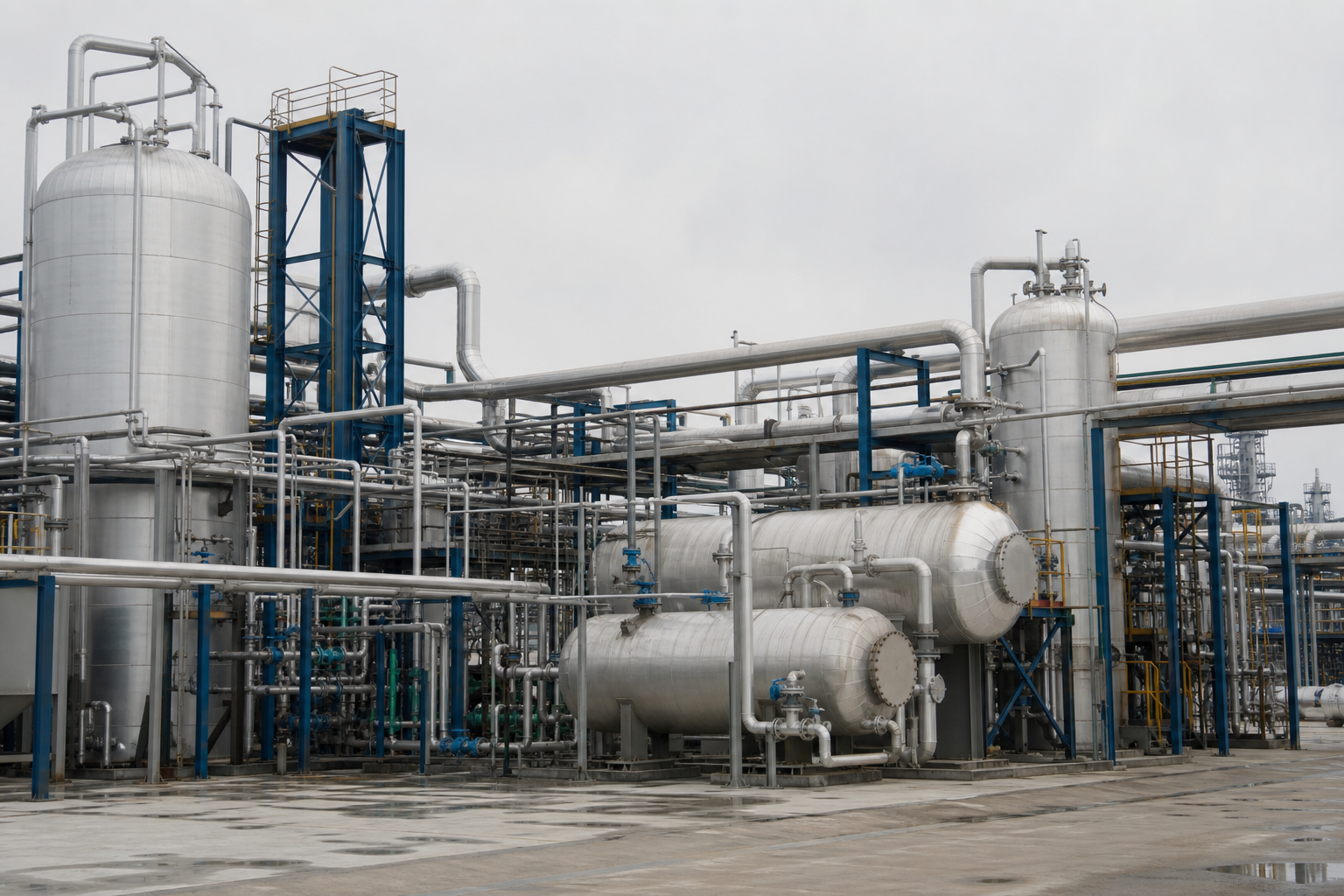
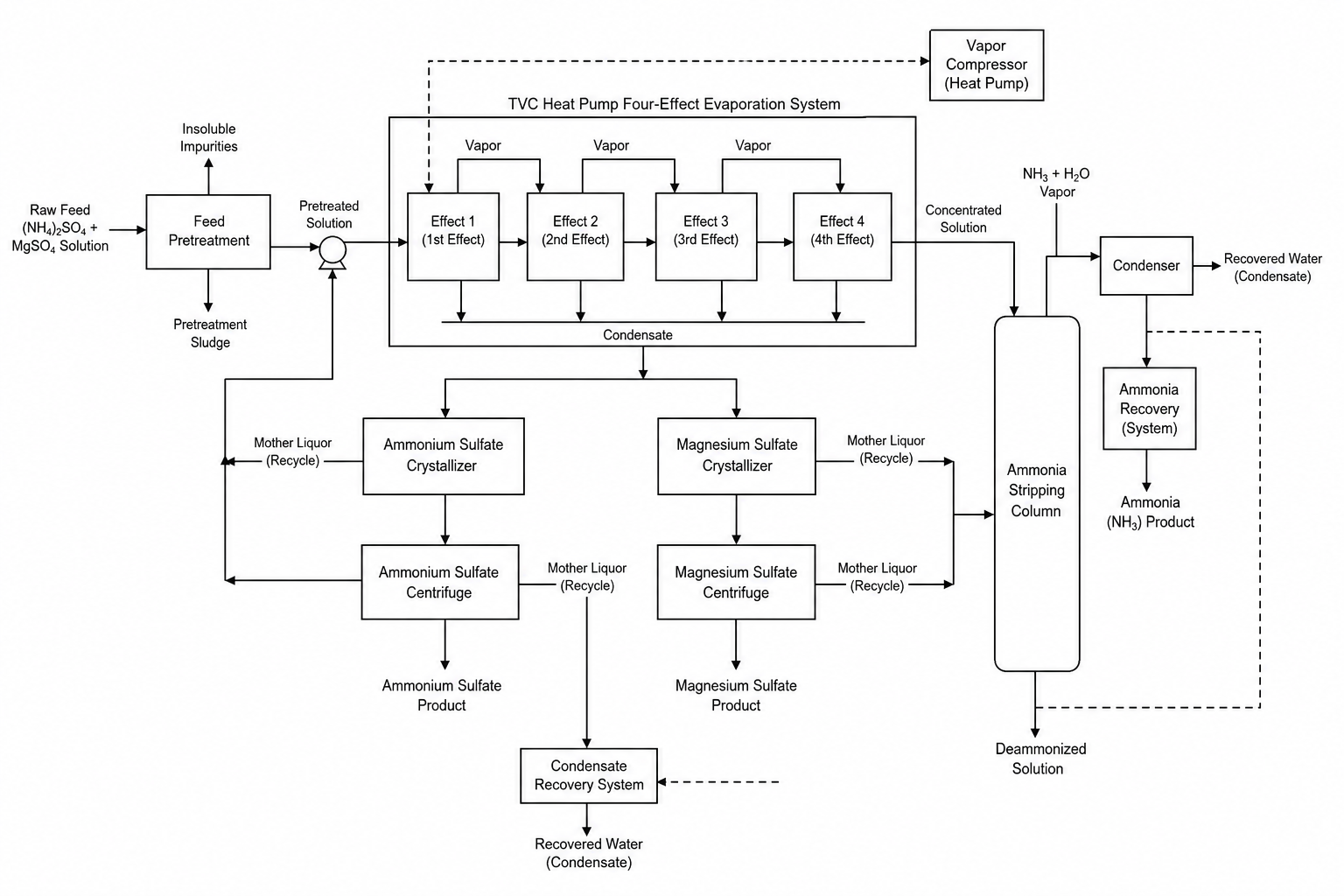
The mixed liquor is filtered and equalized, then split to the two evaporation lines. Each line runs a four-effect train motivated by a TVC thermocompressor: live steam through the ejector entrains and recompresses recycled secondary vapor, driving the first effect; the effects then step down in temperature and pressure, each boiling on the previous effect’s vapor. The TVC arrangement halves the live-steam draw relative to a plain four-effect train — the standard steam-economics move where site steam exists but MVR electric capacity does not.
Ammonia management comes first in the thermal path. Deammonization — ammonia stripping with pH and temperature control and off-gas scrubbing recovery — is applied where the flowsheet needs the ammonium removed or shifted before crystallization chemistry; the recovered ammonium returns to the ammonium sulfate product stream rather than to the atmosphere.
Salt separation exploits the two sulfates’ different crystallization behavior. Concentrated liquor enters the ammonium sulfate crystallization stage, where evaporation-driven supersaturation at controlled temperature grows (NH4)2SO4 crystals that are withdrawn, centrifuged and dried as the first product. The mother liquor, now enriched in magnesium sulfate, advances to the magnesium stage, where the complementary temperature window precipitates MgSO4 fraction as the second product. Both crystallizers run in forced-circulation service — mixed-sulfate liquors are crystallizing, scaling fluids throughout the back end of the train, and pumped circulation is what keeps both heat transfer surfaces and crystal growth behavior in their windows.
Mother liquor recycles between the stages and back to the effect feed, with a controlled purge holding trace metals and organics at steady state. Condensate from the four effects is collected clean and hot, and reused in the plant.
Equipment Configuration
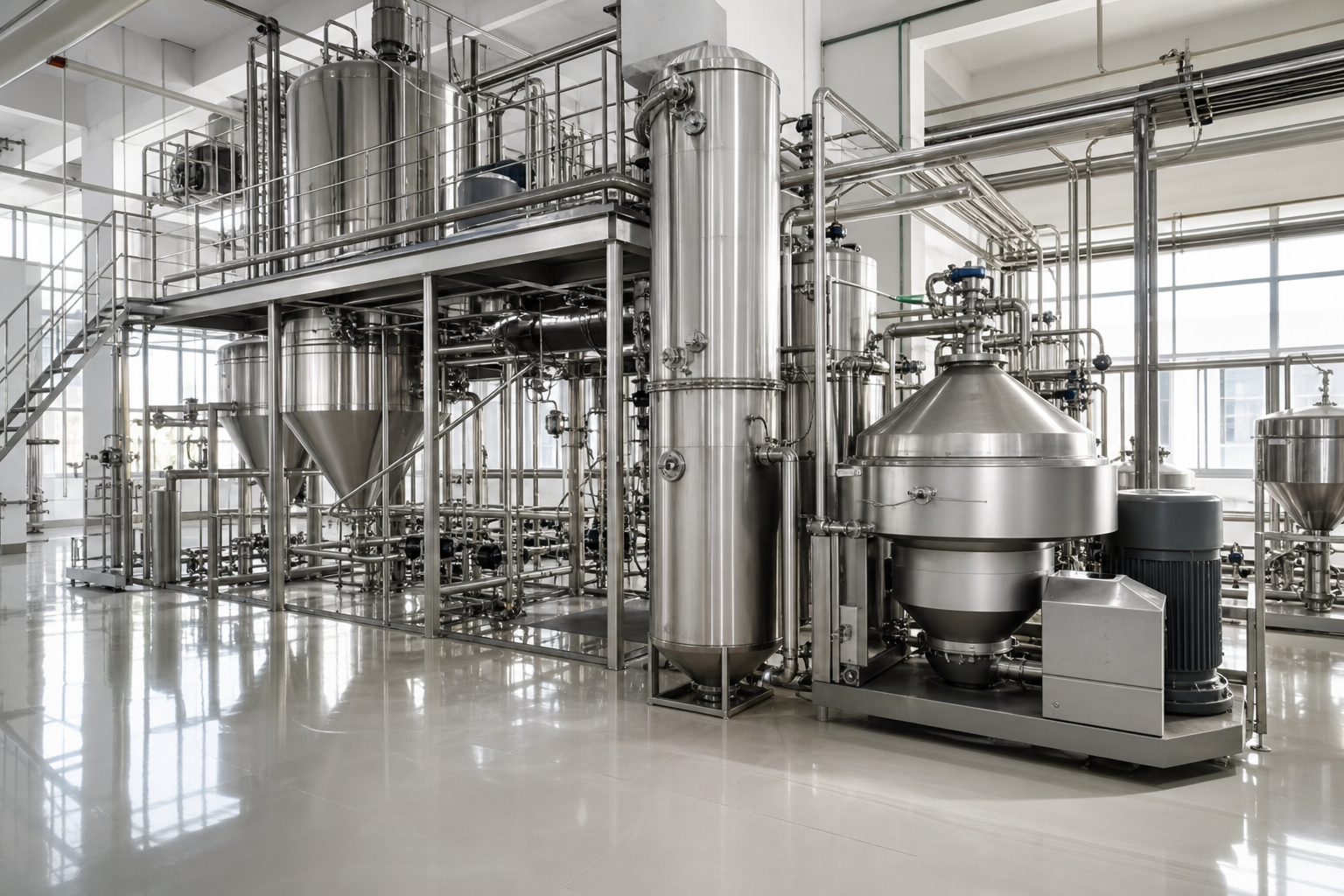
One set of the following equipment is typical per line (two lines for this duty):
- Feed equalization and filtration on the mixed-sulfate liquor
- Four-effect evaporation train with TVC thermocompressor, 2205 duplex wetted parts
- Deammonization / ammonia stripping package with off-gas scrubbing and ammonium recovery
- Forced-circulation crystallizers for ammonium sulfate and for the magnesium sulfate fraction
- Centrifuges and dryers for both salt products; mother-liquor return and purge control
- Condensate collection and reuse; DCS control of the two-line train with stage density and NH3 monitoring
Performance & Outcome
Compiled from published industry project data, indicative: trains of this class split a mixed ammonium–magnesium sulfate liquor into two separate salt products with ammonia contained and recovered, on TVC-driven steam economics, in corrosion-resistant duplex construction. Separation purities and ammonia recovery rates are validated per project.