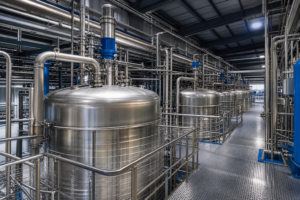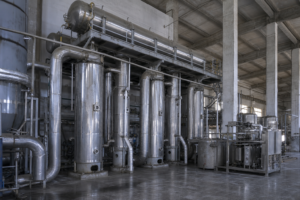
For rare earth operations working ores that carry uranium and thorium, water closure is a radiological design problem before it is a salinity problem: beneficiation and transport waters are mildly radioactive TENORM (technologically enhanced naturally occurring radioactive material), and any zero liquid discharge route must first strip uranium, thorium and daughter products out of the water, then keep the captured activity in a small, characterizable solid stream. The workable route pairs membrane filtration with high fouling resistance and radionuclide retention ahead of thermal concentration, so the evaporator-crystallizer island sees de-radioactivity-ied brine and the activity leaves the site in the membrane concentrate, not dispersed through the salt product. The design premise: radionuclides concentrate wherever the water goes – if you evaporate first and separate later, you have manufactured radioactive salt.
The Problem: Naturally Radioactive Ores Make Radioactive Water
The principal rare earth ore families – bastnasite, monazite, and the apatite-associated phosphoric acid route – carry uranium and thorium at grades that matter to water chemistry. When the ore is ground, floated and transported in water, a fraction of the U and Th (and their daughters) reports to the water: the public reference from the Mountain Pass mine describes transport water with slight radioactivity requiring treatment as part of remediation and water recycling operations. The treatment challenge is not the activity level of the water itself – it is that every downstream volume-reduction step concentrates the activity unless it is removed first, and a salt or sludge stream with elevated radionuclide content changes disposal classification, cost and liability.
The reference installation is nearly three decades old and ran for over a decade: in 1997 a vibratory-shear enhanced membrane filtration (VSEP) nanofiltration system was installed at Molycorp’s Mountain Pass rare earth mine in Southern California to treat the TENORM effluent, removing uranium, metals, colloids and organics from the transport water, with the system operating for more than ten years with periodic membrane replacement and stable flux despite colloids and radionuclides (New Logic Research VSEP case material – an external industry reference, not an EvapCryst delivery). The same technology family appears twice more in the rare earth sector: a 2012 demonstration at Lynas’ Mt. Weld operation filtering thickener overflow (colloids, lime, organics, mineral oil, metals) with 85% of the feed emerging as dilute monovalent NF filtrate feeding an existing spiral RO – turbidity from 250,000 to 1.4 NTU, iron from 1,300 to 0.15 mg/L, manganese from 110 to 0.015 mg/L over a stable two-month pilot; and a one-year acid-tolerant NF demonstration for Arafura’s Nolans project purifying phosphoric acid of uranium, thorium, colloids and metals toward merchant grade, with FEED complete and equipment procurement planned from Q1 2026 (New Logic Research – external industry references, not EvapCryst deliveries).
Illustrative Feed Envelope for Screening
The envelope below consolidates published reference values with ranges used for screening rare earth TENORM waters. It is an illustrative envelope built from public industry material and stated assumptions – not a customer dataset, and not a performance guarantee.
| Parameter | Illustrative range | Basis / note |
|---|---|---|
| Radiological character | Mildly radioactive water; U/Th plus daughters | Bastnasite/monazite/apatite ore families |
| Suspended and colloidal load | Turbidity to 250,000 NTU class in thickener overflow | Published Mt. Weld demonstration feed |
| Metals | Fe to 1,300 mg/L; Mn to 110 mg/L class | Published demonstration reductions |
| Organics / oils | Flotation reagents, mineral oil | SX crud precursors |
| pH range of treatment | pH 0-12 membrane availability | Acid-tolerant NF chemistries |
| Treatment objective | Radionuclide retention in concentrate; clean water for reuse; smaller thermal ZLD downstream | Activity partitioned before volume reduction |
Process Solution: Remove Activity First, Then Close the Water Loop
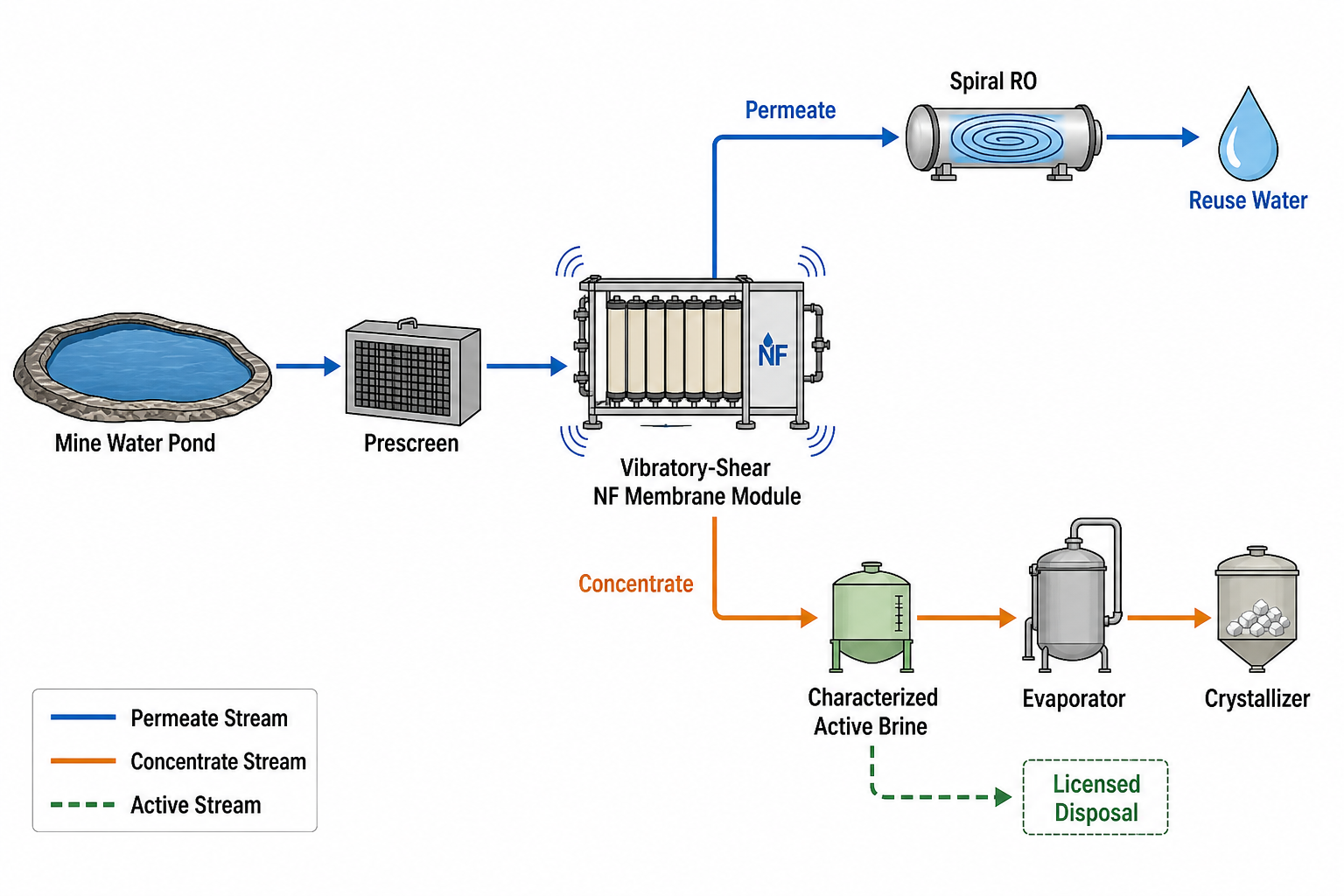
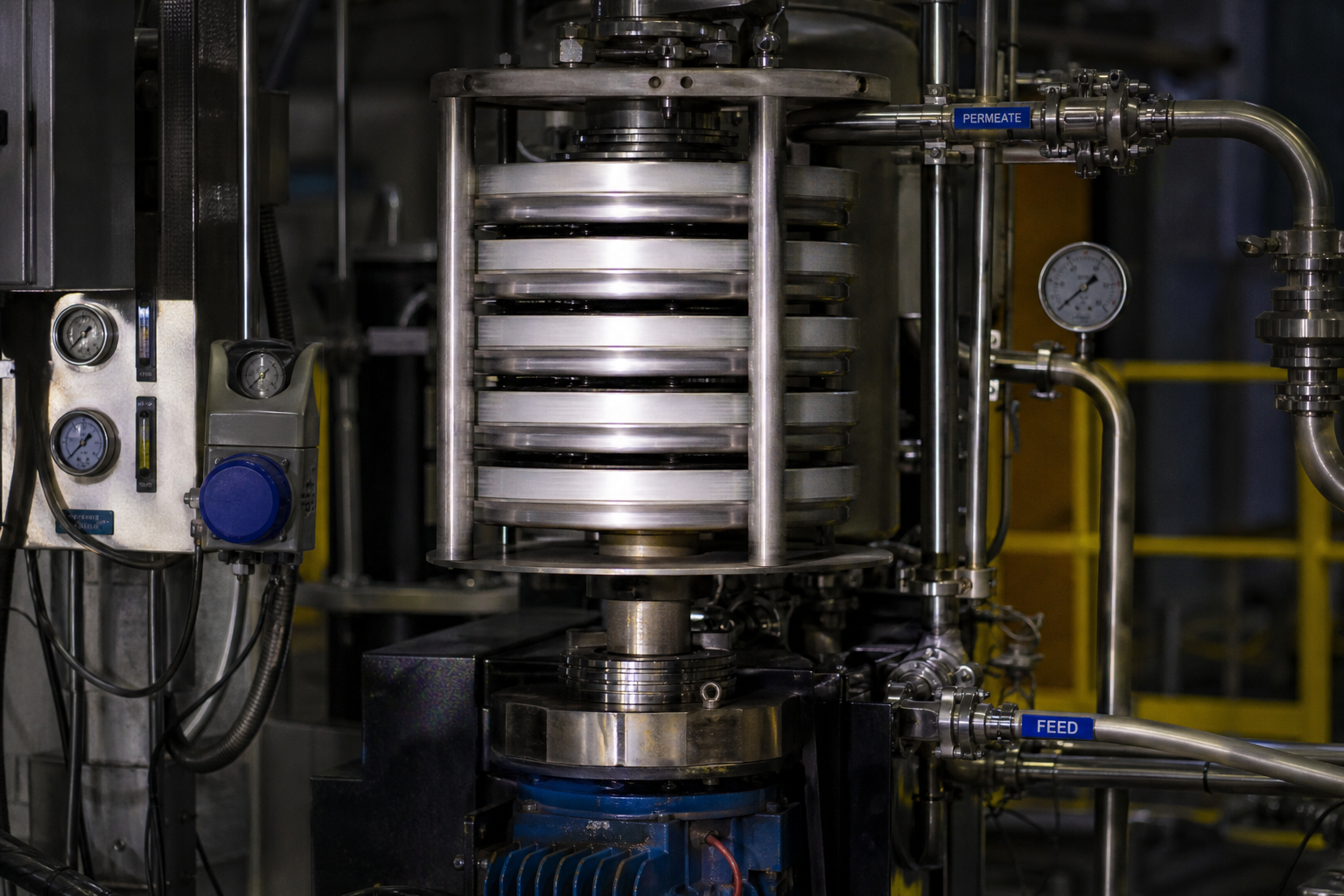
The train runs in four blocks. First, coarse protection: prescreening to remove particles above roughly 100 µm that would abrasively wear the vibratory membrane stack – a stated design consideration for this equipment family. Second, the radionuclide-and-solids barrier: vibratory-shear enhanced nanofiltration, in which high-frequency vibration at the membrane surface suppresses fouling and concentration polarization, letting NF membranes run on feeds that destroy spiral elements – colloids, oils, high-TDS brines, low-pH liquors, and slurries. The NF stage retains uranium, thorium, metals, colloids and organics; the permeate emerges as dilute, largely monovalent water – the published Mt. Weld figure is 85% of feed as NF filtrate clean enough to feed conventional spiral RO.
Third, conventional desalination on the permeate: spiral RO converts the NF filtrate into reuse-grade water at standard recoveries, because the fouling and radioactivity that would have destroyed it have been left behind in the NF concentrate. Fourth, the ending of the concentrate: a small-volume, high-activity brine that reports to the thermal island – evaporator and crystallizer – sized on the salt and activity mass, not the raw water flow. The vibratory RO variant extends this same logic to more saline waters, with published capability to concentrate brines to the 200 g/L class versus roughly the 50 g/L practical ceiling of conventional RO – cutting the evaporator duty that remains.
Technical Features That Decide Whether the Activity Stays Caught
Three features carry the engineering weight. The first is shear at the membrane as the enabler. A TENORM feed carries colloids and radiochemistry that blind a static membrane within hours; the vibratory stack keeps the surface scoured, which is what turned a fouling-impossible duty into a decade-running installation at Mountain Pass. The fouling question and the radionuclide question are the same question here.
The second is the partition point of the activity. Uranium and thorium species are retained by the NF stage and leave in its concentrate; the permeate carries monovalent salts onward to RO. Get this order right and the salt crystallizer at the end produces ordinary salt while the activity sits in a small stream you can characterize, shield if needed, and dispose of at known cost. Get it wrong – evaporate first, polish later – and the activity distributes into every product stream including the recovered water.
The third is verification by testing, not assumption. Radionuclide speciation varies with ore mineralogy and leach chemistry; the published acid-tolerant NF demonstrations (Nolans phosphoric acid, one year of testing toward merchant-grade purity) exist precisely because retention is chemistry-specific. The membrane family’s own guidance is that actual performance is stream-specific and pilot testing selects the membrane, flux and recovery – for TENORM duty that pilot is not optional engineering, it is the qualification basis.
Process Modules
| Process module | Candidate equipment types | Selection rationale | Module duty |
|---|---|---|---|
| Coarse protection | Prescreening above ~100 µm | Protects vibratory stack from abrasion | Remove grit before membranes |
| Radionuclide barrier | Vibratory-shear NF (acid-tolerant chemistries as needed) | Fouling-resistant retention of U/Th, metals, colloids, organics | Partition activity into a small concentrate |
| Water recovery | Spiral RO on NF permeate | Cheap desalination once fouling load is gone | Produce reuse-grade permeate |
| Deep concentration (optional) | Vibratory RO to high TDS | Extends concentration beyond spiral limits | Shrink the thermal island further |
| Thermal finishing | Evaporator + crystallizer | Closes water and salt balance | Solids output on de-radioactivity-ied basis |
| Active solids handling | Characterized collection, shielding per assay, licensed disposal | Activity leaves the site in a known package | Contain and dispose of retained activity |
| Verification | Bench and onsite pilot testing program | Retention is chemistry-specific | Qualify membrane, flux and recovery |
Configuration, materials and operating envelopes above are potential considerations only; actual selections depend on feed composition, temperature, corrosion review, fouling behavior, utilities and project capacity.
Expected Performance and Limits
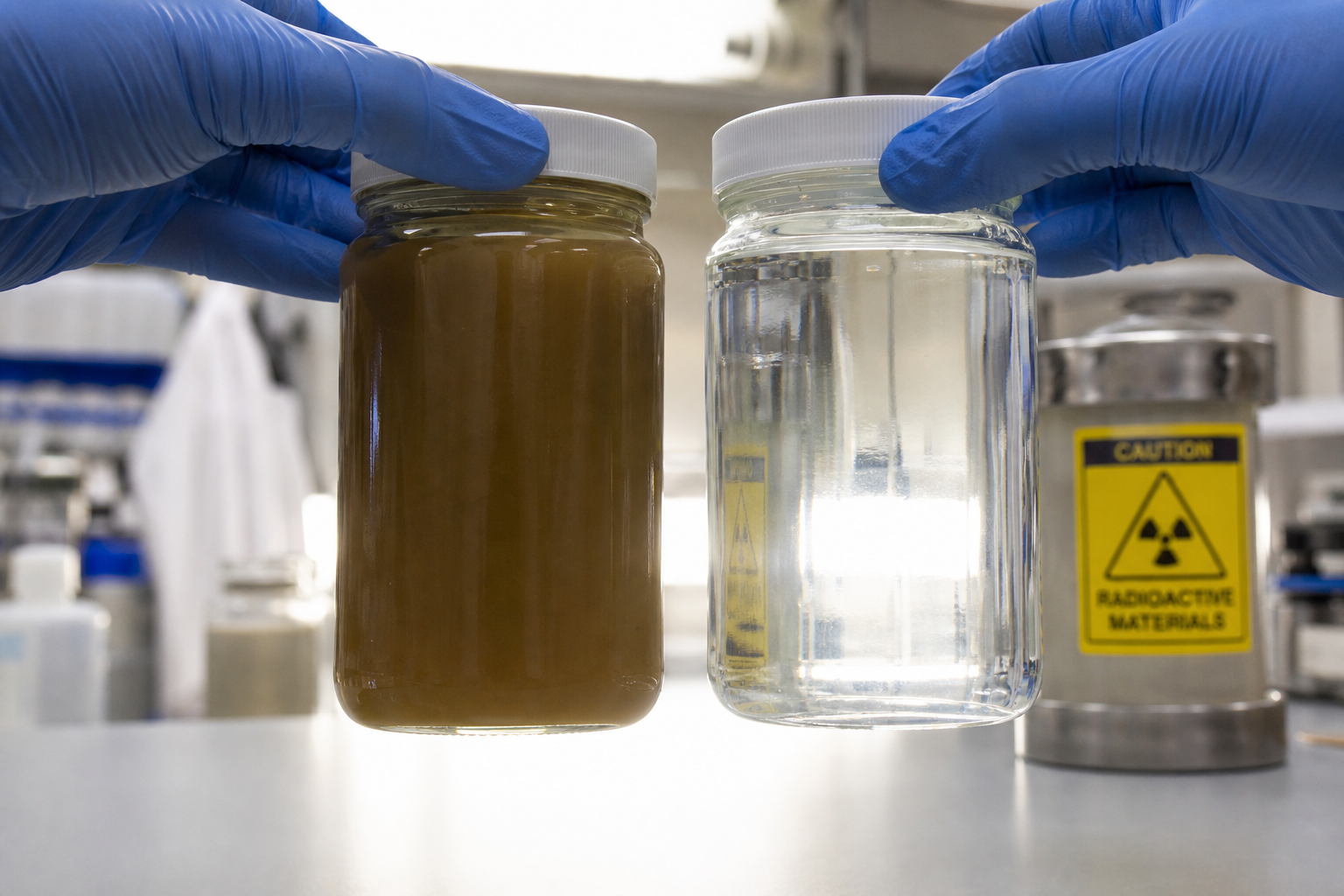
Published reference performance: the Mountain Pass VSEP NF installation removed uranium, metals, colloids and organics from TENORM transport water and ran for over ten years with periodic membrane replacement and stable flux; the Mt. Weld demonstration achieved 85% NF permeate recovery from thickener overflow with turbidity 250,000 to 1.4 NTU, iron 1,300 to 0.15 mg/L and manganese 110 to 0.015 mg/L over two months of stable operation; the equipment family publishes acceptance of pH 0-12 feeds, TDS to 200 g/L (with vibratory RO concentrating toward that ceiling versus roughly 50 g/L conventional), and a temperature limit around 60°C (New Logic Research – external industry references; indicative and stream-specific, not a project guarantee). Engineering estimates for the downstream effect: pre-concentrating brine from the 50 to the 200 g/L class removes on the order of three-quarters of the water that a thermal island would otherwise have to evaporate – the structural OPEX argument for pushing membrane concentration as far as the chemistry allows before evaporation (engineering estimate). Limits worth respecting: recovery is bounded by osmotic pressure and viscosity, not ambition; aromatic solvents and oxidizers are excluded from this equipment family; the 60°C ceiling constrains where in a hot flowsheet the membranes may sit; and radiological performance carries no design guarantees across ore chemistries – each ore’s U/Th speciation demands its own qualification.
Industry References and Validation
The route is anchored on three public references from one technology family (New Logic Research VSEP case material – external industry references, not EvapCryst deliveries): the 1997 Molycorp Mountain Pass TENORM installation – vibratory NF on slightly radioactive transport water removing uranium, metals, colloids and organics, operating over a decade with stable flux; the 2012 Lynas Mt. Weld demonstration – VSEP NF on thickener overflow with the 85% recovery and the turbidity/Fe/Mn reductions cited above, feeding existing spiral RO for clean-water reuse; and the Arafura Nolans project – one year of acid-tolerant NF demonstration purifying phosphoric acid of uranium, thorium, colloids and metals toward merchant-grade requirements, with FEED complete and procurement planned from Q1 2026. For your own project, validation effort should concentrate on: a radiological and chemical characterization of your water (U, Th, daughters, metals, colloids, organics, pH, TDS); a bench and onsite pilot program selecting membrane chemistry, flux and recovery on your stream – the technology supplier’s own stated qualification path; an activity mass balance showing where every becquerel reports in the proposed flowsheet; and early engagement with your regulator on the disposal classification of the retained-activity concentrate.
Frequently Asked Questions
What does TENORM actually mean here?
Technologically enhanced naturally occurring radioactive material. The ore’s uranium and thorium were always natural; mining, grinding and processing concentrate them into water streams and residues at levels that trigger radiological handling rules. It is a classification with disposal and monitoring consequences, not an acute hazard drama.
Why membranes before the evaporator for radioactive water?
Because activity follows concentration. If you evaporate first, the uranium and thorium distribute into the salt, the sludge and the condensate contact points – everything becomes characterizably radioactive. Capturing the radionuclides in a small NF concentrate first keeps the evaporator, its salt and its water on the clean side of the balance.
How does a membrane survive water that fouls everything?
Vibration. High-frequency shear at the membrane surface scours away the colloids and gels that blind static elements – that is the whole premise of the vibratory family, and the decade-plus Mountain Pass runtime is the proof it holds on radioactive, colloid-laden feed.
Does this eliminate the thermal ZLD island?
No – it shrinks and de-risks it. Membranes take the water out cheaply down to their osmotic ceiling; the evaporator-crystallizer still finishes the job, but on a brine that is smaller and, critically, already stripped of its radioactivity.
What regulation drives the design?
Depends on jurisdiction, but the pattern is consistent: waters and solids with elevated NORM activity carry handling, transport and disposal constraints, and the classification of your concentrate stream defines its cost. Engaging the regulator on that classification early is part of the flowsheet, not an afterthought.
When This Route May Not Fit
If your ore is genuinely low in uranium and thorium – some ion-adsorption clays run near-background – the radiological design driver disappears and conventional water treatment economics govern. If your water is already a clean, high-purity acid or brine with a single valorization target (the Nolans phosphoric acid case), the membrane stage is purification rather than water closure and belongs inside the process, not at its end. And if volumes are trivial, characterization-and-truck beats a membrane island regardless of chemistry.
What Must Be Verified Before Committing
Five items: a full radiological and chemical characterization of each water stream including uranium, thorium and daughter speciation; a pilot program on your actual water selecting membrane chemistry, flux and recovery – the stated qualification path for this equipment family; an activity mass balance across the proposed flowsheet accounting for every stream; a disposal pathway and classification agreed with your regulator for the retained-activity concentrate; and the thermal island’s duty and materials confirmed against the de-radioactivity-ied brine’s composition. These map directly onto the modules above and are the standard screening package we would run before any quote.