
Project Parameters
| Parameter | Value |
|---|---|
| Process route | Five-effect plate falling-film evaporation + NMMO concentration and purification loop |
| Industry | Textile fibers — Lyocell cellulosic fiber production (Thailand) |
| Feed type & key components | Dilute spin-bath liquor; N-methylmorpholine N-oxide (NMMO) in water with fiber fines and degradation products |
| Evaporation capacity | 165 t/h |
| Construction materials | SS316L wetted parts (indicative for NMMO aqueous service) |
Representative process configuration compiled from published industry project data. Indicative values, not a process guarantee.
Project Description
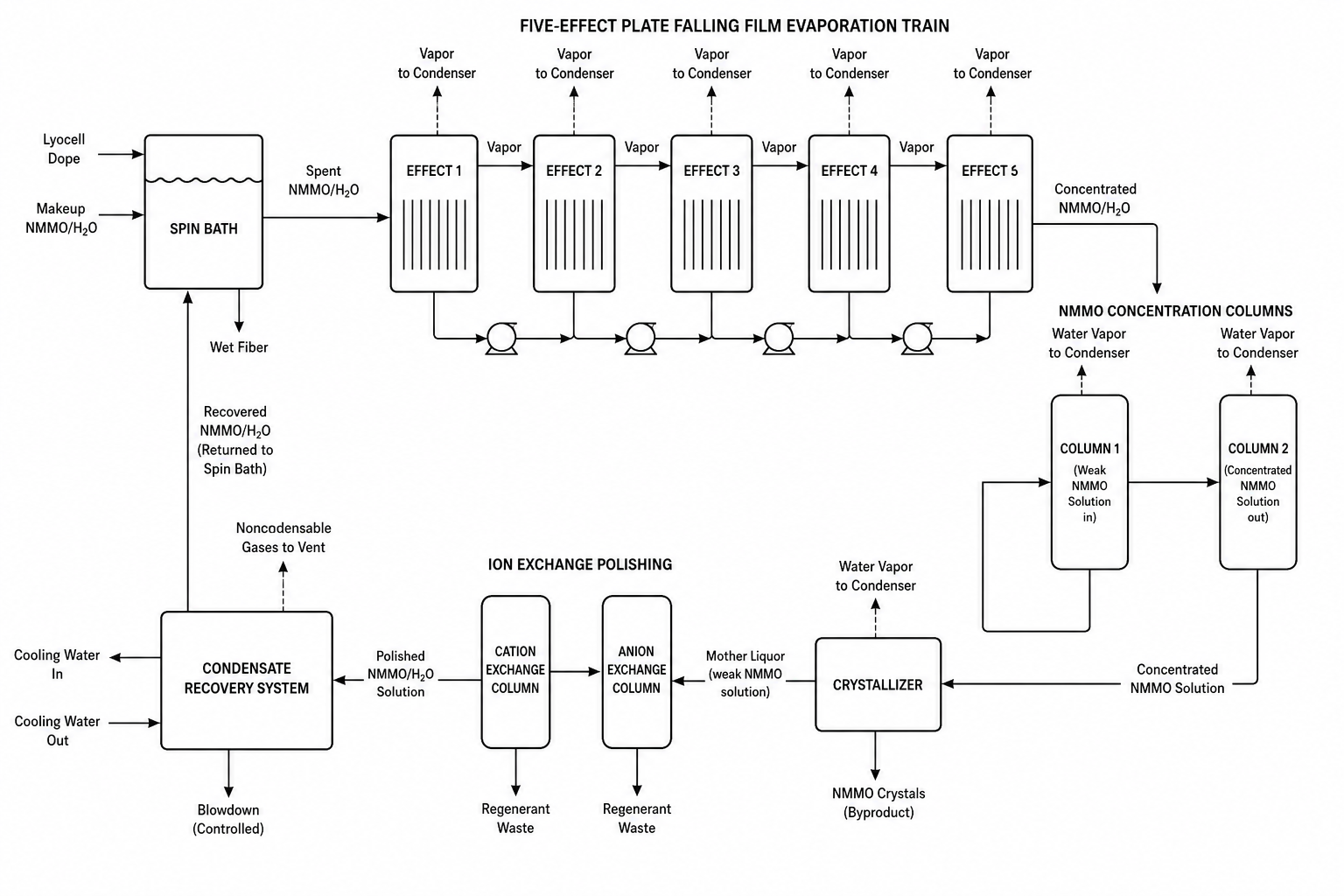
Lyocell is the environmentally decisive cellulosic fiber precisely because its solvent loop closes: cellulose dissolves in N-methylmorpholine N-oxide (NMMO) and water, is spun from that solution, and the spent spin bath is returned to concentration so that the solvent is reused rather than discharged. The economics and the environmental permit of the process both rest on the evaporation plant that reconcentrates the dilute spin-bath liquor.
The reference configuration serves a Lyocell fiber plant in Thailand — one of Southeast Asia’s investment destinations for next-generation fiber capacity — with a 165 t/h evaporation train in five-effect plate falling-film construction. Comparable published configurations run the same duty at 104 t/h in seven-effect plate arrangements at plants in China, confirming multi-effect plate falling film as the segment’s standard architecture for NMMO service.
Process Technology
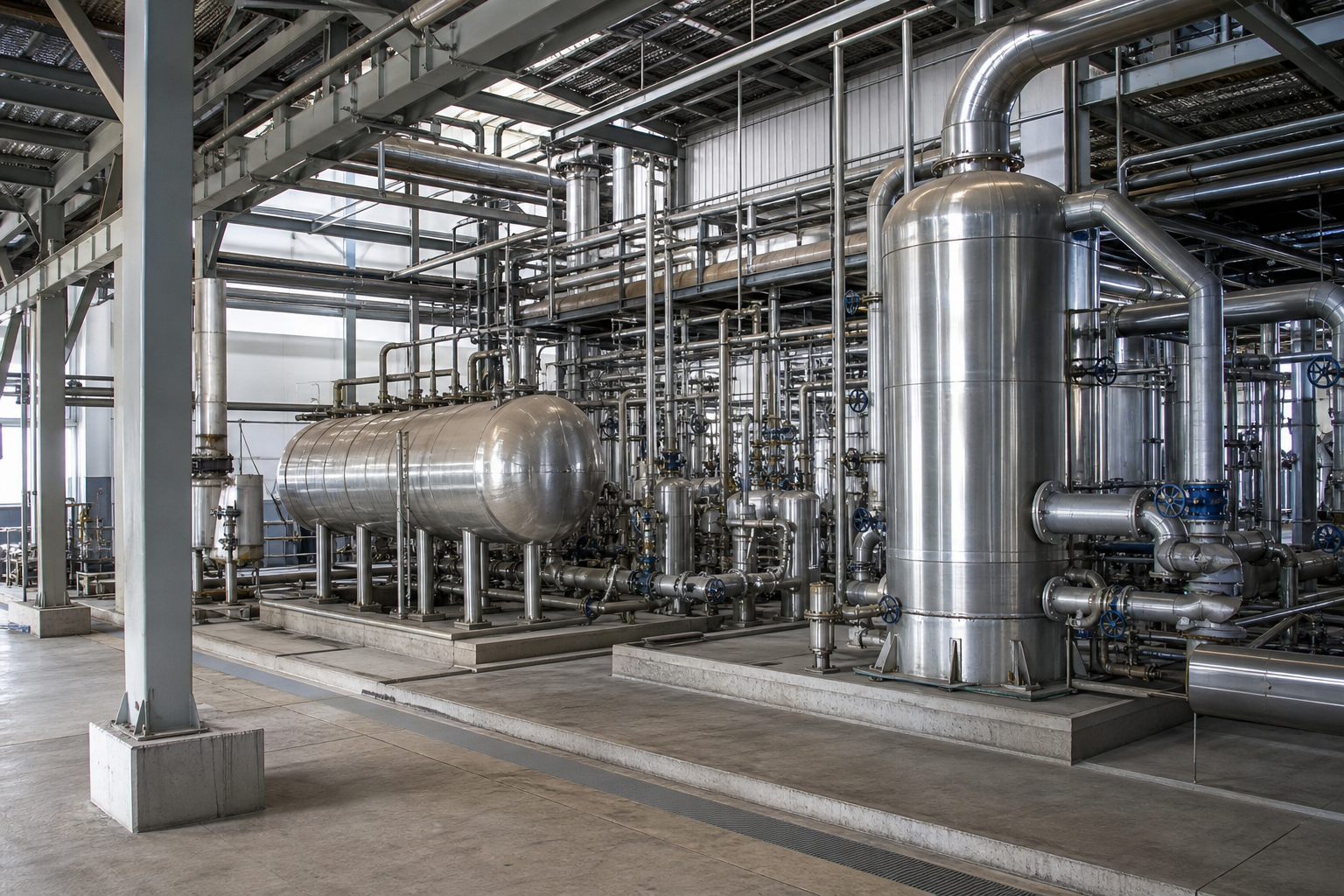
Spent spin bath is first cleaned: filtration removes fiber fines carried over from spinning, and ion-exchange polishing strips the degradation products and colored bodies that accumulate in the solvent loop — a purification step that protects both product color and the thermal stability of the solvent.
The heart of the recovery loop is evaporation. The cleaned dilute NMMO liquor is concentrated in a five-effect falling-film train with plate heat exchangers. Falling film at low temperature difference is the well-matched regime for NMMO: the solvent is thermally stable only within bounds, and degradation products form faster at hot-wall conditions, so the seconds-scale film residence time preserves solvent quality while the plate surfaces deliver the heat transfer coefficients that keep the plant compact.
The five effects step down in temperature and pressure, each boiling on the vapor of its predecessor, so the live-steam draw per tonne of water is cut to roughly a fifth of single-effect evaporation. Water boiled from the spin bath leaves as condensate — hot and clean — and returns to the dissolving and washing steps, closing the fiber plant’s water balance in the same loop that closes its solvent balance.
Concentrated NMMO liquor at dissolving strength is held in product tankage under controlled conditions (NMMO at high concentration demands thermal discipline and contamination control) and recycled to cellulose dissolving. A small purge on the loop manages the slow accumulation of non-removable impurities, with fresh NMMO make-up limited to the fraction that cannot be recovered — the solvent recovery rate is one of the plant’s governing economic indicators.
Equipment Configuration
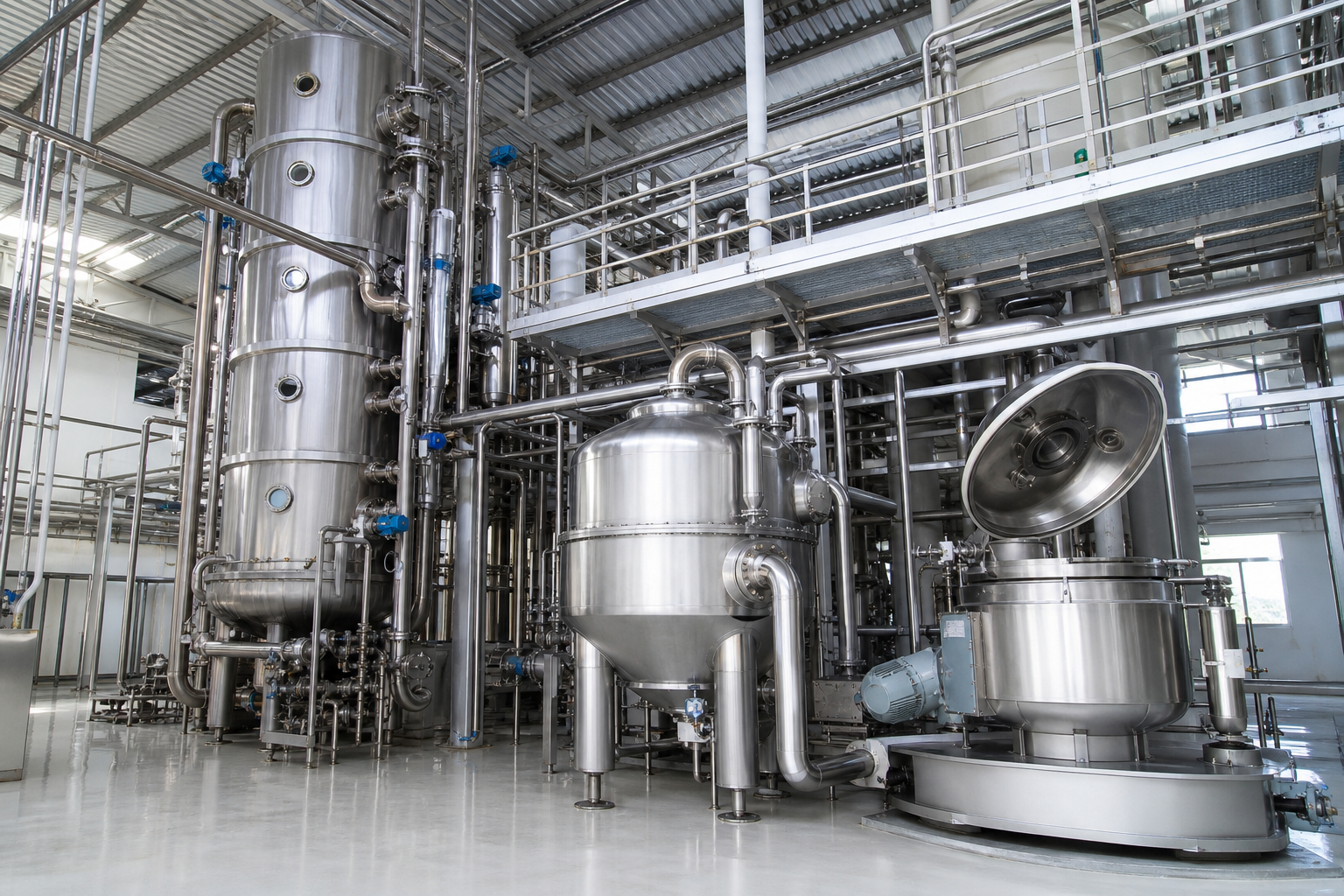
One set of the following equipment is typical for this duty:
- Spin-bath collection, filtration for fiber fines and ion-exchange polishing
- Five-effect falling-film evaporation train with plate heat exchanger packages
- Surface condenser and vacuum system; condensate return to dissolving and washing
- Concentrated NMMO storage under controlled temperature and contamination exclusion
- Loop purge control and fresh NMMO make-up metering; NMMO concentration analytics
- DCS control of effect profile, product concentration and cleaning sequences
Performance & Outcome
Compiled from published industry project data, indicative: trains of this class reconcentrate spin bath to dissolving strength on five-effect steam economy, close the fiber plant’s water loop with clean condensate, and hold NMMO make-up to the small unrecoverable fraction. Solvent recovery rate and specific steam consumption are quoted per project.


