
Project Parameters
| Parameter | Value |
|---|---|
| Process route | Four-effect evaporation: falling-film concentration + forced-circulation service |
| Industry | Food & fermentation — MSG / amino acid production |
| Feed type & key components | Glutamate mother liquor from fermentation and extraction; glutamic acid, residual sugars, sulfate and high-organics broth components |
| Evaporation capacity | 170 t/h total (2 × 85 t/h trains) |
| Construction materials | SS316L wetted parts |
Representative process configuration compiled from published industry project data. Indicative values, not a process guarantee.
Project Description
Monosodium glutamate begins as fermentation — molasses or starch hydrolysate fermented to glutamic acid broth — and the mother liquor left after glutamate extraction is one of the food industry’s most difficult concentration duties: a hot, acidic, organics-laden liquor with dissolved salts, prone to fouling and color formation, produced at very large volume. A fermentation plant in Northeast China (Heilongjiang) operates the reference configuration for this duty at 170 t/h, arranged as two 85 t/h trains — the scale of the region’s amino-acid complexes, where the concentration plant is among the largest energy consumers on site.
The commercial logic is resource recovery: concentrated mother liquor is processed for by-product value — fertilizer-grade organics and compound-feed additives — while the water returns to the plant. Comparable published configurations in the same product family run 60 t/h in four-effect service, confirming the route’s standing across MSG capacity classes.
Process Technology
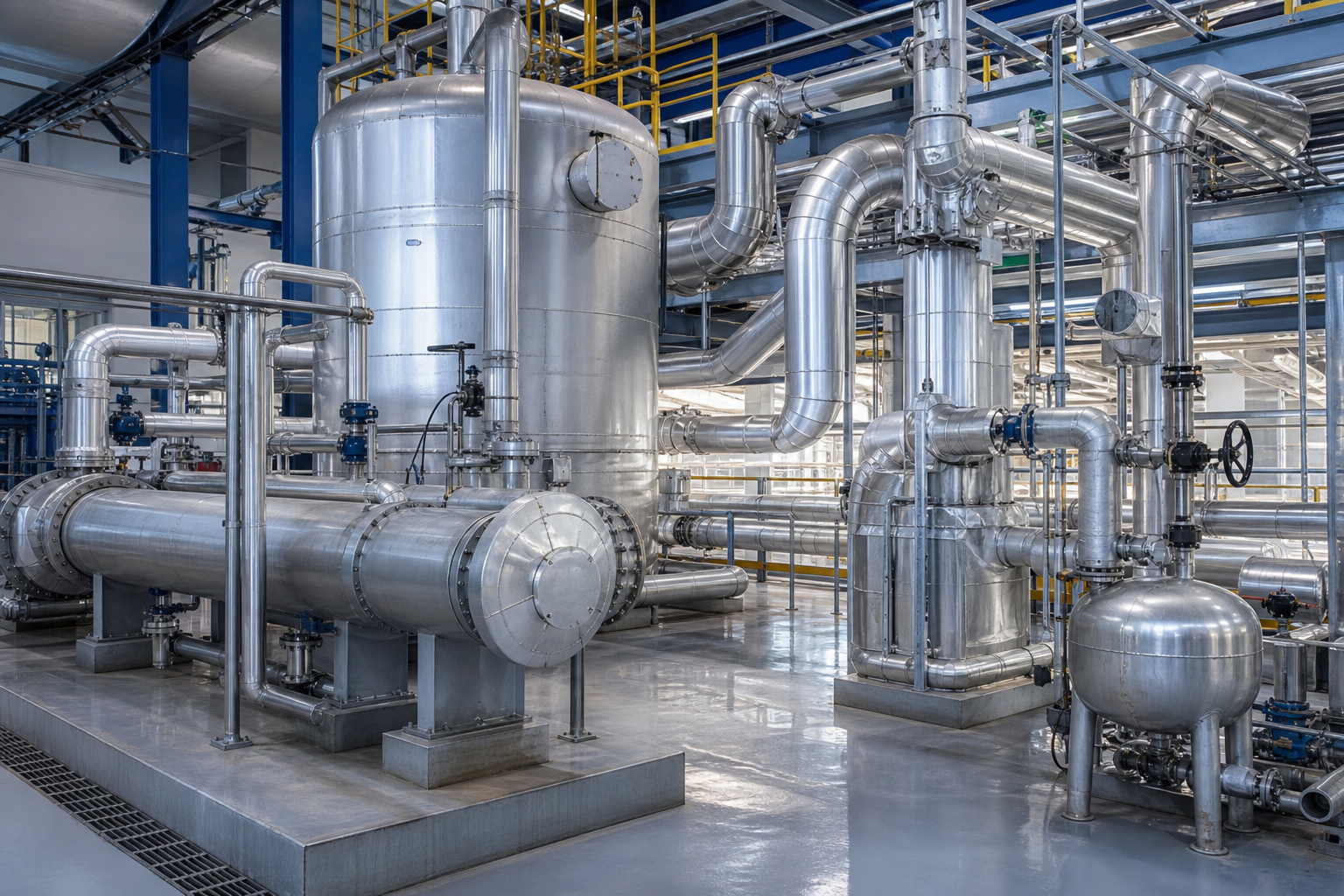
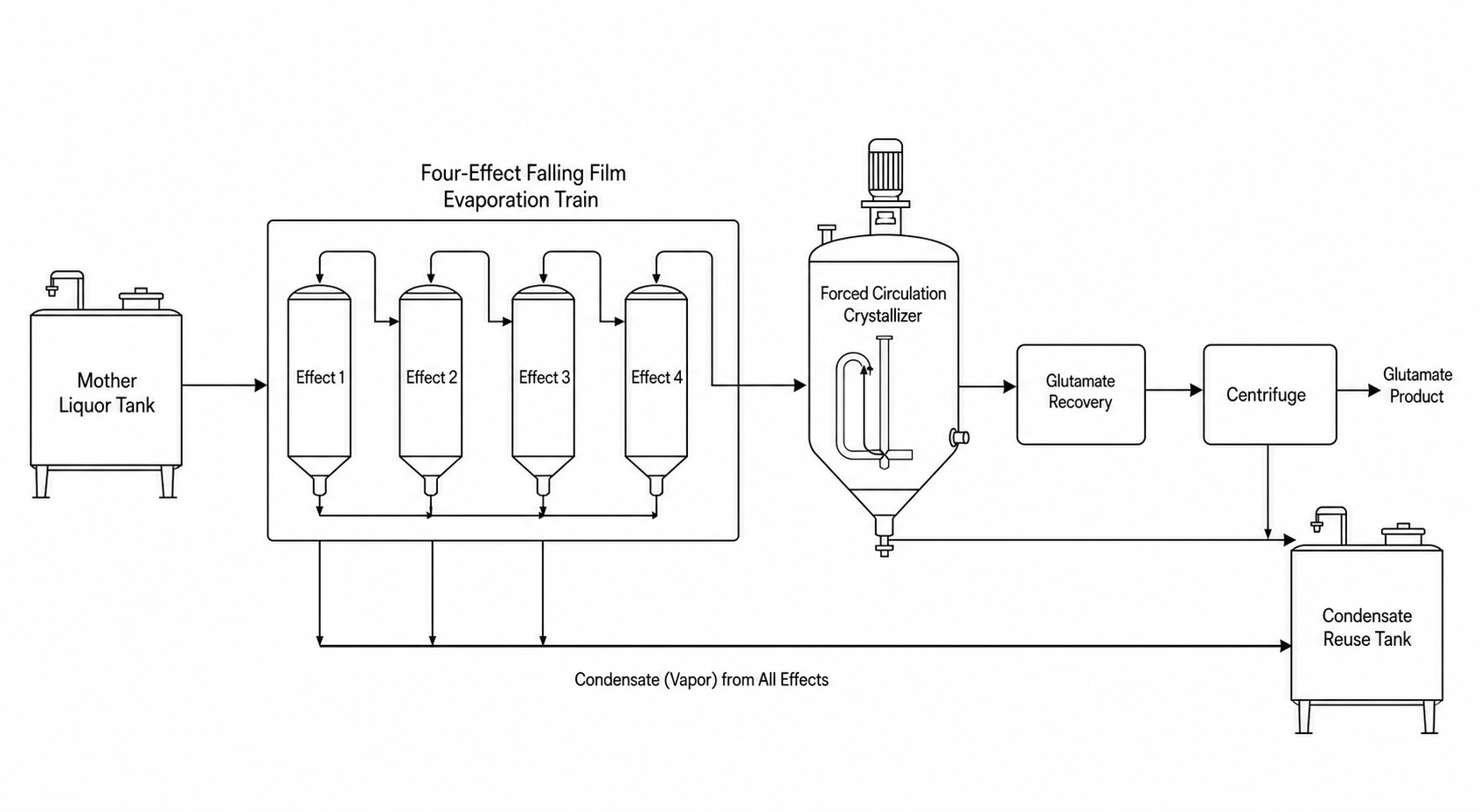
Mother liquor from the glutamate extraction section is screened for suspended solids and conditioned for feed pH, then split across the two trains. Each train runs four effects in series: live steam drives the first effect, and successive effects boil at lower temperature and pressure on the vapor of their predecessor, dividing the steam demand per tonne of water by roughly four.
The effects split their service between geometries. The early effects, where the liquor is thinner and cleaner, run in falling-film service — high heat transfer coefficients and short product contact time protecting the liquor from color degradation. As concentration climbs and the liquor thickens toward the fouling, high-viscosity regime, the duty hands to forced circulation: pumped velocity keeps the organics-laden liquor moving too fast to plate onto heat transfer surfaces, and keeps the train’s run length between cleanings measured in weeks rather than days.
Concentrated mother liquor at target solids discharges to the by-product plant — the fertilizer and feed-additive stream that turns the wastewater duty into a revenue line. A crystallization stage recovers glutamate values where the flowsheet includes the recovery loop. Vapor from the final effect condenses against a surface condenser under vacuum, and condensate is segregated: later-effect condensate is clean hot water for fermentation and extraction reuse; first-effect condensate, carrying volatile organics, is treated separately.
Clean-in-place is a designed-in operating mode on trains of this class — mother liquor fouling is a certainty managed on schedule, not an accident.
Equipment Configuration
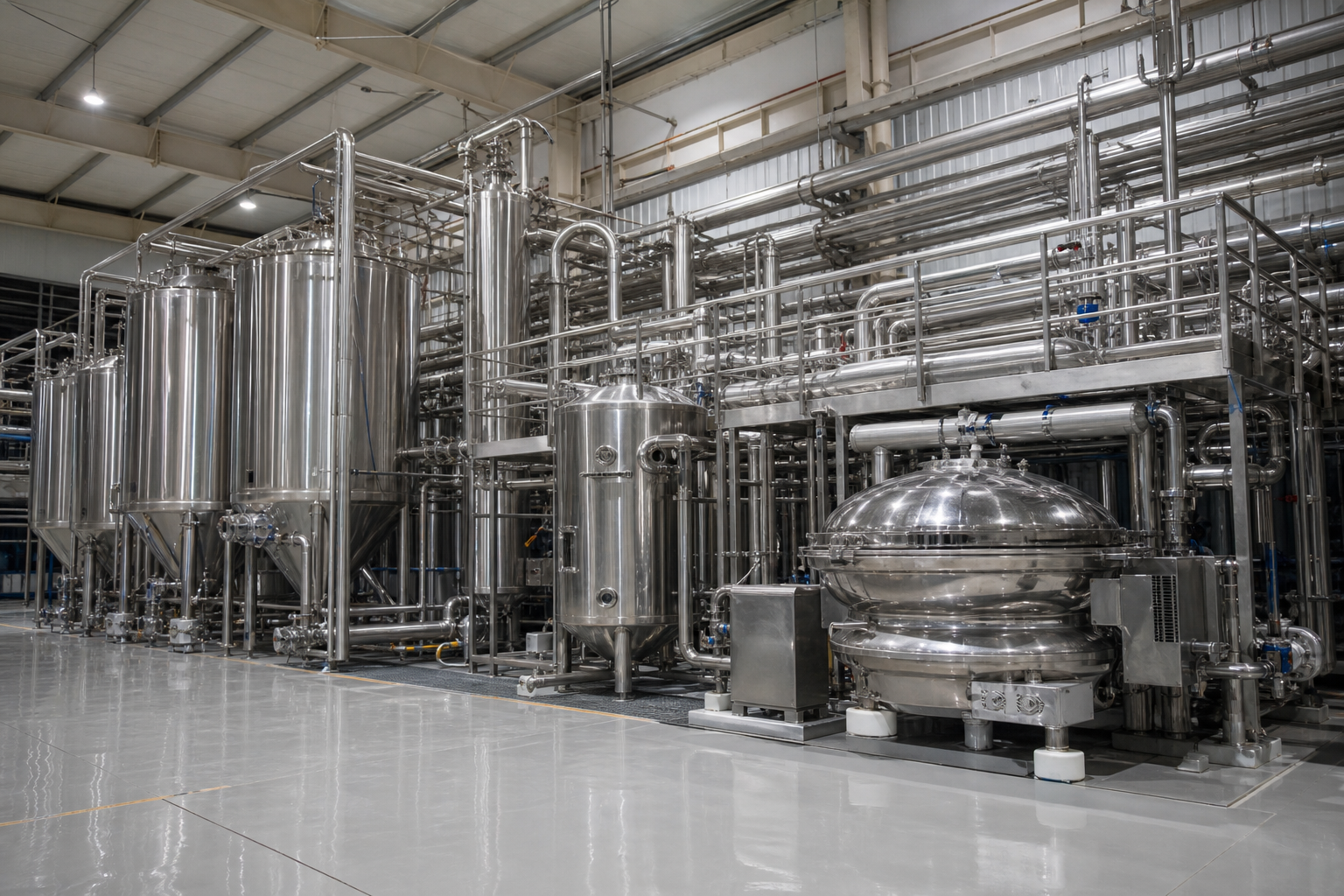
One set of the following equipment is typical per train (two trains for this duty):
- Mother liquor screening and pH conditioning
- Four-effect evaporation train: falling-film early effects, forced-circulation finishing service
- Surface condenser and vacuum system; segregated clean / fouled condensate collection
- Concentrated liquor discharge to by-product (fertilizer / feed additive) processing
- Optional crystallization stage for glutamate recovery from the concentrate
- SS316L wetted parts; DCS control of solids profile, effect temperatures and CIP scheduling
Performance & Outcome
Compiled from published industry project data, indicative: trains of this class concentrate glutamate mother liquor at 60–170 t/h on four-effect steam economy, deliver a by-product concentrate with fertilizer and feed value, and recover clean condensate for fermentation reuse. Steam per tonne and by-product quality are quoted per project.
Project economics of this scale are discussed further in Fermentation Solutions: Lysine, MSG & Citric Acid.


