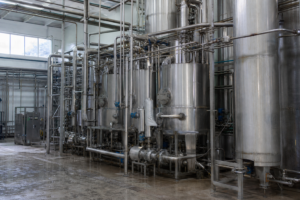
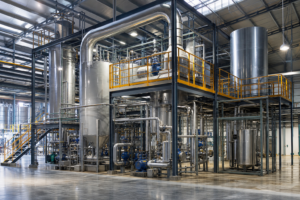
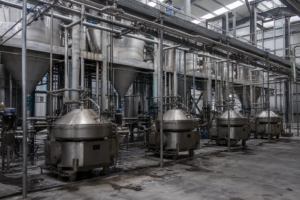
Lysine, monosodium glutamate (MSG), and citric acid are the three highest-volume fermentation products in the food and feed chain, and all three share one bottleneck: fermentation broths leave the bioreactor at low solids content, so every tonne of product demands the evaporation of several tonnes of water before crystallization can even begin. The engineering answer differs sharply by product – lysine splits into two entirely different finishing routes, MSG is finished by vacuum pan crystallization, and citric acid switches crystal form across a narrow temperature boundary – but the plant economics of all three are decided by the same block: evaporation duty, crystallizer configuration, and how the mother liquors are valorized. This guide lays out those three process lines with the numbers that matter for selection.
Why the Concentration-Crystallization Block Dominates Fermentation Plant Economics
A fermentation broth typically contains only a modest percentage of product dissolved in water, together with residual sugars, biomass, amino acids, and inorganic salts from the medium. Downstream of cell removal, the process engineer faces two inseparable tasks: concentrate the dilute liquor with the lowest possible energy cost, and crystallize the product with the purity and crystal form the market pays for. Because fermentation broths are heat-sensitive – prolonged exposure to high temperature degrades amino acids and develops color – evaporation is done under vacuum and at restricted residence times, which pushes the design toward falling-film evaporators rather than forced-circulation or kettle types.
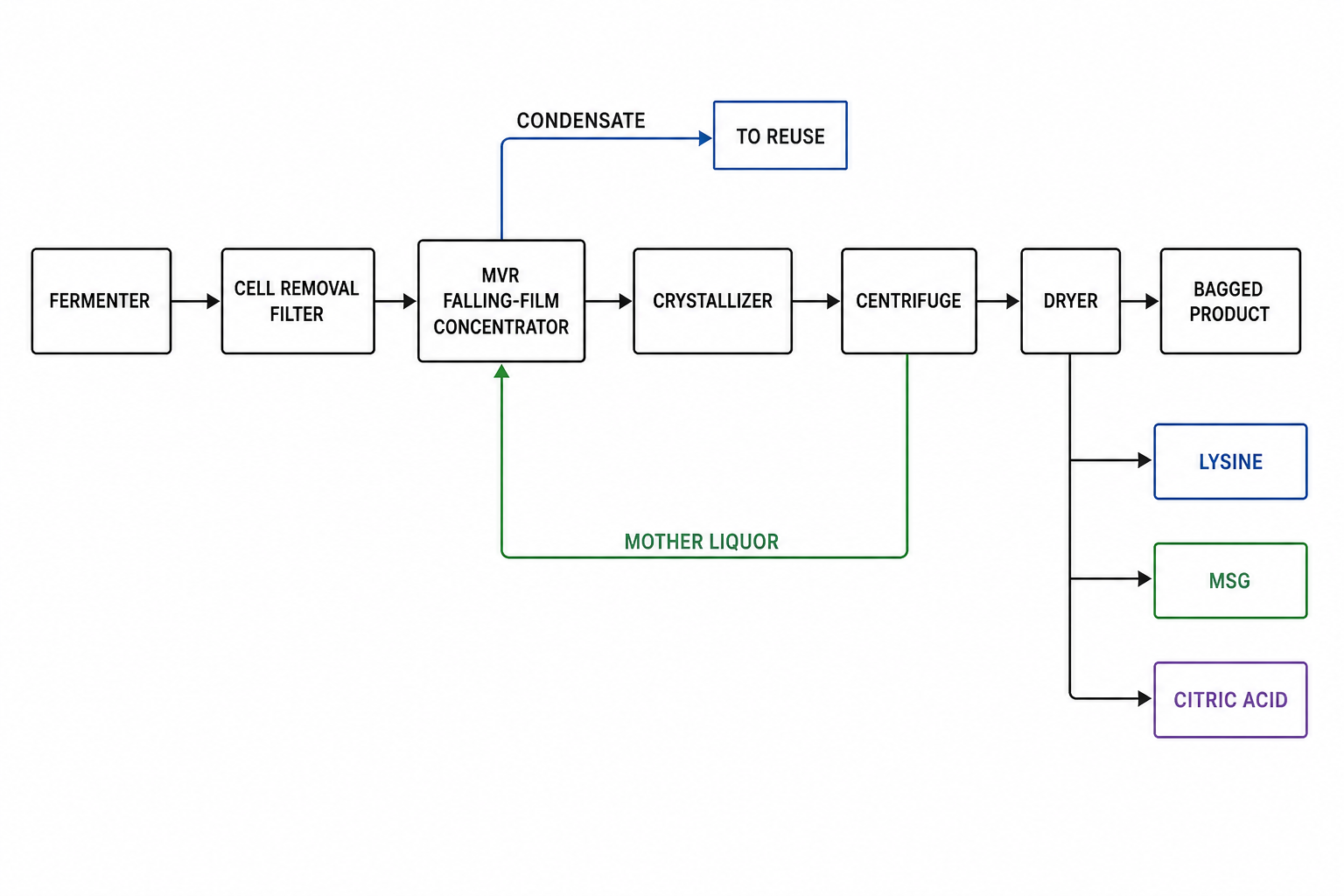
The same concentration step also appears at the back end of the plant in a second role: concentrating the mother liquors and wash streams that would otherwise become a high-COD effluent problem. Fermentation wastewater with high organic load and significant ammonia nitrogen is expensive to treat biologically, so evaporating it to a sellable feed-grade concentrate frequently beats paying for biological treatment capacity.
Lysine: One Fermenter, Two Product Routes
Lysine is sold in two commercial forms, and the finishing plant differs between them more than any other unit in the line. The global lysine market is projected, in published market research, to exceed USD 9 billion by 2028, growing at over 6.5% per year on feed-demand, so capacity decisions here carry real weight – plants are commonly scoped, in published project references, from 100 to 600 tonnes per day of finished product.
| Aspect | Lysine Hydrochloride (98%) | Lysine Sulfate (70%) |
|---|---|---|
| Upstream steps | Fermentation, membrane filtration and refining, concentration | Fermentation, membrane filtration, concentration |
| Finishing operation | Cooling crystallization and dewatering | Spray granulation and drying |
| Purity profile | 98% pure lysine HCl, low impurities | 70% lysine in a matrix of biomass and sulfate |
| End market | Pharma, premium feed, precise formulation | Cost-driven animal feed |
| Evaporator duty | Concentration to crystallizer feed density | Concentration directly to granulator solids |
| By-product handling | Mother liquor purge needs recovery step | Minimal – nutrients stay in the product |
The hydrochloride route crystallizes a high-purity product and therefore carries a mother-liquor loop with impurity build-up, exactly as in any solute-recovery crystallizer. The sulfate route skips crystallization altogether: the concentrated broth is granulated with the sulfate and biomass left in, which is cheaper per tonne of lysine delivered and is the reason sulfate dominates feed-grade volumes. The strategic point for plant design is that the fermentation and initial concentration sections are shared, so a plant can run both finishes off one front end – the evaporation system must therefore be specified for the harder duty, which is almost always the crystallizer feed density of the hydrochloride route.
MVR Retrofit Economics: A Measured Lysine Case
A useful external industry reference for lysine waste-liquor concentration comes from a Chinese MVR supplier’s published project data – vendor-reported figures, presented as an indicative benchmark rather than an EvapCryst delivery or a performance guarantee: a stream of 78 t/h of lysine waste liquor at 5.2% solids and 40 C was concentrated to 35% solids, requiring evaporation of 65 t/h of water. Against a baseline four-effect evaporator, an MVR plus four-effect hybrid configuration improved overall treatment performance by a vendor-reported 30-60% with clearly lower operating cost, and the lower the incoming concentration, the larger the advantage of the MVR hybrid becomes.
Two design conclusions generalize from that case. First, hybrid configurations – MVR on the dilute front end where the boiling-point rise is small, thermal effects on the concentrated back end where viscosity climbs – capture most of the energy benefit without over-sizing the compressor. Second, MVR is usually the first choice for revamping aging evaporator trains, because the existing vessels and heat-transfer area can be retained while the steam system is demoted to a backup role.
MSG: Vacuum Pan Crystallization and the Mother-Liquor Loop
Monosodium glutamate production runs from starch or molasses through glutamate fermentation, isoelectric extraction of glutamic acid, neutralization with sodium hydroxide to the MSG salt, then decolorization and ion-exchange polishing. The finishing step is vacuum pan evaporation crystallization: the polished liquor is concentrated under vacuum until supersaturated, seeded, and grown into the large prismatic crystals consumers recognize, with controlled crystal size achieved by managing the evaporation rate during the growth phase rather than by cooling.
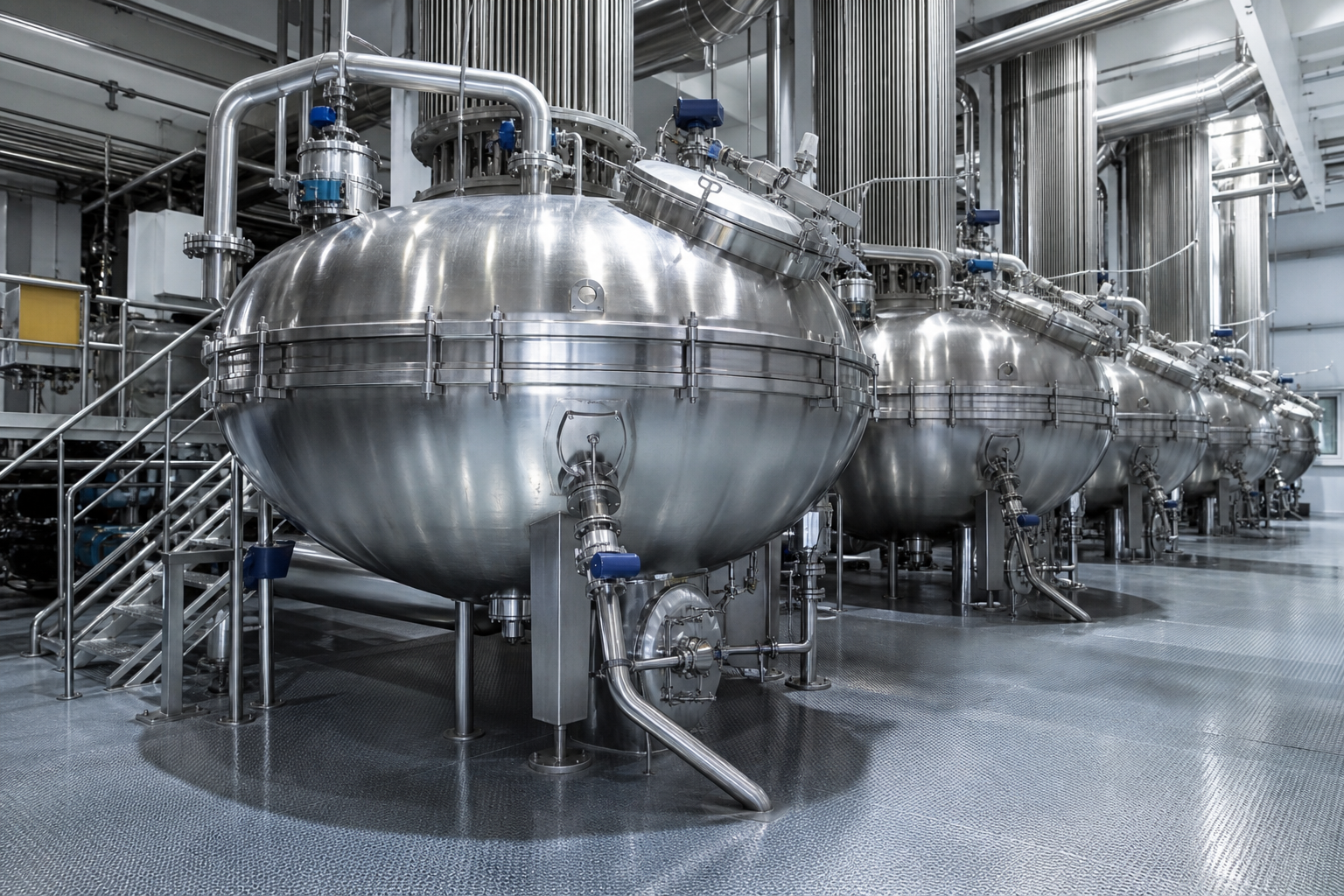
The mother liquor deserves special attention. Each crystallization pass rejects colored bodies and residual salts, so mother liquor is recycled a limited number of times and then must leave the process. That stream is a classic combined challenge – high COD, high ammonia nitrogen, and high sulfate – and the economical answer in most modern plants is evaporation concentration: the water leaves as clean condensate, and the concentrate, rich in organic nitrogen, is dried into a feed by-product rather than discharged. Plants that also crystallize ammonium sulfate from their neutralization liquors can close the loop almost completely.
Citric Acid: One Product, Two Crystal Forms, One Temperature Boundary
Citric acid is produced by fermenting corn-derived sugar, then recovering the acid via the calcium citrate route: the filtered broth is neutralized with lime, calcium citrate precipitates, and sulfuric acid decomposition regenerates citric acid while gypsum leaves as a by-product. After decolorization and ion-exchange polishing – modern plants run these as continuous neutralization and continuous ion exchange rather than batch – the liquor is ready for crystallization.
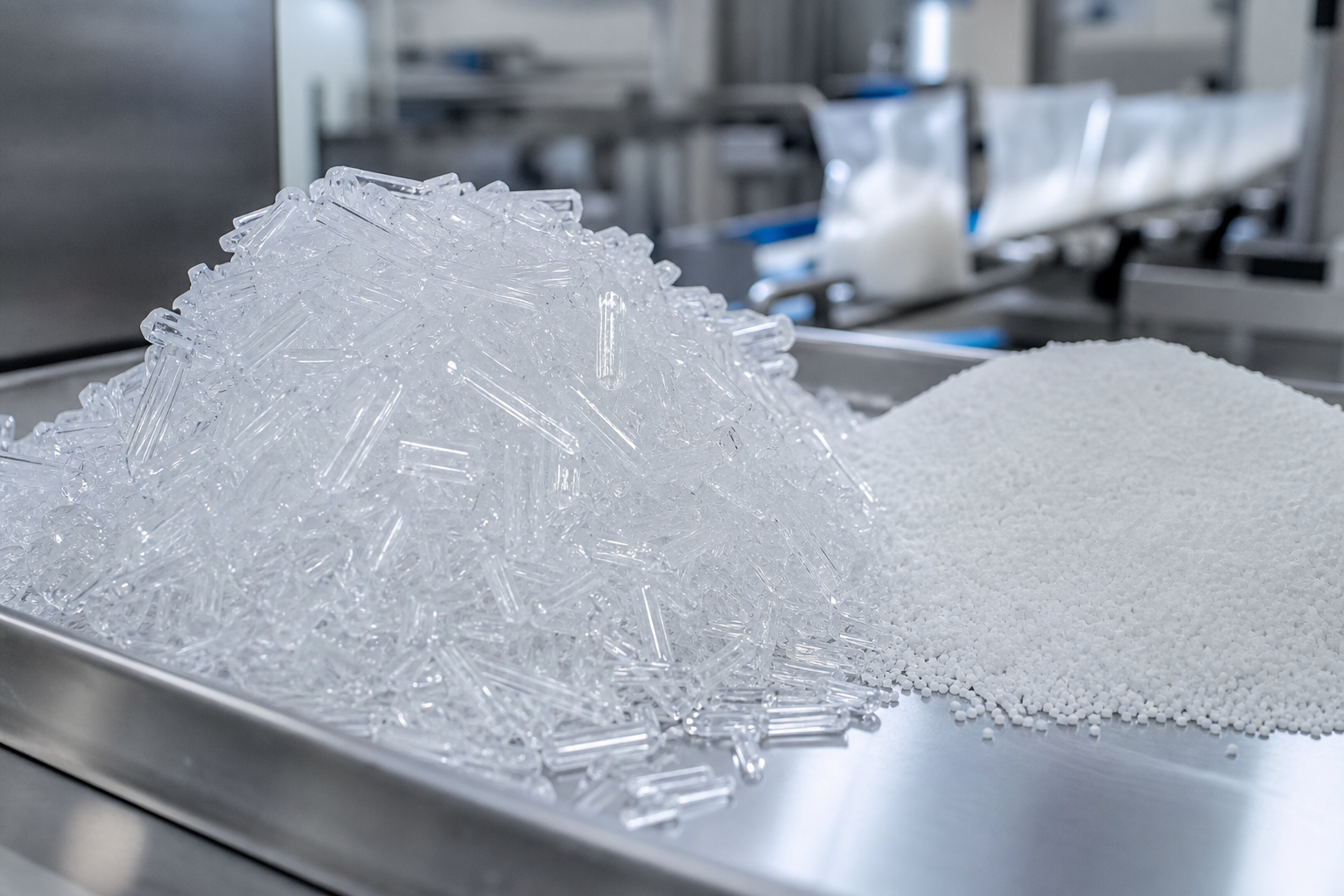
The distinctive engineering feature is the hydrate boundary. Citric acid crystallizes as the monohydrate below approximately 36.6 C and as anhydrous acid above it, so the crystallizer temperature window directly selects the commercial product. Monohydrate production uses vacuum cooling crystallization or combined evaporation-cooling held under the boundary; anhydrous production runs evaporative crystallization above it, at boiling, and then manages a hot, dry downstream to prevent hydration on cooling. Crossing the boundary unintentionally – for instance, anhydrous product cooling too slowly through the transition in humid air – produces caking and off-spec hydrate inclusions.
Industry-reported plant capacities for turnkey citric acid lines span 100 to 1,000 tonnes per day, and waste-heat evaporation is the standard concentration method at the upper end: vapor and condensate heat from the fermentation and acidulation sections preheat and partially drive the evaporator, lowering net steam demand.
Choosing the Evaporation Configuration
| Configuration | Energy Character | Best Fit in Fermentation Plants |
|---|---|---|
| Single-effect | Highest steam per kg water; simplest | Small plants, batch campaigns, waste-steam available |
| Multiple-effect (3-5 effects) | Steam economy scales with effects; higher capex | Mid-to-large capacity with stable, cheap steam supply |
| MVR | Electricity-driven; lowest operating cost per kg water at low boiling-point rise | Dilute fermentation streams, retrofit of old evaporators, energy-cost-driven projects |
| MVR + effects hybrid | MVR on dilute front, thermal effects on viscous back end | High tonnage with wide concentration span, e.g. 5% to 35% solids |
For fermentation duty specifically, note two constraints on the table above. Falling-film bodies are preferred for the front end because broth-derived liquors are heat-sensitive and low-viscosity there. As concentration climbs, viscosity and boiling-point rise climb with it, which erodes MVR compressor efficiency – the reason the hybrid row exists. Our MVR evaporation and multiple-effect evaporation technology pages detail the selection mechanics, and the falling-film evaporator page covers the heat-sensitivity constraints.
Read as process modules, the fermentation finishing block looks like this – candidate equipment types, the selection rationale, and the indicative operating envelope each module must cover (envelopes derived from published industry data, not project specifications):
| Process Module | Candidate Equipment Types | Selection Rationale | Indicative Operating Envelope |
|---|---|---|---|
| Broth pre-concentration | Vacuum falling-film evaporator bodies | Heat-sensitive, low-viscosity dilute liquor | Vacuum operation, restricted residence time |
| Finish concentration | MVR, multi-effect (3-5), or MVR + effects hybrid | Dilute low-BPR front favors MVR; viscous back end favors thermal | Concentration span e.g. 5% to 35% solids (illustrative) |
| Lysine HCl crystallization | Stirred or draft-tube cooling crystallizer | Metastable-zone operation with size control | Mother-liquor loop with purge recovery |
| MSG finishing | Vacuum pan evaporative crystallizer | Crystal size set by evaporation rate during growth | Seeded growth to large prismatic crystals |
| Citric acid crystallization | Vacuum cooling (monohydrate) or evaporative (anhydrous) | Temperature window selects the commercial product form | Either side of the 36.6 C hydrate boundary |
| Waste-side valorization | Mother-liquor concentrator plus dryer; ammonium sulfate crystallizer | Converts effluent liabilities into feed and fertilizer products | Condensate returns as process water |
Configuration, materials, and operating ranges depend on the actual feed, temperatures, pressures, corrosion review, fouling behavior, utilities, and project capacity.
Crystallizer Selection Across the Three Products
Lysine hydrochloride cooling crystallization and citric acid monohydrate crystallization both operate in the metastable zone with size-control requirements, which points to stirred or draft-tube geometries; citric acid anhydrous and MSG pan crystallization run evaporative at boiling, where forced-circulation crystallizers and pan-type vessels dominate. Where the highest crystal uniformity is the selling point – MSG for the retail market being the clearest case – classified-product crystallizers with fines destruction pay back quickly. The general framework for matching supersaturation generation method to crystal spec is on our crystallization technology page, and an interactive shortlist can be produced with the crystallizer selector.
Valorizing the Waste Side
Every fermentation plant of this type has three residual streams that concentrate-and-dry converts from liabilities to revenue: cell-containing thin stillage or fermentation residues (dried to feed products in the same way DDGS is produced from ethanol plants), ammonium sulfate from neutralization and recovery liquors (crystallized as a fertilizer-grade salt), and the mixed mother liquors discussed above. The plants that consistently win on cash cost are those in which the evaporation section was designed from the start to handle product concentration and waste concentration as one integrated duty with shared utilities, rather than as separate islands. Where discharge permits tighten, the same block extends naturally toward zero liquid discharge, with salt separation handled per our salt separation systems page.
How We Deliver These Lines
EvapCryst scopes fermentation finishing projects around a mass and energy balance of the real broth, not catalogue assumptions: evaporation staging, MVR versus thermal selection, crystallizer type, and mother-liquor routing are fixed together, because a decision on any one of them changes the duty on the other two. Scope typically discussed ranges from a single concentration-crystallization train to a complete finishing island, integrated with the fermentation section already operating. More context on our delivery model for this industry is on the food and fermentation industry page, and product crystallization scope is summarized under concentration and crystallization solutions.
When This Route May Not Fit
The concentration-crystallization block described here assumes food- and feed-grade products with sellable residues. Where the mother liquor carries toxics or heavy metals that bar feed use, the valorization economics collapse and the block becomes a disposal duty. Very small fermentation operations – a few tonnes per day – cannot amortize MVR or multi-effect complexity, and batch kettle evaporation is honest equipment at that scale. Product route matters: if the market only pays for lysine sulfate, the hydrochloride crystallizer loop is unnecessary. And sites with cheap surplus steam may find the MVR hybrid case inverted – thermal effects on the dilute end are then the defensible choice.
What Must Be Verified
Before this block is configured, the real broth must be measured: solids and product concentration across the campaign, viscosity and boiling-point rise versus concentration (they size the evaporator bodies and cap MVR efficiency), and the heat-sensitivity limits that fix residence time and temperature. On the product side, the commercial specification – purity, crystal form (citric acid monohydrate versus anhydrous), and particle size for MSG – must be confirmed with buyers, not assumed. The mother-liquor analysis (COD, ammonia nitrogen, sulfate) decides whether the feed-by-product route is legitimate. Utility data – steam, power, and any waste-heat sources – completes the input set.
FAQ
Why do lysine sulfate and lysine hydrochloride need different downstream equipment?
Hydrochloride is a 98% purity crystalline product that requires cooling crystallization and dewatering after concentration, while sulfate is sold as a 70% granulated product in which the biomass and sulfate stay in – it goes straight from evaporator to spray granulation, with no crystallizer at all.
Is MVR worthwhile for fermentation broth concentration?
Usually yes at the dilute end. The vendor-reported lysine reference above – 78 t/h feed and 5.2% solids concentrated to 35% (65 t/h water evaporated) – showed 30-60% better performance for an MVR plus four-effect hybrid than a four-effect steam system alone, and the advantage grows as feed concentration falls. MVR is also the default choice when revamping old evaporator trains.
What determines monohydrate versus anhydrous citric acid production?
The hydrate phase boundary at approximately 36.6 C. Crystallizing below it yields monohydrate, typically by vacuum cooling or evaporation-cooling; crystallizing above it at boiling yields anhydrous acid, which must then be kept hot and dry downstream to prevent hydration and caking.
How is MSG crystallized?
By vacuum pan evaporation crystallization: neutralized, polished liquor is concentrated under vacuum to supersaturation, seeded, and grown slowly into large prismatic crystals, with crystal size controlled through the evaporation rate during growth. Mother liquor is recycled a limited number of times, then concentrated and dried into a feed by-product.
Can fermentation mother liquors be turned into products instead of effluent?
Yes. Concentration followed by drying converts high-organics mother liquors into feed-grade products, ammonium sulfate streams crystallize into fertilizer salt, and the condensate returns as process water – which frequently makes the evaporation block cheaper than the biological treatment capacity it displaces.
To start a first-pass screening of your finishing line, send the broth analysis (solids, product titer, viscosity, BPR, heat-sensitivity limits), the target product form and specification, and the site energy picture.