Project Parameters
| Parameter | Value |
|---|---|
| Process route | Four-stage countercurrent sodium extraction + flash potassium extraction; Phase 2 retrofit: MVR sodium extraction + flash potassium extraction |
| Industry | Hazardous waste resource recovery — zinc metallurgy with MSWI fly ash and steel sintering dust inputs |
| Feed type & key components | Water-washing rinsing liquor: total chloride 140–160 g/L, K:Na near 1:1, sulfate approx. 10 g/L |
| Product specification | Sodium chloride 96–98% (dry salt); potassium chloride ≥ 85% (wet salt) |
| Retrofit energy result | Operating energy down 40%+ after MVR retrofit (published) |
| Construction materials | SS316L / duplex wetted parts (indicative for high-chloride service) |
Representative process configuration compiled from published industry project data. Indicative values, not a process guarantee.
Project Description
A hazardous waste recovery complex in Qinzhou, Guangxi — in South China’s metals-processing corridor — reclaims zinc-bearing materials from a feed mix dominated by metallurgical residues, with shares of MSWI fly ash and steel sintering electrofilter dust. The recovery route is washing: water leaches the soluble chlorides out of the residues so the metals fraction can process cleanly, and the washing stage generates a rinsing liquor of fearsome composition — total chloride of 140 to 160 g/L, potassium and sodium in nearly equimolar ratio, and about 10 g/L of sulfate along for the ride.
The published project converts that liquor from a disposal problem into two product salts: sodium chloride at 96–98% purity as dry salt, and potassium chloride at 85% or better as wet salt. The technology is fractional crystallization — the potassium-sodium separation that the salt-chemistry industry has refined for decades, applied here to one of its most difficult feeds.
Process Technology
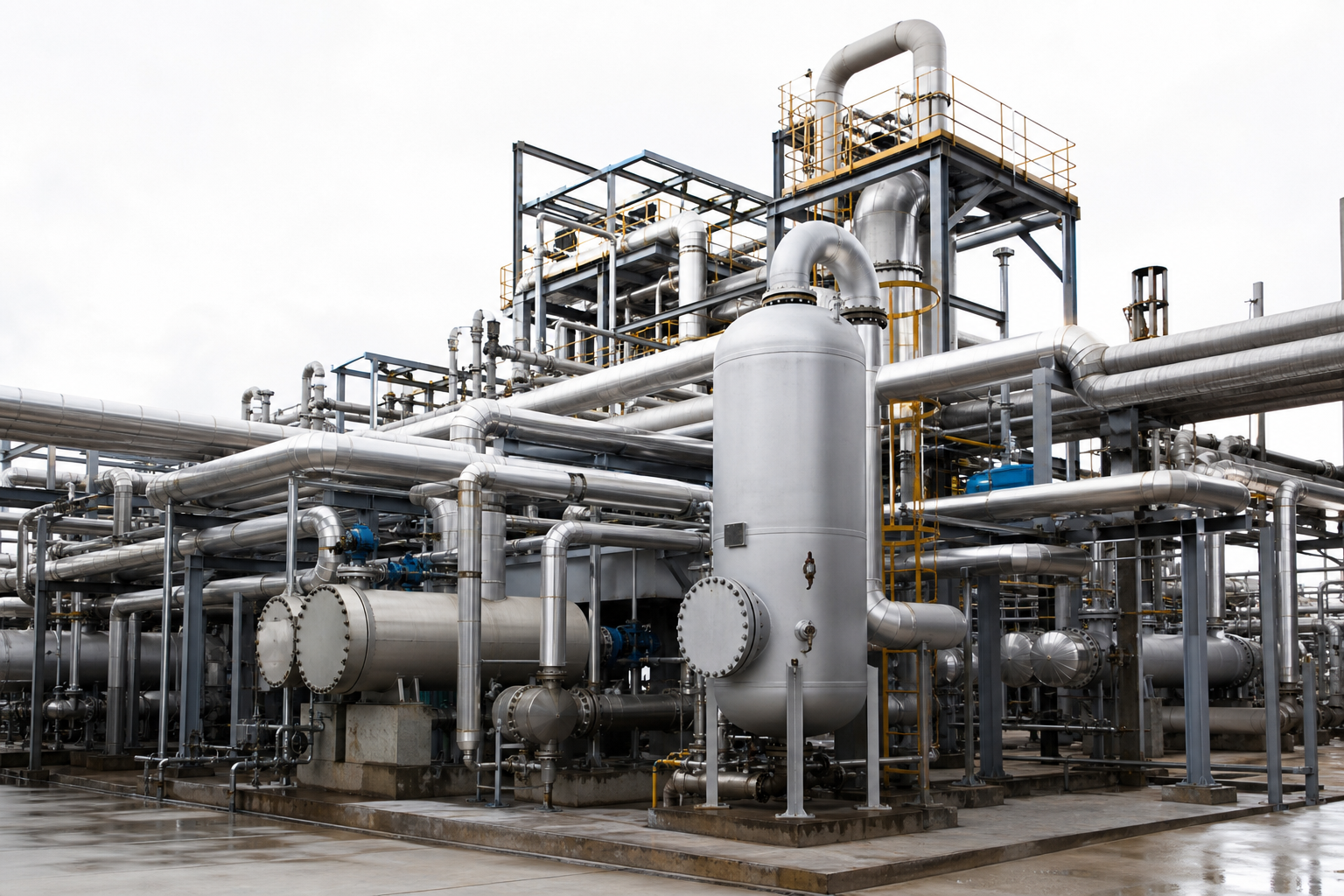
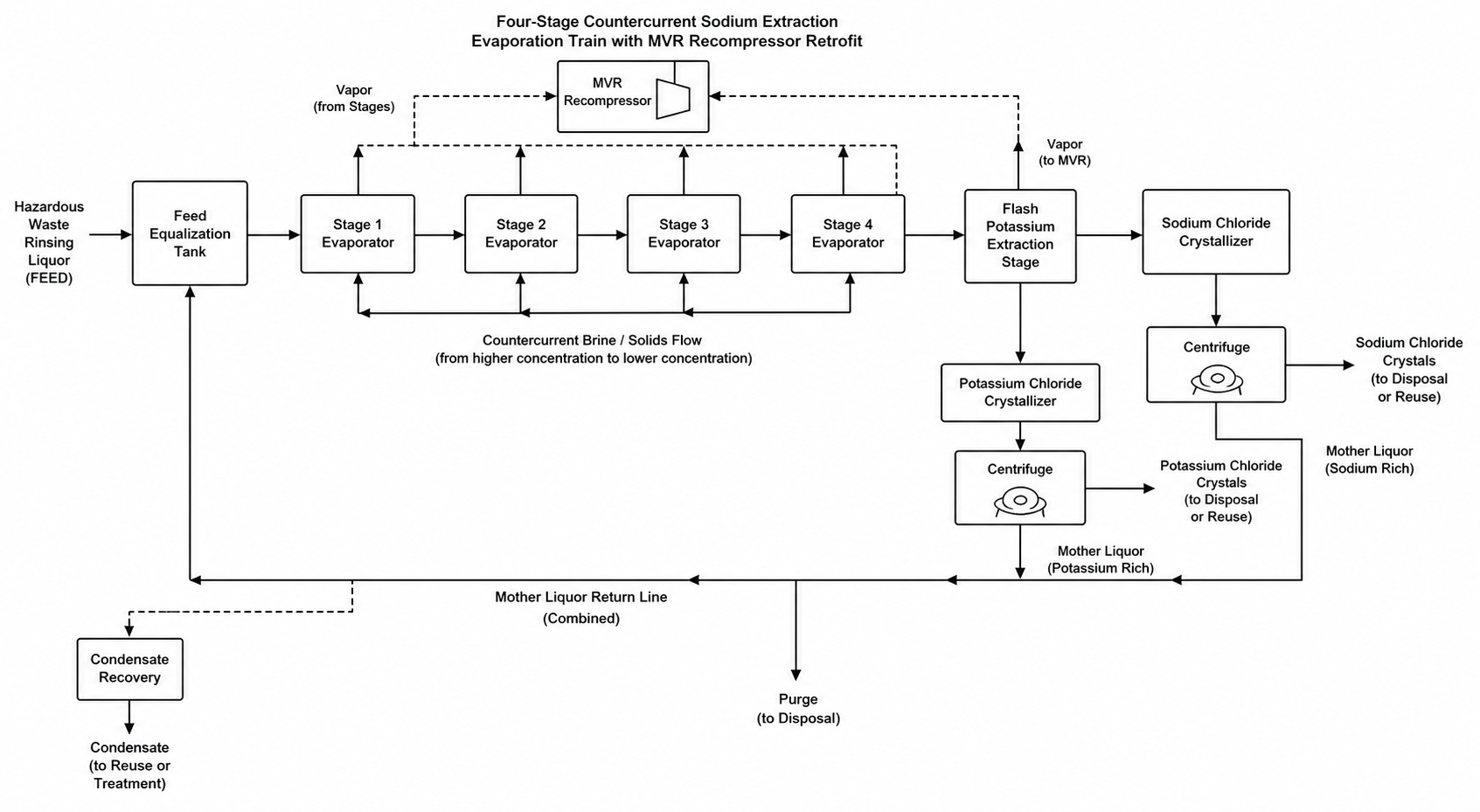
The base-process route published for this project is four-stage countercurrent sodium extraction with flash potassium extraction. Countercurrent staging concentrates the sodium stream while minimizing thermal duty: liquor moves through the evaporation stages against the vapor flow, sodium chloride crystallizes first on the solubility curve as concentration proceeds, and the mother liquor — now enriched in potassium — passes to the flash stage, where pressure let-down and cooling precipitate potassium chloride on its own curve. The two salts leave from separate crystallizers, each dewatered to its product form: NaCl centrifuged and dried to the 96–98% dry specification, KCl centrifuged to the ≥85% wet specification.
The sulfate in the liquor is the quiet third component the design must tolerate: at 10 g/L it rides through the train, and purge management keeps it from accumulating to the point where it contaminates either product or scales the heaters.
The published Phase 2 energy retrofit tells the modern half of the story: the sodium-extraction evaporation was converted to MVR drive — mechanical vapor recompression replacing purchased steam as the heat source — while the flash potassium stage kept its flash character. The published result is operating energy down by more than 40% after the retrofit, the signature economy that has made MVR the default retrofit for steam-hungry salt trains.
High-chloride liquor at 150 g/L is aggressive: chloride stress corrosion excludes standard stainless from hot concentrated service, and the wetted parts of trains in this service run in higher-alloy or duplex materials. Mother liquors from both crystallizers return to the front of the train with controlled purges, holding impurities — sulfate, calcium, and traces of heavy metals from the residue washing — outside the product crystals.
Equipment Configuration
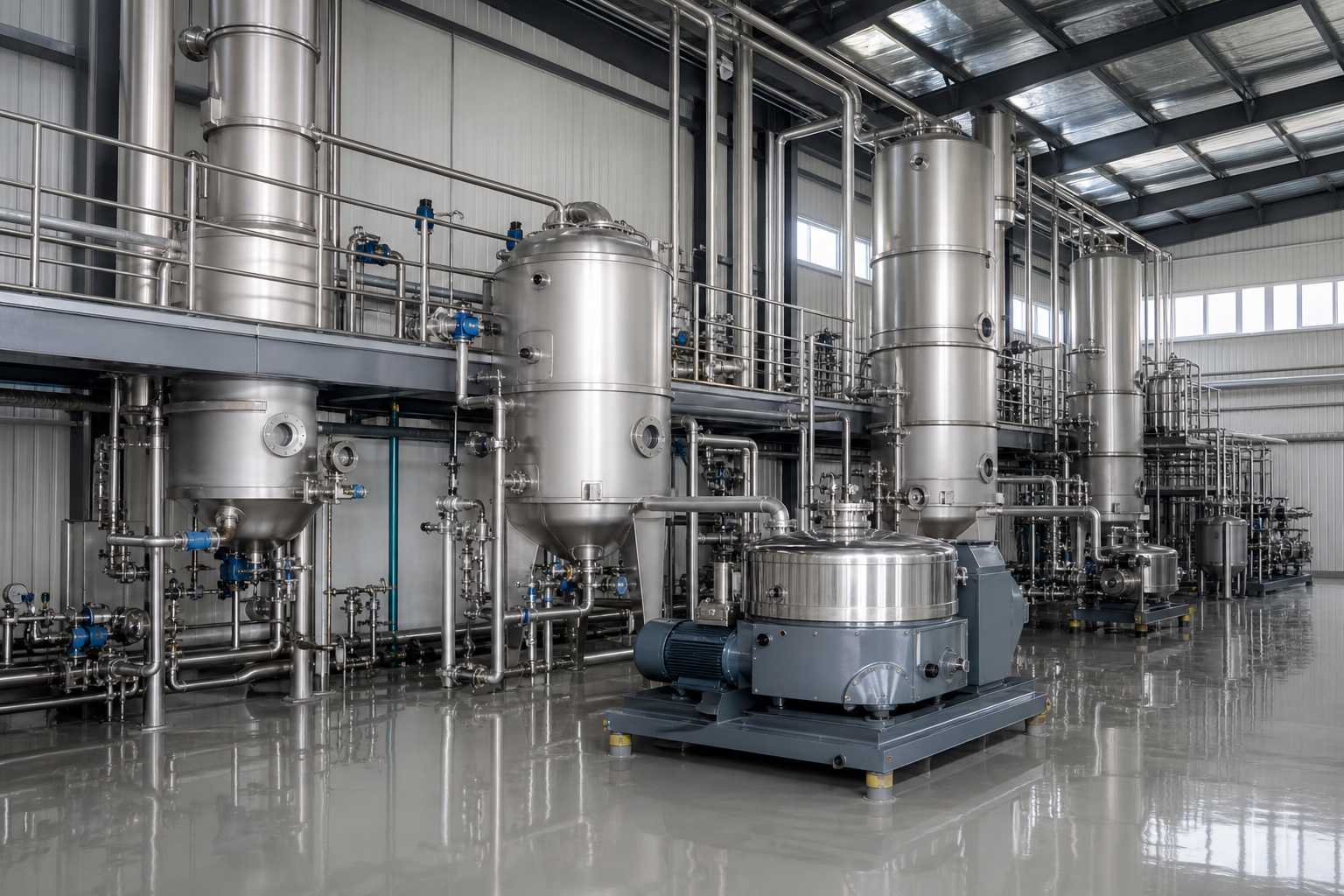
One set of the following equipment is typical for this duty:
- Rinsing liquor reception, equalization and sulfate-tolerant pretreatment
- Four-stage countercurrent sodium extraction evaporation (retrofitted to MVR drive)
- Flash potassium extraction stage with cooling crystallization
- NaCl crystallizer with centrifuge and drying to 96–98% dry salt
- KCl crystallizer with centrifuge to ≥85% wet salt
- Mother-liquor returns with sulfate and metals purge control; high-alloy wetted parts
Performance & Outcome
Compiled from published industry project data, indicative: sodium chloride at 96–98% dry purity and potassium chloride at ≥85% wet purity recovered from 140–160 g/L chloride rinsing liquor, with the MVR retrofit cutting operating energy by more than 40%. Salt grades are quoted per project liquor analysis.
The underlying design logic is summarized in Hydrometallurgy Evaporation & Crystallization.