Project Parameters
| Parameter | Value |
|---|---|
| Process route | Physicochemical pretreatment + MVR forced-circulation evaporation crystallization |
| Industry | Shale gas field produced water, southern Sichuan national demonstration zone (Zigong) |
| Feed type & key components | Produced water with chemical additives, formation organics and trace metals; membrane concentrate from upstream treatment |
| Evaporation capacity | 90 t/d |
| Construction materials | Alloy wetted parts per chloride service (indicative) |
Representative process configuration compiled from published industry project data. Indicative values, not a process guarantee.
Project Description
Southern Sichuan is the core of China’s national shale gas demonstration effort, and the wells there produce water as persistently as they produce gas. The produced stream is a formation brine dressed in everything a frac job adds — scale inhibitors, friction reducers, biocides — plus the organics and trace metals it picks up from the rock. Membrane stages at the field’s water plants recover what they can, and the concentrate they reject is the fraction that decides whether the operation’s water balance closes.
The reference configuration is a 90 t/d MVR forced-circulation train at a produced water treatment facility in Zigong, co-located with an industrial host site. The plant takes the field’s produced water and the membrane concentrate of the upstream treatment, and returns two things: water clean enough for industrial reuse at GB/T 19923-2005 process-water grade, and salt recovered as a solid instead of a dissolved liability.
Process Technology
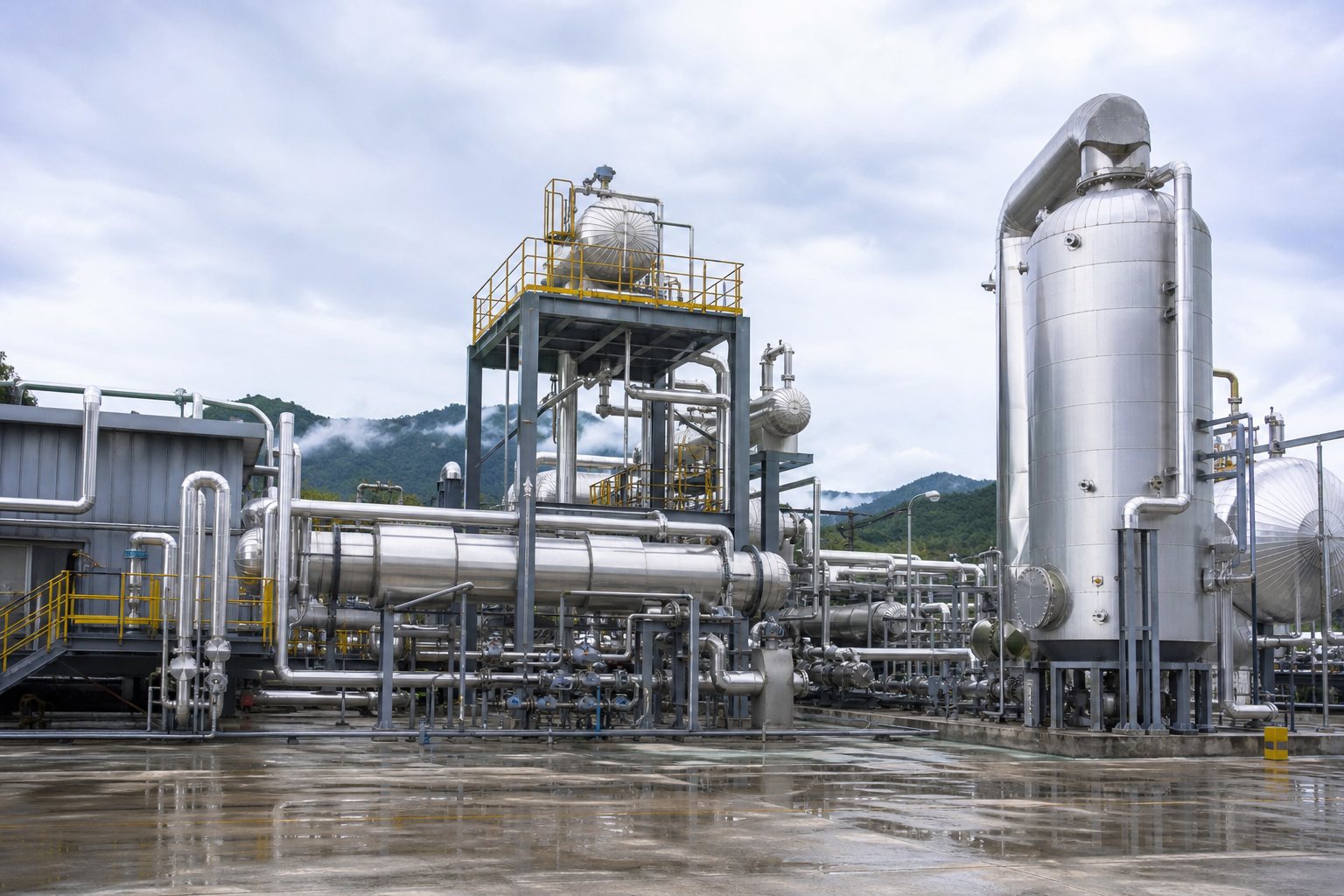
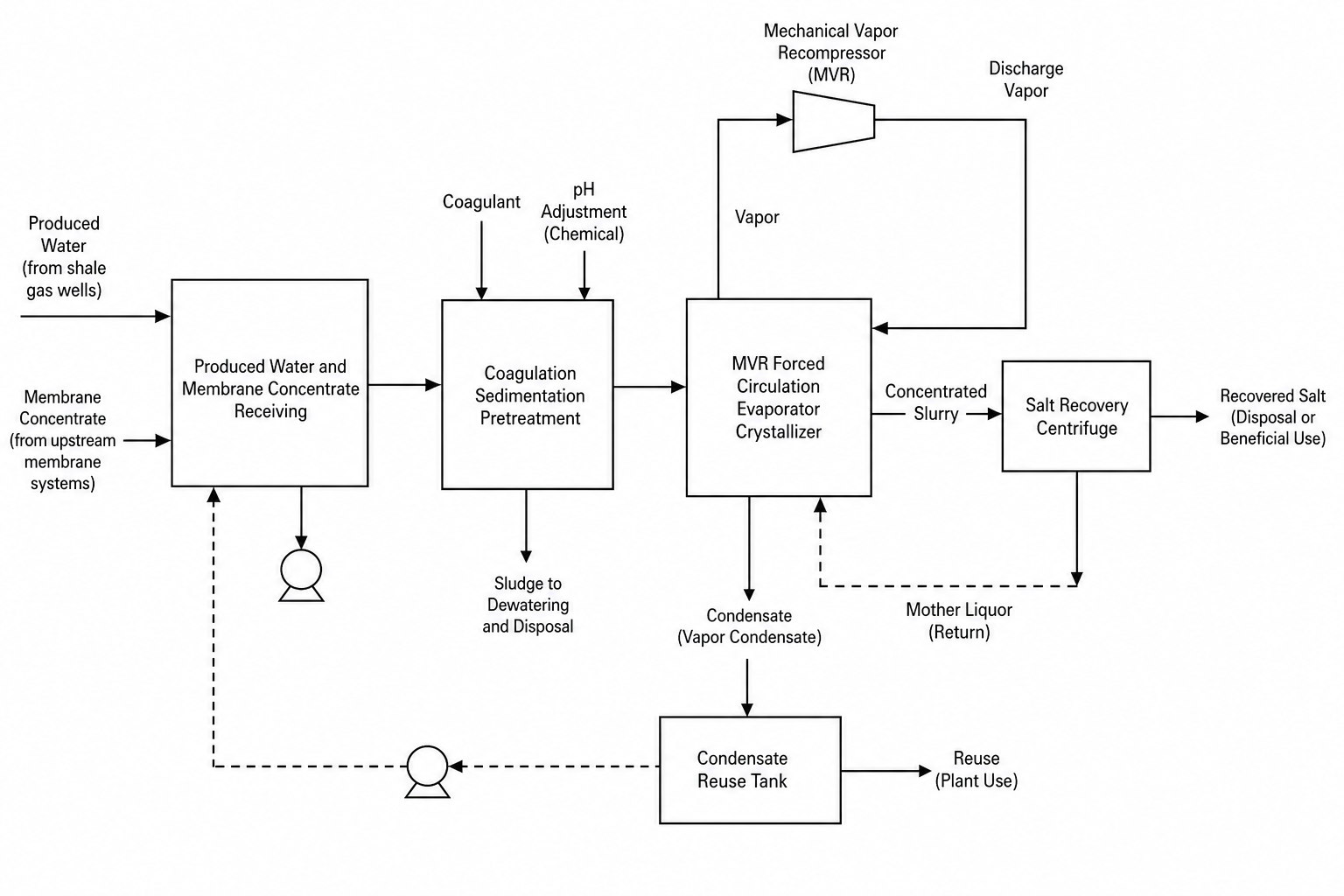
Pretreatment is physicochemical, and it earns its place: coagulation and sedimentation pull the suspended solids, colloids and a first cut of organics and metals out of the raw stream before evaporation. The published reference for this class of plant is explicit about why — the impurities removed here are the ones that would otherwise scale, foul and corrode the evaporator circuit, so every kilogram caught in pretreatment is operating stability bought in the MVR train.
The MVR forced-circulation evaporator crystallizer is the core unit. Under vacuum and mechanical vapor recompression, the train concentrates the pretreated brine on electrical energy; forced circulation keeps the high-salinity liquor moving through the heat exchanger at velocity, suppressing the crystal deposition this feed’s scaling chemistry would otherwise deposit on every surface. The reference configuration credits the design with high evaporation efficiency, strong anti-scaling behavior and a materially lower per-ton operating cost than the live-steam alternative — the property that aligns thermal treatment with the energy discipline of a national demonstration zone.
Condensate leaves the train at GB/T 19923-2005 Table 1 process and product water grade under the reference configuration, and is reused — in the shale field’s case, the published basis points the reuse back to gas field operations and the co-located industrial host’s production circuit. The co-location is itself the design statement: treatment beside a user, so reclaimed water has somewhere to go.
Salt crystallizes from the concentrated liquor and is recovered and comprehensively utilized rather than landfilled — closing the mass balance on solid waste as well as water, which the reference project treats as part of the environmental ledger rather than an afterthought.
Equipment Configuration
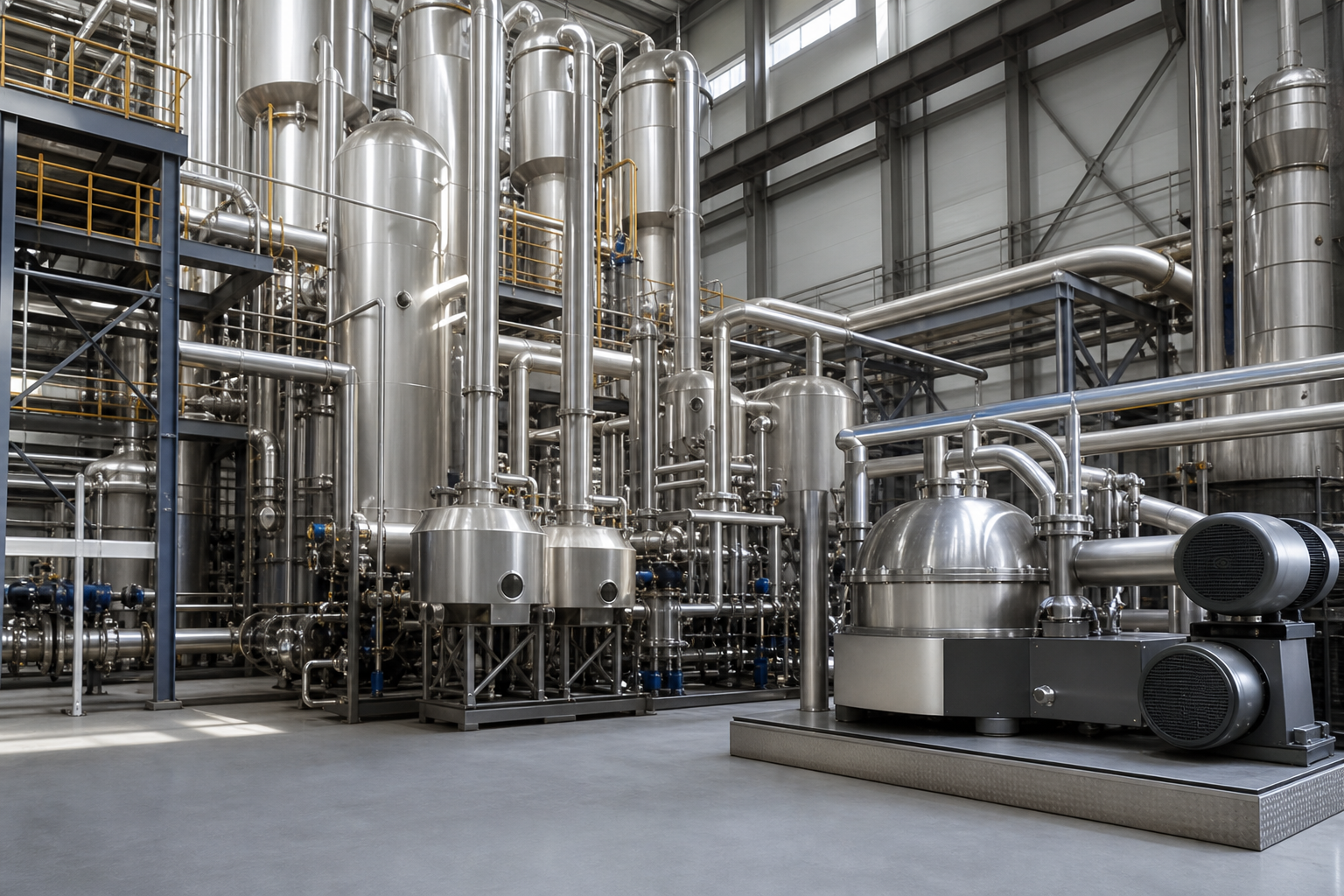
One set of the following equipment is typical for this duty:
- Produced water and membrane concentrate receiving
- Coagulation-sedimentation pretreatment for solids, organics and metals
- MVR forced-circulation evaporation crystallization train
- Salt dewatering and recovery for utilization
- Condensate to GB/T 19923-2005 process-water reuse
- DCS control with online quality monitoring
Performance & Outcome
Compiled from published industry project data, indicative: 90 t/d trains of this class turn southern Sichuan shale produced water into process-grade reuse condensate and recovered salt on electrically driven forced-circulation MVR energy, with pretreatment carrying the scaling and fouling risk ahead of the evaporator. Specific energy and salt utilization route are quoted per field chemistry.
Simplified PFD
The simplified process flow diagram above shows produced water and concentrate receiving, physicochemical pretreatment, the MVR forced-circulation crystallizer, salt recovery and condensate reuse.