
Project Parameters
| Parameter | Value |
|---|---|
| Process route | MVR falling-film evaporation ahead of acid crystallization |
| Industry | Bio-based chemicals — C4 dicarboxylic acid (succinic acid) via fermentation |
| Feed type & key components | Succinic acid solution from fermentation, acidification and purification |
| Evaporation capacity | 60 t/h |
| Plant context | Expansion phase of a bio-based chemical plant (50,000 t/a class) |
| Region | East China (Shandong) |
Representative process configuration compiled from published industry project data. Indicative values, not a process guarantee.
Project Description
Succinic acid is fermentation chemistry’s C4 workhorse — a bio-based dicarboxylic acid feeding PBS bioplastics, polyesters, plasticizers and food applications — and its production route runs through exactly the unit this configuration describes. After fermentation, acidification and purification, succinic acid solution must be concentrated to the supersaturation at which the acid crystallizes as product. The published project behind this configuration is that concentration duty at 60 t/h, part of a 50,000-tonne-per-year-class expansion at a bio-based chemical producer in East China.
The expansion context defines the engineering culture. A plant scaling bio-based succinic acid from demonstration to industrial volume needs evaporation that scales the process’s economics, not just its tonnage: fermentation-derived feeds are lower-margin than petrochemical ones, so the energy line has to be attacked directly. The published answer is MVR falling-film evaporation — electric heat, gentle handling, and a train that plugs into the expansion’s new utility picture instead of straining the old boiler house.
Process Technology
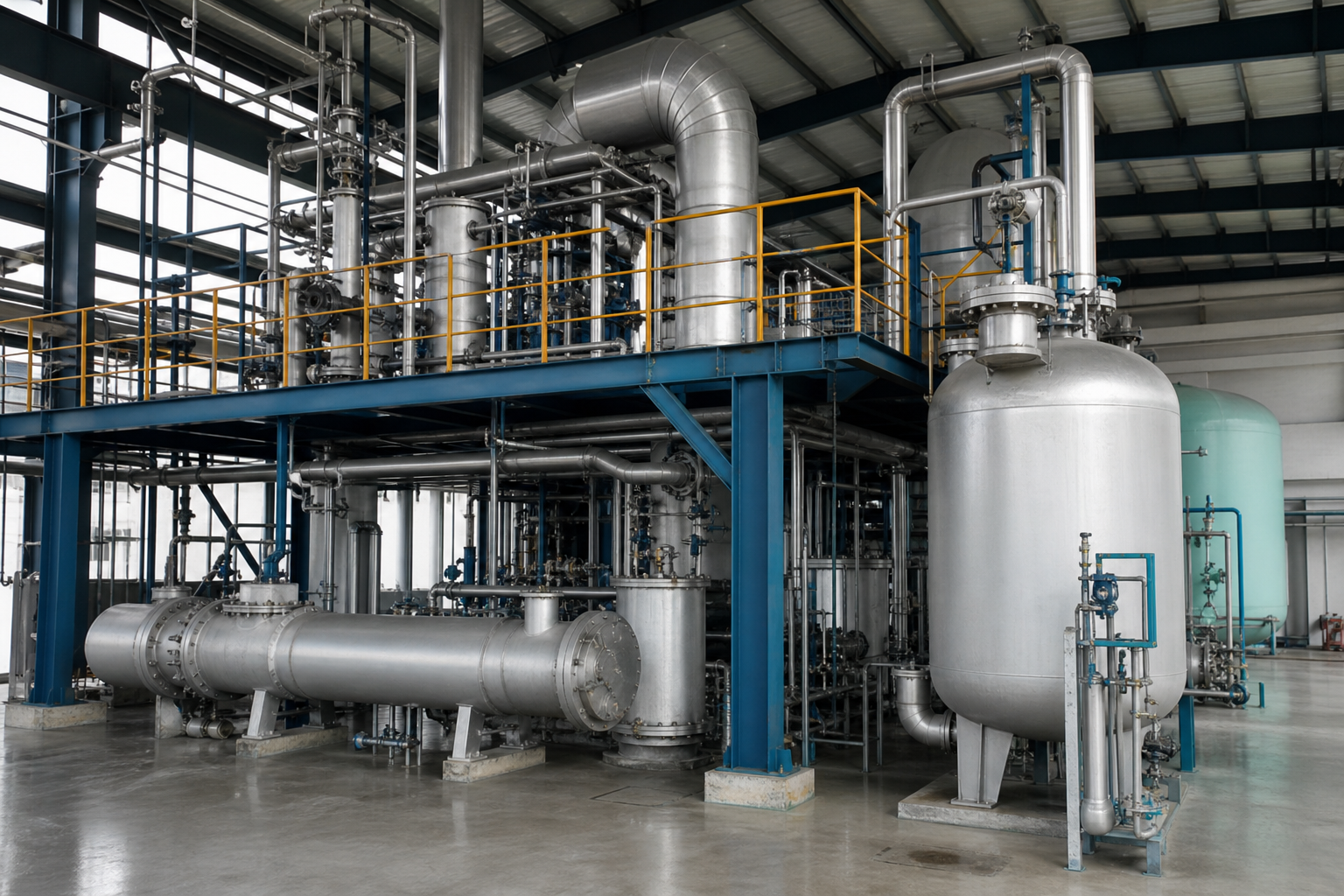
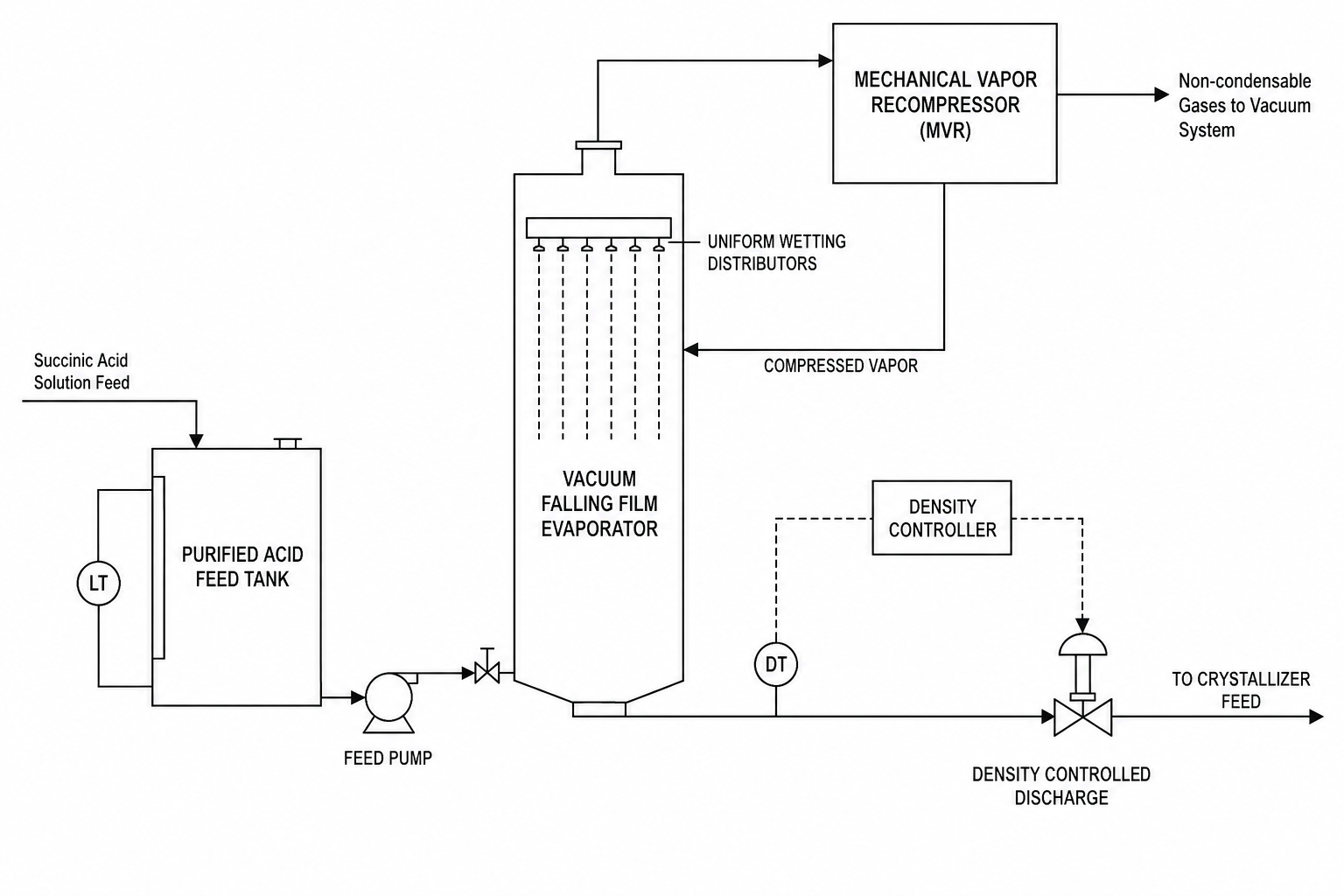
Purified succinic acid solution feeds the MVR falling-film body. Falling film suits the acid duty on the usual grounds — short residence time, low temperature difference, vacuum operation — and on a dicarboxylic-acid-specific one: succinic acid solutions crystallize readily when local supersaturation spikes, and a gravity-fed film with uniform wetting avoids the dry spots and concentration gradients where premature crystallization would crust a tube. Distributor design and tube wetting are the anti-fouling engineering.
The MVR loop runs the train on its own vapor. Secondary vapor from the separator is compressed to a modest condensing pressure and returned to the shell side; the body heats itself with a small electric input per tonne of water, and the expansion’s steam system keeps its capacity for the fermentation, hydrogenation-neutralization and drying duties that genuinely need it. For a 60 t/h duty this is the standard modern selection in bio-based organics.
Materials selection follows the acid. Succinic acid at concentration and temperature is a moderate organic acid — less aggressive than mineral acids, more demanding than neutrals — and the published class of plant uses stainless wetted parts with corrosion allowances set by the purification carry-over profile (residual sulfate from acidification being the species to watch). Vapor-liquid separation protects the compressor from acid entrainment; condensate grades return to the plant water loop.
The endpoint is crystallizer feed. The train concentrates under inline density control to the supersaturation band the crystallization section calls for — typically operating so the acid remains fully dissolved at train temperature, flashing down to controlled crystallization — and the expansion’s crystallizers, centrifuges and dryers finish the product. Between campaigns, warm-water and CIP cycles keep the organic-acid films from aging into fouling.
Equipment Configuration
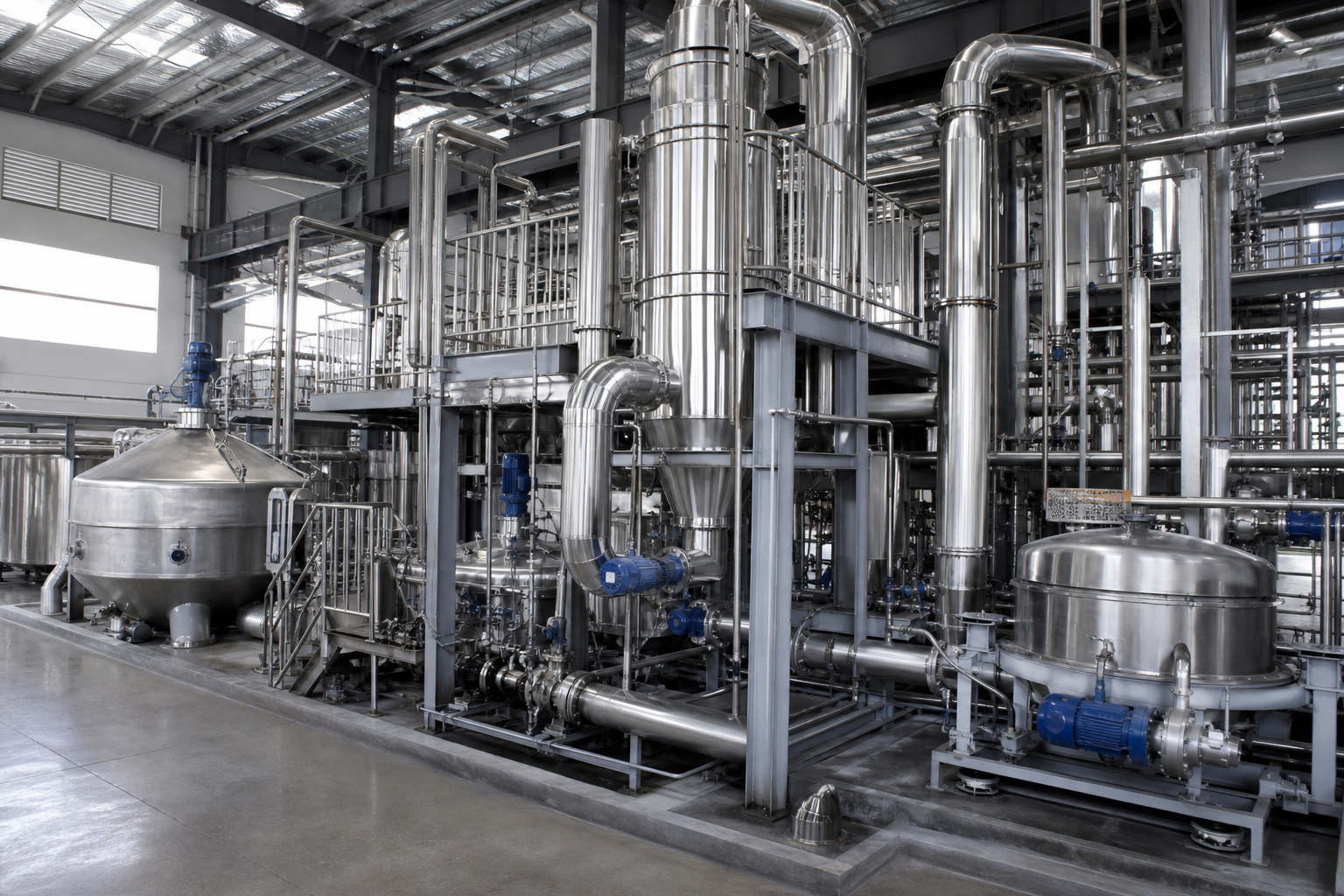
One set of the following equipment is typical for this duty:
- Purified succinic acid solution feed tank
- MVR falling-film evaporator with uniform-wetting distributors
- Mechanical vapor recompressor with acid-duty construction
- Vacuum system and surface condenser
- Acid-conscious stainless metallurgy with corrosion allowance
- Density-controlled discharge to crystallizer feed
- Condensate return by cleanliness class; CIP for acid-film service
Performance & Outcome
Compiled from published industry project data, indicative: trains of this class concentrate 60 t/h of succinic acid solution on MVR electric energy at crystallizer-feed density, supporting 50,000 t/a-class bio-based acid expansions. Steam-equivalent savings and endpoint precision are quoted per project solution specification.
Simplified PFD
The simplified process flow diagram above shows acid solution feed, the vacuum MVR falling-film body with recompressor, and discharge to crystallization.


