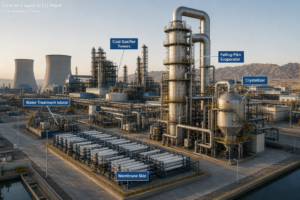
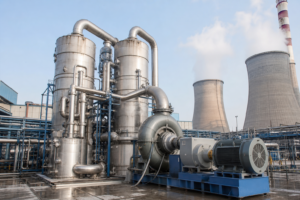
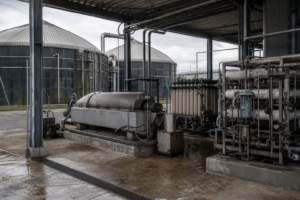
Flavor and fragrance wastewater is one of the classic hard cases of fine-chemical effluent: strong organic load — industry-reported at tens of thousands of mg/L of COD in concentrated streams — combined with a dissolved-salt background introduced by neutralization, salting-out and washing operations, and laced with aroma compounds that are mildly toxic to the microorganisms a conventional treatment plant depends on. Evaporation-based treatment sidesteps the biology entirely: the water is boiled out under vacuum, the salt falls out as crystal in a crystallizer, and the organic load is concentrated into a small volume that is far cheaper to incinerate or reprocess than the original dilute stream. For F&F plants facing discharge limits, odor complaints and rising liquid-waste bills, an evaporation-crystallization train is usually the only single technology that addresses all three at once.
Where Flavor & Fragrance Wastewater Comes From
F&F effluent is not one stream but a family of them, and the blend ratio shifts batch by batch. Esterification and condensation syntheses — the backbone of ester and synthetic aroma chemistry — generate acidic or alkaline washing water after neutralization, carrying dissolved sodium or potassium salts plus unreacted alcohol and product losses. Salting-out operations, used in natural-extraction and some synthesis routes, discharge near-saturated brine laced with organics. Steam stripping and distillation of natural raw materials — flowers, spices, citrus peel — produce condensates with low COD but intense odor. Equipment and floor washing between product changeovers adds short, violent slugs of solvent, surfactant and dissolved fragrance. Synthetic-route plants add reaction mother liquors: process water from diketene or heterocycle chemistry, allyl and phenyl chemistry streams, and catalyst-bearing washes. The unifying feature is that every one of these streams is either too salty, too toxic or too odorous for a straightforward pass through a municipal or on-site biological plant.
Why Conventional Biology Struggles
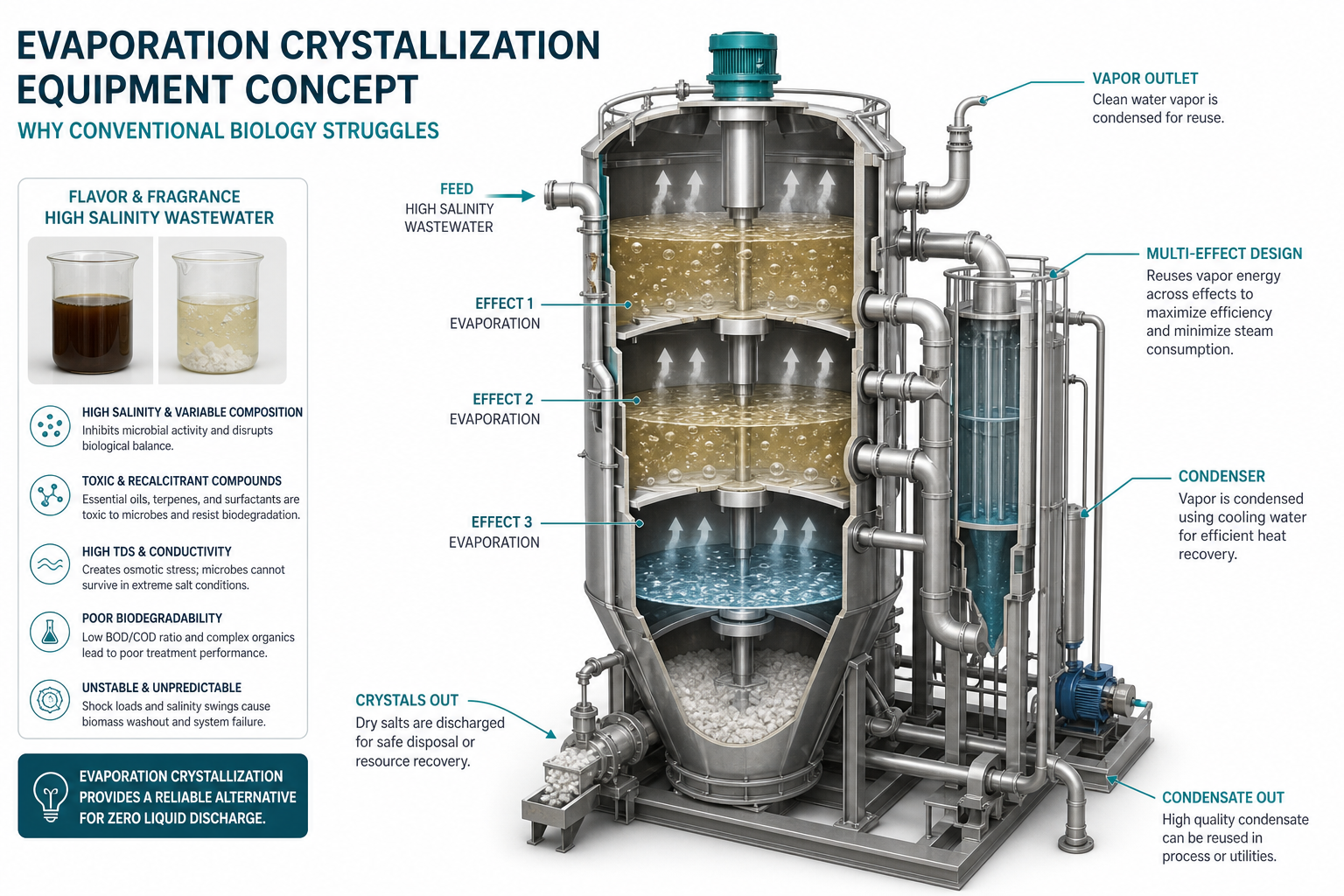
Three failure modes recur. First, salinity: dissolved salts at the levels typical of neutralization and salting-out washes suppress floc formation, reduce settling and depress microbial activity, so COD removal sags exactly when the load peaks. Second, inhibition: many aroma chemicals — certain aldehydes, phenols, terpenes and heterocycles — are biocidal at concentrations that are trivially small in chemical-engineering terms but decisive in biological terms, so shock loads knock the consortia back for days. Third, variability: fragrance production runs short campaigns of many products, and the wastewater composition can change shift by shift, which no steady-state biological system accommodates gracefully. The engineering consequence is well understood in the sector: F&F plants either over-design biological stages with massive dilution and holding capacity, or they route the strongest fractions out as paid liquid waste. Evaporation attacks that decision directly.
Stream Profiles and Where Evaporation Fits
Not every F&F stream deserves the evaporator. The table below maps the typical stream families to their sensible destinations in a hybrid plant design.
| Stream family | Illustrative character | Sensible destination |
|---|---|---|
| Neutralization / salting-out washes | High salinity, high COD, product losses | Evaporation + crystallization — salt and water recovery, organics concentrated |
| Synthesis mother liquors | High COD, specific organics, possible catalyst residues | Evaporation concentration; residue to incineration or solvent recovery |
| Distillation / stripping condensates | Low COD, strong odor, hot | Direct recycle as process water after odor polishing; heat recovery |
| Washdown and changeover water | Intermittent slugs of surfactant, solvent, fragrance | Equalization then evaporation, or biological treatment after dilution with salt-free streams |
| Scrubber blowdown | Mild salinity, trace organics | Evaporation in blend, or discharge after polishing where permitted |
Stream characterizations are an illustrative envelope from published F&F effluent practice, not a customer or project dataset; each plant’s survey governs.
The pattern: evaporation earns its place on the salty, strong, toxic minority of the flow — the fraction that breaks biology — while the weak, salt-free majority can still go the conventional route or straight to reuse.
The Evaporation-Crystallization Process Route
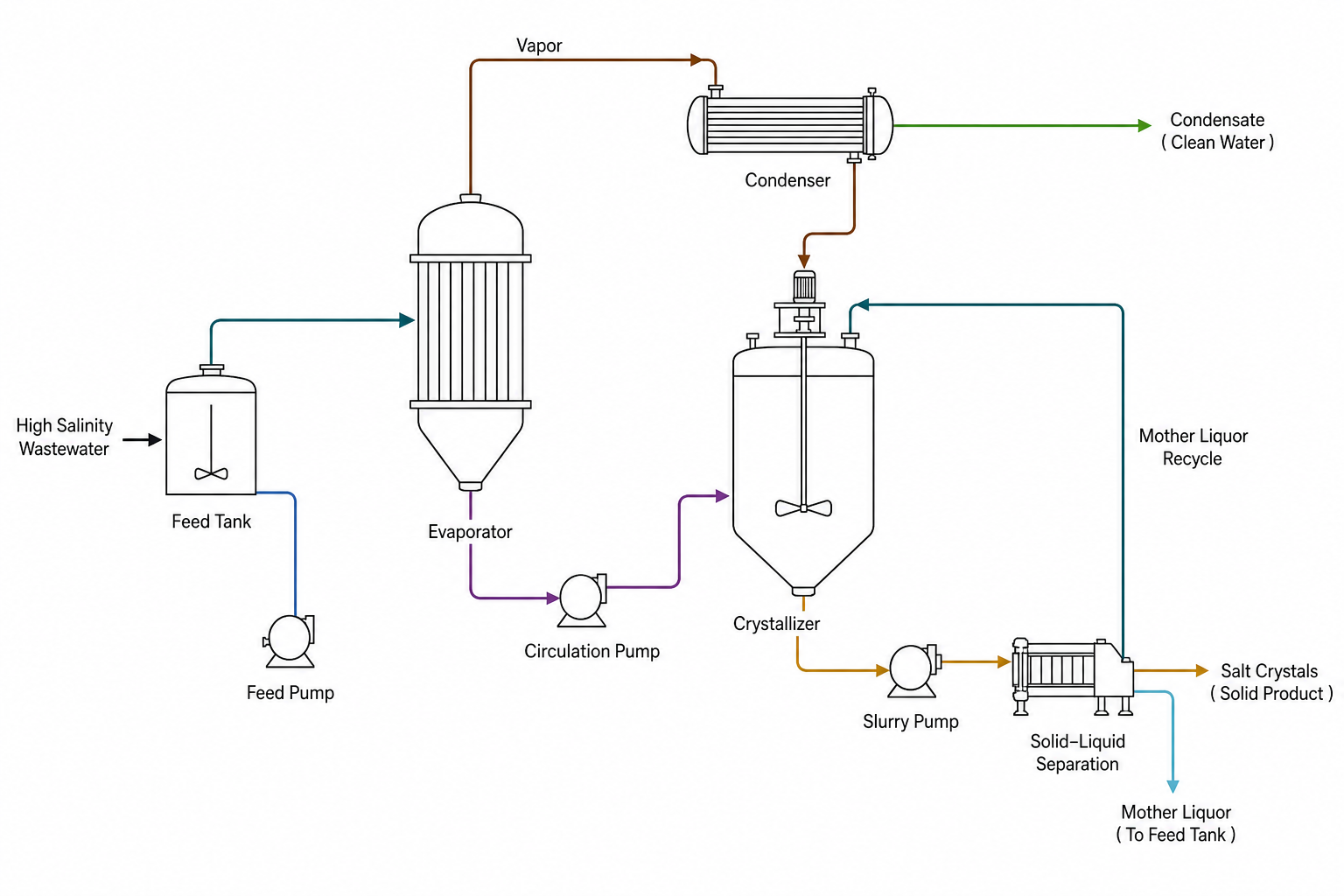
Pretreatment: recover value before you boil
Before the brine reaches the evaporator, gravity oil removal, pH correction and dissolved-air flotation pull free product and oils out — in an F&F plant this recovered organic phase is often worth reprocessing rather than burning, because fragrance materials carry high unit value. Equalization ahead of the evaporator is not optional: campaign-driven composition swings would otherwise hunt the evaporator’s control loops and destabilize the crystallizer’s salt quality.
Evaporation concentration
The core water removal runs in vacuum evaporation — falling-film bodies for the bulk duty, where high heat-transfer coefficients and short residence times limit thermal damage to heat-sensitive organics, and forced-circulation service as saturation approaches and fouling tendency rises. MVR recompression is the default energy scheme where electricity is available, recycling the vapor as heating steam and cutting energy use sharply versus live-steam operation; in comparable saline duties, supplier-published MVR figures report energy reductions above 60% against conventional evaporation (indicative, not a project guarantee). Multi-effect evaporation remains the rational choice where the site already has economic steam from a boiler or a neighbor. Because aroma compounds are to varying degrees volatile, the condensate can carry traces of them — which is not a treatment failure but a design input: the condensate polisher is specified from the start, usually activated carbon or a small biofilter, so that the recovered water meets the plant’s reuse standard without odor.
Crystallization and salt handling
The concentrated brine discharges to a forced-circulation crystallizer, which yields a dewaterable mixed salt — typically dominated by sodium chloride or sodium sulfate, depending on which acid and base the plant’s chemistry employs. Mixed or organics-tainted salt is usually stabilized and disposed of as a solid, already a large saving against liquid haulage; where the salt system is simple and pretreatment is effective, separation stages can upgrade it toward industrial-reuse quality. Mother liquor recycles to the front of the evaporation train, and a small purge keeps organics from accumulating — that purge, concentrated and small, is the incineration or reprocessing stream.
| Module | Candidate Equipment Types | Selection Rationale | Indicative Operating Envelope |
|---|---|---|---|
| Equalization and pretreatment | Gravity oil removal, DAF, pH correction | Recovers product value; stabilizes campaign swings | Sized to longest product changeover |
| Vacuum evaporation bodies | Falling-film calandrias | Short residence limits thermal damage to organics | Vacuum bulk-duty boiling |
| Finishing and crystallization | Forced-circulation crystallizer | Handles viscosity and fouling near saturation | Mixed salt, NaCl or Na2SO4 dominated |
| Condensate polishing | Activated carbon, small biofilter | Strips volatile aroma traces for reuse | To plant reuse standard |
| Odor control and sealing | Sealed trains, negative pressure, vent scrubbing | Closes every odor escape path | Closed, sub-atmospheric operation |
Configuration, materials, and operating ranges depend on the actual feed, campaign blend, corrosion review, fouling behavior, site utilities, and project capacity.
Odor and VOC Control: The F&F-Specific Layer
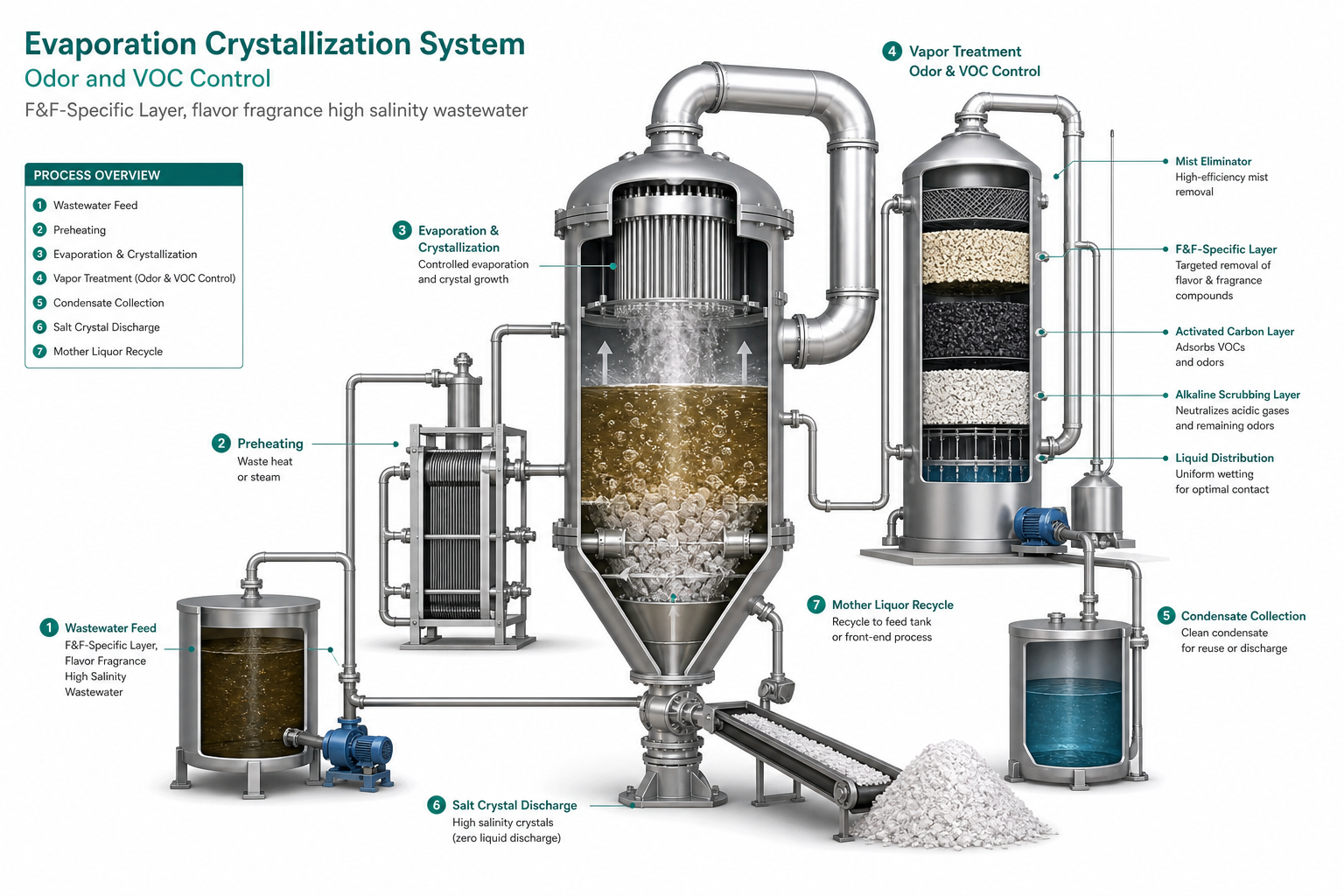
No other sector weighs odor as heavily as flavor and fragrance. An evaporation system concentrates odorous organics by design, so the design must close every escape path: sealed feed and concentrate handling, vapor routed through condensation rather than vented, scrubbing on any necessary vents, and condensate polishing as described above. Handled this way, the evaporation island typically improves a plant’s odor position rather than worsening it — the strongest odorous mass moves from an open lagoon or holding tank into a closed, negative-pressure train. Plants under neighbor pressure often find that this containment effect, unbidden, is the project’s most appreciated feature.
Integration Options
- Stand-alone island: the evaporation-crystallization train treats the strong salty fraction only; weak streams continue to existing biological or municipal discharge. Lowest capital, fastest payback where disposal cost is the driver.
- ZLD configuration: evaporation plus crystallization plus drying of the final residue closes the water balance entirely — the architecture described in our zero liquid discharge solutions overview — suited to plants under discharge permits with no numeric headroom.
- Solvent-bearing streams: where alcohol or other solvents are present in meaningful fraction, a solvent-recovery distillation step ahead of the evaporator recovers them as product; the aqueous remainder then goes to salt recovery, as covered in our solvent recovery and distillation capability.
- Park connection: plants inside chemical parks sometimes evaporate only to the concentration that meets the park’s pipe acceptance limits for salinity and COD, letting the park’s central plant finish the job — an intermediate option that trims crystallizer capital.
Design Notes Specific to F&F Service
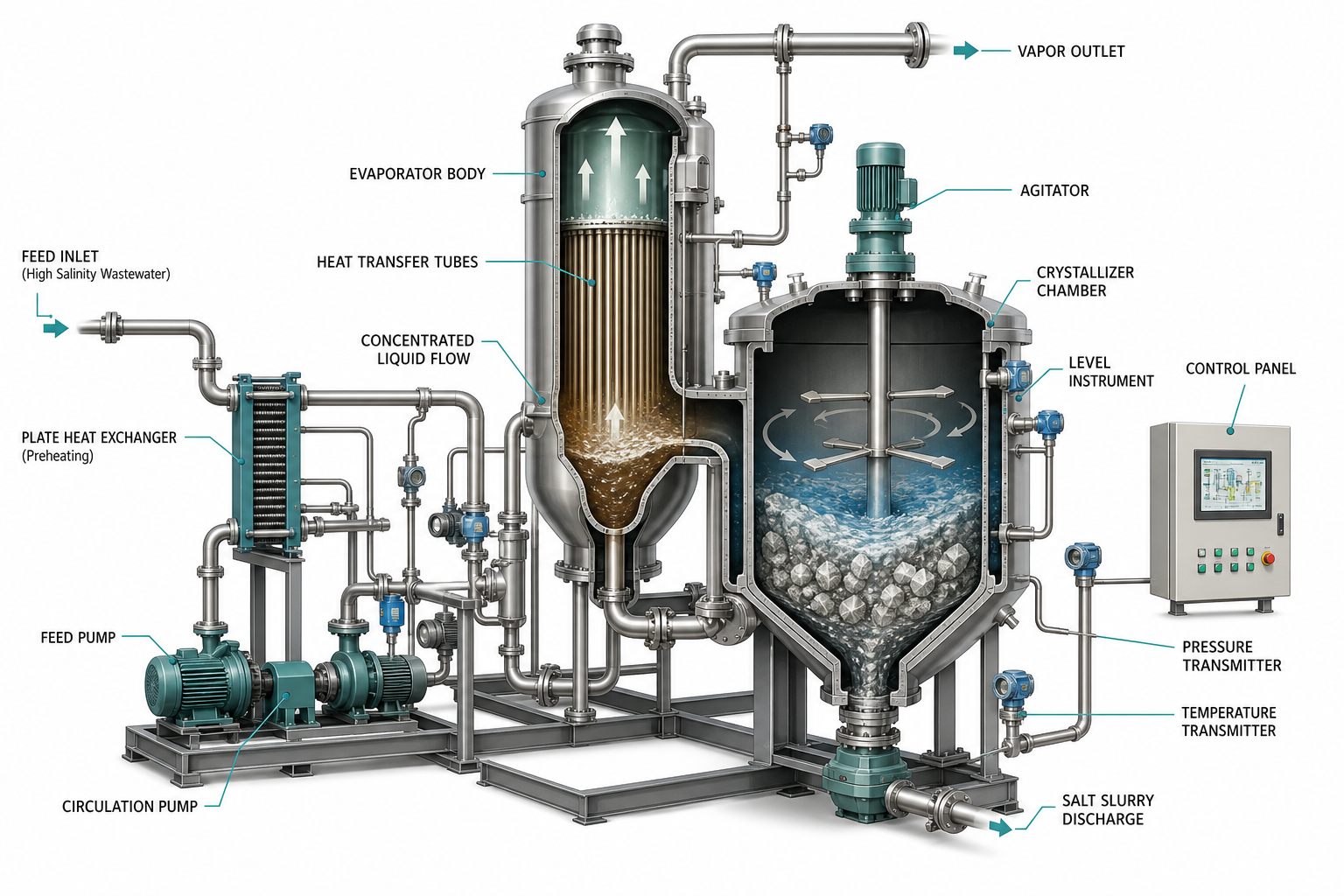
- Expect fouling from organics, not just salt. Fragrance oils and waxes deposit on hot surfaces; forced-circulation finishing sections and scheduled clean-in-place belong in the base design, not the options list.
- Materials follow the chemistry. Chloride-neutralized streams at low pH push beyond standard stainless toward higher alloys; specify from the water analysis, not by analogy.
- Qualify the water. A lab evaporation test on the actual mixed feed confirms foaming behavior — F&F surfactants foam aggressively — and sets antifoam strategy before it becomes a commissioning crisis.
- Plan for campaign changeovers. Equalization volume sized to the longest product changeover protects both evaporator stability and salt quality.
How evapcryst Builds F&F Wastewater Systems
evapcryst designs evaporation and crystallization systems for high-salinity, difficult organics waters across the chemical and specialty sectors. For flavor and fragrance plants we work from the stream survey — which washes, mother liquors and condensates carry the salt and the toxicity — then size the MVR evaporation and falling-film bodies, the crystallizer and the odor-control layer as one integrated island. The same architecture serves our projects across chemical and agrochemical wastewater and in structurally similar duties such as emulsion evaporation. Bring the stream data and the current disposal cost per ton — from there we can outline a recovery scheme, an equipment list and an indicative budget.
Validation Focus
No project dataset is cited on this page; stream behavior descriptions are sector engineering practice. Before an F&F train is committed, validation should cover a stream survey across campaigns, lab evaporation tests for foaming and fouling, condensate odor analysis against reuse targets, and salt residue characterization for disposal or reuse routing.
When This Route May Not Fit
Evaporation-crystallization is the wrong investment for the weak majority of the flow. If the survey shows mostly low-salt, low-COD wash water, equalization plus biology is the cheaper answer and the evaporator should shrink or disappear. Solvent-rich streams deserve recovery distillation first; boiling alcohol-water mixtures to recover salt wastes the solvent value. Sites with cheap park-central treatment available to concentrated liquor may stop at the concentration the park accepts, skipping crystallization entirely. Continuous-steam plants with no power headroom complicate MVR selection. Where disposal costs are trivial or discharge permits are loose, the whole business case of disposal savings, water reuse, and odor containment may not fund the capital. Salt without a disposal or reuse route also stops the ZLD variant cold.
What Must Be Verified
An F&F evaporation project stands on its stream survey. Verify campaign-by-campaign volumes and composition of every family — neutralization washes, mother liquors, condensates, washdown — because blend ratio sets sizing. Run lab evaporation on the mixed feed for foaming, fouling rate, and condensate odor against the reuse standard. Characterize the salt residue for its disposal class or reuse market. Confirm utility economics: electricity for MVR versus steam price, and equalization volume against the longest changeover. Confirm the permit wording — which fractions the plant may still discharge, and what the park or municipality will accept — before the architecture is frozen. Recovered-product value from pretreatment should be priced with the plant, since it can swing payback materially.
FAQ
Can flavor and fragrance wastewater go to biological treatment at all?
The weak, salt-free fractions usually can — washdown water, scrubber blowdown and dilute condensates are commonly handled biologically after equalization. It is the salty, strongly organic, biotoxic minority — neutralization washes, salting-out brines and synthesis mother liquors — that breaks biology, and that fraction is what an evaporation-crystallization train takes off the biological plant’s back.
Does evaporation fix the odor problem?
It contains it. A sealed, vacuum-operated evaporation train moves the odorous organic mass into closed vessels and condensate, where carbon or biofilter polishing removes it, instead of leaving it in open tanks and lagoons. Plants with neighborhood odor complaints typically see improvement, but the containment has to be engineered — vents, seals and polishers are part of the design, not accessories.
What happens to the salt from an F&F crystallizer?
It emerges as a mixed crystal, usually sodium chloride or sulfate dominated. With effective pretreatment and a simple salt system it can approach industrial-reuse quality; more often it is dewatered and disposed of as a stable solid — still a major saving against liquid-hazardous haulage. The choice is a feasibility question driven by the plant’s specific chemistry and local salt markets.
Is the evaporator condensate reusable?
Generally yes, after consideration of volatile aroma carryover. The condensate is hot, low-salt water; with carbon or biofilter polishing it suits washing, cooling makeup and many process duties. Where the feed carries meaningful alcohol, a solvent-recovery step ahead of the evaporator recovers that value instead of letting it pass into the condensate.
MVR or multi-effect for an F&F plant?
MVR where electricity is available and the duty is continuous — it recycles vapor and minimizes energy cost, with supplier-published reported reductions above 60% versus conventional evaporation in comparable saline service (indicative). Multi-effect where the site has cheap steam already raising from its boilers. Many plants combine: film evaporation for bulk duty, forced circulation into the crystallizer for finishing, with the energy scheme set by the site’s utility balance.
For a first-pass screening of an F&F wastewater project, send the stream survey (or ask what to sample), current disposal cost per ton, and discharge target; in return you receive an indicative hybrid architecture and energy scheme, before any detailed engineering.