Project Parameters
| Parameter | Value |
|---|---|
| Process route | Falling film evaporation under vacuum, low-temperature fruit juice duty |
| Industry | Coconut water beverage production (Vietnam, Southeast Asia) |
| Feed type & key components | Fresh coconut water, heat-sensitive sugars, minerals and aroma |
| Evaporation capacity | 5 t/h |
| Construction materials | SS304 / SS316L food-grade wetted parts (indicative) |
Representative process configuration compiled from published industry project data. Indicative values, not a process guarantee.
Project Description
Coconut water went from tropical by-product to global beverage category in a decade, and the Mekong Delta is one of its centers of supply. The processing problem is distance: fresh coconut water is perishable within hours at tropical temperature, while the bottling plants, dairy blenders and export customers are thousands of kilometers away. Concentration is the bridge — remove most of the water near the groves, ship the concentrate, reconstitute or blend at destination. The reference configuration is a 5 t/h falling film evaporator at a Vietnamese coconut water plant.
Coconut water is a gentle feed chemically — low solids, low acidity, no scaling salts to speak of — and a demanding one organoleptically. Its flavor is a fragile combination of sugars, minerals and volatile aroma compounds; its nutritional identity, which is what the label sells, is potassium and other electrolytes that survive heat poorly. The evaporator’s entire design brief is water removal with minimal thermal signature: low temperature, short residence, gentle handling.
Process Technology
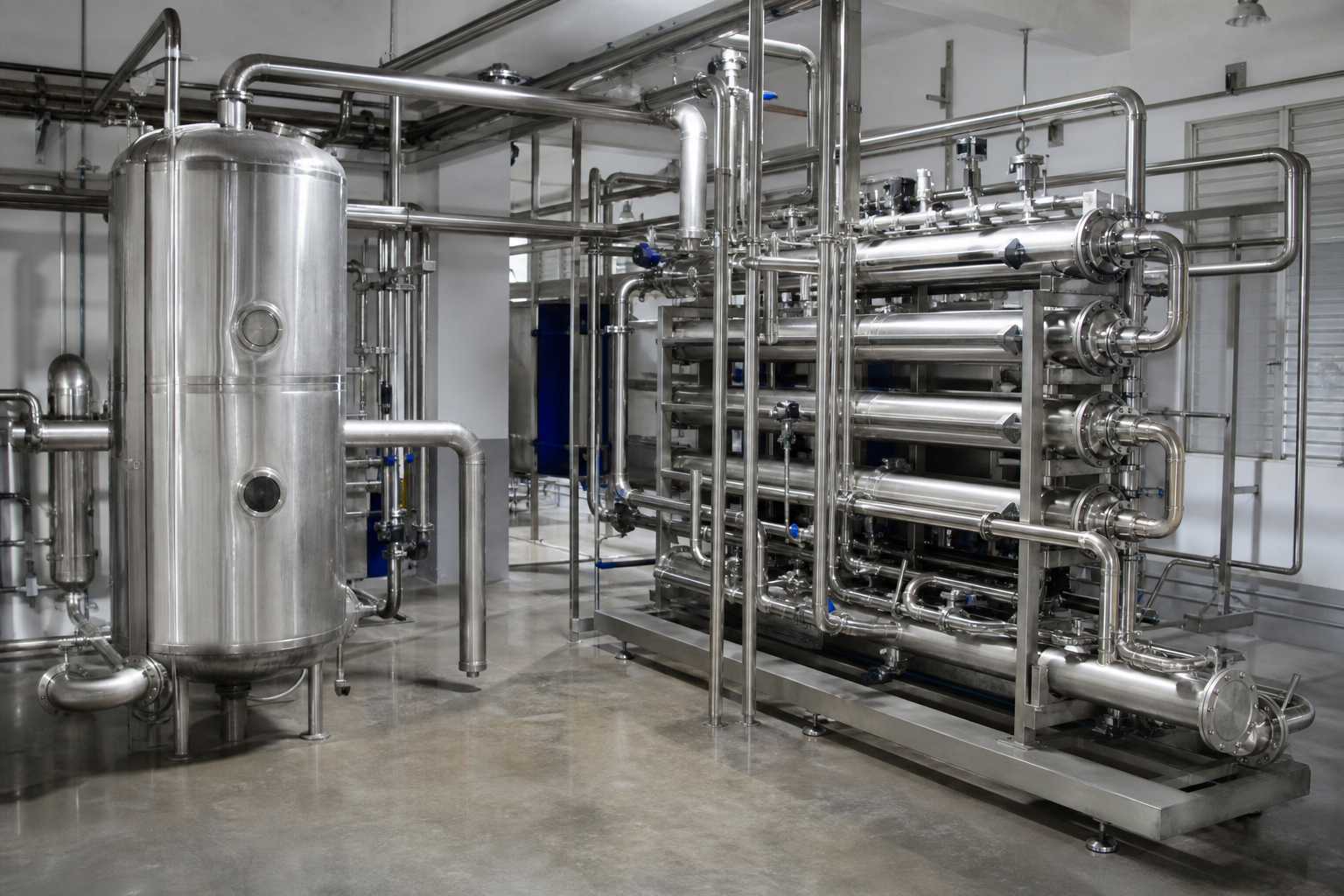
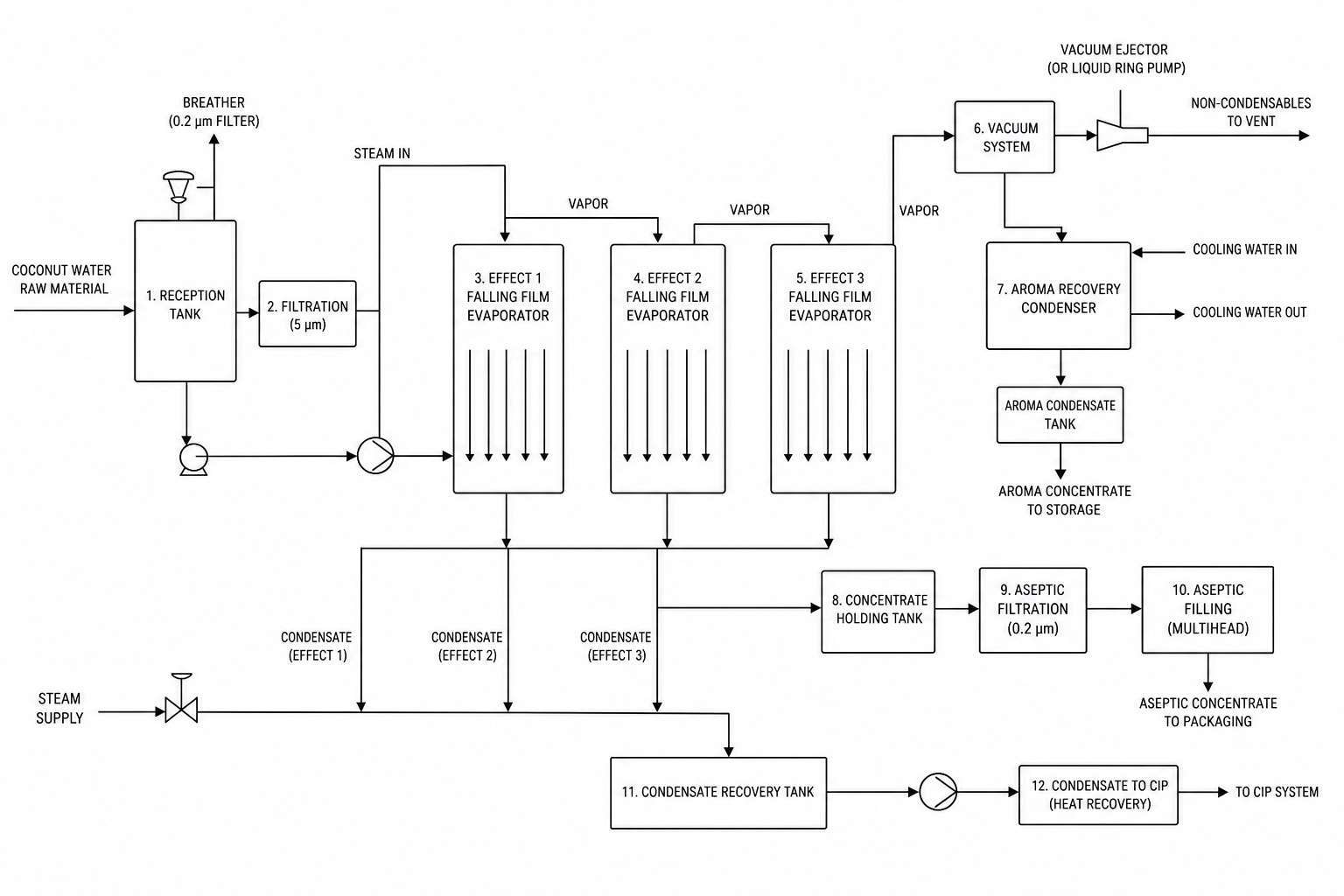
Clarified coconut water feeds the falling film distributor, which spreads it as an even liquid film down the inside of the heated tubes. The film geometry is the point: each element of juice sees seconds of heat transfer, evaporating under vacuum at temperatures in the 50–70 °C class rather than boiling hard. There is no bulk boiling of the product, no local overheating on the wall, and no long soak in a hot vessel — the difference between concentrate that tastes of coconut and concentrate that tastes of cooked sugar.
The multi-effect structure multiplies the energy economy: vapor evaporated from the juice in one effect becomes the heating medium of the next, so a tonne of steam (or of MVR compressor work, on electrically driven variants) removes several tonnes of water across the train. Aroma recovery on the vapor path condenses the volatile fraction separately, returning the top notes to the concentrate that drying and shipping would otherwise strip.
Concentrate at the target Brix discharges to aseptic filling or to downstream packing for export; condensate — essentially distilled water evaporated from the juice — recovers to CIP and washing duty. Comparable published tropical juice configurations across Vietnam, the Philippines and Indonesia run falling film concentration for coconut water, pineapple juice and coffee extract at 5–25 t/h scales on the same low-temperature logic.
Equipment Configuration
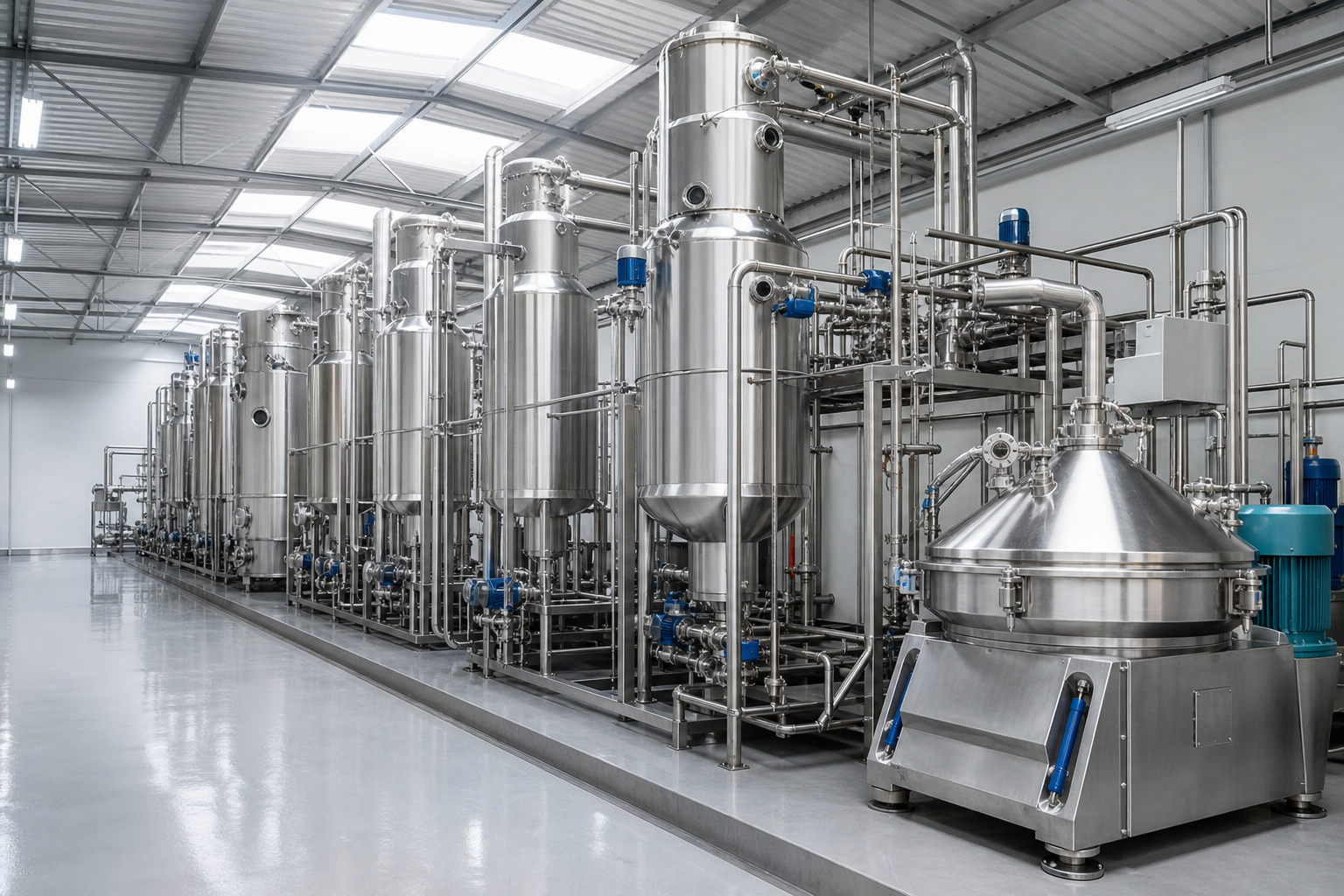
One set of the following equipment is typical for this duty:
- Coconut water reception, filtration and clarification
- Multi-effect falling film evaporator with vacuum system
- Aroma recovery condenser on the first-effect vapor path
- Aseptic concentrate filling / export packing interface
- Condensate recovery to CIP and plant washing
- CIP system for hygienic beverage turnaround
- PLC control of Brix endpoints, temperatures and vacuum profile
Performance & Outcome
Compiled from published industry project data, indicative: falling film systems of this class concentrate coconut water at 5 t/h under vacuum at low temperature, preserving aroma and electrolyte identity through concentration. Concentrate Brix and aroma retention are quoted per project product specification.
Simplified PFD
The simplified process flow diagram above shows clarified coconut water feed, multi-effect falling film evaporation with aroma recovery, and concentrate packing for export.