For most industrial wastewater and concentration duties, the economic effect count lands between two and four effects — double-effect and triple-effect designs cover the common cases, and anything above five effects needs a strong economic justification written down before purchase. The choice is not “more effects are better”: each added effect saves a shrinking slice of steam while adding a full set of heat-transfer area, bodies, pumps, and instrumentation. Three constraints set the answer for any specific project: the available temperature difference (shrunk by boiling point elevation), the material’s BPE and viscosity behavior, and the local steam-versus-electricity price ratio — the same ratio that decides whether the project should jump technology lanes to MVR entirely. This article works through each constraint, the feeding arrangements that interact with effect count, and the decision baselines that experienced designers actually use.
What Each Additional Effect Buys
The physics is simple and worth restating precisely. In a single-effect evaporator, the secondary vapor’s latent heat is thrown away at the condenser; roughly 1 kg of live steam evaporates about 1 kg of water (steam economy ≈ 0.8–0.9, industry-reported range). A multi-effect train routes that secondary vapor into the next effect as heating steam, so the same latent heat is reused before it is rejected: a double-effect system cuts steam consumption close to half, a triple-effect system drops it further, and every subsequent effect adds less. Each effect operates at a successively lower pressure and temperature — the first effect highest, the last under vacuum — forming the temperature-difference chain that drives heat flow from body to body.
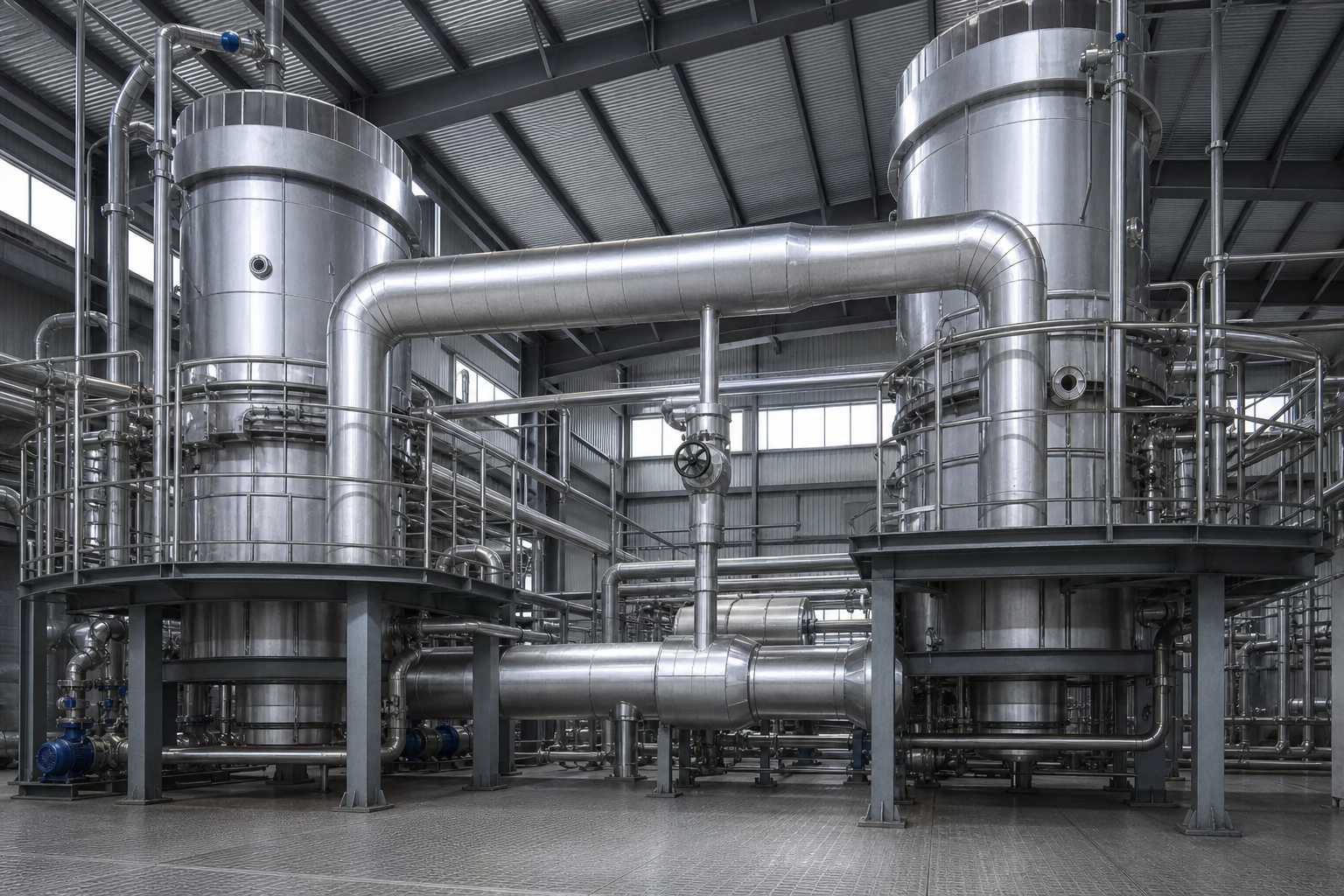
The counterweight is capital. Effects share the total temperature difference, so more effects mean less driving force per effect, larger heat-transfer areas to compensate, more bodies, more pumps, more instruments, and a bigger footprint — total heat-transfer area rises roughly linearly with effect count. Steam economy improves along a flattening curve while investment climbs along a steepening one. Somewhere between those two curves sits the project’s optimal effect count, and finding it is an exercise in arithmetic, not taste.
| Configuration | Steam economy (order) | Capital trend | Typical duty |
|---|---|---|---|
| Single effect | 0.8–0.9 | Lowest | Small throughput, batch operation, very cheap steam, frequent product changeover and cleaning |
| Double effect | ~1.6–1.8 | Low-mid | Moderate continuous duty where steam is inexpensive |
| Triple effect | 2.2–2.7 | Mid | The wastewater workhorse: continuous, large volume, steam-cost sensitive |
| Four to five effects | ~3+ with diminishing gain per effect | High | Large water volumes with expensive steam; needs explicit payback case |
| MVR (reference) | Equivalent to a very high effect count | Shifts cost to compressor + electricity | Favorable electricity pricing, no steam source, lowest-OPEX targets |
The First Constraint: Available Temperature Difference
Effect count is bounded above by temperature arithmetic before it is bounded by money. The total available temperature difference equals the first effect’s maximum allowable heating temperature minus the last effect’s saturation temperature under vacuum. That nominal difference is then taxed twice per effect: the boiling point elevation of the liquor (which rises with concentration and is large for high-salt, high-organic wastes) and the minimum heat-transfer temperature difference each effect needs to transfer heat at a reasonable area. What remains after the taxes is the usable driving force, and it must stay positive for every effect.
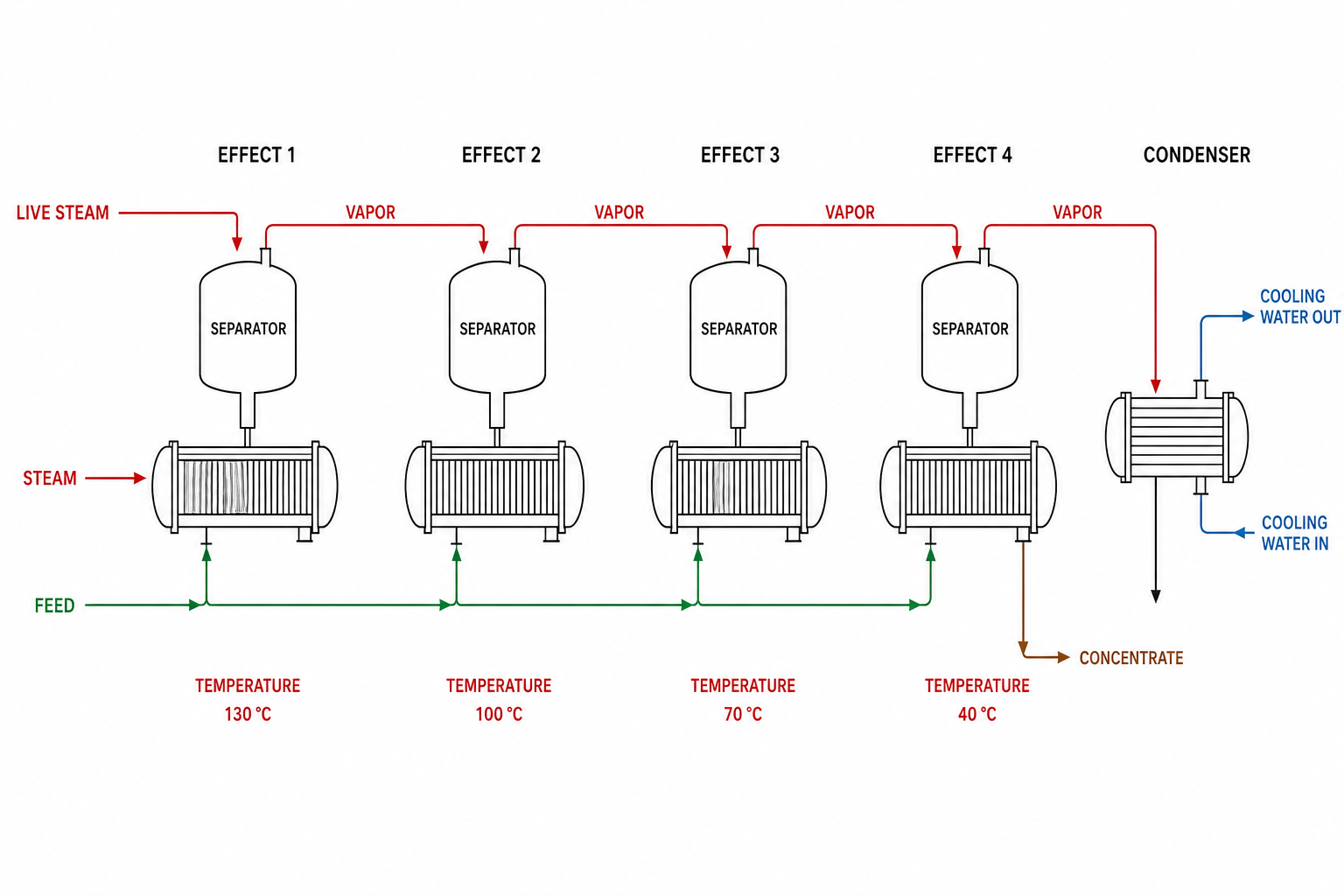
An illustrative allocation shows the mechanism. Take a first-effect heating temperature of 100°C and a last-effect vacuum saturation temperature of 45°C — a nominal 55°C spread. If the liquor’s BPE costs 3°C per effect and each heat exchanger needs at least 6–8°C of driving force, then a three-effect design consumes roughly 3 × (3 + 7) = 30°C of the 55°C budget with margin to spare, while a five-effect design consumes 50°C and lands at the edge of feasibility, forced into oversized areas to keep the last effects alive. Raise the BPE to 7°C per effect — typical of a concentrated high-salt liquor — and the five-effect option goes negative on usable driving force entirely. This is why high-BPE materials have a low effect-count ceiling, and why designers demand a water analysis before quoting an effect number.
The Money Constraint: Steam Price vs Incremental Capital
The economic optimum is the balance point where the annual value of steam saved by one more effect equals the annualized cost of the equipment that effect adds. Practical corollaries follow directly. Expensive steam pushes the optimum toward more effects — or out of the multi-effect lane altogether; cheap steam pulls it back toward fewer effects and simpler plants. Water volume scales the whole argument: the larger the evaporative duty, the larger the absolute steam saving each effect captures, and the shorter the payback on the incremental capital — large-volume continuous wastewater duty is the classic multi-effect application precisely because the savings are large enough to amortize the steel.
Thermal vapor recompression sits inside this ledger as a halfway move: one TVR recovers roughly the steam equivalent of an added effect, without adding a full effect’s worth of bodies and area, at the price of requiring motive steam at pressure. For a plant whose steam header can supply motive steam cheaply, “three effects plus TVR” often outbids “four effects” on total cost.
Where MVR Enters the Decision
MVR is not an effect — it is an exit from the effect-counting game. Because the compressor recycles all secondary vapor with electricity, the design escapes the total-temperature-difference allocation constraint entirely; engineers describe it as equivalent to a very high effect count without the per-effect temperature tax. The decision between more effects and MVR is therefore a technology-lane choice governed by the steam-to-electricity price ratio, steam availability, and compressor capital — quantified fully in steam and electricity consumption calculation. The practical split that vendors observe: where electricity is expensive and steam is cheap and abundant, multi-effect wins on investment; where electricity is favorable or steam is unavailable or unreliable, MVR wins on operating cost.
Feeding Arrangements Interact with Effect Count
Forward vs Backward Feeding
Forward feed sends liquor and steam in the same direction: dilute liquor meets the hottest first effect, then flows downhill in temperature and pressure — effects transfer liquor by pressure difference without pumps, saving motive power and complexity. Its trap is the last effect: lowest temperature combined with highest concentration stacks viscosity exactly where the temperature difference is weakest, degrading the final effect’s heat transfer. The more effects, the colder and more concentrated that last effect becomes, so the forward-feed penalty grows with effect count. Backward feed reverses the path — liquor enters at the cold last effect and is pumped forward toward the hottest first effect, so the most concentrated liquor evaporates at the highest temperature, holding viscosity and heat-transfer coefficients where they matter. The costs: inter-effect pumps fighting the pressure staircase, and higher fouling and corrosion risk at the hot, concentrated end, which raises metallurgy requirements. The selection rule is viscosity behavior: materials whose viscosity climbs steeply with concentration (and high-BPE liquors generally) argue for backward feed; ordinary brine wastewaters run forward feed and bank the simplicity.
Parallel Feeding for Salt Production
Parallel feed splits the liquor across effects that each concentrate and discharge independently, rather than cascading a single stream. Its natural home is salt crystallization service, where each effect produces its own salt slurry for the centrifuge and the flowsheet avoids pushing crystals through multiple bodies. Evaporative crystallization trains — NaCl, sodium sulfate, and similar inorganic salts (illustrative applications) — frequently adopt parallel or mixed feeding for exactly this solids-handling reason, trading some steam-economy elegance for reliable crystal production.
The Triple-Effect Forced-Circulation Workhorse
One combination deserves its own paragraph because it is among the most widely deployed configurations in inorganic-salt wastewater service: triple-effect forced circulation. The three effects supply the steam economy (utilization roughly three times a single effect, before BPE and heat-loss discounts), while forced circulation supplies the fouling defense — circulation pumps hold tube velocity in the 2–3 m/s range (typical published design values) so that liquor does not boil inside the tubes, suppressing scale where it is hardest to remove. A common configuration concentrates in the first two effects and crystallizes in the last effect or a dedicated crystallization section, with salt slurry dewatered by centrifuge and distillate recycled. Its economic boundary is exactly the price ratio above: high electricity prices with cheap, ample steam favor this configuration on investment; favorable power pricing favors MVR. The concentration-plus-crystallization duty it serves is detailed on the concentration and crystallization solutions page, with the circulation technology itself on forced-circulation evaporation.
Practical Selection Baselines
| Project condition | First-pass recommendation |
|---|---|
| Small throughput, batch, cheap steam | Single effect |
| Continuous wastewater, moderate volume, cheap steam | Double effect |
| Continuous wastewater, large volume, steam-cost sensitive | Triple effect (forced circulation if fouling/high-salt) |
| Very large volume, expensive steam | Four-plus effects or TVR hybrid — with written payback case |
| Favorable electricity price, or no reliable steam source | MVR instead of adding effects |
| High-BPE liquor (concentrated high-salt, high-organic) | Cap effects at two-three; verify temperature budget per effect |
| Viscosity climbing steeply with concentration | Backward feed; consider fewer effects with MVR or forced circulation |
Three mistakes recur in effect-count decisions. Chasing steam economy past the temperature budget: effects added beyond the available temperature difference do not save steam — they simply fail to transfer heat at reasonable area. Ignoring BPE until commissioning: high-BPE liquors must be screened at quotation stage from a real water analysis, because they silently delete the last effect’s driving force. And comparing multi-effect and MVR proposals on capital alone: MVR’s compressor investment is repaid by the operating-cost ledger, so a capital-only comparison structurally biases the decision toward steam. Run the comparison through the full cost calculation, and let the two technology lanes compete on lifetime numbers — the underlying technology profiles sit on the multi-effect evaporation and MVR evaporation pages.
When This Route May Not Fit
Multi-effect counting is the wrong exercise for several common situations. Small batch duties on a site that already owns cheap steam are best served by a single effect: the incremental capital of a second body cannot be repaid by steam that costs almost nothing. Sites with favorable electricity pricing, or with no reliable steam source at all, should not be optimizing effect count — they should exit the lane and evaluate MVR, where the effect-count arithmetic does not apply. Liquors whose boiling point elevation locks the temperature budget — concentrated high-salt, high-organic wastes — cap out at two to three effects regardless of economics, because additional effects simply have no usable driving force left to share. And a design that needs a fifth effect sitting at the edge of the temperature budget pays for oversized areas in its late effects while collecting the smallest marginal steam saving of the whole train.
What Must Be Verified
Four inputs decide the effect count before any quotation is meaningful. A water analysis giving the real BPE-versus-concentration curve, because a laboratory number at feed concentration says nothing about the last effect’s liquor. The steam-to-electricity price pair with annual operating hours, which decides whether the project belongs in the multi-effect lane at all. The per-effect temperature budget check — BPE times effect count plus minimum heat-transfer driving force times effect count, against the total available difference — run before the effect number is fixed. And the liquor’s viscosity behavior with concentration, which selects forward versus backward feeding and can override an otherwise attractive effect count.
FAQ
How many effects should a wastewater evaporator have?
For most industrial wastewater duties, two to three effects — double effect where steam is cheap and volumes moderate, triple effect for continuous large-volume duty. Four to five effects require an explicit economic justification, because each added effect saves less steam while adding a full set of area and equipment. Above five, the temperature-difference budget rarely supports the design.
Why can’t I just add more effects to save more steam?
Two walls stop the strategy. The temperature wall: total available temperature difference (first-effect heating temperature minus last-effect vacuum temperature) must cover every effect’s BPE plus heat-transfer driving force — more effects divide a fixed budget into shares too small to transfer heat. The money wall: steam economy improves with diminishing returns while heat-transfer area and equipment grow roughly linearly, so each added effect pays back less until the balance goes negative.
When is MVR better than adding another effect?
When electricity is favorably priced against steam, when no reliable steam source exists at the site, or when the liquor’s high BPE has already capped the effect count. MVR recycles all secondary vapor with electricity and escapes the temperature-difference allocation constraint — it competes on the operating-cost ledger, not on the effect-count arithmetic.
Forward or backward feed for a multi-effect system?
Forward feed (liquor and steam co-current) is simpler — pressure-driven transfer, no inter-effect pumps — and suits ordinary brine wastewaters. Backward feed puts the most concentrated liquor in the hottest effect, protecting heat transfer for viscous, high-BPE materials, at the cost of pumps and higher fouling-corrosion risk at the hot end. The higher the effect count, the stronger the case for backward feed on viscous liquors.
Does boiling point elevation limit my effect count?
Yes — it is often the binding constraint. Every effect pays the liquor’s BPE out of the temperature budget before any heat transfers. A liquor with 3°C BPE can support more effects than one with 7°C. Concentrated high-salt, high-organic wastes carry the largest BPE and therefore the lowest effect ceilings; get the water analyzed before fixing the flowsheet.