Project Parameters
| Parameter | Value |
|---|---|
| Process route | MVR + three-effect falling-film evaporation, forced-circulation crystallization |
| Industry | Rare earth extraction / non-ferrous hydrometallurgy (Inner Mongolia, North China) |
| Feed type & key components | Ammonium chloride wastewater from rare earth extraction; NH4Cl-dominant brine with trace rare earth values |
| Evaporation capacity | 19.3 t/h |
| Construction materials | SS316L wetted parts (indicative for chloride service; higher alloys per concentration) |
Representative process configuration compiled from published industry project data. Indicative values, not a process guarantee.
Project Description
Rare earth extraction in Inner Mongolia runs on ammonium salt chemistry: the ores and concentrates are leached with ammonium-based reagents, and the effluent carries the counter-ion out as ammonium chloride — a single-salt brine produced continuously by the region’s separation plants. The stream cannot be discharged at concentration, but it is far from worthless: ammonium chloride is a product (fertilizer grade and battery-materials precursor grade both trade), so the treatment objective is recovery, not disposal. The reference configuration treats this duty at 19.3 t/h at a rare earth operation in Baotou, the center of the region’s rare earth industry.
Two engineering realities shape the plant. Ammonium chloride brine is chloride service — wetted materials are selected for chloride corrosion at temperature, with SS316L as the indicative reference and higher alloys in the hottest, most concentrated zones. And the salt is volatile-adjacent: ammonium species demand sealed systems and controlled pH to keep ammonia where it belongs, in the product, rather than in the condensate or the plant air.
Process Technology
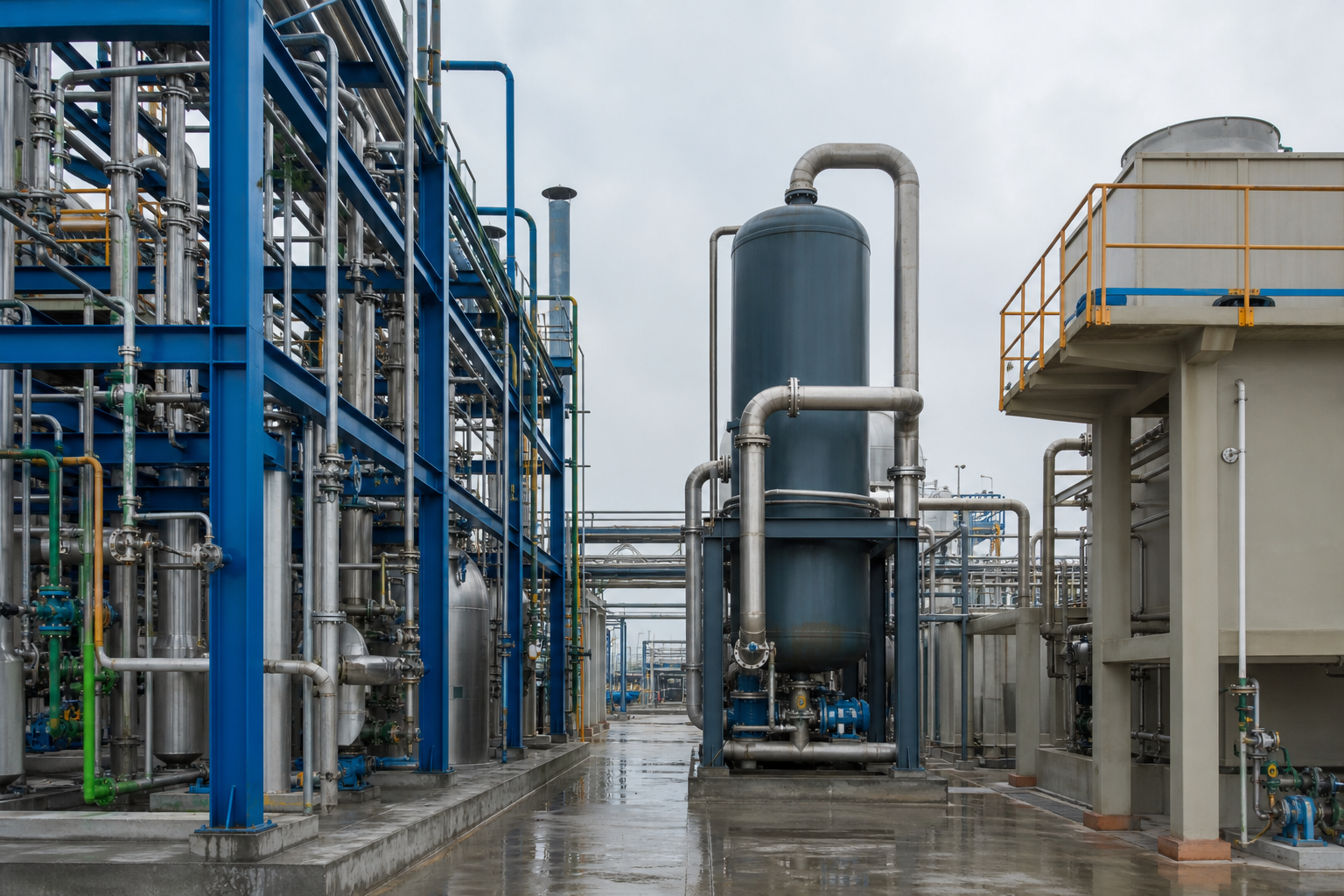
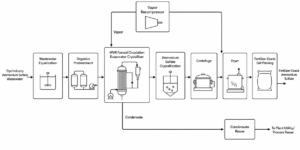
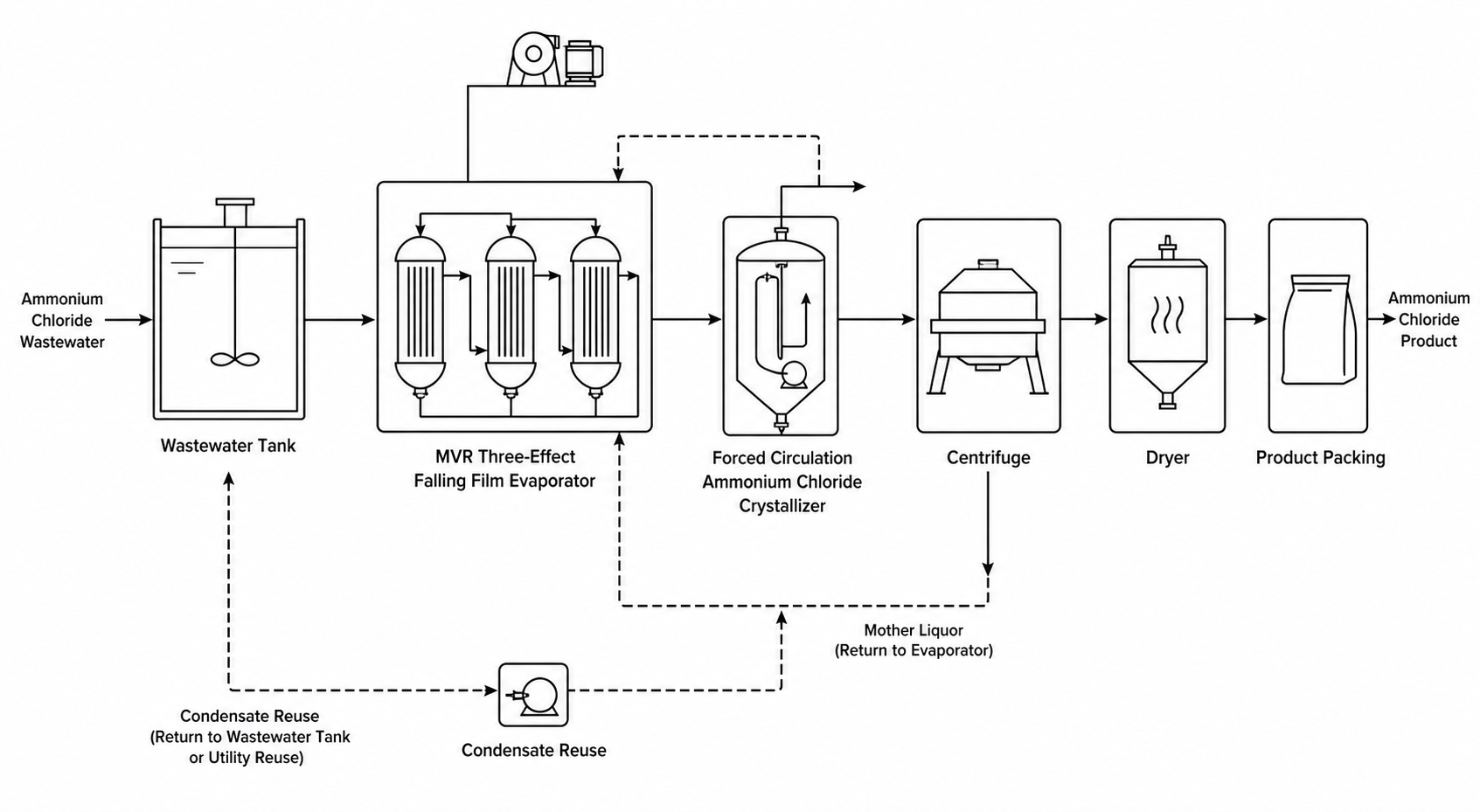
The wastewater is equalized, filtered for suspended solids from the extraction circuit, and polished for trace rare earth values — the residual heavy rare earths in the brine are worth recovering upstream of the evaporator, both for their value and for product salt purity.
Concentration runs across a three-effect train with MVR drive on the head effect. The falling-film effects carry the early concentration, where the liquor is thinner and clean-film heat transfer is at its most efficient; the MVR recompressor supplies the first effect’s thermal drive electrically, with the effects reusing vapor down the chain for multi-effect steam economy in a hybrid arrangement that matches the site’s utility balance.
As ammonium chloride approaches saturation the duty transitions to forced-circulation crystallization — the standard regime for a crystallizing chloride salt, where pumped velocity holds the heat transfer surface clean and supersaturation is relieved on growing crystals rather than on the exchanger. The crystallizer grows NH4Cl under controlled slurry density; pH management through the section keeps the ammonia equilibrium pinned to the liquid phase.
Centrifuging dewaters the crystal slurry, and a dryer finishes the ammonium chloride to product moisture for fertilizer or industrial offtake. Mother liquor recycles to the effect feed with a purge controlling trace species. Condensate from the train is collected hot and clean — its ammonia content monitored as a quality metric — and reused in the extraction circuit.
Comparable published configurations in the same rare earth segment run multi-effect service at 9 t/h for pharmaceutical-linked rare earth effluents, confirming the evaporation-crystallization route across the sector’s capacity range.
Equipment Configuration

One set of the following equipment is typical for this duty:
- Feed equalization, filtration and rare earth value polishing
- Three-effect falling-film train with MVR recompression on the head effect
- Forced-circulation crystallizer for NH4Cl with pH-controlled ammonia management
- Centrifuge and dryer finishing product-grade ammonium chloride
- Mother-liquor return and purge; condensate monitoring and reuse in extraction
- PLC/DCS control of densities, effect profile and crystal inventory
Performance & Outcome
Compiled from published industry project data, indicative: trains of this class convert rare earth ammonium chloride wastewater into product-grade NH4Cl on hybrid MVR multi-effect energy, with condensate recovered for extraction reuse. Salt purity and specific energy are quoted per project brine chemistry.
The underlying design logic is summarized in Ammonium Chloride Evaporation, Crystallization & Drying.