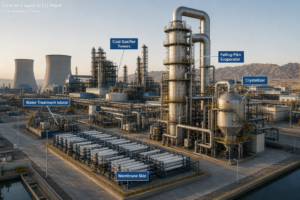
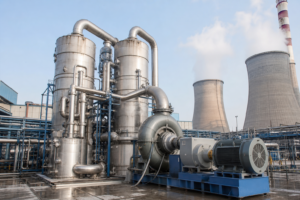
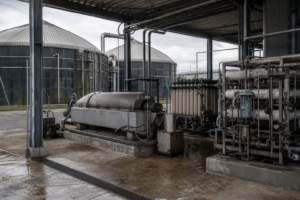
Rare earth mining and smelting wastewater — high in ammonium chloride, heavy metals, and solvent-extraction residues — reaches zero liquid discharge by a staged route: neutralization and impurity removal first, then MVR evaporation-crystallization recovering ammonium chloride as saleable product in the first crystallization stage and mixed salts in the second, with membrane polishing of condensate closing the water loop. The approach is documented by an external industry reference: a publicly reported rare earth group project (not an EvapCryst project) treating 500 m³/d of ammonium chloride wastewater with MVR consumed about 37 kW·h per ton of water — a reported saving above 65% versus the multi-effect evaporation it replaced; indicative of that deployment, not a guarantee. No liquid discharge, one recovered chemical, one characterized solid, reusable water.
Why Rare Earth Wastewater Defies Conventional Treatment
Ion-adsorption rare earth ores are leached with ammonium sulfate or chloride solutions, and downstream separation runs on acid leaching and solvent extraction. The result is a wastewater family whose defining features are:
- High dissolved solids — an illustrative envelope of tens of thousands to over one hundred thousand mg/L TDS from published sector literature; extraction and ion-exchange streams can exceed 100,000 mg/L
- Ammonium nitrogen — the core pollutant of the sector, present as ammonium chloride or ammonium sulfate
- Heavy metals — lead, cadmium, arsenic, chromium and others from the ore body
- Organic pollutants — extraction agents and kerosene-based diluents carried over from separation
- Naturally occurring radioactive materials — uranium and thorium associated with some ores, requiring managed handling
Traditional end-of-pipe processes were engineered for a different era and a weaker wastewater:
| Limitation of traditional processes | Practical impact on rare earth plants |
|---|---|
| Biological treatment inhibited by salinity | High TDS suppresses microbial activity; biological systems collapse or never start |
| Poor removal of dissolved pollutants | Dissolved salts, low-level organics, and ammonia pass through neutralization and coagulation |
| Excessive sludge generation | High-moisture, complex sludge — frequently classified as hazardous waste |
| Water wasted rather than recovered | Treated water is discharged instead of reused in a water-stressed mining region |
| Cannot meet modern discharge standards | Tightening rare earth industry limits exceed what precipitation alone can deliver |
The sector conclusion is consistent: for high-ammonium, high-salt rare earth wastewater, evaporation-based recovery is not one option among many — it is the enabling technology for compliance.
The Two-Stage Ammonium Chloride Recovery Concept
For ion-type operations, the dominant salt is ammonium chloride. The recovery concept divides the evaporation duty into two crystallization stages, each optimized for a different output:
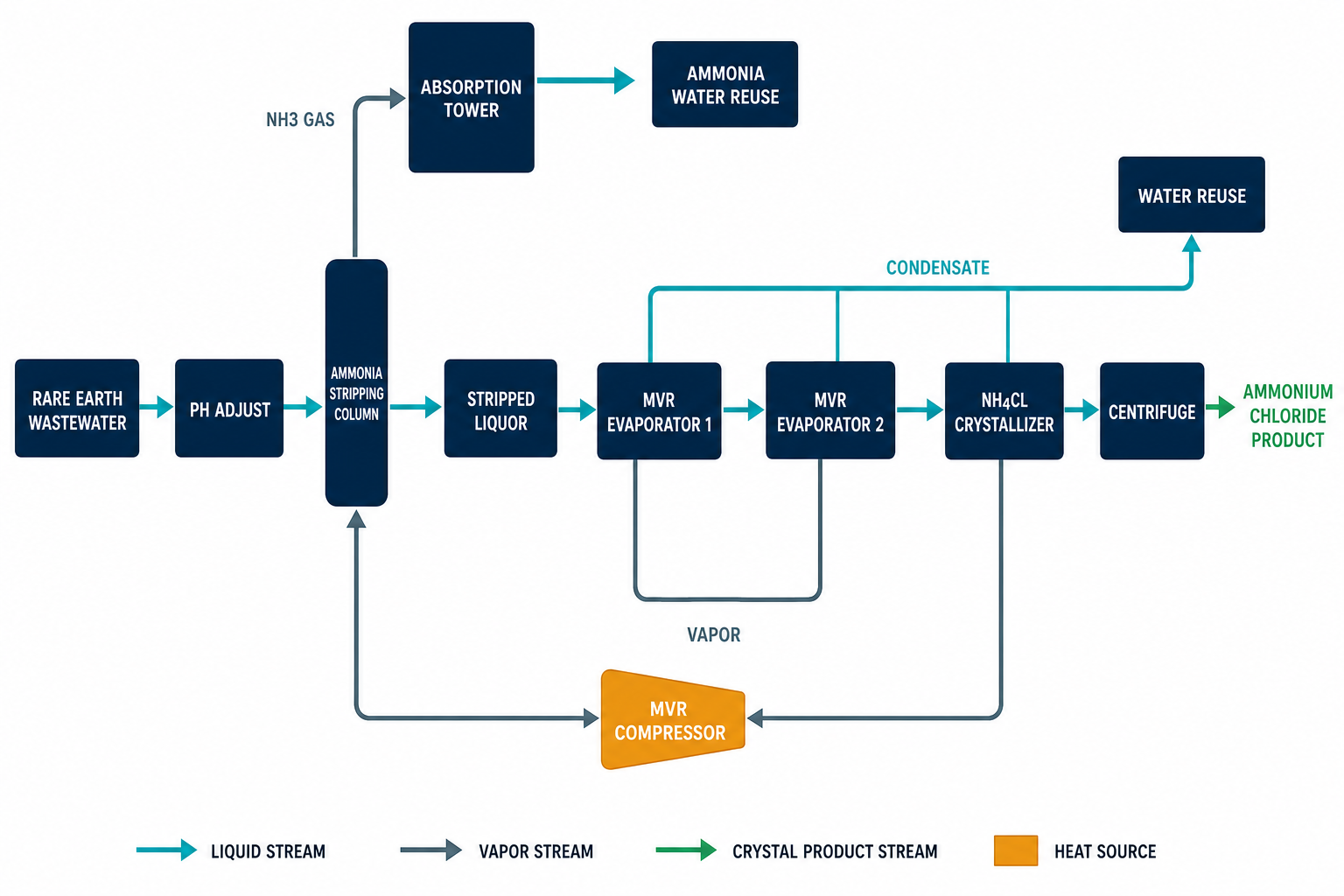
- First stage — product crystallization. Pretreated wastewater is concentrated under vacuum by MVR until ammonium chloride crystallizes. Controlled supersaturation, seeding, and classification produce a coarse, washable NH₄Cl crystal for by-product sale or recycle as leaching make-up.
- Second stage — impurity salt capture. First-stage mother liquor carries accumulated magnesium, calcium, sodium, sulfate, and trace metals. A second, smaller crystallizer drives these to a mixed-salt solid, characterized and disposed of as general or hazardous waste per its analysis — the purge that keeps first-stage product clean and the loop stable.
- Condensate polishing. Ammonia carryover in distillate is controlled by pH management and polished — with the membrane stage — so recovered water meets reuse standards for leaching, washing, or make-up.
This two-stage structure converts a treatment plant into a chemical recovery plant: ammonium chloride leaves as product, a small impurity salt as the only waste.
Process Flow, Stage by Stage
| Process Module | Function & Selection Basis | Output |
|---|---|---|
| Pretreatment | Remove suspended solids, adjust pH, soften hardness, break organics and emulsions | Stable, low-fouling feed for the evaporator train |
| Resource recovery | Recover residual rare earth values by precipitation, membrane separation, or selective adsorption | Rare earth concentrate returned to the separation circuit |
| MVR evaporation — concentration | Vacuum evaporation with mechanical vapor recompression; typically concentrates the stream more than tenfold | Clean condensate + concentrated ammonium brine |
| MVR crystallization — stage 1 | Ammonium chloride crystallization and centrifugal dewatering | By-product NH₄Cl crystals |
| MVR crystallization — stage 2 | Impurity purge crystallization | Characterized mixed-salt solid for disposal |
| Membrane polishing (RO) | Polish condensate; total salt rejection above 99.5% in well-designed systems | High-purity reuse water; overall system water recovery rates above 90% |
Note: configurations and figures are indicative industry-reported ranges, not project guarantees; selection depends on actual feed, chloride activity, corrosion review, and capacity.
Four Wastewater Types, Four Routes
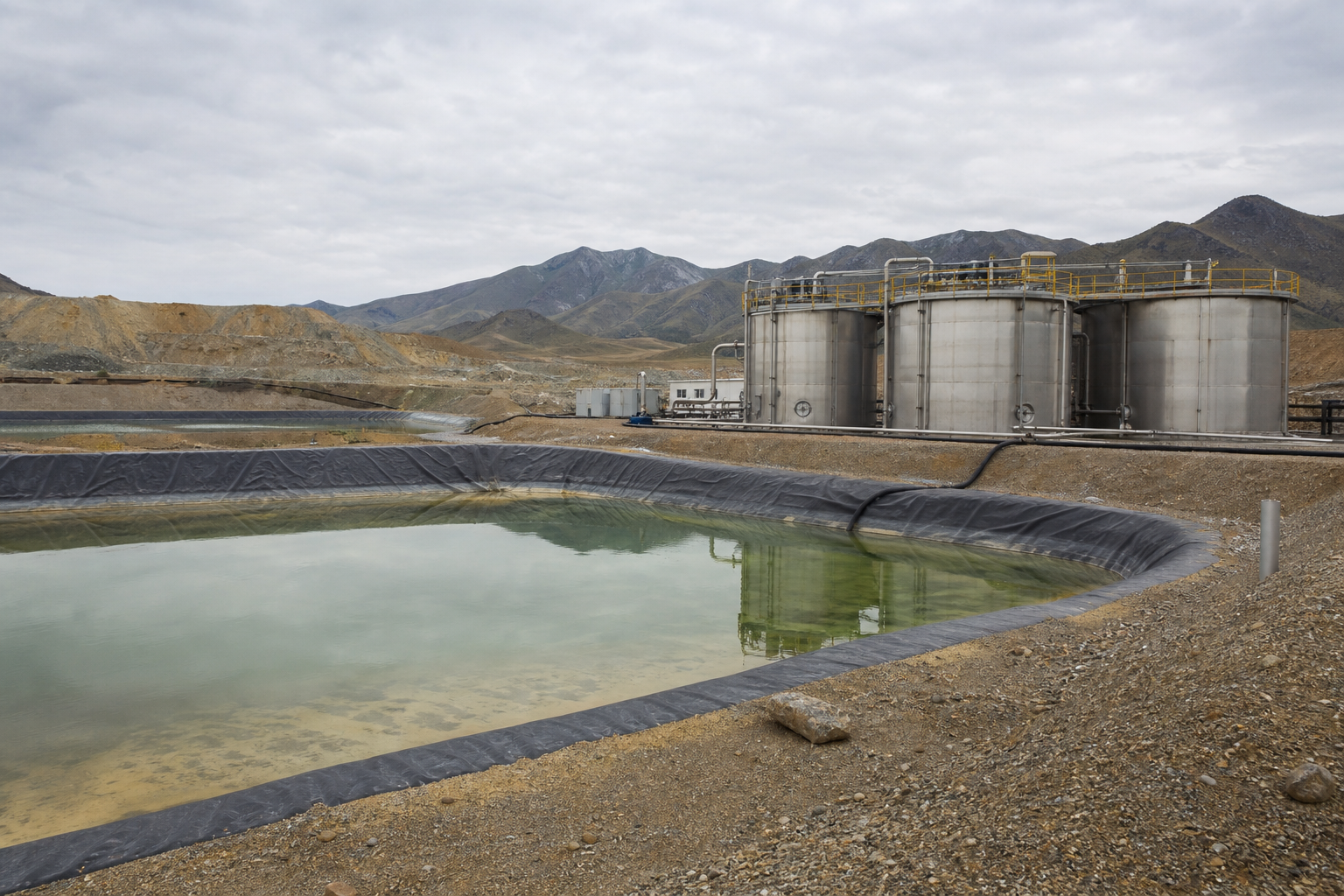
A rare earth site is not one wastewater but four, and mature design routes each separately:
- Beneficiation wastewater — high suspended solids and flotation reagents, comparatively low salinity: coagulation-sedimentation and ultrafiltration return it to reuse without evaporation.
- Decomposition wastewater — extreme pH, high salinity (ammonium chloride or sulfate), dissolved rare earths and heavy metals: neutralization-precipitation, MVR evaporation, RO polishing — high-purity water plus salt crystals.
- Extraction / ion-exchange wastewater — the hardest stream: salinity above 100,000 mg/L, COD from extractants, high ammonia, valuable rare earths: oil-removal pretreatment, MVR evaporation recovering rare-earth-bearing concentrate and condensate, then advanced oxidation and RO to reusable water.
- Refining (precipitation mother liquor) wastewater — high salt, lower organics: pH adjustment, evaporation-crystallization, condensate polishing — reusable water and recovered salts.
Proven Performance Benchmarks
The performance envelope of this route is documented in public industry reporting rather than vendor claims alone. The figures are external industry references — indicative ranges, not EvapCryst project data or performance guarantees:
- Energy. A rare earth group ammonium chloride project (500 m³/d, MVR, EPC with contracted operation) reported approximately 37 kW·h per ton treated — more than 65% saving against the multi-effect benchmark. Sector-wide, MVR is quoted at 30–50% lower energy than multi-effect, and better than 80% steam saving versus single-effect.
- Volume reduction. Evaporation routes reduce volume 80–95%, concentrating the stream more than tenfold before crystallization.
- Water recovery. With RO polishing, overall water recovery above 90% is achievable, membrane salt rejection above 99.5%.
- Deployment speed. Modular factory-assembled units cut on-site installation roughly 80% versus stick-built — material in remote mining regions.
Materials and Equipment Selection
Ammonium chloride is deceptively aggressive: pH-neutral but corrosive to carbon steel and marginal stainless grades, especially under oxygen at temperature. Material strategy follows concentration and chloride activity:
- 316L stainless steel as the baseline for moderate chloride service
- Duplex stainless, titanium, or Hastelloy for the hottest, most concentrated crystallizer surfaces — titanium and Hastelloy are standard for long-term chloride-rich rare earth service
- Forced-circulation evaporators for crystallizing stages — slurry service, scaling tendency, and viscosity rise rule out falling film beyond the dilute front end
- Demisting and ammonia control on the vapor side to protect compressor and condensate ammonia specification
Radioactive elements (uranium, thorium) are managed in pretreatment and sludge handling, not in the evaporator; routing is established from ore mineralogy during design.
Water Balance and Plant Integration
Zero liquid discharge is plant-wide, so the recovery island must be designed against the site’s real water balance, not a single influent number. Three integration points decide success:
- Feed stability. Ore grade, leaching agent strength, and rainfall all move ammonium concentration. Equalization sized for the leaching cycle’s rhythm — not the calendar day — keeps the train on design concentration and protects crystal quality.
- Condensate routing. Recovered water earns value only by displacing fresh water: leaching make-up, equipment washing, and cooling make-up are standard destinations. The polishing specification should be written from those destinations backward.
- Ammonia balance. Ammonium chloride recycled as leaching agent re-enters the ore circuit; ammonium sold as product leaves. Which the site emphasizes changes first-stage crystallizer product specification and drying duty, and should be decided before detailed design.
Commercially, rare earth recovery plants are increasingly delivered under EPC with contracted operation — the owner buys treated-water compliance and by-product output rather than equipment. The reference project cited above ran under exactly this model — an external industry example, not an EvapCryst delivery.
Ammonium Chloride By-Product and Salt Handling
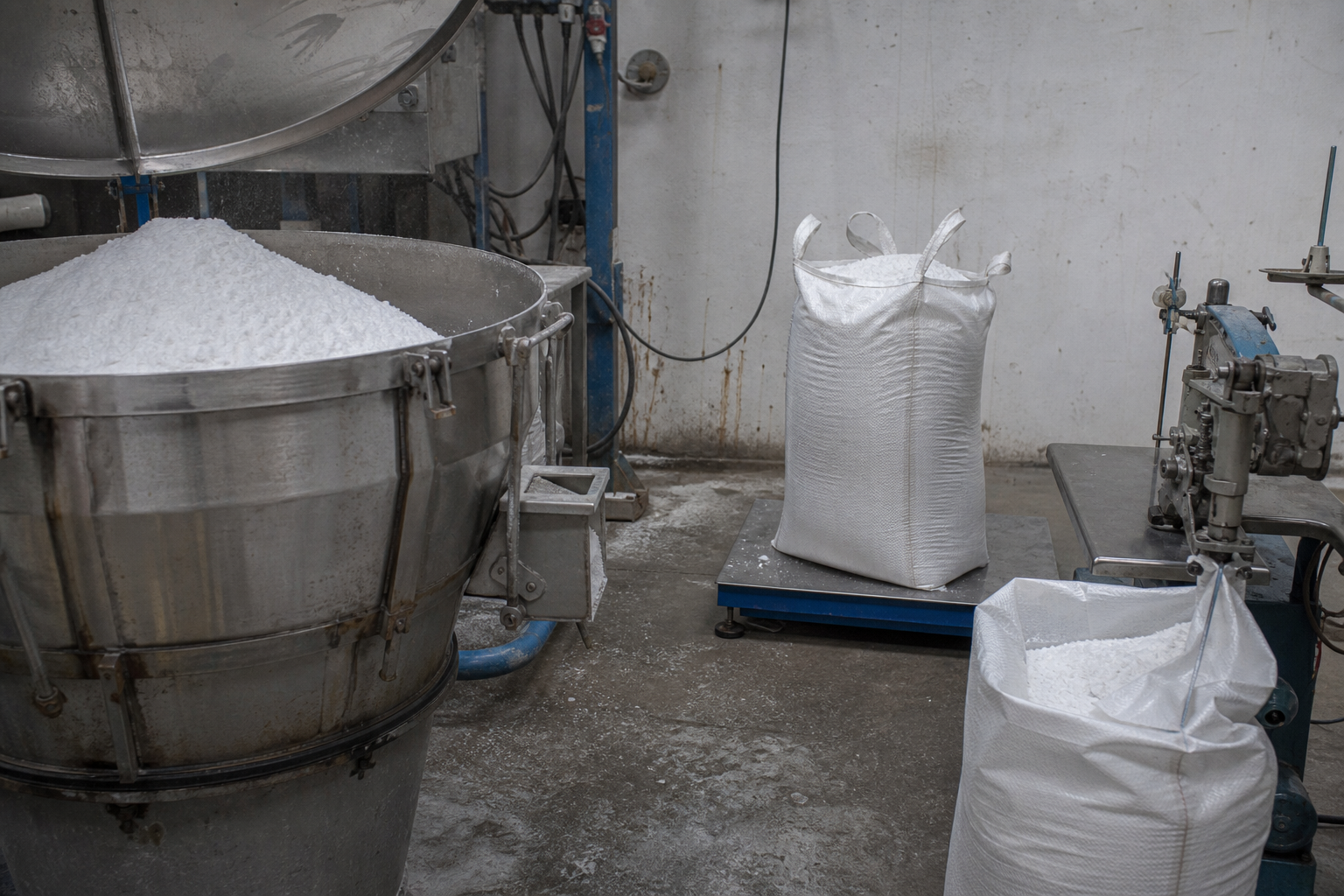
First-stage NH₄Cl is centrifuged and dried to free-flowing product. Value routes include sale as fertilizer-grade or industrial ammonium chloride and recycle as leaching make-up for ion-adsorption operations — closing ammonia and water balances together. Second-stage mixed salt is characterized per local solid-waste classification before disposal.
The same ammonium-salt resource recovery logic extends across adjacent battery-material chemistries — see our lithium precipitation mother liquor recovery solution for the sulfate-route counterpart.
Explore the underlying capability lines: MVR evaporation, forced-circulation crystallizers, drying and packing systems for the NH₄Cl product, the full ZLD solution architecture, and our rare earth industry page.
When This Route May Not Fit
Evaporation-based ammonium recovery earns its place only against genuinely saline, ammonium-rich streams, and several situations fall outside that envelope. Beneficiation waters — high in solids, low in salt — are served by coagulation and filtration at far lower cost. Very dilute ammonia-bearing effluents with little salt belong to stripping or breakpoint chemistry instead, not to a thermal island. Where ammonium chloride has no local market and no recycle role in the leaching circuit, the recovered crystal becomes a storage problem rather than any revenue. Where ore mineralogy carries significant uranium or thorium, the permitting burden of a crystallization island may exceed what the site can carry. And small or intermittent flows cannot amortize the compressor train that makes the route efficient.
What Must Be Verified
Validation before any capital commitment must cover the full stream picture: a water balance and full characterization for each of the four wastewater types on site — TDS, ammonium form, heavy metals, extractant organics, radioactivity — because each routes differently and mixing them destroys the economics. Pretreatment confirmation: oil and emulsion breaking verified on the actual extraction wastewater before that stream ever meets the evaporator. Product market verification: whether the first-stage NH₄Cl crystal meets fertilizer or industrial specifications, and at what washing cost. Solid classification: second-stage mixed salt and pretreatment sludge tested against local hazardous-waste classification rules. Radioactivity routing established from ore mineralogy during design, and condensate ammonia checked against each of the intended reuse destinations before the island is ordered.
Required inputs for screening: per-stream water analysis (TDS, ammonium, metals, organics), volumes, reuse targets, and the intended NH₄Cl disposition — enough to route the four wastewater types.
Frequently Asked Questions
Why can’t rare earth wastewater simply go to a conventional treatment plant?
Because its defining pollutants are dissolved salts and ammonia at concentrations that shut down biological treatment, pass through chemical precipitation, and generate hazardous-classified sludge when forced through them. Evaporation-based recovery is the only route that simultaneously removes the salt, recovers the ammonium, and returns reusable water.
What is recovered from the wastewater besides water?
Ammonium chloride as a first-stage crystalline by-product (fertilizer-grade or industrial sale, or recycle as leaching make-up), mixed impurity salts as a characterized solid, and — where the design includes it — residual rare earth values recovered ahead of the evaporator and returned to the separation circuit.
How much energy does MVR consume on ammonium chloride wastewater?
The external reference project reported roughly 37 kW·h per ton at 500 m³/d, over 65% better than multi-effect. Across published industry practice, expect 30–50% energy savings versus multi-effect and better than 80% steam saving versus single-effect thermal evaporation, with the exact figure set by feed concentration and heat-recovery design.
What materials are required?
Ammonium chloride service requires more than carbon steel and 304: 316L is the baseline, with titanium or Hastelloy on hot, concentrated crystallizer surfaces for long life. Material selection should be finalized against the full water analysis, including chloride activity and any acid excursions.
Does the process handle the radioactive elements in some rare earth ores?
Uranium and thorium associated with certain ores are addressed in pretreatment and sludge management rather than in the evaporator. Their concentration and routing must be established from ore mineralogy during design so that all solid outputs carry correct waste classification.