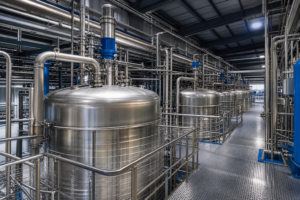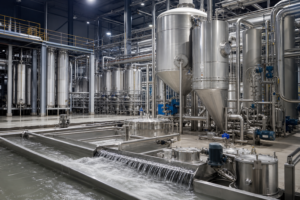
Copper sulfate production concentrates and crystallizes wherever copper value and water management meet: smelting and metallurgy plants, copper processing, and PCB etching lines all generate sulfate-bearing liquors rich in dissolved copper. Evaporation-crystallization – increasingly MVR-driven – converts those liquors into saleable copper sulfate pentahydrate crystal, reusable water, and a minimized wastewater footprint. This page lays out the product chemistry, process routes, and how MVR evaporative crystallization applies to copper sulfate duties.
Where Copper Sulfate Comes From and Who Buys It
Copper sulfate is among the most versatile industrial salts. Classical routes include smelting and refining with extraction and purification, leaching of copper oxides and scrap in sulfuric acid, and recovery from fabrication byproduct streams. The product serves four broad markets:
- Agriculture – fungicide formulations (Bordeaux mixture and successors), soil copper correction, and seed treatment
- Mining – activator in the froth flotation of sphalerite and other sulfide ores
- Chemical synthesis and electroplating – reagent-grade feedstock and copper-plating electrolytes
- Feed and micronutrients – trace copper supplementation
Across all of them the product is predominantly copper sulfate pentahydrate (CuSO4·5H2O), the blue triclinic crystal. Whatever the upstream route, final purification and product formation is crystallization — why evaporation-crystallization capacity sits at the heart of every flowsheet.
Product Chemistry: Why Pentahydrate Rewards a Combined Route
Copper sulfate’s solubility rises steeply with temperature — a large multiple between ambient and near-boiling. That sensitivity is the designer’s lever, and two crystallization modes follow:

- Evaporation crystallization removes solvent to drive supersaturation at roughly constant composition — the route for dilute liquors and waste streams needing volume minimization anyway.
- Cooling crystallization exploits the steep solubility curve: saturate hot, chill to precipitate crystal without evaporating more water — energy-efficient with already-concentrated liquor and available process heat.
Industrial plants typically combine them: evaporative concentration brings liquor to near-saturation, and controlled cooling (or continued vacuum evaporation, which self-cools) generates the supersaturation that grows pentahydrate crystal. Controlled cooling rewards gentle, well-mixed geometry — crystal size, shape, and caking behavior all trace back to how supersaturation was created and relieved.
Choosing the Crystallization Route
| Criterion | Evaporation crystallization | Cooling crystallization | Combined evaporate-then-cool |
|---|---|---|---|
| Best feed | Dilute liquor, waste streams | Hot saturated liquor | Dilute feed targeting coarse crystal |
| Water removal | Full | None (temperature-driven) | Partial |
| Energy emphasis | Latent heat – MVR strongly favored | Refrigeration/heat rejection | Split duty |
| Waste volume reduction | Strong | None | Strong |
| Typical product control | Good, circulation-governed | Excellent (slow cooling grows coarse crystal) | Excellent |
For copper-bearing waste streams the evaporation column dominates: the plant’s job is not only product but making water leave the circuit — precisely the duty MVR was built for.
Recovering Copper Sulfate from Etch Solutions and Waste Streams
A growing application is copper recovery from the etch solutions of copper sulfate production and fabrication. Etch solution carries dissolved copper plus process impurities; historically a waste liability, with traditional handling losing both copper value and water. An MVR evaporative crystallization device changes the arithmetic:
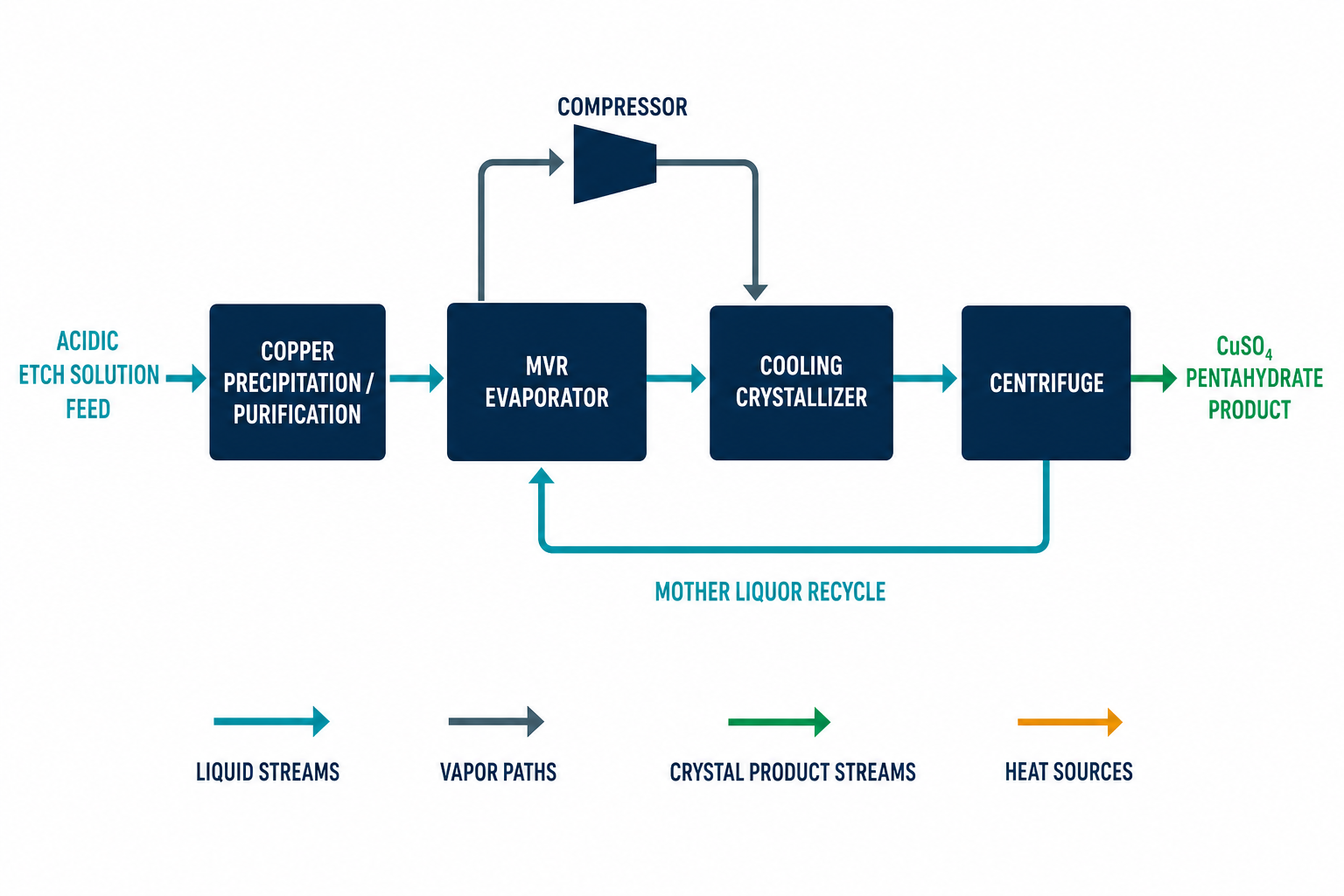
- Evaporation. The etch solution boils in the evaporator body: water leaves as vapor while copper and other components concentrate toward saturation.
- Vapor recompression. The vapor is compressed to higher temperature and pressure and reused as heating medium — the cycle sustains itself on a fraction of the external energy conventional evaporation demands.
- Crystallization. As saturation is reached, copper sulfate crystallizes as controlled pentahydrate.
- Separation and recycle. Crystal is centrifuged as high-purity product; mother liquor recycles to the evaporator; condensate returns as clean water.
The impurity profile deserves explicit attention. Etch and smelter-derived liquors accumulate companion metals and anions (iron, nickel, arsenic, chloride), and the loop needs a purge strategy so impurities exit without smothering crystal purity. Fractional crystallization — exploiting differing solubility to reject impurities to mother liquor — is the standard tool, and purge liquor can itself feed a zero-liquid-discharge train. See our salt separation and fractional crystallization capabilities for the underlying methods.
Why MVR Fits Copper Sulfate Duty
Conventional evaporation spends external energy – usually boiler steam – on every ton of water, and on dilute waste streams the tonnage is large. MVR attacks exactly that cost:
- Vapor recycling replaces most live steam. The compressor upgrades evaporated vapor into heating steam, so ongoing energy input is compressor electricity plus small trim steam, not ton after ton of boiler steam.
- Crystallization pays for the evaporation. Recovered high-purity crystal is product revenue, not waste — turning a disposal cost line into byproduct income.
- Wastewater volume is minimized. Water leaves as reusable condensate and dissolved load as crystal; residual wastewater shrinks dramatically, cutting disposal cost and compliance exposure.
- Steady low-temperature boiling. Vacuum operation keeps liquor below temperatures that promote corrosion and side-reactions, protecting equipment and crystal quality.
The detailed compressor cycle, temperature lift and control philosophy are covered in the MVR evaporation technology overview.
Reference Project: MVR Crystallization at a Meizhou Metallurgy Plant
The following is an external industry reference from published project reporting — not an EvapCryst project or evidence of our delivery record; outcomes are vendor-reported for that installation, indicative rather than guarantees. A company operating in Meizhou – a metallurgy smelting center – produces copper sulfate as a key raw material stream; the critical handling step is the etch solution carrying dissolved copper and impurities. An MVR evaporative crystallization device was engineered specifically for that stream, with three reported outcomes:
- Efficiency in the smelting-related process – vapor recycling inside the MVR cycle removes most of traditional evaporation’s external energy demand
- Recovery of high-purity copper sulfate crystal – dissolved copper returns as saleable product rather than waste loss, improving yield and opening additional revenue
- Wastewater minimization – wastewater volume falls substantially, cutting disposal cost and contamination risk while supporting compliance
Projects of this shape also strengthen the regulatory and customer position: a smelter converting effluent into product while shrinking discharge satisfies scrutiny on both fronts.
Scope of Supply for a Copper Sulfate Train
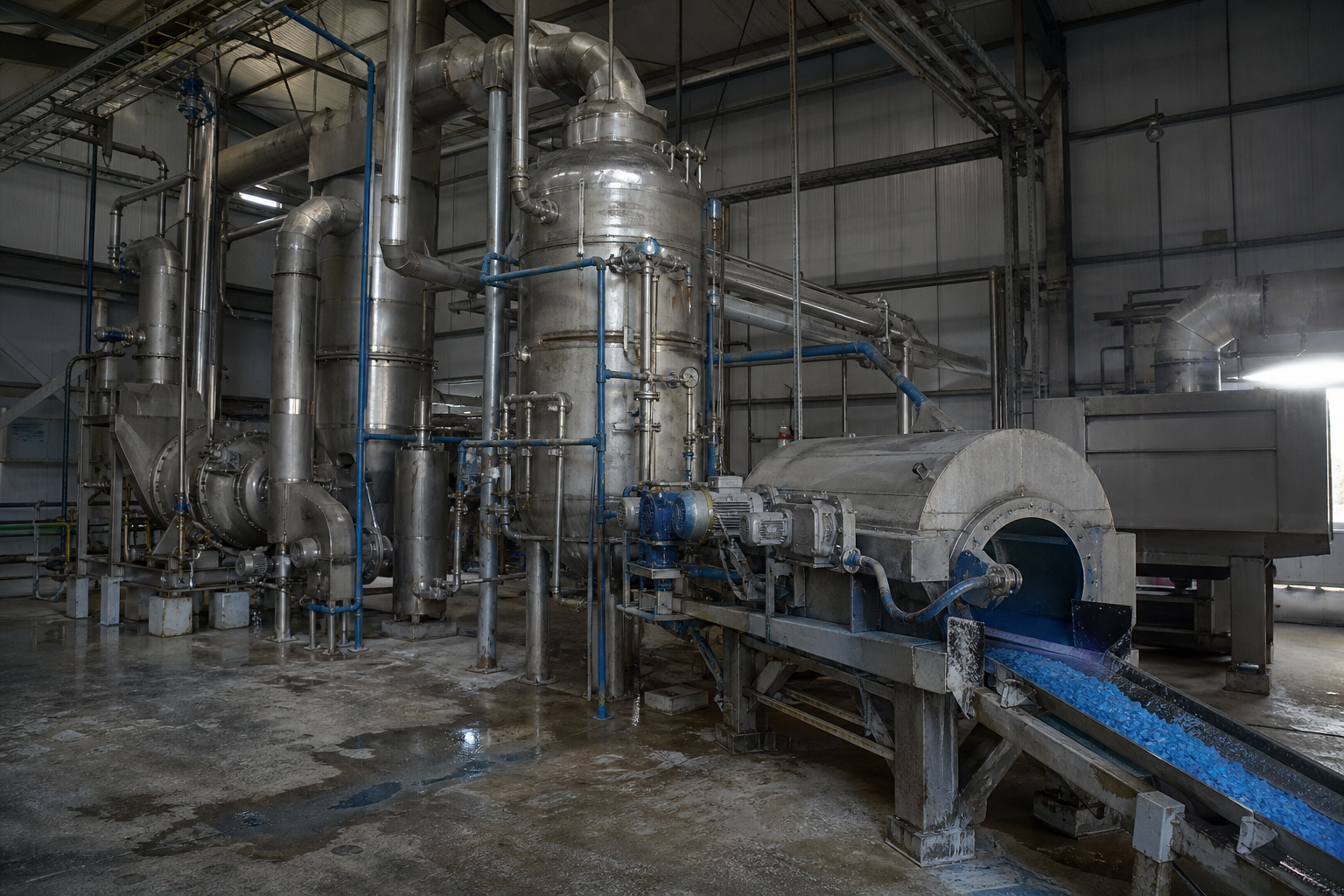
A complete plant normally comprises: feed pretreatment and filtration, MVR (or multi-effect) evaporator with forced-circulation or OSLO crystallizer body, vapor compressor and surface condenser, thickener and centrifuge, and drying and packing for the pentahydrate product. Materials follow the liquor: sulfate media suit stainless construction, while chloride-carrying etchants (ammoniacal or acidic chloride) demand the titanium and duplex zoning used in chloride service. Pretreatment removing organics ahead of evaporation protects heat transfer and crystal color — a real commercial concern for agricultural-grade blue crystal.
The Sulfate-Salt Family
Copper sulfate rarely operates alone. The same architecture – adjusted for each salt’s solubility personality – serves neighboring sulfate duties: zinc sulfate solutions for agrochemical and electroplating chains, manganese sulfate solutions for feed and battery materials, and mixed-salt systems under zero liquid discharge where several salts must leave the circuit separately. Buyers on one sulfate duty should check adjacent pages: the evaporator that fits copper today usually has a zinc or manganese extension tomorrow.
Process Modules and Selection Basis
| Process Module | Candidate Equipment | Selection Basis |
|---|---|---|
| Pretreatment & filtration | Filters, organics removal | Protect heat transfer and crystal color |
| Evaporation | MVR or multi-effect body, vacuum | Dilution of feed; energy economics; corrosion ceiling |
| Crystallization | Forced-circulation or OSLO body; combined evaporate-then-cool | Solubility slope; target crystal size |
| Separation & recycle | Thickener, centrifuge, mother-liquor purge | Impurity companions; product purity spec |
| Drying & packing | Dryer, screening, bagging | Pentahydrate caking and color behavior |
Note: configurations are indicative; selection depends on actual feed, chloride presence, corrosion review, utilities, and capacity.
Scale and Delivery Considerations
Copper sulfate trains scale across a wide band — package units treating a few hundred liters per hour at PCB workshops, mid-size smelter byproduct lines, and continuous agrochemical-grade plants running parallel crystallizers. Because pentahydrate is a bagged commodity, drying, screening, and packing deserve as much layout attention as the evaporator; undersized drying shows up as caked, off-color product and customer claims. Modular shop-assembled delivery shortens site works and adds capacity in steps as recovery volumes grow.
When This Route May Not Fit
MVR evaporative crystallization earns its place when water tonnage and copper value are both large, and several situations break that balance. Very dilute streams with low copper tenor spend more energy evaporating water than the recovered crystal can return — solvent extraction or electrowinning fits that regime better. Chloride-dominated etchants (ammoniacal or acidic chloride systems) demand titanium and duplex zoning whose cost must be justified by throughput, and at small scale a simpler steam-heated crystallizer may be the honest answer instead. Where the crystal has no sales outlet and no internal use, recovery merely converts a liquid problem into a solid one. And where arsenic or other regulated companions run high, the purge-disposal burden can outweigh the by-product economics entirely.
What Must Be Verified
No external case data beyond the reported reference above is embedded here, so validation before any capital commitment must cover all of the following: a full liquor characterization — copper tenor and swing, sulfate versus chloride system, companion metals (iron, nickel, arsenic), and organics — across representative production campaigns over several weeks; an impurity-partitioning check confirming which companions reliably stay in mother liquor at the intended crystallization window; a purge and ZLD plan for the mother-liquor bleed where discharge limits demand it at the site; a full materials review zoned by chloride presence and by temperature; and a product-market confirmation that the pentahydrate’s color and purity meet the intended agricultural, mining, or electroplating specification before the drying line design is frozen for order.
Frequently Asked Questions
Is copper sulfate pentahydrate produced by evaporation or cooling crystallization?
Both are used, often together. Evaporation crystallization concentrates dilute liquor and suits waste-stream minimization; cooling crystallization exploits copper sulfate’s strong temperature-solubility slope to grow coarse crystal from hot saturated liquor with little added evaporation. Most continuous plants combine the two.
Can copper be recovered from etch solution economically?
Yes. MVR crystallization concentrates the etch solution, crystallizes copper as high-purity sulfate, and returns condensate for reuse — saleable crystal that typically converts treatment cost into a modest net gain.
How does MVR reduce wastewater volume?
Water leaves the process as evaporated vapor, which is condensed as clean reusable condensate, while the dissolved copper leaves as crystal. The liquid discharge stream shrinks to a small purge, cutting both disposal cost and compliance risk.
What happens to impurities like iron, nickel or arsenic?
They concentrate in the mother liquor rather than the crystal if the crystallization window is correctly set. A controlled purge keeps them from accumulating; purge liquor can be further treated in a ZLD train when discharge limits demand it.
What construction materials are required?
For sulfate liquors, stainless steel construction is generally adequate. When the feed is a chloride-bearing etchant, wetted parts step up to duplex and titanium in the same temperature-zoned approach used for other chloride duties.
In summary, copper sulfate evaporation-crystallization is where environmental duty and product economics converge. The plant concentrating liquors by MVR, crystallizing pentahydrate for sale, and returning water to process improves yield, energy cost, and compliance together — what regulators and finance both reward.
Required inputs for screening: liquor analysis (copper tenor, sulfate/chloride, companions), volume, and target product grade — enough to outline the train and the purge strategy.