Project Parameters
| Parameter | Value |
|---|---|
| Process route | Triple-effect evaporation + forced-circulation crystallization |
| Industry | Chemical processing — ammonium-bearing plant effluent |
| Feed type & key components | Ammonium chloride wastewater from chlor-amination and by-product chemistry |
| Evaporation capacity | 6 t/h water removal |
| Construction materials | SS316L / duplex wetted parts (indicative) |
Representative process configuration compiled from published industry project data. Indicative values, not a process guarantee.
Project Description
A chemical plant in China runs chlor-amination and allied chemistry in which ammonium chloride appears as the inevitable by-product salt: every tonne of product leaves a salt load in the process water that the site must either discharge, dilute, or recover. Ammonium chloride effluent resists the usual escapes — it is toxic to biological treatment at modest concentrations, it carries chloride that corrodes conventional steel, and its nitrogen content draws regulatory attention that a simple discharge permit will not cover. The site’s program is a 6 t/h evaporation and crystallization unit that turns the stream into a dewaterable ammonium chloride solid and recyclable condensate.
The reference configuration is a triple-effect train closing in a crystallizing section. At this scale the triple-effect route is the balanced answer: steam economy roughly tripled over a single body without the compressor capital of MVR, a match for a site with dependable process steam and a moderate continuous duty. Ammonium chloride’s own behavior dictates the finish — it crystallizes readily on concentration, so the train is built to end in controlled crystallization rather than in a simple concentrate draw.
Process Technology
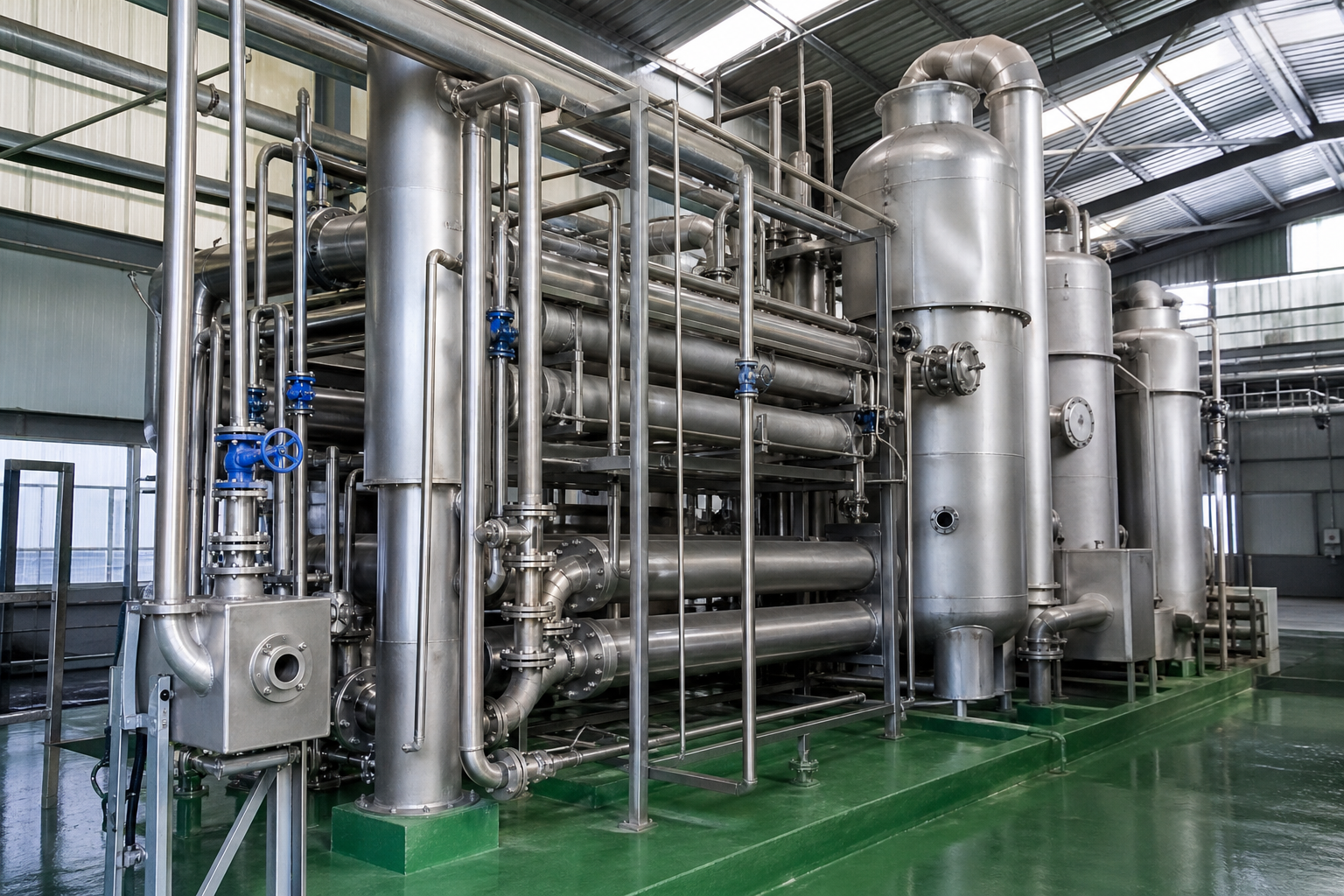
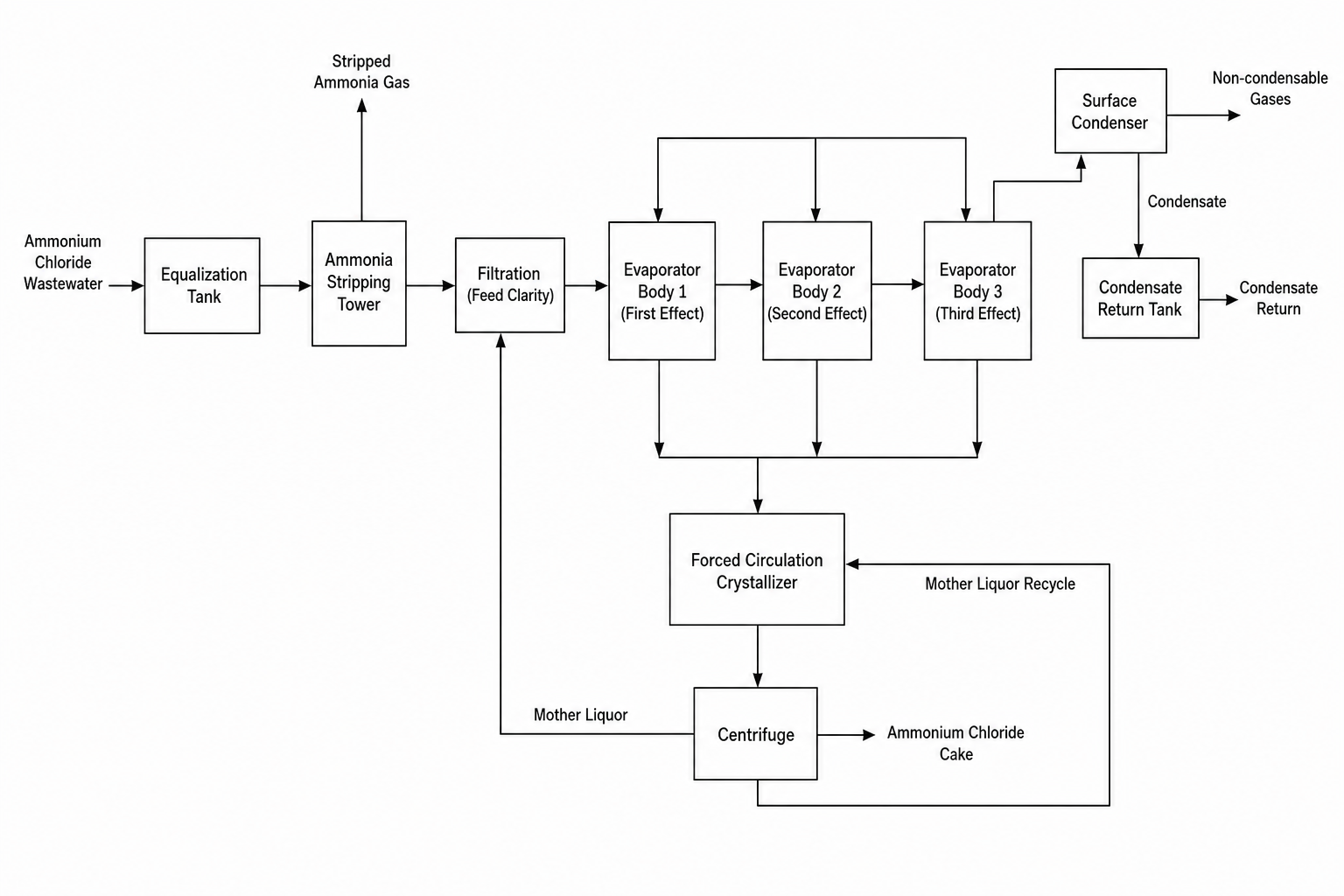
The wastewater is equalized to smooth the upstream batch cycles, filtered for organics and fines, and where the ammonia load runs high, a stripping or pH-management step ahead of the train recovers free ammonia — ammonia that would otherwise ride the vapor path and contaminate the condensate. This is the quiet design decision that decides condensate quality on ammonium service: manage the free ammonia before evaporation, and the condensate returns clean; skip it, and every effect carries ammonia forward.
The three effects run in a descending temperature ladder, live steam to the first body and each subsequent body heated by its predecessor’s vapor at lower pressure. The front effects concentrate the liquor well below saturation — plain water removal at maximum steam economy. As the liquor approaches the crystallization window it enters the crystallizing section, operated on the forced-circulation pattern: high-velocity pumped flow through the heater, boiling suppressed to the separator, ammonium chloride crystals nucleating and growing in the bulk liquor instead of on the heat transfer surface. Ammonium chloride’s chloride load makes any wall deposition doubly unwelcome — fouling and hot-chloride corrosion arrive together — so the architecture that keeps the wall wet with moving liquor is the one that keeps the campaign long.
Slurry from the crystallizing section reports to a centrifuge; the ammonium chloride cake is handled as fertilizer-grade or industrial-feedstock material per the site’s offtake, and mother liquor recycles to the train with a purge controlling trace impurity build-up. Condensate from the surface condenser is collected, checked for ammonia carryover, and returned to the plant’s washing circuit — closing the water balance alongside the salt balance.
Equipment Configuration
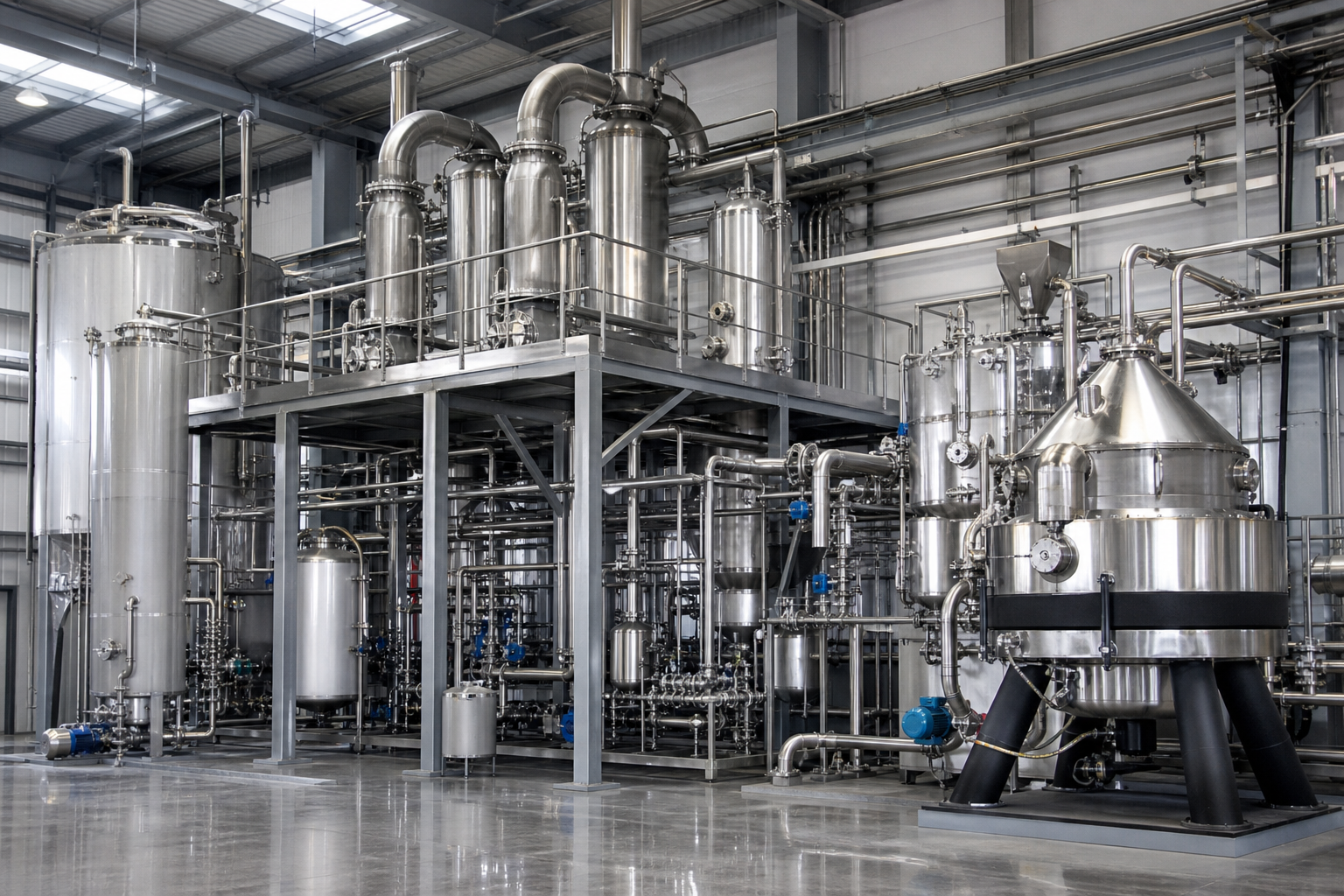
One train of this class comprises:
- Equalization and filtration; free-ammonia stripping or pH management ahead of the train where required
- Triple-effect evaporator bodies with inter-effect vapor transfers, surface condenser and vacuum system
- Forced-circulation crystallizing section with high-flow pump and flash separator
- Centrifuge for ammonium chloride cake; mother-liquor recycle with purge
- Condensate collection with ammonia check, and return pumping to plant washing duty
- Density-based control of the crystallizing cut with clean-in-place circuit
SS316L wetted parts with duplex on the hottest, most concentrated chloride service is the indicative metallurgy; graphite heat exchangers are an established alternative on ammonium chloride duty and are evaluated per project.
Performance & Outcome
Compiled from published industry project data, indicative: triple-effect trains of this class recover ammonium chloride from chemical effluent at duties around 6 t/h as a dewaterable cake with condensate returned to plant reuse, with steam economies typical of three-effect service. Cake grade, ammonia management and energy figures depend on feed strength and are validated per project.
Simplified PFD
The simplified process flow diagram above illustrates the train from equalization through the three effects to crystallization, dewatering and condensate return.