For rare earth separation plants, ammonia nitrogen treatment is not one process but three, selected by concentration: high-strength streams (tens of grams per liter as NH4Cl) go to vacuum evaporation-crystallization that recovers industrial-grade ammonium chloride and RO-polishable condensate; mid-concentration streams (gram-per-liter class) go to ammonia stripping; polishing loads (tens of milligrams per liter) go to breakpoint chlorination. And where a steam-driven stripping system already exists, converting it to MVR stripping cuts its operating cost by more than half. The design premise: matching process to concentration band is what makes an ammonia strategy economical – running the wrong unit on the wrong band is how rare earth plants burn money on nitrogen.
Why One Ammonia Process Cannot Serve a Rare Earth Plant
Rare earth separation is an ammonia generator at every stage: saponification of extractants, carbonate precipitation, chloride circuits and wash waters produce streams whose ammonium nitrogen spans four orders of magnitude – from mother liquors at 130 g/L NH4Cl down to final washes below 100 mg/L. The peer-reviewed reference that defines the graded strategy measured and costed all three bands at one plant: evaporation crystallization for the high band, stripping for the middle, breakpoint chlorination for the low (Huang, Xiao and Yan, Desalination and Water Treatment 8 (2009) 109-117 – external peer-reviewed reference).
The mismatch penalties run both directions. Biological and chemical methods are overwhelmed at gram-per-liter strength – reagent doses scale with load, and salinity inhibits the biology entirely. Evaporation on a dilute stream, conversely, boils water to recover a trivial crystal mass. Each band has exactly one economical resident process, and a surprising share of operating cost in this industry traces to plants that ignored that.
For the mid-band, the energy question has a contemporary answer: MVR ammonia-stripping. A published retrofit reference converted direct steam-stripping ammonia removal to MVR two-stage compression on a 65 t/h train with influent ammonia nitrogen of 2,000-7,000 mg/L, cutting steam use from 98 to 20 kg per ton of water, circulating water from 12.3 to 3.1 t, lifting electricity from 1.5 to 10.5 kWh/t, and bringing operating cost from 32.91 to 13.97 RMB per ton – an annual saving of 8.86 million RMB (about 1.23 million USD) at 7,200 operating hours, with tower-bottom ammonia nitrogen below 15 mg/L (a supplier’s project page – an external industry reference, not an EvapCryst delivery; supplier-published values, not a project guarantee). The same source notes rare earth wet-separation ammonia typically at 0.6-1.6 g/L – squarely in this band.
Illustrative Feed Envelope for Screening
The envelope below consolidates the published three-band reference values with ranges used for screening rare earth ammonia streams. It is an illustrative envelope built from published data and stated assumptions – not a customer dataset, and not a performance guarantee.
| Band | Illustrative range | Resident process | Reference outcome |
|---|---|---|---|
| High strength | NH4Cl around 130 g/L | Vacuum evaporation crystallization, 22-55 kPa, pH near 4 | Industry-grade crystal; condensate ~12 mg/L NH4-N to RO |
| Mid concentration | ~1.5 g/L class (0.6-7 g/L family) | Ammonia stripping (MVR-driven where scale justifies) | ~95% removal; effluent ~80 mg/L; tower bottom <15 mg/L in MVR reference |
| Low concentration | ~70 mg/L class | Breakpoint chlorination, pH 7, Cl:N 8:1 | 97.4% removal; TN 3.4 mg/L; TOC 140 to 14.7 mg/L |
| Common matrix | Chloride-dominant; trace metals, organics | Set by upstream circuit chemistry | Drives materials and pretreatment choices |
| Objective | Discharge-standard compliance with recovery where it pays | Band-by-band selection | Economically appraised viable |
Process Solution: Three Bands, Three Units, One Water Balance
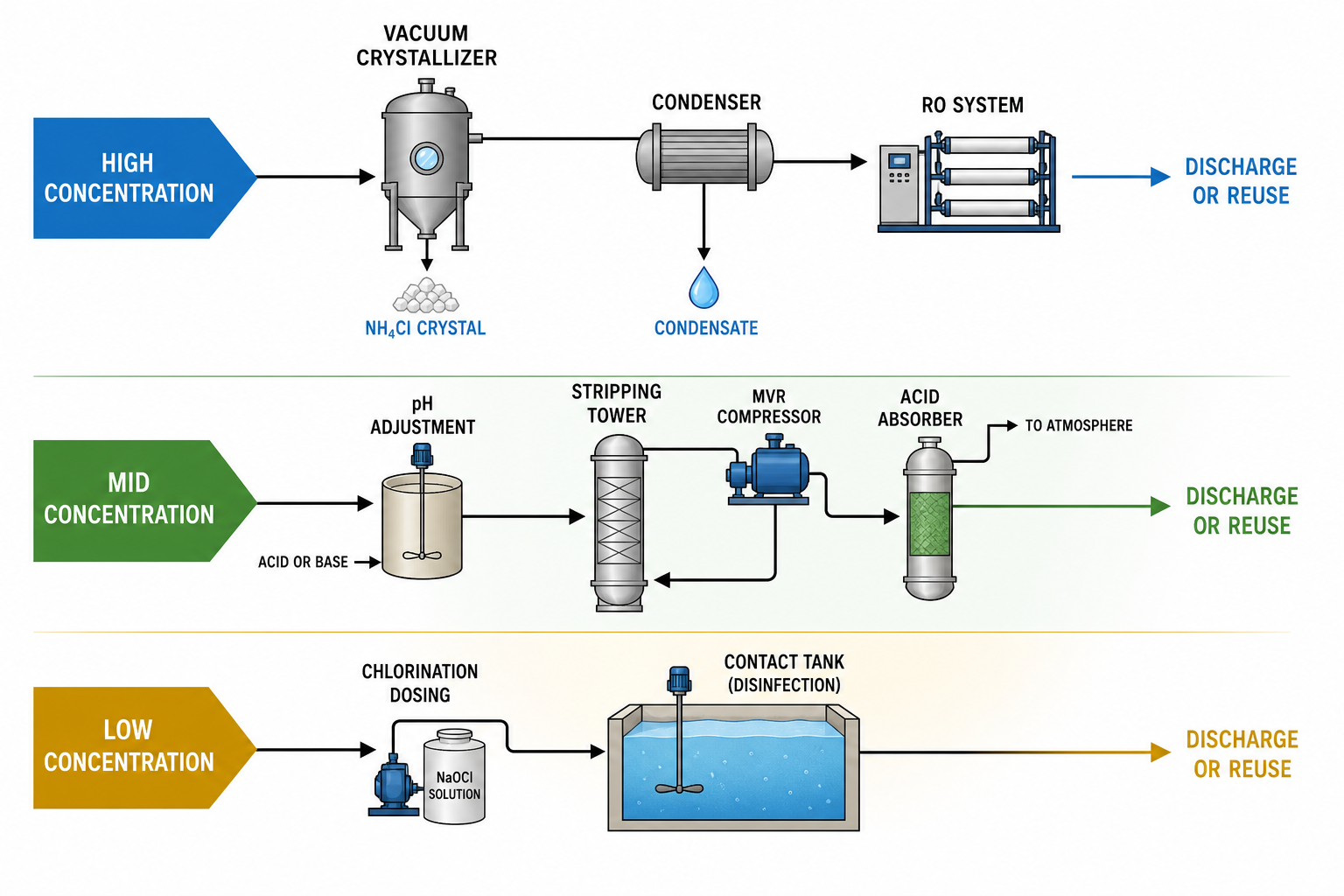
The strategy runs as three parallel treatment lines sized by the plant’s ammonia mass balance. First, the high-strength line: NH4Cl mother liquors at the 100 g/L class enter vacuum evaporation crystallization operated at 22-55 kPa with pH held near 4 – the acidity that keeps ammonia in its soluble ammonium form so it stays with the liquor and reports to the crystal rather than volatilizing with the vapor. The output is crystalline ammonium chloride at industry-level quality, and a condensate carrying only around 12 mg/L NH4-N, clean enough to return to the plant’s RO system and close the pure-water loop.
Second, the mid-band line: wash and general process waters at the gram-per-liter class go to ammonia stripping – pH shifted to around 12 with alkali, heated to the 35-45°C window, and stripped with air in the reference study at 27 L/min for 2 hours, reaching about 95% removal and an effluent near 80 mg/L; at plant scale, an MVR-driven stripping tower with two-stage mechanical compression replaces direct steam as the heat engine, delivering the sub-15 mg/L tower-bottom performance and the halved operating cost of the published retrofit. The stripped ammonia is absorbed in acid and leaves as ammonium salt – recovering nitrogen rather than releasing it.
Third, the polishing line: dilute streams at the tens-of-milligrams class receive breakpoint chlorination at pH 7 with a chlorine-to-ammonium ratio near 8:1, oxidizing the residual ammonium to nitrogen gas; the reference measured 97.4% removal with total nitrogen at 3.4 mg/L and TOC falling from 140 to 14.7 mg/L. The three lines together are what let a separation plant meet discharge standards while monetizing its strongest stream.
Technical Features That Decide the Economics of the Graded System
Three features carry the engineering weight. The first is pH discipline as the selectivity lever. The high band runs acidic so ammonium stays dissolved; the mid band runs at pH 12 so the ammonia/ammonium equilibrium shifts to the strippable free base. Getting either wrong does not merely lose efficiency – it sends the ammonia to the wrong place (vapor in the crystallizer, liquor in the stripper).
The second is the MVR retrofit economics on stripping. The published comparison is stark in structure even before its numbers: steam collapses from 98 to 20 kg/t, circulating water from 12.3 to 3.1 t, and electricity rises from 1.5 to 10.5 kWh/t – the compressor trades cheap kWh for expensive steam and cooling. Whether that trade pays at your site depends on your actual steam and power prices, which is why the energy model belongs in screening, not in procurement.
The third is the boundary drawing between bands. The 130 g/L and 1.5 g/L and 70 mg/L reference points anchor the bands, but a real plant’s streams fall between them. The allocation rule is marginal cost per kilogram of nitrogen removed: as a stream gets more dilute, evaporation’s cost per kilogram climbs steeply and stripping’s falls; somewhere in the gram-per-liter region the lines cross, and that crossing – computed on your energy prices and reagent costs – is the boundary your flowsheet should respect.
Process Modules
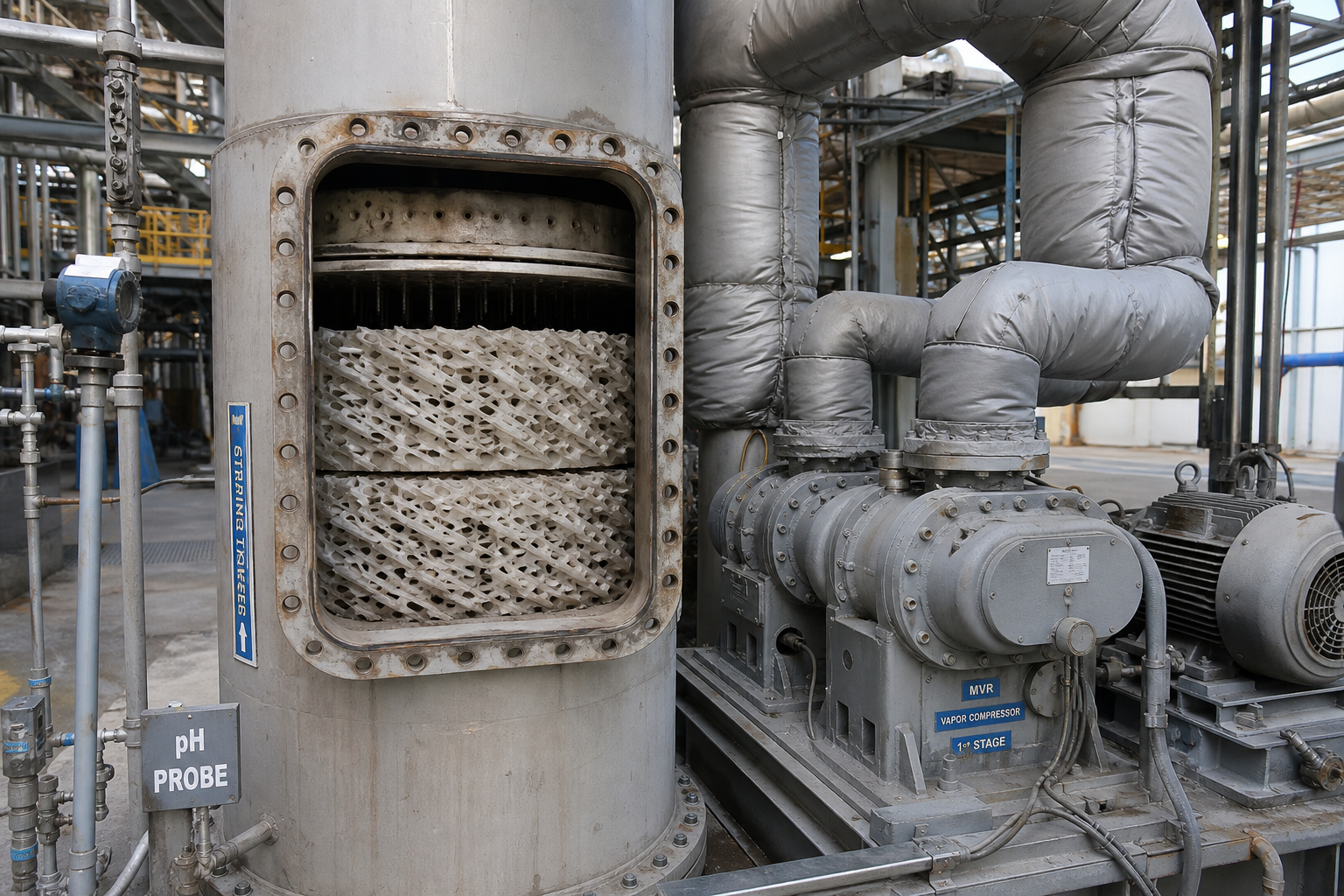
| Process module | Candidate equipment types | Selection rationale | Module duty |
|---|---|---|---|
| Stream segregation | Collection and balancing tanks by concentration band | The graded strategy fails if bands blend | Keep each band at its resident process |
| High-band recovery | Vacuum evaporation crystallizer (forced-circulation class) | Acid-pH vacuum operation keeps NH4 in liquor | Industry-grade NH4Cl + clean condensate |
| Mid-band removal | Stripping tower; MVR two-stage compression on scale | pH-shifted air/steam stripping at gram-per-liter class | ~95% ammonia removal with recovery |
| Ammonia absorption | Acid scrubber on stripper offgas | Converts stripped NH3 to saleable ammonium salt | Close the nitrogen balance |
| Low-band polish | Breakpoint chlorination (dosing, contact, dechlorination) | Stoichiometric oxidation of residual ammonium | Discharge-grade nitrogen |
| Condensate return | RO polishing train | ~12 mg/L NH4-N condensate upgrades to process water | Recover the evaporated water |
| Materials | Potential material considerations: chloride-service grades in hot NH4Cl sections | Ammonium chloride corrosion profile | Contain every band’s chemistry |
Configuration, materials and operating envelopes above are potential considerations only; actual selections depend on feed composition, temperature, corrosion review, fouling behavior, utilities and project capacity.
Expected Performance and Limits
Published reference performance, band by band. High: vacuum evaporation crystallization at 22-55 kPa and pH near 4 of 130 g/L NH4Cl liquor yielding industry-level crystal and condensate at about 12 mg/L NH4-N for RO return (Huang et al., DWT 2009 – external peer-reviewed reference). Mid: stripping at 35-45°C, pH 12, 27 L/min, 2 h reaching about 95% removal to around 80 mg/L (same source); and at plant scale, the MVR retrofit on 65 t/h with 2,000-7,000 mg/L influent reaching below 15 mg/L at the tower bottom with operating cost falling from 32.91 to 13.97 RMB/t and 8.86 million RMB saved per year (a supplier’s project page – external industry reference; supplier-published values, not a project guarantee). Low: breakpoint chlorination at pH 7 and Cl:N 8:1 removing 97.4% to TN 3.4 mg/L with TOC from 140 to 14.7 mg/L (peer-reviewed reference). Limits worth respecting: breakpoint chlorination produces its own byproduct considerations at scale and consumes chlorine stoichiometrically with load – it is a polish, not a workhorse; the MVR retrofit numbers assume the published utility prices, and the trade must be recomputed locally; and the high-band condensate’s 12 mg/L is a reference value, not a guarantee against different vapor velocities and liquor foaming.
Industry References and Validation
Two public references anchor this route. The graded-strategy reference: the peer-reviewed complex treatment system for a rare earth separation plant – evaporation crystallization, ammonia stripping and breakpoint chlorination each matched to its concentration band, with the operating conditions and outcomes cited above and an economic appraisal finding the combination attractive (Huang, Xiao and Yan, Desalination and Water Treatment 8 (2009) 109-117 – external peer-reviewed reference; mechanism and data may be cited). The retrofit-economics reference: the MVR ammonia-removal conversion of direct steam stripping at 65 t/h with the energy, cost and performance values above, noted as applicable to rare earth wet-separation ammonia of 0.6-1.6 g/L (a supplier’s project page – an external industry reference, not an EvapCryst delivery; supplier-published values, not a project guarantee). For your own project, validation effort should concentrate on: a stream-by-stream ammonia and salinity inventory; band-boundary analysis on your utility prices; crystallization behavior of your high-band liquor; and a stripping pilot establishing pH, temperature and air/steam ratio for your matrix.
Frequently Asked Questions
Why not treat everything in one biological plant?
Salinity and strength. High-chloride, gram-per-liter ammonia streams inhibit nitrifying biology, and the strong mother liquors are outright toxic to it. Biology has a place at moderate dilute strength, but the graded chemical-thermal strategy is what handles the full span a separation plant produces.
What does the MVR retrofit actually change?
The heat source. Direct steam stripping injects live steam that dilutes and heats the liquor; the MVR version compresses and recycles vapor – mechanical work replaces most of the steam, cooling water falls, electricity rises modestly, and the operating cost roughly halves in the published comparison. The tower chemistry stays the same.
Why keep the high band acidic and the mid band at pH 12?
The ammonia/ammonium equilibrium. Acidic conditions hold nitrogen as dissolved ammonium so it crystallizes as NH4Cl product; pH 12 shifts it to free ammonia gas so the stripper can remove it. Each band’s pH is its selectivity lever.
Isn’t breakpoint chlorination just adding another pollutant?
Used correctly it is a measured polish: chlorine oxidizes ammonium to nitrogen gas at roughly the 8:1 ratio, with dechlorination managing the residual. At tens of milligrams per liter it is economical; at gram strength the chlorine bill would dominate – which is exactly why it is the low-band process only.
How do I know where to draw the band boundaries?
By marginal cost per kilogram of nitrogen. Compute each process’s cost curve against concentration on your own energy and reagent prices; the curves cross in the gram-per-liter region, and those crossings – not rules of thumb – are your boundaries. We run this analysis as part of screening.
When This Route May Not Fit
If your plant has no high-strength stream – no mother liquors worth crystallizing – the recovery line drops out and the strategy simplifies to stripping plus polish, still graded but two-headed. If your ammonia arrives predominantly as sulfate or nitrate rather than chloride, the crystallization product and stripper chemistry change materially and the flowsheet must be re-derived. And if discharge standards are loose and water cheap, a single adequate process may beat an optimized three-band system on simplicity – the graded strategy earns its complexity where nitrogen loads and discharge pressure are both real.
What Must Be Verified Before Committing
Five items: a complete stream inventory with ammonia species, salinity and flow for every source; band-boundary economics computed on your actual utility and reagent prices; crystallization and condensate-quality testing for your high-band liquor; a stripping pilot fixing pH, temperature and gas rate for your mid-band matrix with ammonia absorption specified; and chlorination jar testing for the polish including byproduct and dechlorination needs. These map directly onto the modules above and are the standard screening package we would run before any quote.