Project Parameters
| Parameter | Value |
|---|---|
| Process route | Multi-effect falling-film evaporation, 11 bodies / 7 effects, full plate-type construction |
| Industry | Pulp & paper — chemical pulping (kraft) black liquor |
| Feed type & key components | Weak black liquor from chemical pulping; dissolved lignin, cooking chemicals and organics |
| Evaporation capacity | 750 t/h water removal |
| Construction materials | SS316L wetted parts, plate heat transfer surfaces (indicative) |
Representative process configuration compiled from published industry project data. Indicative values, not a process guarantee.
Project Description
Black liquor evaporation is the energy heart of a kraft mill: weak black liquor at 15–20% solids must be raised to firing concentration for the recovery boiler, and the evaporation plant is the largest single consumer of thermal drive and the largest single producer of hot condensate in the pulp mill. The reference configuration — a 750 t/h evaporation plant serving a world-scale fiber line in Hubei, Central China — operates at a capacity that ranks among the largest black liquor evaporation trains installed in the region, matching the newest generation of large-format pulp machines built there.
The configuration pairs two defining choices: an 11-body, 7-effect arrangement, and full plate-type falling-film construction. The multi-body layout lets the plant distribute concentration duty across parallel effects at the stages where liquor volumes are highest, while the 7-effect steam economy cuts live steam per tonne of water to a fraction of a single-effect plant. Comparable published configurations at 268 t/h run the same 10-body/7-effect full plate architecture — the design language scales from mid-size to world-class mills.
Process Technology
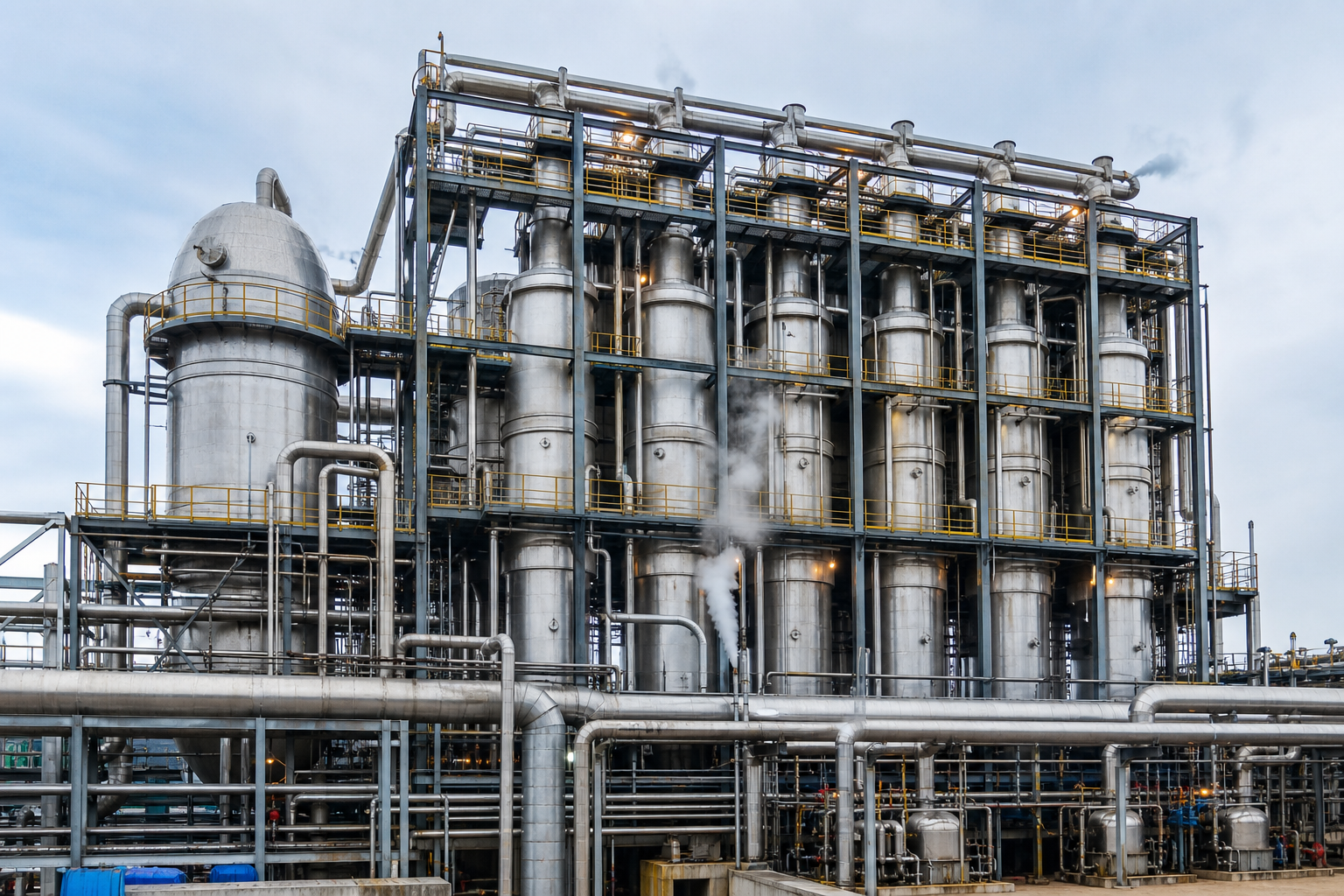
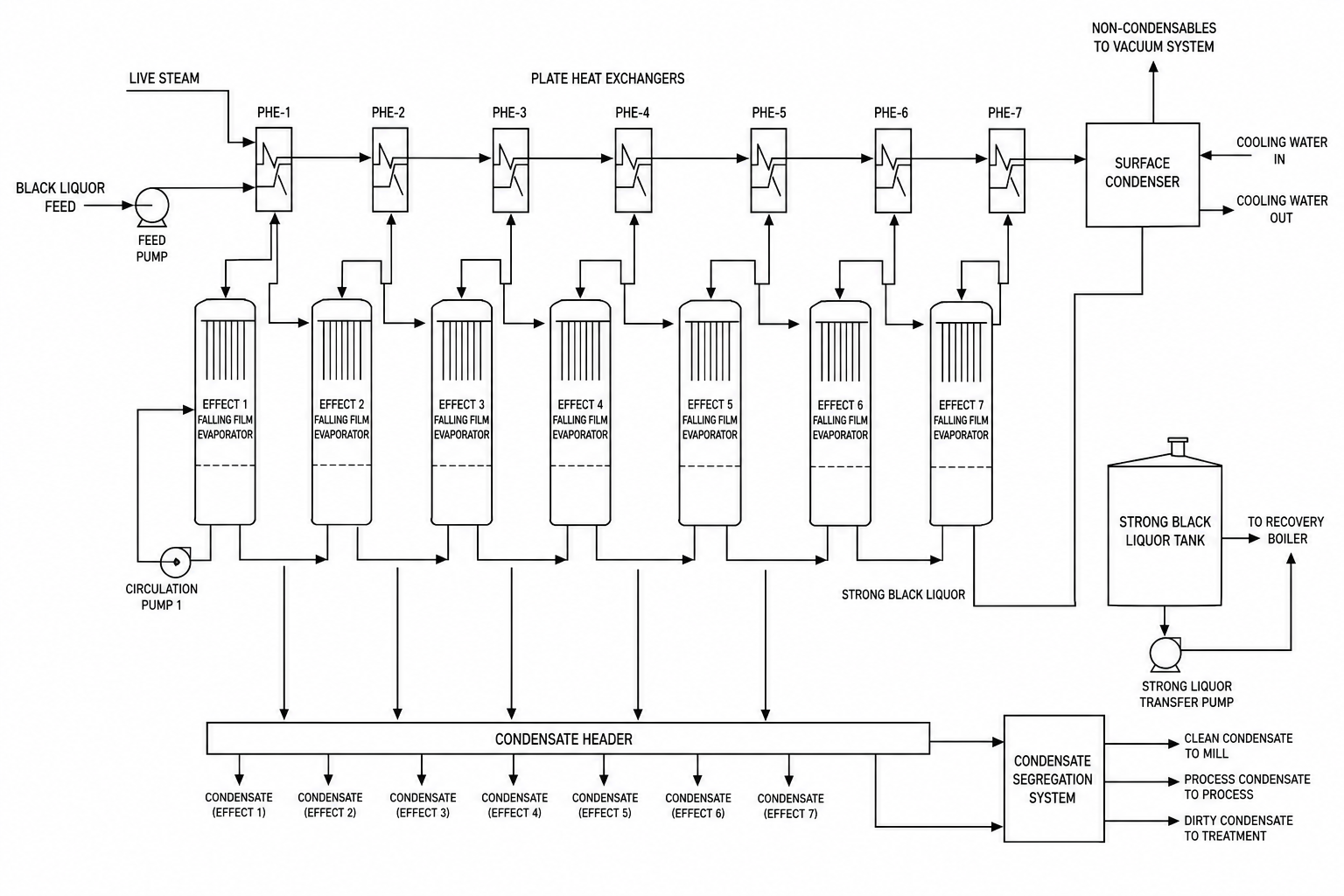
Weak black liquor from the brown stock washing plant is screened for fiber and soap, and fed forward through condensate-based preheaters — the first stage of the plant’s heat integration. The liquor then enters the falling-film bodies.
Falling film is the incumbent technology for black liquor for a physical reason: the liquor films down the heat transfer surface under gravity at low temperature difference, so the residence time at any hot wall is seconds, not minutes. That matters because black liquor organics degrade and scale when held at wall temperature — short-contact evaporation is the difference between a plant that runs months between cleans and one that does not. In plate construction, the corrugated plate packs raise heat transfer coefficients above tubular equivalents while holding liquor inventory low, which is why the newest large evaporation plants in the segment are full plate designs.
The seven effects step down in temperature from the first effect, heated by live steam, to the final effect operating under vacuum with a surface condenser. Each effect boils on the vapor of the one before it, so each tonne of live steam evaporates roughly seven tonnes of water across the train. The 11 bodies distribute this duty: parallel bodies in the early effects handle the high-volume, low-concentration liquor, while the later effects concentrate the diminishing flow toward firing solids.
Condensate segregation is engineered as carefully as the evaporation itself: clean secondary condensate from the later effects feeds the mill’s hot water and washing systems, while fouled condensate from the first effects — carrying methanol and reduced sulfur compounds — is collected separately and treated. Concentrated liquor leaves the final body at firing strength for the recovery boiler, closing the mill’s chemical and energy loop.
Equipment Configuration
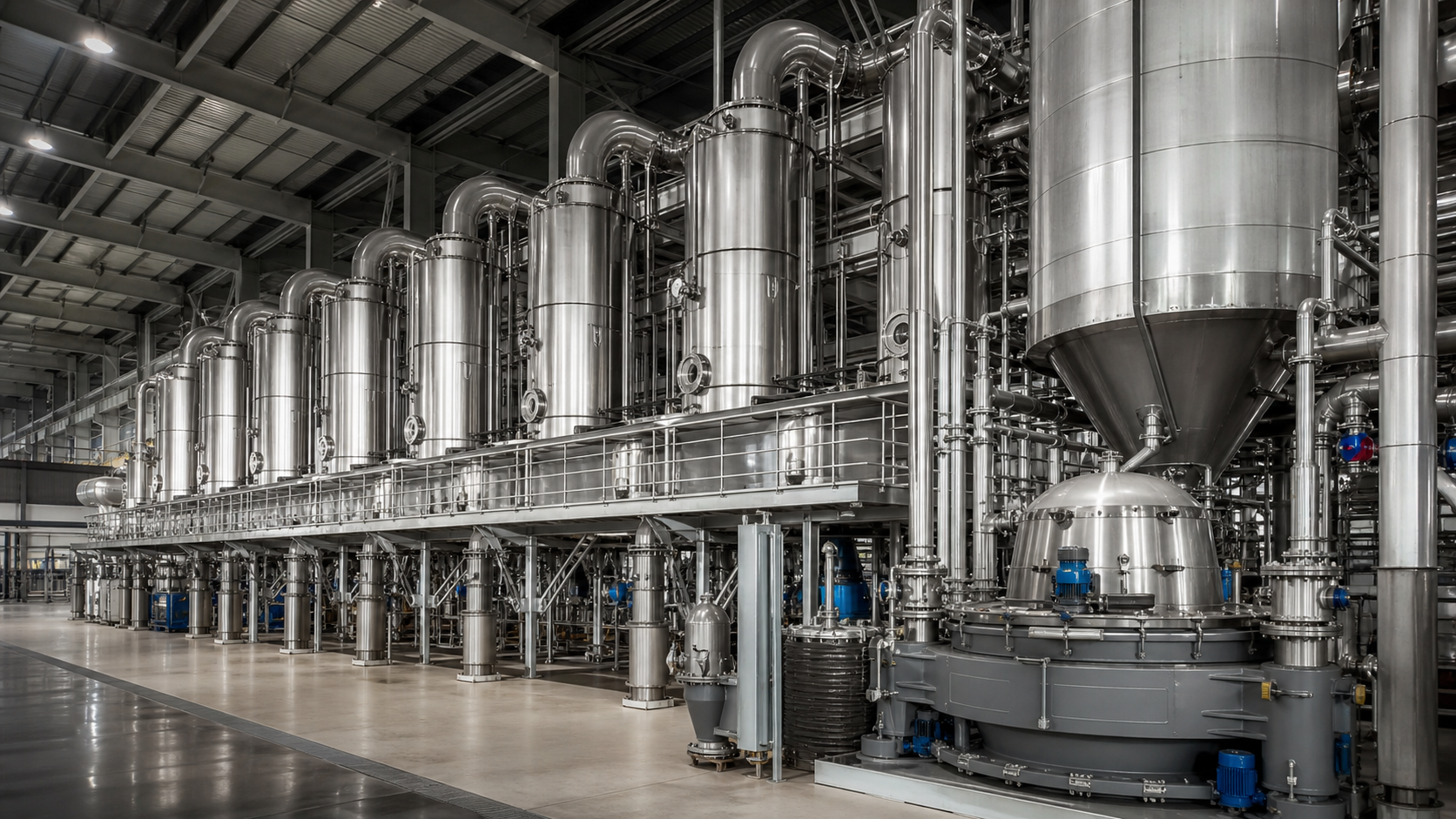
One set of the following equipment is typical for this duty:
- Weak liquor screening, soap separation and condensate-based feed preheating
- 11 falling-film evaporator bodies across 7 effects, plate-type heat transfer packages
- Live-steam first effect with thermocompressor or MVR hybrid options per mill steam balance
- Surface condenser and vacuum system on the final effect
- Segregated clean / fouled condensate collection with methanol and TRS handling
- Strong liquor tankage to the recovery boiler; DCS control of effect temperatures, solids profile and wash sequences
Performance & Outcome
Compiled from published industry project data, indicative: plants of this class raise black liquor to firing solids on 7-effect steam economy with plate falling-film availability, supplying the majority of the mill’s hot condensate. Steam per tonne of water and final solids are quoted per project and wood furnish.