Project Parameters
| Parameter | Value |
|---|---|
| Process route | MVR falling-film evaporation + four-effect duty ahead of crystallization |
| Industry | Starch sweeteners — crystalline glucose (dextrose) production |
| Feed type & key components | Refined glucose solution from saccharification and filtration |
| Evaporation capacity | 70 t/h |
| Product context | Crystalline glucose (dextrose monohydrate / anhydrous) project |
| Region | East China (Shandong) |
Representative process configuration compiled from published industry project data. Indicative values, not a process guarantee.
Project Description
Crystalline glucose is made by concentrating refined dextrose liquor to the supersaturation at which glucose crystallizes, then growing and harvesting the crystal. The evaporation step sits between saccharification and the crystallizers, and its discipline decides the plant’s yield: too much thermal exposure colors the liquor, fouls the surfaces and poisons crystal growth downstream. The published project behind this configuration evaporates 70 t/h of refined glucose solution at a dextrose project in East China, running MVR falling-film concentration with a four-effect section in the duty split.
The configuration choice follows the material. Glucose liquor is heat-sensitive and viscosity-steep: it concentrates from roughly one-third solids to the massecuite-adjacent densities the crystallizers feed on, and every degree saved in the evaporation train is color-body avoided. MVR supplies the latent heat electrically at low temperature lift, and the four-effect path covers the same flexibility duty other large sweetener trains publish — a second heat path for maintenance windows and turndown, so the crystallization house never starves.
Process Technology
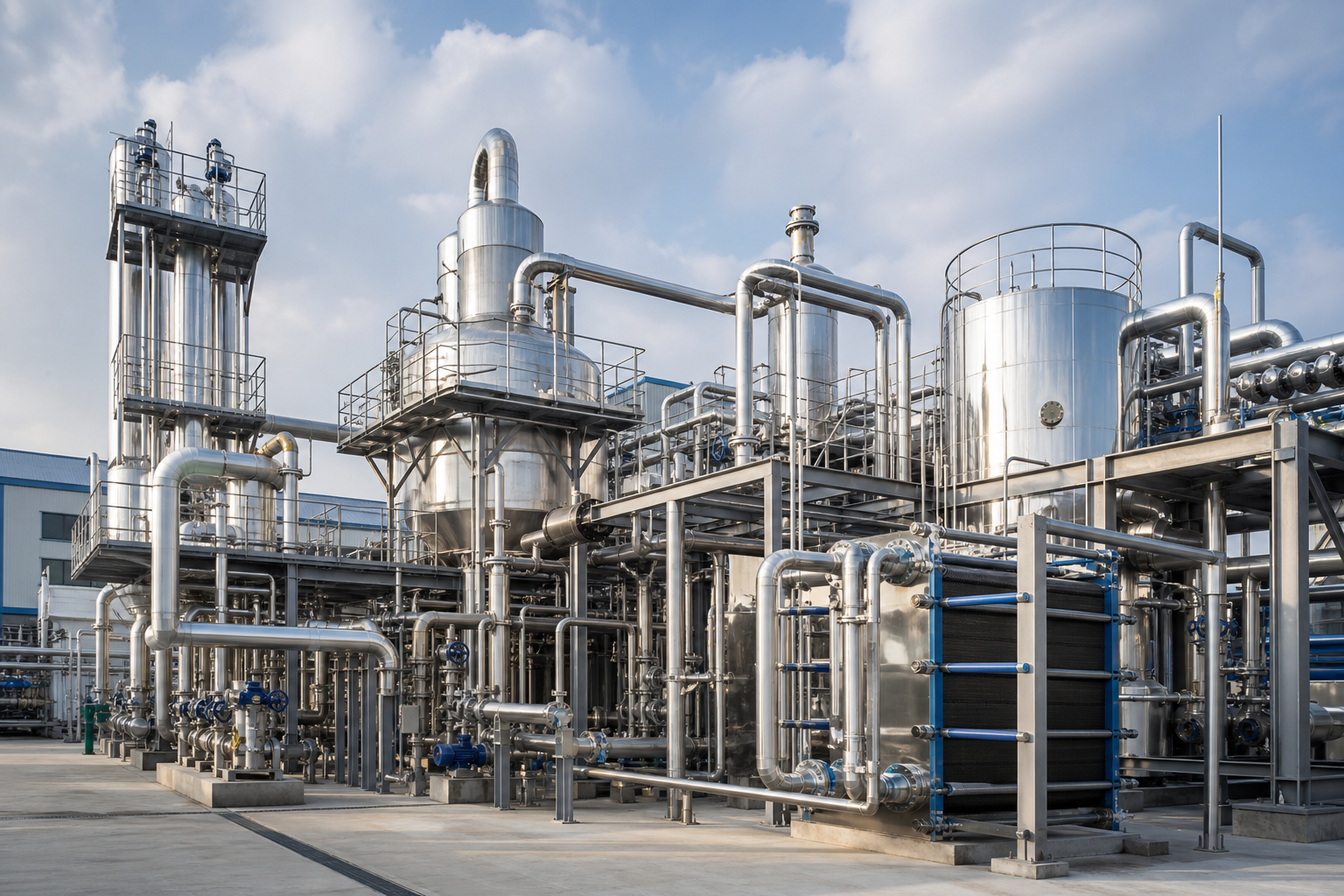
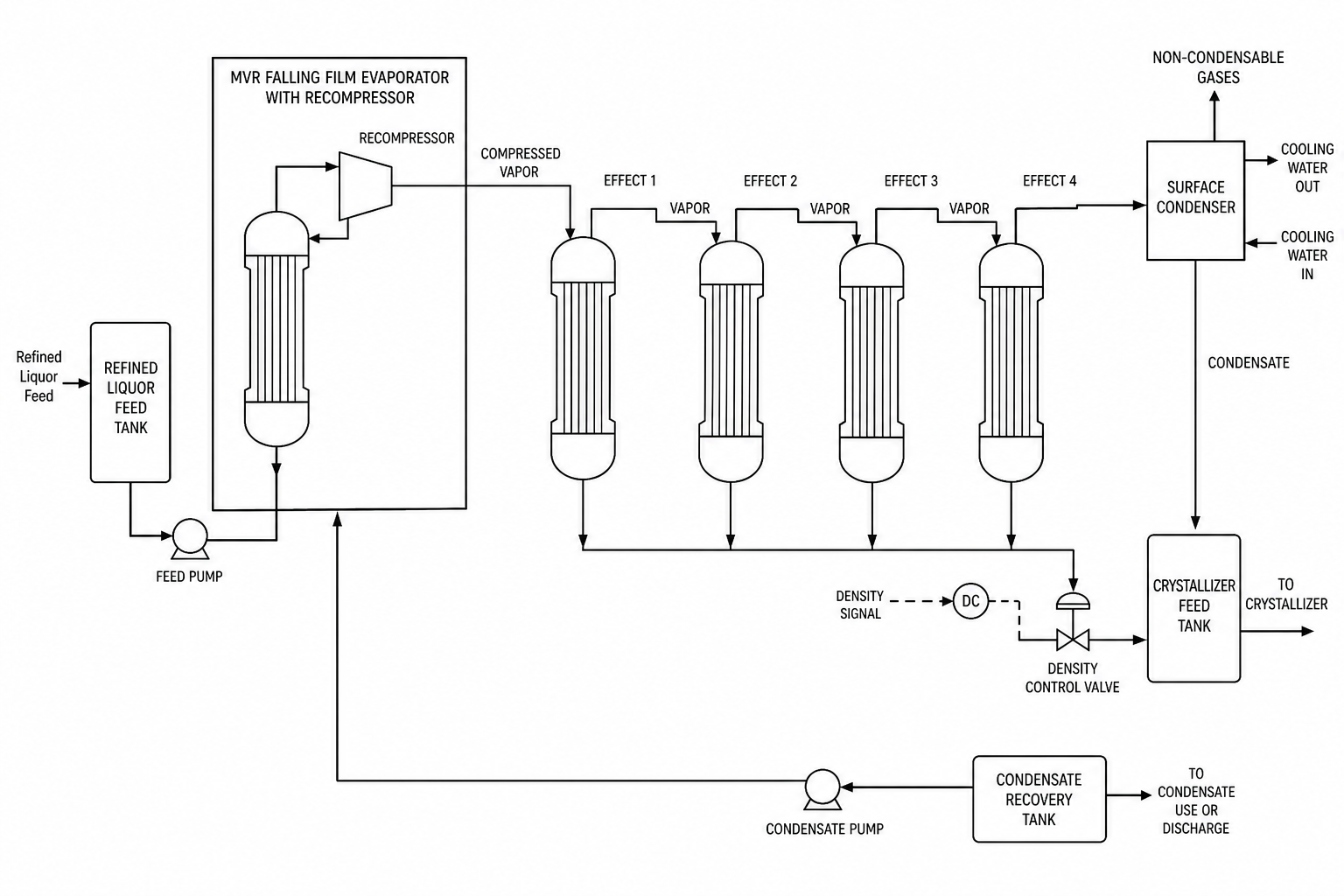
Refined liquor from the saccharification filtration stage enters the train at controlled pH and temperature. The MVR falling-film section takes the bulk concentration: liquor descends as a calibrated film inside vertical tubes, vapor condenses outside, and the mechanical recompressor recovers the vapor from the separator, compresses it a few tens of degrees, and returns it as the heating steam. The evaporator effectively heats itself; live steam appears only at start-up and upset.
Falling film earns its place twice over with glucose. First, residence time: the film spends seconds on the hot surface per pass, protecting the liquor’s color. Second, temperature: film evaporation works at low temperature difference, and vacuum operation holds the liquor inside the thermal window where dextrose is stable — the same window the downstream crystallizers need the liquor to arrive in.
As solids climb toward the crystallization feed density, viscosity rises steeply — the regime where liquid distribution over the tube bundle is the engineering that separates a clean train from a fouling one. The published configuration handles this with generous distributor design and circulation support, concentrating to the exact brix the crystallizer feed tank calls for, controlled by inline density measurement.
Condensate is the quiet product: hot, clean water in food-grade quantity, returned to the starch or refining sections that consume most of a sweetener complex’s water. The four-effect section shares the load profile, its later-effect condensate segregated by cleanliness class, and clean-in-place cycles between campaigns manage the protein and color traces that saccharification always leaves behind.
Equipment Configuration
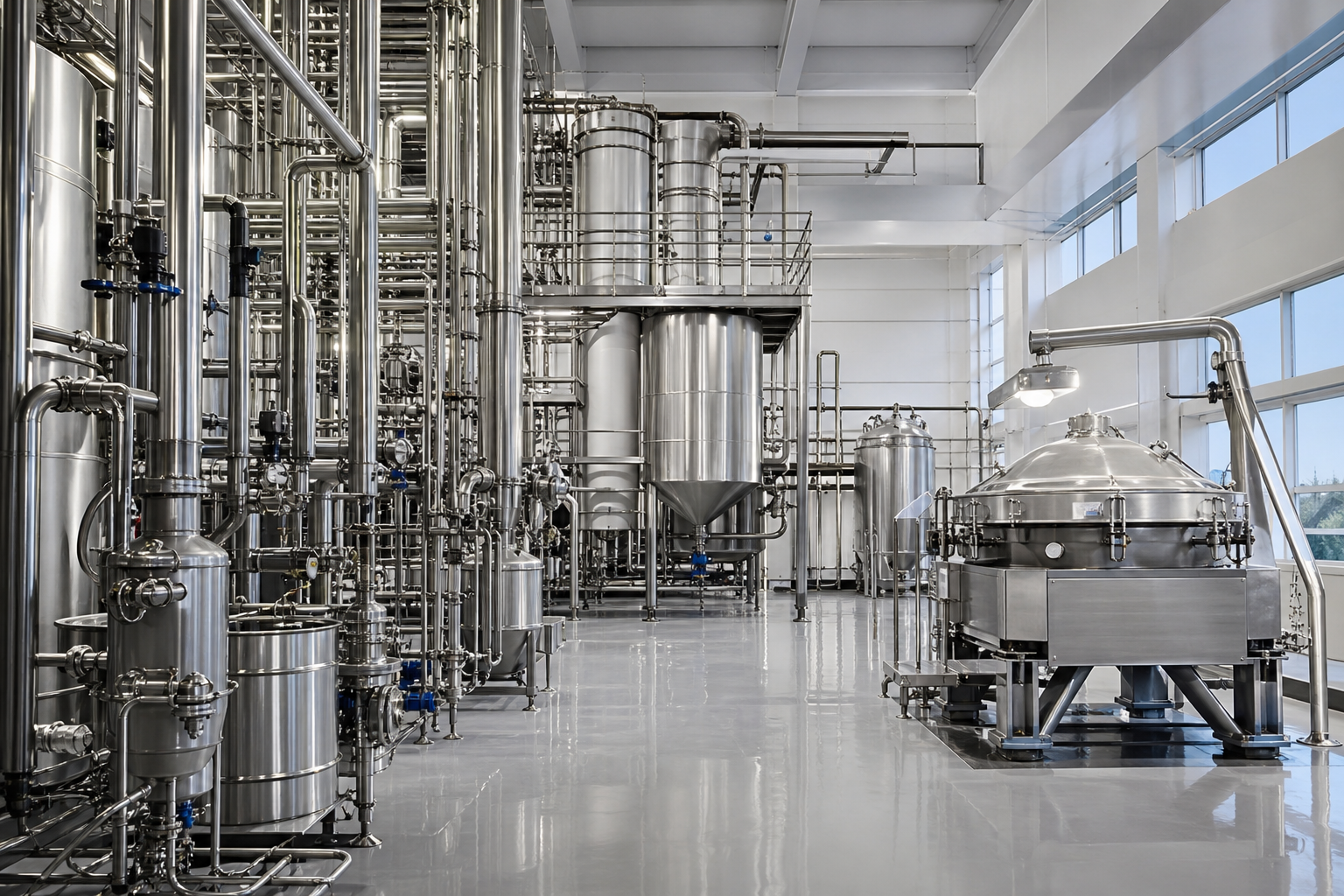
One set of the following equipment is typical for this duty:
- Refined-liquor feed tank with inline filtration
- MVR falling-film evaporator body with high-capacity liquid distributors
- Mechanical vapor recompressor with food-grade construction
- Four-effect evaporation section for flexibility and maintenance duty
- Surface condenser, vacuum system and segregated condensate headers
- Density-controlled discharge to the crystallizer feed tank
- PLC control with CIP sequences for food-safety changeovers
Performance & Outcome
Compiled from published industry project data, indicative: trains of this class evaporate 70 t/h of refined glucose liquor on MVR energy at low temperature lift, delivering crystallizer feed at controlled brix with condensate returned to process reuse. Color retention and specific energy are quoted per project liquor specification.
Readers comparing technologies may also find Starch Syrup & Sweetener Evaporation Solutions useful.