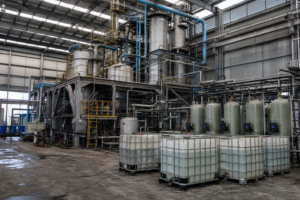
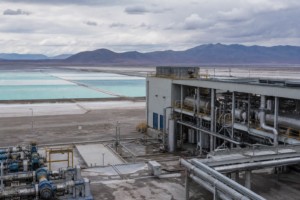
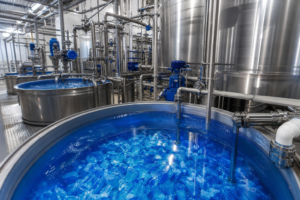
Cathode material plants and lithium battery recycling lines generate a family of sulfate-bearing wastewaters — nickel, cobalt and manganese sulfates from precursor co-precipitation, sodium sulfate from lithium recovery circuits, and NMP-laden wash water from electrode coating — and the profitable way to handle them is not discharge but evaporation and crystallization into battery-grade or saleable sulfate salts. An external industry reference: 16,000 tons-per-year lithium battery materials recycling systems now operating for Korean recyclers, built around pyrolysis-calcination front ends (third-party projects reported in vendor publications, not EvapCryst deliveries), feed hydrometallurgical trains whose liquors are finished by exactly this evaporation-crystallization chemistry. This page maps the wastewater sources, the crystallization systems that convert them into battery-chain products, and the design rules — purity, hydrate control, energy — that decide whether the output is battery grade or merely industrial grade: the salt-engineering view. The cross-chain ZLD architecture — the four-layer membrane-to-thermal stack, lithium recovery economics and delivery models — is mapped once in our battery materials wastewater ZLD overview.
Where Cathode Material Wastewater Comes From
Three production families produce nearly all of the sulfate wastewater in the battery materials chain, and each hands the crystallization plant a different liquor. The full battery-chain water map (LFP, lithium refining and every other node) is on the ZLD overview page; here we stay on the sulfate-bearing streams the crystallizer sees.
precursor co-precipitation (NCM/NCA). Nickel-cobalt-manganese hydroxide precursors precipitate from mixed sulfate solutions into ammonia-bearing mother liquor. The overflow carries residual metal sulfates, sodium sulfate from the caustic dosing, and ammonia nitrogen — a stream that wants ammonia stripping, metal recovery and sulfate crystallization before any water leaves the site.
Cathode plants (LFP, NCM sintering lines). Electrode coating uses NMP as the cathode solvent; washing and condensate streams carry dilute NMP that is recovered by distillation, while lithium recovery circuits precipitate carbonate and leave sodium sulfate-rich mother liquor behind — typically the single largest salt stream by mass in a cathode plant’s water balance.
Battery recycling (black mass hydrometallurgy). After pyrolysis and calcination liberate the black mass from foils and binders, sulfuric acid leaching with hydrogen peroxide dissolves the metals into a sulfate liquor; solvent extraction separates nickel, cobalt and manganese into purified sulfate solutions, and sodium carbonate precipitation of lithium leaves behind a sodium sulfate bleed that grows with every recycling pass. The pyrolysis-calcination and hydrometallurgical relationship is described in our lithium battery recycling wastewater and salt recovery overview.
Wastewater Streams and Their Crystallization Products
| Stream Origin | Dominant Salts | Companion Load | Recovery Product |
|---|---|---|---|
| NCM precursor co-precipitation overflow | Na₂SO₄ with residual Ni/Co/Mn sulfates | Ammonia nitrogen, trace metals | Ammonia recovery + sodium sulfate (industrial or battery-chain grade after polishing) |
| Cathode plant lithium recovery mother liquor | Na₂SO₄ | Trace Li, carbonate | Sodium sulfate crystals + lithium scavenging |
| Recycling leaching and purification circuit | NiSO₄ / CoSO₄ / MnSO₄ purified liquors | Ca, Mg, Fe, Cu impurities to be stripped | Battery-grade sulfate salts for precursor production |
| NMP wash water and coating condensate | Organic solvent in water | Low TDS | Recovered NMP by distillation, clean water return |
The Sodium Sulfate Problem — and Paycheck
Sodium sulfate is the tonnage champion of battery-chain wastewater: every kilogram of lithium precipitated with sodium carbonate, every cubic meter of precursor overflow loads the water balance with Na₂SO₄ that the site cannot discharge at scale. Evaporation-crystallization converts this liability into anhydrous sodium sulfate or Glauber’s salt with a genuine market — glass, detergent and paper industries buy it continuously. The engineering choices (hydrate route, Glauber’s salt versus anhydrous, MVR versus multi-effect energy, purity polish toward battery-chain reuse) follow the same design logic laid out on our sodium sulfate evaporation and crystallization solutions page, and where chloride co-breakthrough from recycling feedstock contaminates the salt, fractional crystallization separates the sulfate from chloride streams as described under salt separation technologies.
Battery-Grade Sulfate Crystallization: The Purity Machine
On the metals side, purified nickel, cobalt and manganese sulfate liquors from recycling or primary refining are crystallized into the hydrate salts the precursor plants consume: nickel sulfate hexahydrate, cobalt sulfate heptahydrate and manganese sulfate monohydrate. The plant is a purity machine — every unit operation exists to hold the crystal within the impurity envelope that battery customers specify.
Concentration
Purified liquor — an illustrative envelope of a few tens of grams per liter of metal from solvent-extraction delivery, constructed from published battery-chain practice rather than any customer dataset — is concentrated in MVR falling film or forced-circulation evaporators whose energy performance (industry-published 15–30 kWh per ton of water on low-BPE purified sulfate liquors; 30–50 kWh on high-BPE brines — indicative, site-wide caliber) dominates the plant’s operating cost. Contact surfaces are stainless at minimum, with higher alloys where chloride creeps into the liquor profile.
Crystallization and Hydrate Control
Each metal sulfate crystallizes as a defined hydrate whose stability window must be respected — wrong temperature or supersaturation produces the wrong hydration state, caking fines or occluded mother liquor in the crystal. Cooled or evaporative crystallizers run with classified suspension so that crystals grow coarse and wash free; mother liquor recycles with a controlled purge that bleeds accumulated impurities to the wastewater train.
Contamination Discipline
Battery-grade specifications are dominated by chemistry foreign to ordinary chemical engineering: magnetic foreign matter (tramp iron from pumps and piping), calcium and magnesium, copper and zinc traces. The crystallization plant answers with non-contact seals and polymer-lined equipment on the critical path, electromagnetic filters before drying, closed handling of dry product, and dense-phase rather than dilute-phase conveying where attrition and metal pickup matter. Getting this discipline wrong is the most common reason a new sulfate line makes only industrial grade.
Drying and Packing
Fluid-bed or flash dryers bring the hydrate to specified free moisture without driving off water of crystallization — overheating nickel sulfate hexahydrate partially dehydrates it and fails the spec — followed by screening and moisture-sealed packing in the caking-controlled format precursor plants expect. Design principles for this finishing stage are shared with our drying and packing systems page.
| Module | Candidate Equipment Types | Selection Rationale | Indicative Operating Envelope |
|---|---|---|---|
| Ammonia stripping | Steam or air stripping column | Recovers ammonia; protects sulfate product | From precursor overflow |
| MVR concentration | Falling-film or FC evaporator | Energy performance dominates operating cost | 15–30 kWh/t on low-BPE sulfate liquor (30–50 high-BPE), indicative |
| Hydrate crystallization | Classified-suspension crystallizer | Holds defined hydrate windows | Hexa-, hepta-, monohydrate routes |
| NMP recovery | Distillation column set | Returns solvent value to coating | Batch or continuous profile |
| Drying and packing | Fluid-bed or flash dryer, EM filter, sealed packing | Protects hydrate and magnetic spec | Moisture-sealed product format |
| Condensate reuse | Polishing, routing to leaching and washing | Closes the site water balance | Largest freshwater substitute |
Configuration, materials, and operating ranges depend on the actual feed, liquor chemistry, corrosion review, fouling behavior, site utilities, and project capacity.
NMP and Solvent Recovery Alongside the Salt Train
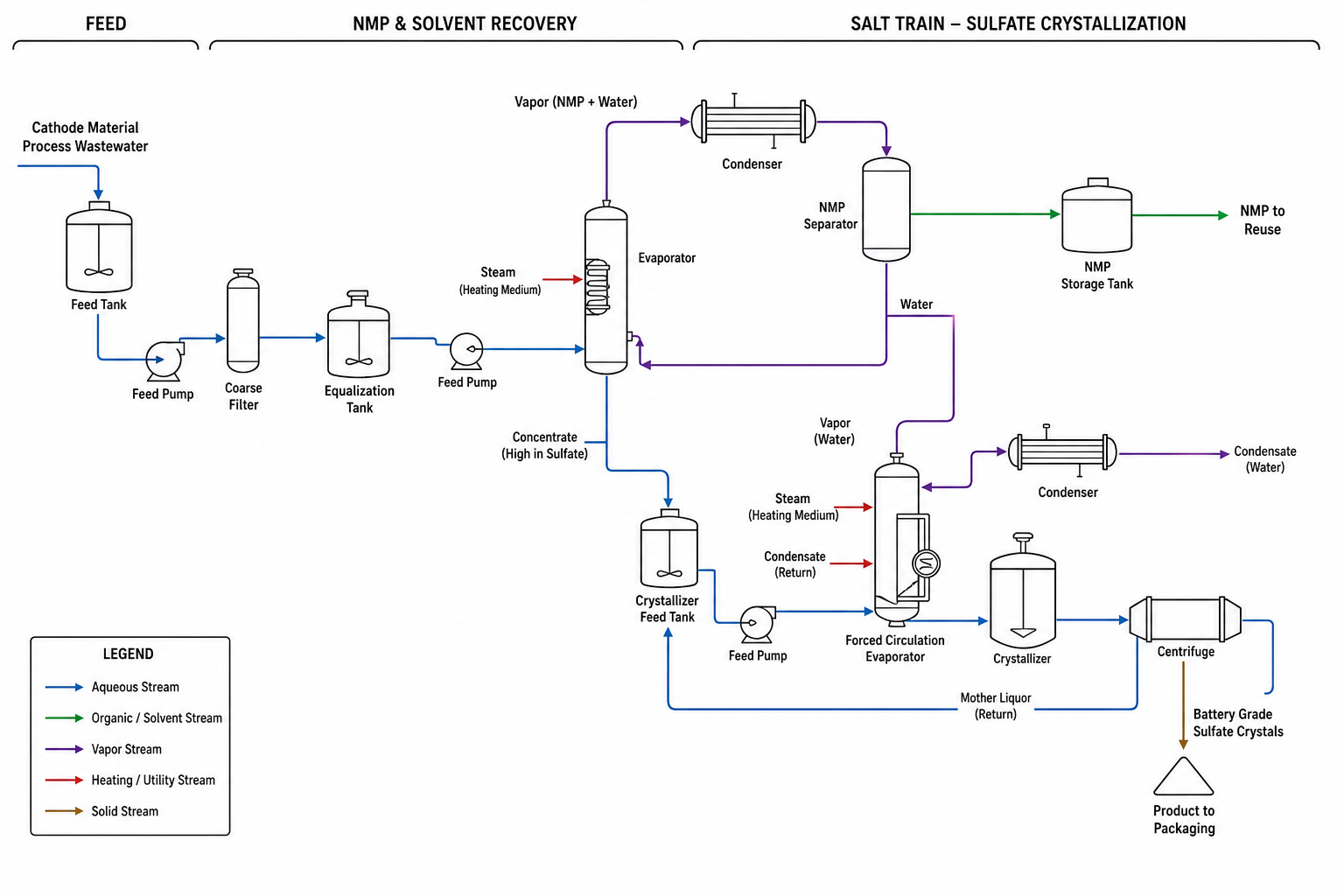
Cathode wastewater is not only salty — the NMP in coating wash water is valuable enough that its recovery line often pays for the whole water treatment building. Distillation columns concentrate and return solvent-grade NMP to the coating line while the bottoms water reports to the saline train. The distillation side of this duty is covered on our solvent recovery and distillation technology page; the design interface that matters operationally is that NMP recovery swing (batch versus continuous) sets the diurnal flow pattern the evaporators must absorb.
Ammonia Management in Precursor Wastewater
Co-precipitation overflow carries ammonia as free ammonia and ammonium sulfate. Standard treatment strips ammonia in a steam or air stripping column into a recovered ammonium water stream with reuse value, while the stripped liquor continues to sulfate crystallization. Leaving the ammonia in place would contaminate the sodium sulfate product and corrode overheads; stripping first is the difference between saleable salt and a hazardous waste discussion.
Integration Pattern: Recycling Project Anatomy
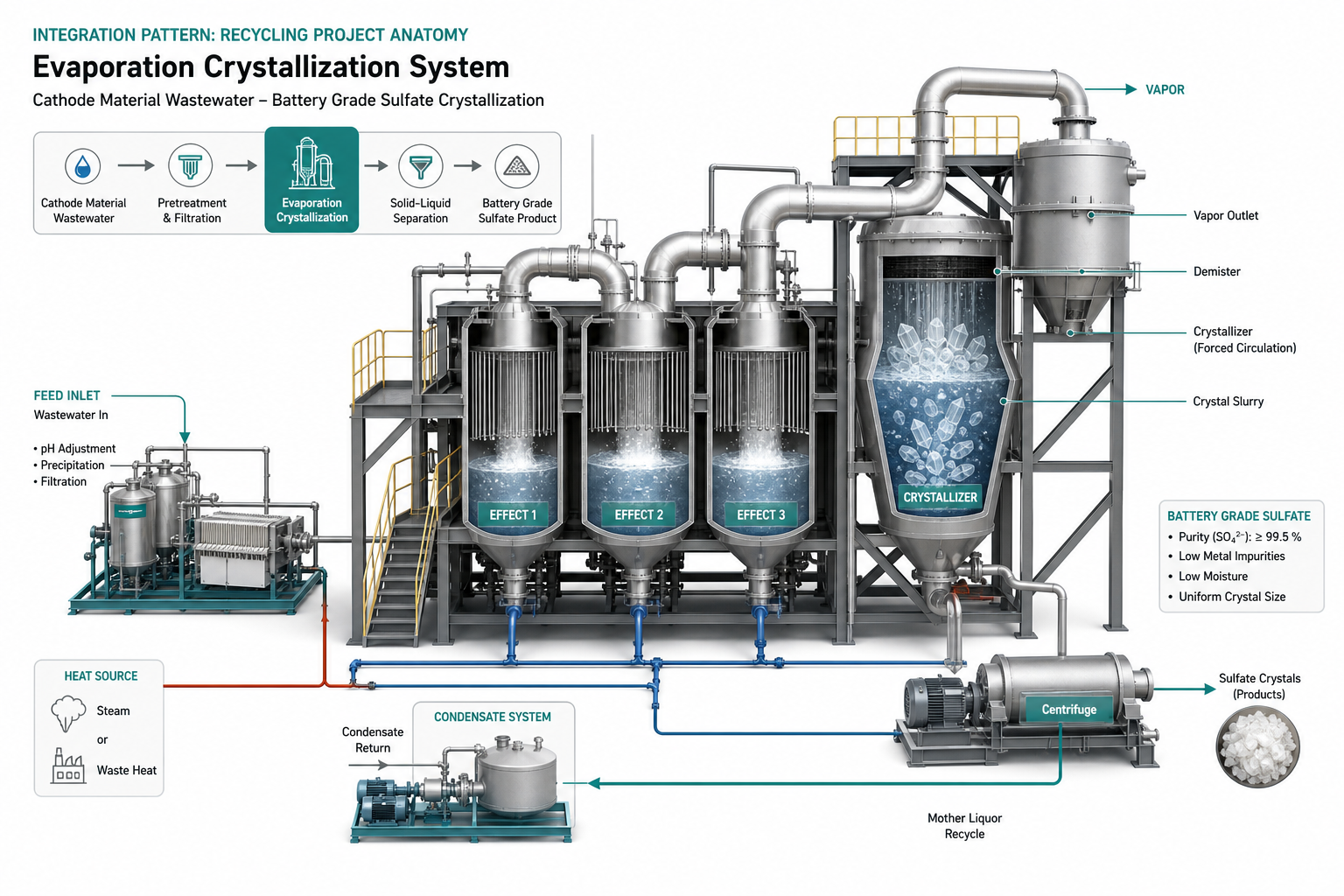
| Block | Function | Crystallization Interface |
|---|---|---|
| Pyrolysis-calcination | Removes binders and carbon, liberates black mass (as configured in large export systems, e.g. 16,000 t/y class; external reference) | Feeds leaching; off-gas scrubber blowdown joins wastewater train |
| Leaching and purification | Sulfuric acid leach, iron/copper removal, solvent extraction | Delivers purified Ni/Co/Mn sulfate liquors to crystallization |
| Lithium recovery | Sodium carbonate precipitation, lithium polishing (hydroxide route covered in our lithium hydroxide solutions) | Generates the sodium sulfate mother liquor stream |
| Evaporation-crystallization | MVR concentration, hydrate crystallizers, sulfate salt recovery | Product: battery-grade metal sulfates, saleable Na₂SO₄, clean condensate |
| Water management | Condensate polishing and reuse | Closes the site water balance toward ZLD |
The Purity Ladder and Its Economics
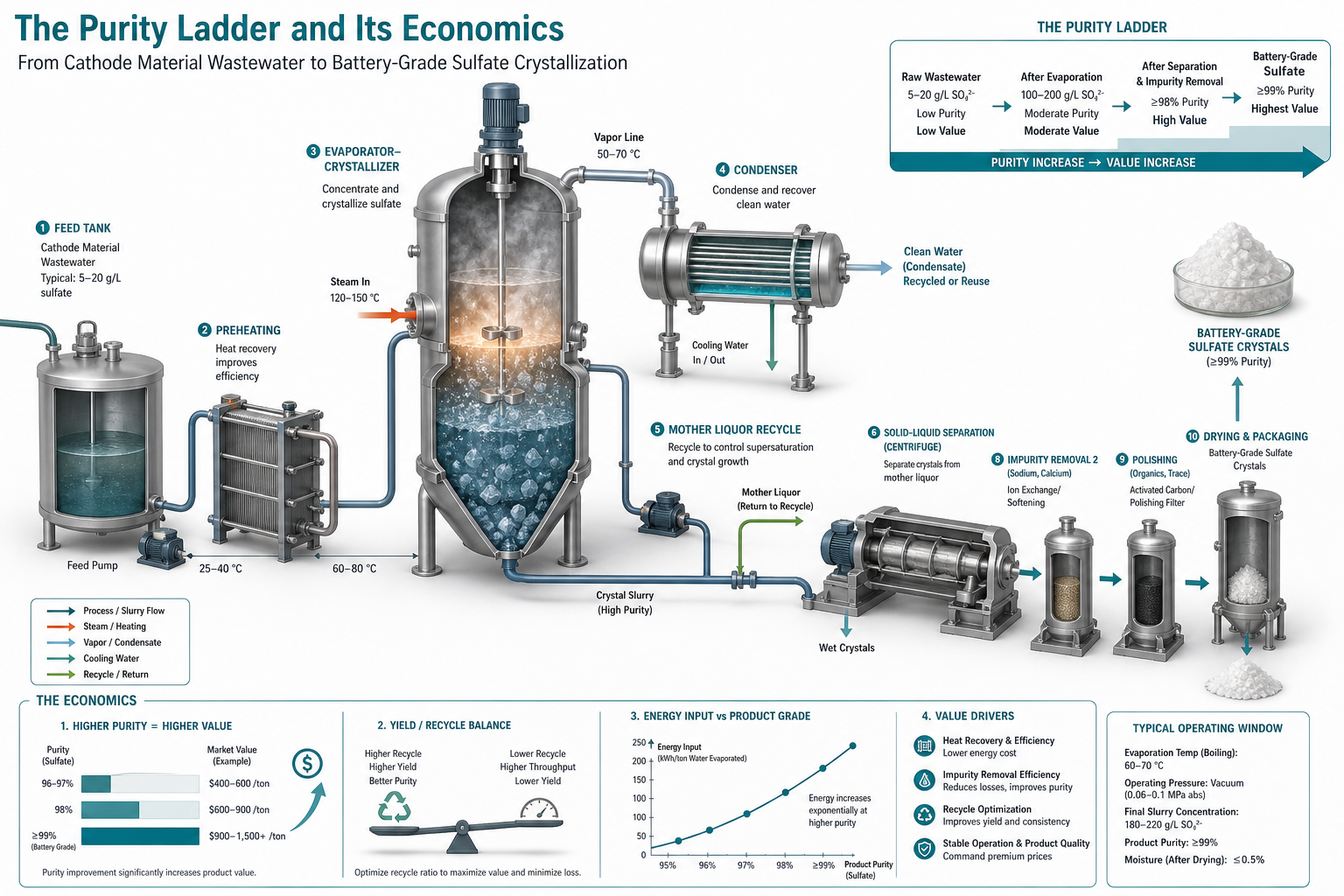
Every sulfate stream in the battery chain sits somewhere on a purity ladder, and each rung has a different market. Recycled sodium sulfate polished free of metals and organics sells into glass and detergent markets; pushed further it can re-enter the battery chain as a feedstock. Purified nickel and cobalt sulfates crystallized inside the magnetic-and-cation envelope command battery-grade premiums; the same salts crystallized carelessly sell at industrial discounts or not at all. The economic design question is therefore not whether to crystallize but how far up the ladder to build: purification depth, iron-free transfer equipment and sealed handling are capital items, and they are justified by the grade differential on the specific metal, which is why cobalt lines carry more purity capital per ton than manganese lines. Plants that make this decision per stream, rather than applying one standard everywhere, capture the premium where it pays and stop short where it does not.
Closing the Water Balance Toward ZLD
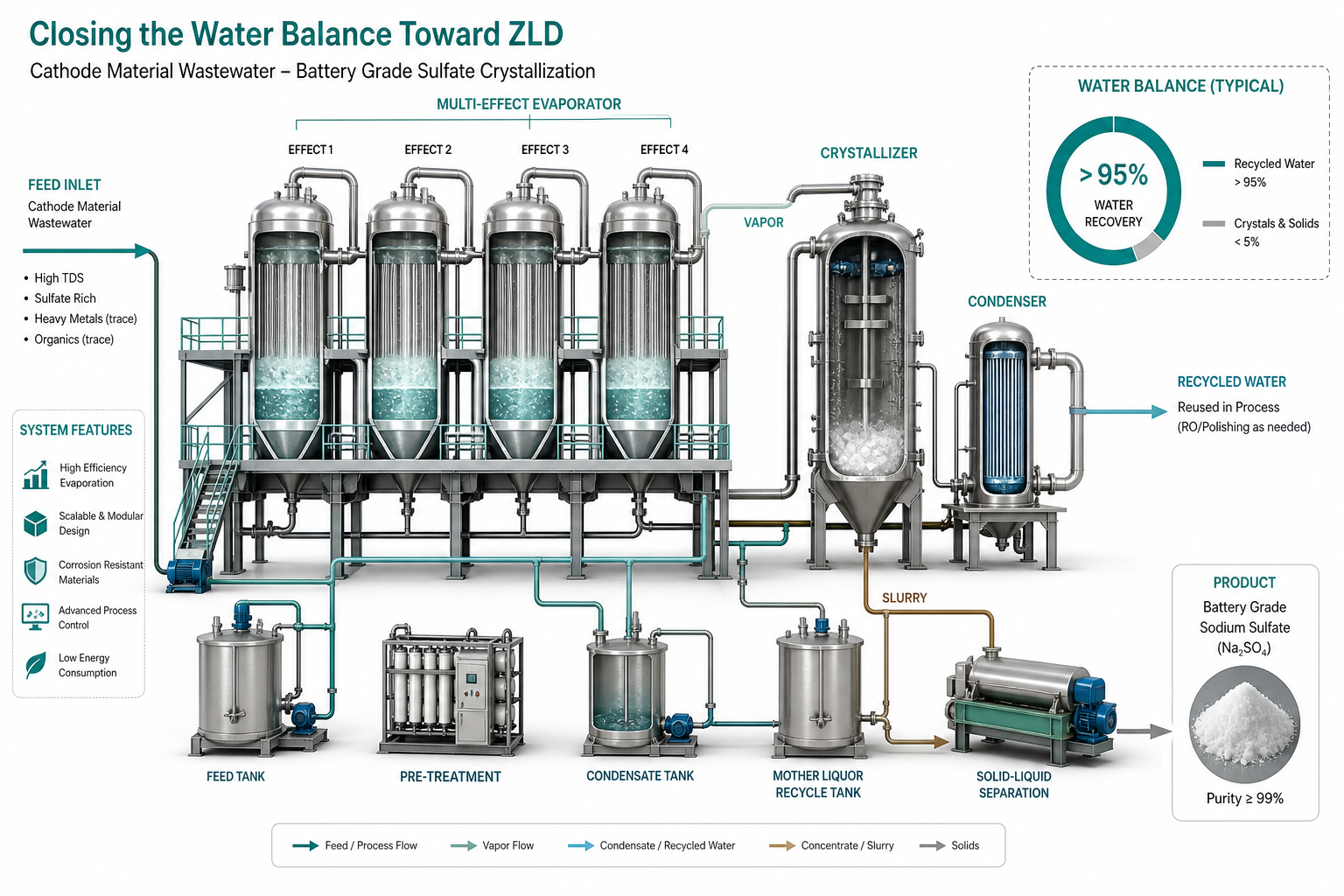
The condensate leaving the evaporators is the site’s largest freshwater substitute. Clean condensate from the saline train returns to leaching, washing and cooling make-up; condensate from NMP bottoms is polished and recycled; only a small final bleed — mother liquor purge and scrubber blowdown — remains for the wastewater plant, and sites under discharge pressure take even that through a final forced-circulation crystallizer into mixed salt for disposal or recovery. Arranged this way, the crystallization plant is not the end of the pipe but the hinge of the whole site water balance, converting a battery materials factory from a water consumer with a discharge problem into a water recycler with salt products. The site-wide four-layer architecture this hinge sits in is mapped in the battery materials wastewater ZLD overview.
When This Route May Not Fit
Crystallization-to-product assumes the salts have somewhere to go. A site with no sodium sulfate offtake within hauling distance should compare mixed-salt disposal honestly before building Glauber’s-salt hardware. Industrial-grade markets that do not pay for battery-grade discipline make the purity capital a loss, not an investment. Very small or pilot-scale precursor plants may not generate liquor volumes that amortize MVR compression. Where chloride contamination from mixed feedstock is chronic, fractional-crystallization complexity may outweigh salt value. A recycling project whose black-mass feed chemistry swings widely hands the crystallization train a moving target that no fixed recipe holds. Sites without magnetic-contamination controls in the surrounding plant should fix that first; the crystallizer cannot polish tramp iron out of an upstream habit.
What Must Be Verified
Every claim in this chain deserves measured confirmation before capital. Verify each liquor’s full analysis: metal assay, sulfate load, ammonia, Ca/Mg/Cu/Zn, chloride, and organics, because the purity ladder is built on chemistry the plant actually has. Confirm hydrate windows against the customer’s written specification, including free-moisture and magnetic-matter limits. Confirm salt offtake: who buys sodium sulfate, at what grade, at what distance. Verify energy economics for MVR against the site’s actual tariffs and liquor volumes. For recycled feedstock, verify black-mass variability across the supplier mix, and pilot the crystallization where the feed is new. NMP recovery scope needs the coating line’s real wash-water profile. Each verification item converts a grade assumption into a specification the equipment is built to hold.
FAQ
What makes a sulfate salt battery grade rather than industrial grade?
Impurity limits on calcium, magnesium, copper, zinc and above all magnetic foreign matter, plus correct hydrate form and controlled free moisture — specifications enforced through crystallization discipline, non-iron contact parts, electromagnetic filtration and sealed product handling rather than by end-of-line testing alone.
Why is sodium sulfate the biggest salt stream in battery material wastewater?
Because both lithium carbonate precipitation (using sodium carbonate) and precursor caustic dosing convert their reagents into sodium sulfate stoichiometrically — every unit of production creates sulfate that must leave the process, and evaporation-crystallization is how it exits as product instead of discharge.
Can MVR evaporation handle nickel sulfate crystallization directly?
Conditionally. MVR forced-circulation evaporation-crystallization in one train suits steady, high-tonnage duties where evaporation itself drives supersaturation; where the hexahydrate stability window is narrow and crystal size distribution drives value, flash or cooled crystallization in classified suspension is the preferred finish — the route split used in our nickel sulfate coverage. Either way the constraint is materials and hydrate stability rather than the vapor system.
How does recycling capacity affect the crystallization plant?
Linearly in salt load: an externally referenced 16,000 t/y class recycling line implies sulfate and sodium sulfate crystallization capacity sized to its lithium recovery chemistry, so the crystallization scope is fixed at flowsheet stage, not retrofitted.
Is NMP recovered in the same system as the salts?
No — NMP recovery is a distillation duty returning solvent to the coating line, run ahead of and separate from the saline evaporation train; its batch profile influences evaporator sizing but not the salt chemistry.
For a first-pass screening of a cathode or recycling wastewater project, send the liquor analyses, salt loads, and target product grades; in return you receive an indicative train architecture with purity-ladder positioning, before any detailed engineering.