Project Parameters
| Parameter | Value |
|---|---|
| Process route | Dual-train falling-film evaporation: 76 t/h MVR train + 7 t/h TVR train |
| Industry | Fermentation — lactic acid (food / industrial / PLA feedstock) |
| Feed type & key components | Purified lactic acid solution; heat-sensitive organic acid, residual sugars |
| Evaporation capacity | 83 t/h total (76 + 7) |
| Region | East China (Anhui) |
Representative process configuration compiled from published industry project data. Indicative values, not a process guarantee.
Project Description
Lactic acid has graduated from food additive to industrial feedstock — the PLA bioplastic chain begins with fermentation lactic acid — and its production volume now justifies serious evaporation engineering. The published project behind this configuration concentrates lactic acid solution at a fermentation-acid producer in East China with a dual-train block totaling 83 t/h: a 76 t/h MVR falling-film train carrying the bulk duty and a 7 t/h TVR falling-film train alongside it.
The two-train split is energy engineering, not redundancy. The big train runs on electric vapor recompression — the lowest operating cost per tonne of water the site can buy — while the small train runs on a TVR thermocompressor with motive steam, giving the plant a duty path that survives compressor maintenance, covers turndown, and absorbs the smaller, specialty liquor streams a lactic-acid producer always has. One block, two heat sources, full availability.
Process Technology
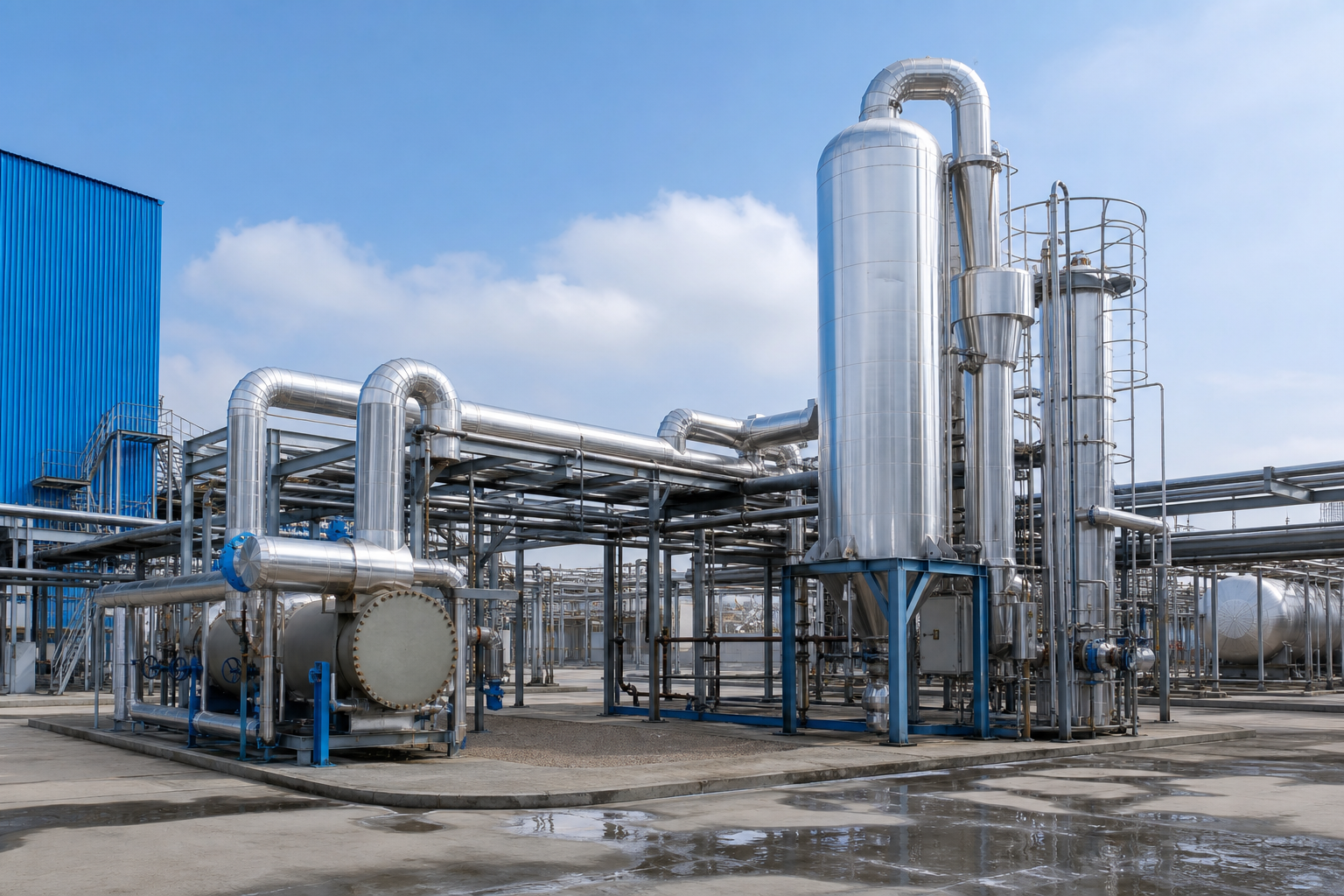
Lactic acid is the textbook heat-sensitive feed: an organic acid that discolors, esterifies and degrades under thermal dwell, in a product market — food grade, and increasingly optical-purity PLA grade — where color and purity are the specification. Both trains therefore run as falling-film bodies under vacuum: the liquor films down vertical tubes at low temperature difference, spending seconds per pass at the wall, with wide-body separation keeping entrainment out of the vapor path.
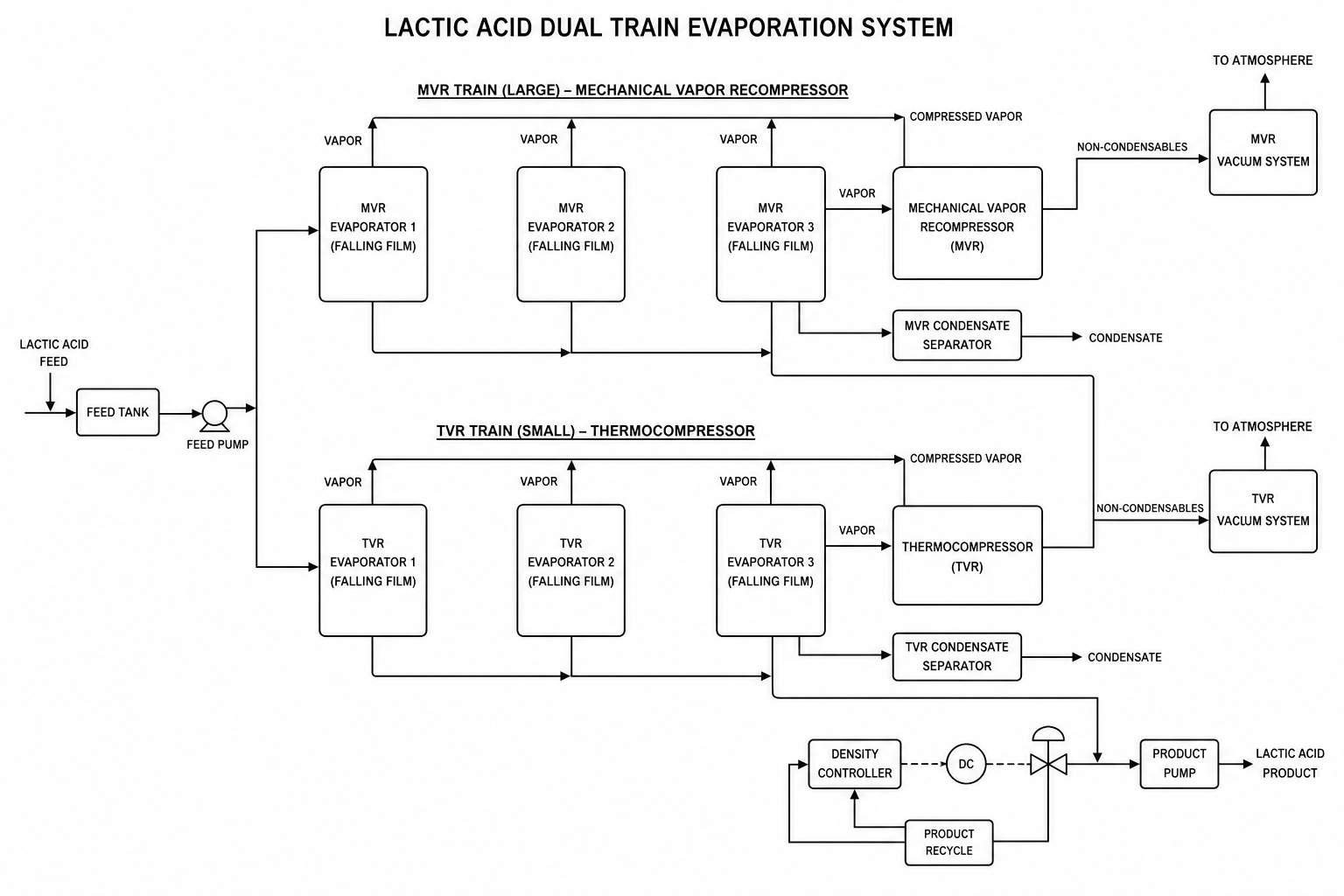
The 76 t/h MVR train works exactly as its class prescribes: the recompressor lifts separator vapor to condensing pressure and returns it as heating steam, and the body heats itself on a small electric input per tonne. At 76 t/h this is the plant’s main energy statement — tens of tonnes per hour of water removed without a boiler load, in a fermentation complex whose steam is better spent on sterilization and drying.
The 7 t/h TVR train covers the complementary duties. A thermocompressor — the TVR — entrains effect vapor with motive steam and recompresses the mixture to the first-effect steam chest: no rotating parts, no electric drive, tolerant of the intermittent service that smaller streams impose. In a dual-train block it is the right machine for side duties, campaign liquors and maintenance-window coverage.
Concentration endpoints route by product line: food-grade liquor to its polishing and packaging density, fermentation-side and technical liquors to the esterification or PLA-chain densities. Condensate from both trains segregates by cleanliness — lactic acid carry-over is a condensate contaminant to manage, not ignore — and CIP cycles between grades keep the acid films from aging into color problems.
Equipment Configuration
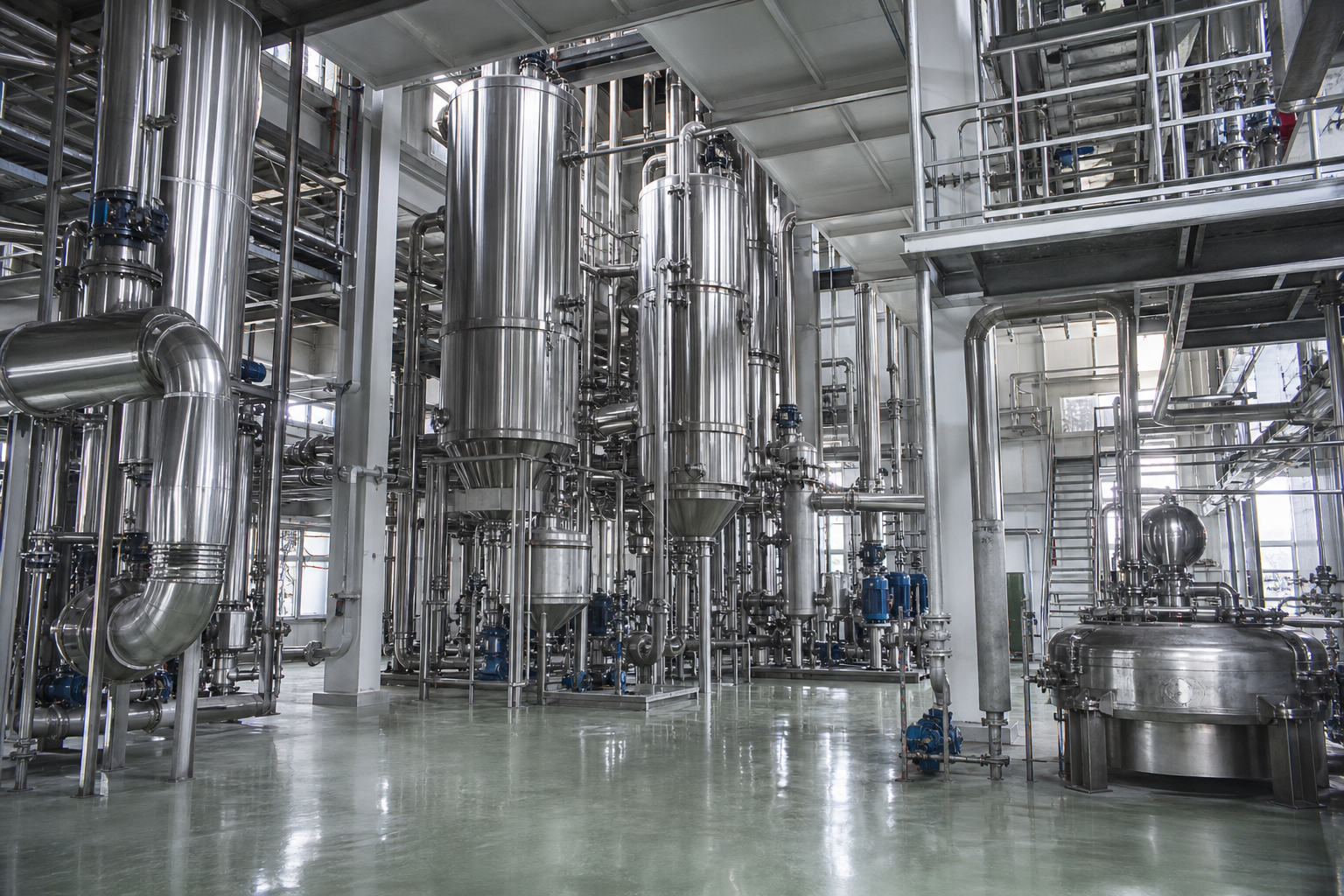
One set of the following equipment is typical for this duty:
- Lactic acid solution feed tanks with grade segregation
- 76 t/h MVR falling-film evaporation train with mechanical vapor recompressor
- 7 t/h TVR falling-film evaporation train with thermocompressor
- Vacuum systems and surface condensers per train
- Density-controlled discharge by product line
- Segregated condensate headers with acid-carryover monitoring
- PLC control with CIP sequencing between grades
Performance & Outcome
Compiled from published industry project data, indicative: dual-train blocks of this class evaporate 83 t/h of lactic acid solution with the bulk duty on MVR electric energy and the side duty on TVR steam, holding the vacuum falling-film conditions that protect acid color and purity. Per-train economies are quoted per project solution specification.
Simplified PFD
The simplified process flow diagram above shows the two falling-film trains with their separate heat sources and the shared condensate and product routing.