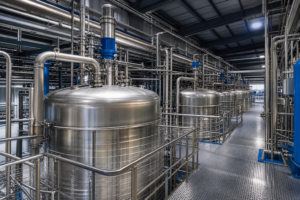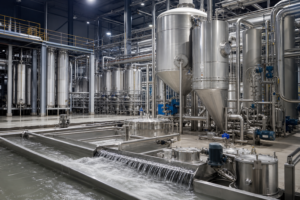
Separating NaCl from KCl in a mixed chloride brine is a solubility-engineering problem, not a filtration problem. The industrial answer is two-stage fractional crystallization: evaporate first to crystallize sodium chloride, whose solubility is nearly flat with temperature, then flash-cool the de-sodiated mother liquor to crystallize potassium chloride, whose solubility drops sharply as temperature falls. On feed streams running 140–160 g/L total chloride with a K:Na ratio close to 1:1, vendor-published performance data report NaCl recovery at 96–98% dry-basis purity and KCl at 85% or better, and retrofitting the sodium stage from multi-effect evaporation to MVR has cut operating energy by more than 40% in externally published operating cases — indicative external references, not EvapCryst deliveries and not a project guarantee.
Why NaCl–KCl Mixtures Resist Conventional Separation

Sodium chloride and potassium chloride are both highly soluble, highly mobile chlorides that crystallize as separate phases but compete for the same water. The difficulty is not making salt come out; it is making the right salt come out at the right moment. Three conditions make the problem harder:
- Near-equal K:Na ratios. When the molar ratio of K to Na approaches 1:1, neither salt can be flushed out as a minor impurity. Both must be recovered as products, which demands sequential crystallization stages rather than a single polishing step.
- High sulfate backgrounds. At sulfate concentrations around 10 g/L, mixed K–Na sulfate double salts (glaserite/aphthitalite-type phases) begin to form on evaporation. Once a double salt nucleates, it traps potassium in the sodium circuit and drags purity below saleable grades. Plants running K:Na ≈1:1 with elevated sulfate are the classic failure case for naive single-stage evaporation.
- Corrosive, impurity-laden matrices. Metallurgical hazardous-wash streams carry zinc, heavy metals, and fine suspended solids. Chloride brines at 140–160 g/L total chloride are aggressively corrosive to standard stainless steels at evaporation temperatures.
Where Mixed K/Na Chloride Streams Come From
Three industrial sources dominate. First, steel sinter plant flue dust (sinter machine head ash): the dust carries water-soluble K and Na salts (added deliberately as fluxes or scavenged from ores) that must be washed out before the dust can be recycled to the sinter bed or disposed safely. Industry-reported washing practice at a solid-to-liquid ratio of 1:3 to 1:5 for 30–60 minutes dissolves more than 90% of the soluble K and Na, producing a low-concentration rinse liquor that feeds the evaporation plant. Second, metallurgical hazardous waste recovery: zinc-bearing residues, incineration fly ash, and mixed sinter dusts are de-chlorinated by water washing, and the combined rinse liquor is a concentrated mixed chloride brine. Third, chemical production: potash processing, agrochemical synthesis, and salt-chemical plants generate sodium- and potassium-bearing mother liquors that need salt recovery before discharge or reuse of condensate. Treat the feed figures quoted across this page (140–160 g/L total chloride, K:Na ≈1:1, sulfate around 10 g/L) as an illustrative feed envelope constructed from the published external cases cited below — not customer or project data; the actual brine must be confirmed by full analysis.
The Core Separation Logic: Exploit the Solubility Gap
The entire flowsheet rests on two well-behaved solubility facts. NaCl solubility rises only about 3–4 g per 100 g water between 20 °C and 100 °C — effectively flat. KCl solubility roughly triples over the same range (from roughly 34 to roughly 56 g per 100 g water). Therefore:
- While evaporating at high temperature, the liquor stays unsaturated in KCl relative to NaCl, so NaCl crystallizes preferentially and cleanly. This is the sodium removal stage.
- When the NaCl-depleted mother liquor is flash-cooled, KCl solubility collapses and KCl crystallizes without further evaporation. This is the potassium recovery stage.
The two stages reinforce each other: removing sodium first concentrates potassium in a smaller mother liquor volume, and cooling afterwards recovers potassium without re-dissolving sodium. Plants that try to shortcut this order — crystallizing both salts together — produce a mixed salt that is far harder to upgrade than either separated product.
Process Route, Stage by Stage
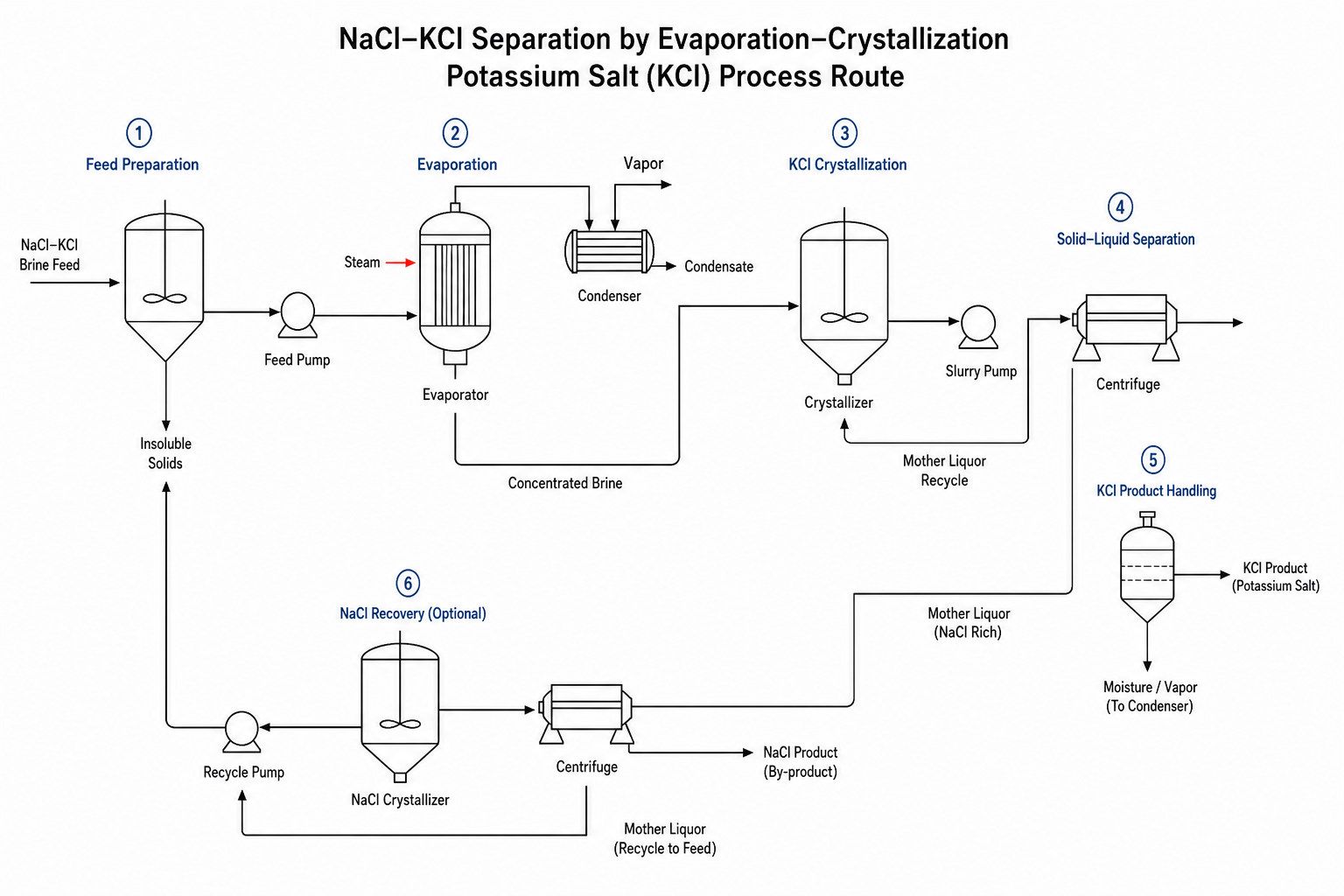
1. Feed clarification and pretreatment
Rinse liquors from dust washing carry suspended fines and scaling ions. Settling plus filtration ahead of the evaporators protects heat-transfer surfaces; sulfate levels above roughly 10 g/L may justify a targeted sulfate-removal or sulfate-tolerant design margin, because sulfate is the trigger for double-salt formation in the sodium circuit.
2. Stage one — evaporation to crystallize NaCl
The clarified brine is concentrated in a forced-circulation evaporation train operating on the sodium circuit. Both multi-effect countercurrent trains and MVR forced-circulation systems are used. The control variable is the evaporation endpoint: the liquor is concentrated until NaCl crystallization has removed sodium down to the level that leaves the mother liquor rich in KCl but still below KCl saturation at the operating temperature, avoiding co-crystallization.
3. Stage two — flash cooling to crystallize KCl
The hot, de-sodiated mother liquor passes into a flash-cooling (vacuum cooling) crystallizer. Sudden depressurization and temperature drop force KCl out of solution as the solubility curve falls away. Design margin matters here: full-scale plants deliberately reserve spare evaporation capacity to absorb feed-quality swings, because a K:Na ratio that drifts during operation shifts the crystallization endpoints faster than a fixed-geometry train can follow.
4. Centrifugation, drying, and condensate recycle
Each crystallizer discharges slurry to centrifuges; NaCl is typically dried to a free-flowing industrial salt, while KCl is commonly sold or stored as wet cake. Condensate from the evaporators is clean hot water and is recycled to the upstream washing step, closing the water loop and cutting fresh-water consumption for dust washing.
5. MVR retrofit for the sodium stage
Because the sodium stage evaporates the bulk of the water, it is the natural target for energy optimization. In one externally published two-phase vendor case (an external industry reference, not an EvapCryst delivery), phase one used a four-effect countercurrent train for sodium removal with flash cooling for potassium; phase two replaced the sodium-side evaporation with MVR, recompressing secondary vapor as the heating source. Published result: operating energy fell by more than 40%, and the plant shed most of its dependence on external live steam — the main energy input becoming electricity for the compressor.
| Process Module | Candidate Equipment Types | Selection Basis | Module Function |
|---|---|---|---|
| Feed clarification | Settler, polishing filter; sulfate-removal step where justified | Suspended solids and sulfate load | Protects heat-transfer surfaces and suppresses double-salt triggers |
| Sodium-stage evaporation | Forced-circulation multi-effect or MVR train (potential material consideration: TA2-class titanium core, 2205-class duplex per published references) | Water load, energy price, retrofit phasing | Crystallizes NaCl at high temperature while KCl stays in solution |
| Potassium-stage crystallization | Flash-cooling (vacuum cooling) crystallizer, FC unit in cooling mode | Solubility curve, cooling utility | Crystallizes KCl from de-sodiated mother liquor without further evaporation |
| Separation and drying | Centrifuges; salt dryer for NaCl product | Product form and offtake specification | Dewaters both salts; NaCl dried to industrial salt, KCl sold as wet cake |
| Condensate and water loop | Condensate collection and routing to washing | Site water balance | Returns clean hot water to dust washing, cutting freshwater draw |
Configuration, materials and operating envelopes above are potential considerations and indicative envelopes; actual selections depend on feed composition, temperature, pressure, corrosion review, fouling behavior, utilities and project capacity.
Reference Project Data

The table below consolidates externally published vendor case data from full-scale K/Na separation projects treating metallurgical and sinter-dust wash streams — external industry references, not EvapCryst deliveries; figures are indicative, not a project guarantee.
| Parameter | Metallurgical waste recovery project (Qinzhou, China) | Sinter-dust rinse liquor project (Gejiu, China) |
|---|---|---|
| Feed origin | Zinc residues + incineration fly ash + sinter dust, water-washed | Sinter machine head ash, de-chlorination rinse |
| Total chloride in feed | 140–160 g/L | High-salinity rinse liquor |
| K:Na ratio | ≈1:1 | ≈1:1 with high sulfate |
| Sulfate | ≈10 g/L | Elevated (double-salt risk) |
| Sodium stage | Four-effect countercurrent, phase 2 MVR retrofit | Three-effect countercurrent |
| Potassium stage | Flash cooling crystallization | Flash cooling crystallization |
| Throughput | 20 m³/h rinse liquor | Design-margin equipped train |
| NaCl product | 96–98% (dry salt) | ≥95% (dry salt) |
| KCl product | ≥85% (wet salt) | ≥85% |
| Energy after MVR retrofit | >40% reduction vs multi-effect baseline | — |
Crystallizer and Equipment Selection

For potassium chloride service, the forced-circulation (FC) crystallizer is the workhorse. An FC crystallizer consists of a crystallization chamber with a conical bottom, a circulation pipe, an axial-flow circulation pump, and a heat exchanger; slurry is recirculated through the heater back into the chamber continuously, and crystal slurry is drawn from the cone. It can run continuously or in batches, and with the heater bypassed and a vacuum system attached it doubles as a cooling crystallizer — which is exactly how the KCl flash-cooling stage is implemented. Supplier-published FC crystallizer literature for chloride service indicates product crystal sizes typically in the 0.05–0.8 mm range.
| Selection factor | Sodium circuit (NaCl) | Potassium circuit (KCl) |
|---|---|---|
| Supersaturation driver | Evaporation at high temperature | Flash cooling / vacuum cooling |
| Preferred crystallizer | FC forced-circulation evaporating crystallizer | FC in cooling mode or dedicated flash chamber |
| Energy fit for MVR | High — evaporates the bulk of the water; retrofit pays back fastest here | Low — little or no evaporation; cooling duty is cheap |
| Crystal size expectation | Typically 0.05–0.8 mm (supplier-published indicative range) | Comparable, size-controlled by slurry density and cooling rate |
| Product form | Centrifuged and dried industrial salt | Wet cake or dried potash raw material |
Materials of Construction and Failure Modes
Chloride brines at 140–160 g/L are beyond the safe envelope of 316L at evaporation temperatures. Material assignments reported in published project references: TA2 industrial pure titanium for all wetted core parts in contact with the process liquor, and 2205 duplex stainless steel for water-side and vapor-side components. Skipping this grading invites chloride stress-corrosion cracking and pitting on the heat-transfer surfaces.
The dominant operational failure modes are predictable and designable:
- Double-salt formation when sulfate is allowed to concentrate beyond the design envelope in a 1:1 K:Na liquor — shows up as purity loss in the NaCl stream.
- Local crystallization and tube blockage when evaporation rate outruns circulation — controlled by trimming compressor speed, heating temperature, and residence time rather than pushing throughput.
- Feed-ratio drift as upstream washing varies — absorbed by the reserved evaporation margin and by monitoring K/Na concentration in the feed in real time.
Product Outlets and Economics
The recovered salts are commodities with established offtake. NaCl at 96–98% dry purity meets industrial salt specifications for chlor-alkali feedstock and general industrial use. KCl at ≥85% purity sells as a potash fertilizer raw material or as feedstock for further upgrading. Against these revenue lines, the plant books avoided disposal costs for the hazardous wash stream, condensate reuse credits, and — after an MVR retrofit — an energy line item reduced by more than 40% in the published cases cited above. For potassium-rich streams (K high, Na low), the process order inverts: crystallize KCl first at high temperature where its solubility advantage keeps it soluble until the concentrate point, then recover residual KCl by cooling, and finally crystallize NaCl from the spent mother liquor — prioritizing the higher-value product first.
When This Route May Not Fit
Two-stage fractional crystallization earns its complexity only when both salts are worth recovering as products. It may not fit when: the K:Na ratio is extreme enough that the minor salt is better treated as an impurity polished out in a single crystallization stage, not a second product circuit; sulfate cannot be held below the double-salt envelope and no removal step is acceptable, so fractional purity targets are unreachable by this chemistry alone; the stream carries organic load, chelants or surfactants that foul heat transfer and distort crystal growth; throughput is very small, where batch crystallization in simple vessels beats a continuous two-circuit train; or the product must reach food, battery or pharmaceutical grades, which demand recrystallization or dissolution-reprecipitation beyond this flowsheet. Where none of the salt has a buyer, a ZLD disposal train is the more honest scope.
What Must Be Verified
Before this route is committed for your brine, verify: a complete feed analysis — K, Na, total chloride, sulfate, heavy metals and suspended solids, with realistic swing, because ratio drift moves both crystallization endpoints; a sulfate speciation and double-salt review (phase-equilibrium check) at your concentration and temperature envelope; bench or pilot evaporation-and-cooling tests on the actual liquor confirming crystal purity and growth behavior; a corrosion review confirming titanium-class and duplex-class assignments against your chloride level and temperature; confirmed offtake specifications for both salts, since the economics stand on two product revenues; and site utilities — electricity for MVR, cooling water for the flash stage. Performance figures on this page come from external vendor-published cases: indicative, not a project guarantee.
Frequently Asked Questions
Can reverse osmosis or nanofiltration separate KCl from NaCl?
Not economically at high salinity. Monovalent K+ and Na+ are too similar in hydrated radius for conventional membranes to split cleanly, and the osmotic pressure of a 140–160 g/L chloride brine exceeds practical RO limits. Membranes are useful upstream for concentrating dilute rinse waters, but the K/Na split itself is a crystallization job.
What K:Na ratio makes separation worthwhile?
Both near-1:1 streams and potassium-rich streams are routinely processed; the flowsheet changes, not the feasibility. At 1:1, sodium removal precedes potassium recovery. In potassium-rich sinter-dust liquors, potassium is recovered first to lock in the higher-value product, with sodium recovered last from the tail mother liquor.
How much energy does the MVR retrofit actually save?
Externally published vendor cases report operating energy reductions of more than 40% when the sodium-side multi-effect train is converted to MVR, because MVR recycles secondary vapor heat via an electrically driven compressor instead of consuming live steam effect by effect — indicative external references, not a project guarantee.
What purity can the products reach?
Vendor-published full-scale cases report NaCl at 96–98% as dry salt and KCl at 85% or better as wet salt on feeds near 140–160 g/L total chloride with sulfate around 10 g/L. Higher KCl grades are achievable with recrystallization or product washing where the offtake justifies it.
Why does sulfate matter so much?
Sulfate is the enabler for potassium–sodium double salts. Above roughly 10 g/L in a near-1:1 K:Na liquor, evaporation can push the solution into double-salt crystallization regions, contaminating the NaCl product and locking potassium away. Sulfate either needs a removal step or explicit design accommodation.