Project Parameters
| Parameter | Value |
|---|---|
| Process route | Pretreatment (aeration, DAF, dual-alkali softening) + plate MVR forced-circulation evaporation crystallization |
| Industry | Gasfield wastewater treatment, O&M reference (Deyang, Southwest China) |
| Feed type & key components | Mixed gasfield streams (produced water, fracturing flowback, mud filtrate): hardness ~22,000 mg/L fluctuating, high metal ions, low pH, low-boiling organics |
| Evaporation capacity | 600 t/d |
| Operating envelope | Evaporator inlet hardness controlled to 500–1,000 mg/L; continuous runs beyond 30 days between cleanings |
Representative process configuration compiled from published industry project data. Indicative values, not a process guarantee.
Project Description
Every evaporator supplier can draw a clean flowsheet; the differences show up in the second year of operation. This reference case is the operating record of a 600 t/d MVR crystallization train in Deyang, Sichuan, treating a genuinely hostile mix: gasfield produced water, fracturing flowback and mud-press filtrate in one plant. The feed swings — hardness around 22,000 mg/L with wide fluctuation, a low pH, elevated metal ions, and a population of low-boiling organic compounds that behave badly in a vacuum evaporator.
The value of this case is not the equipment list; comparable trains run across the gas provinces. The value is the documented set of countermeasures — what was tightened, redosed and repositioned to keep a scaling brine from running the plant instead of the reverse.
Process Technology
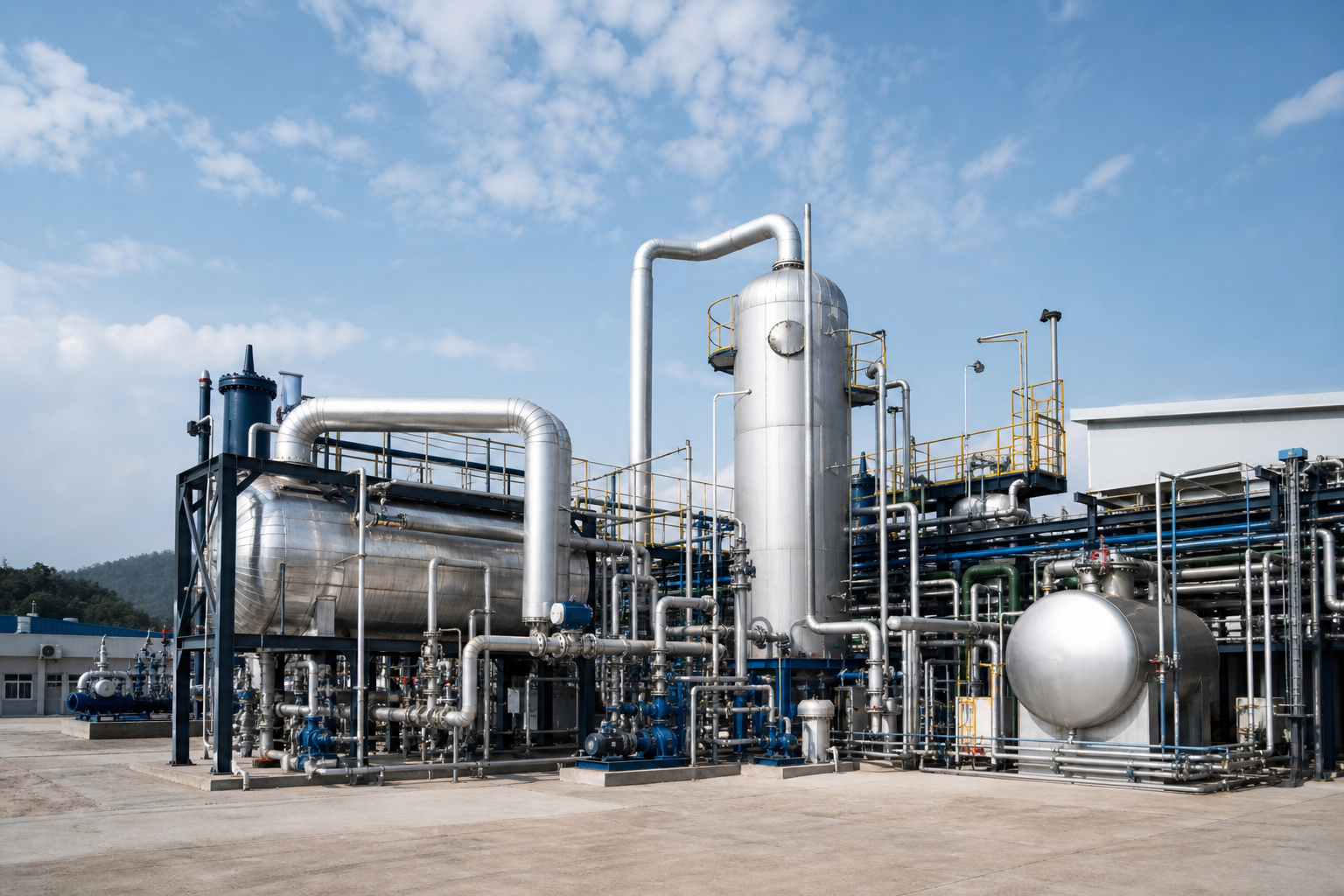
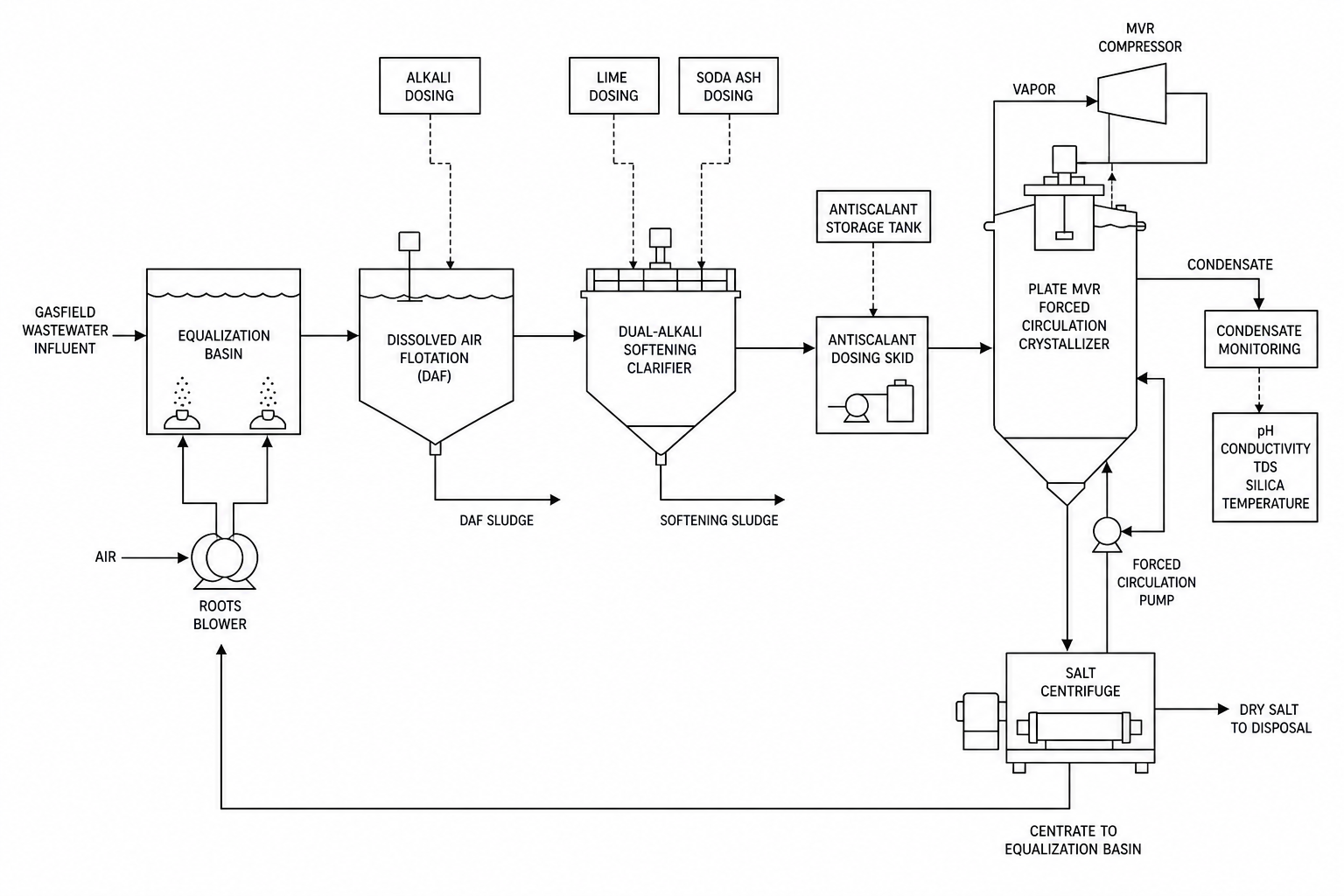
Low boilers first. Volatile organics in the feed would flash with the water vapor and contaminate the condensate, so the train front-ends with jet aeration on roots-blower air: the basin strips the light fractions to atmosphere (through odor management) before they can reach the evaporator. This is the cheapest place in the plant to remove them — after they reach the condensate, they are a water-quality problem instead of an air one.
Flotation chemistry second. Dissolved air flotation performance on oily, surfactant-laden gasfield water is pH-sensitive, and this feed arrives acidic. Alkali dosing ahead of the DAF — with the PAM flocculant injection point repositioned to where the floc actually forms — converted the flotation stage from marginal to stable in the reference operating record.
Hardness third, and it is the main event. A brine at ~22,000 mg/L hardness pumped straight into a forced-circulation evaporator scales the heat transfer surface on a schedule measured in days. The countermeasure train here: dual-alkali softening (lime-soda chemistry) plus a compounded antiscalant, tuned so that evaporator inlet hardness lands in a controlled 500–1,000 mg/L window — soft enough to keep the surfaces clean, dosed economically rather than softened to drinking-water standards the process does not need.
COD is handled upstream where it is cheap: front-end PAM-assisted removal takes the organic load down before evaporation, protecting condensate quality. Under this envelope the reference plant runs continuous campaigns beyond 30 days between cleaning interventions, with condensate meeting GB/T 31962-2015 class-C reuse criteria and salt dewatered to GB/T 5462-2015 grade-1-or-better wet industrial salt.
Equipment Configuration
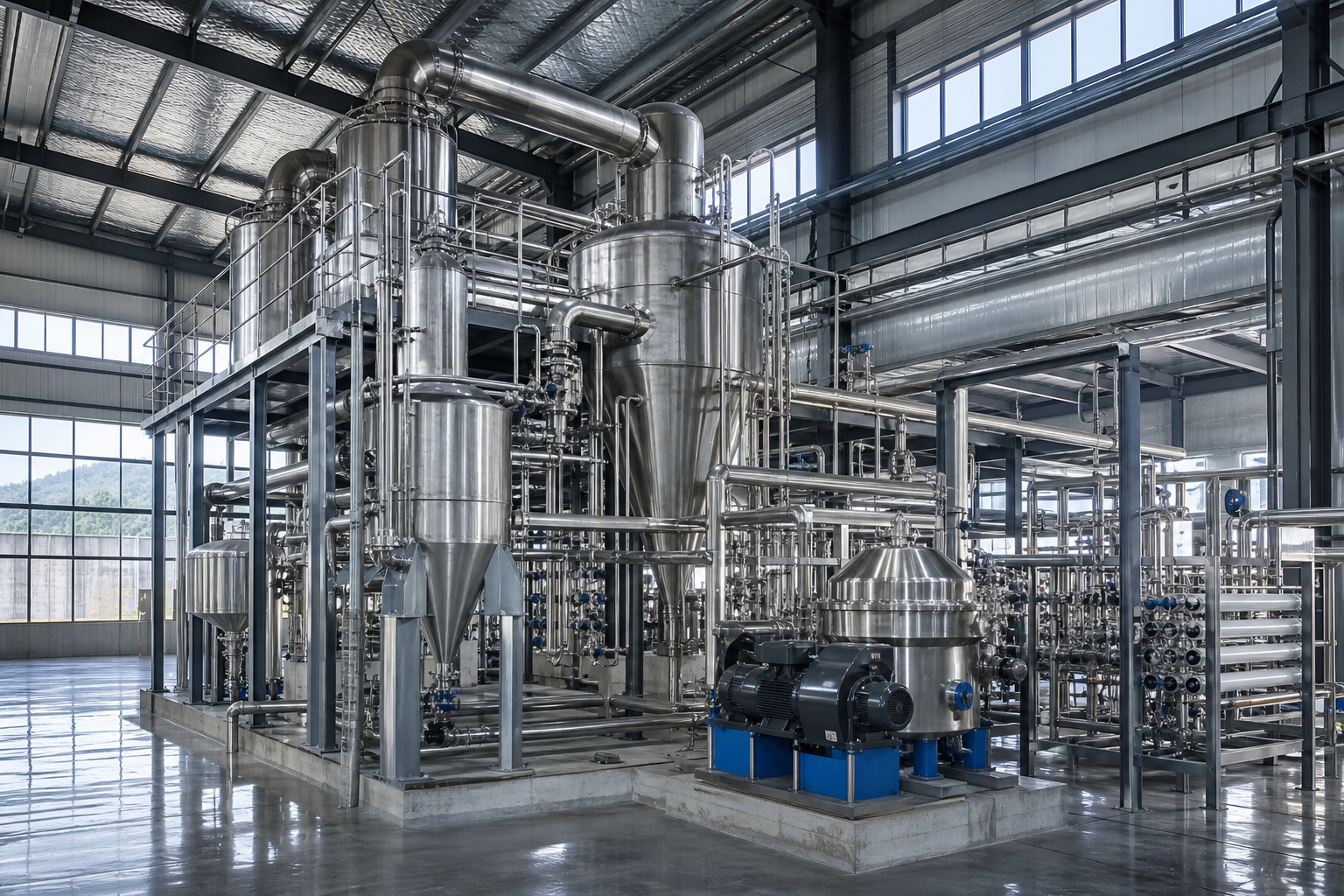
One set of the following equipment is typical for this duty:
- Jet aerators on roots-blower air for low-boiler stripping in equalization
- Dissolved air flotation with pre-DAF alkali dosing and repositioned PAM injection
- Dual-alkali softening train plus compounded antiscalant dosing to a 500–1,000 mg/L inlet window
- Plate MVR forced-circulation evaporation crystallization train with CIP provision
- Salt dewatering to GB/T 5462 product; condensate to GB/T 31962 class-C reuse
- Online hardness, pH and condensate monitoring tied to dosing interlocks
Performance & Outcome
Compiled from published industry project data, indicative: with inlet hardness disciplined to 500–1,000 mg/L and low boilers stripped ahead of the train, 600 t/d gasfield MVR plants of this class sustain beyond-30-day continuous runs, producing class-C reuse condensate and grade-1 salt. Cleaning frequency and chemical dose rates are quoted per feed chemistry.
Simplified PFD
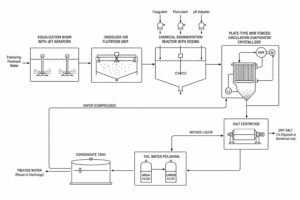
The simplified process flow diagram above shows aeration, pH-controlled DAF, dual-alkali softening with antiscalant, and the plate MVR forced-circulation crystallizer.