Project Parameters
| Parameter | Value |
|---|---|
| Process route | MVR evaporation + concentration, crystallization for sodium sulfate recovery |
| Industry | Battery materials — ternary NCM precursor production |
| Feed type & key components | Sodium sulfate wastewater from NCM precursor synthesis and washing; trace nickel–cobalt–manganese values |
| Evaporation capacity | 82 t/h |
| Construction materials | SS316L wetted parts (indicative for neutral sulfate service) |
Representative process configuration compiled from published industry project data. Indicative values, not a process guarantee.
Project Description
Ternary precursor (nickel–cobalt–manganese hydroxide) plants are, in hydraulic terms, sodium sulfate factories attached to a cathode chain: the co-precipitation chemistry and the multi-stage washing of the precursor product both run on sodium hydroxide, and every mole leaves the plant as sodium sulfate in water. At a very large NCM complex in Central China, this stream reaches 82 t/h of evaporation duty — a scale at which the wastewater plant is itself one of the larger evaporation installations in the regional chemical industry.
Two objectives define the reference configuration. The first is volume: the brine cannot be discharged, and the water must come back to the washing circuit — at this scale every percent of condensate recovery is an industrial quantity of fresh water saved. The second is value: the sulfate leaves as sodium sulfate by-product salt, and the trace nickel, cobalt and manganese carried over from synthesis are recovered upstream so that metal values return to the process instead of to the salt. Comparable published configurations in the same battery-materials segment run at 80–150 t/h, confirming this duty class as an established MVR domain.
Process Technology
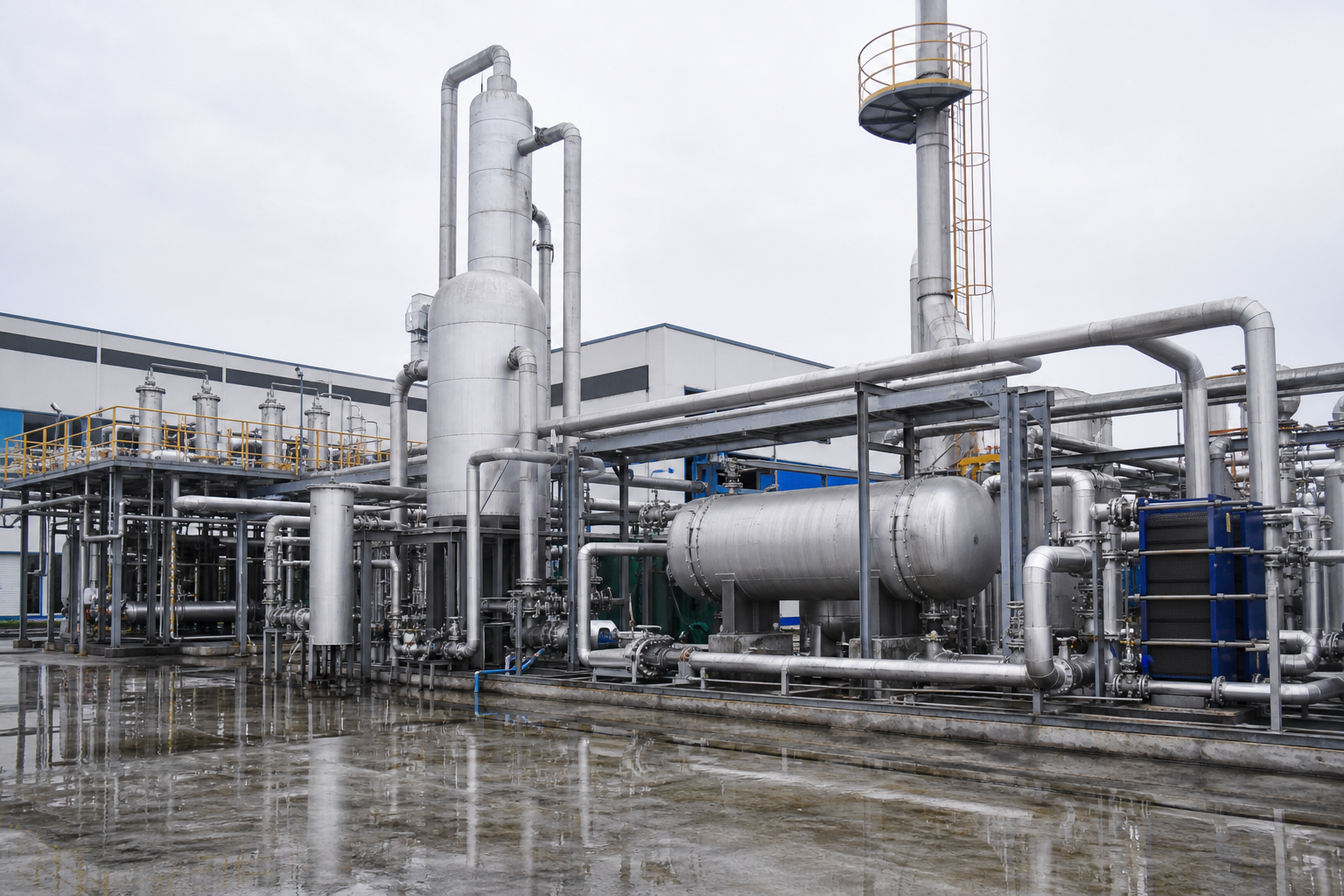
Wastewater from synthesis and washing is collected and treated first for metal recovery: precipitation or ion-exchange polishing steps pull the residual nickel, cobalt and manganese values out of the brine before it is concentrated — both because the metals are worth more in the precursor plant than in the salt, and because battery-grade salt offtakes tolerate far less transition-metal contamination than older industrial channels.
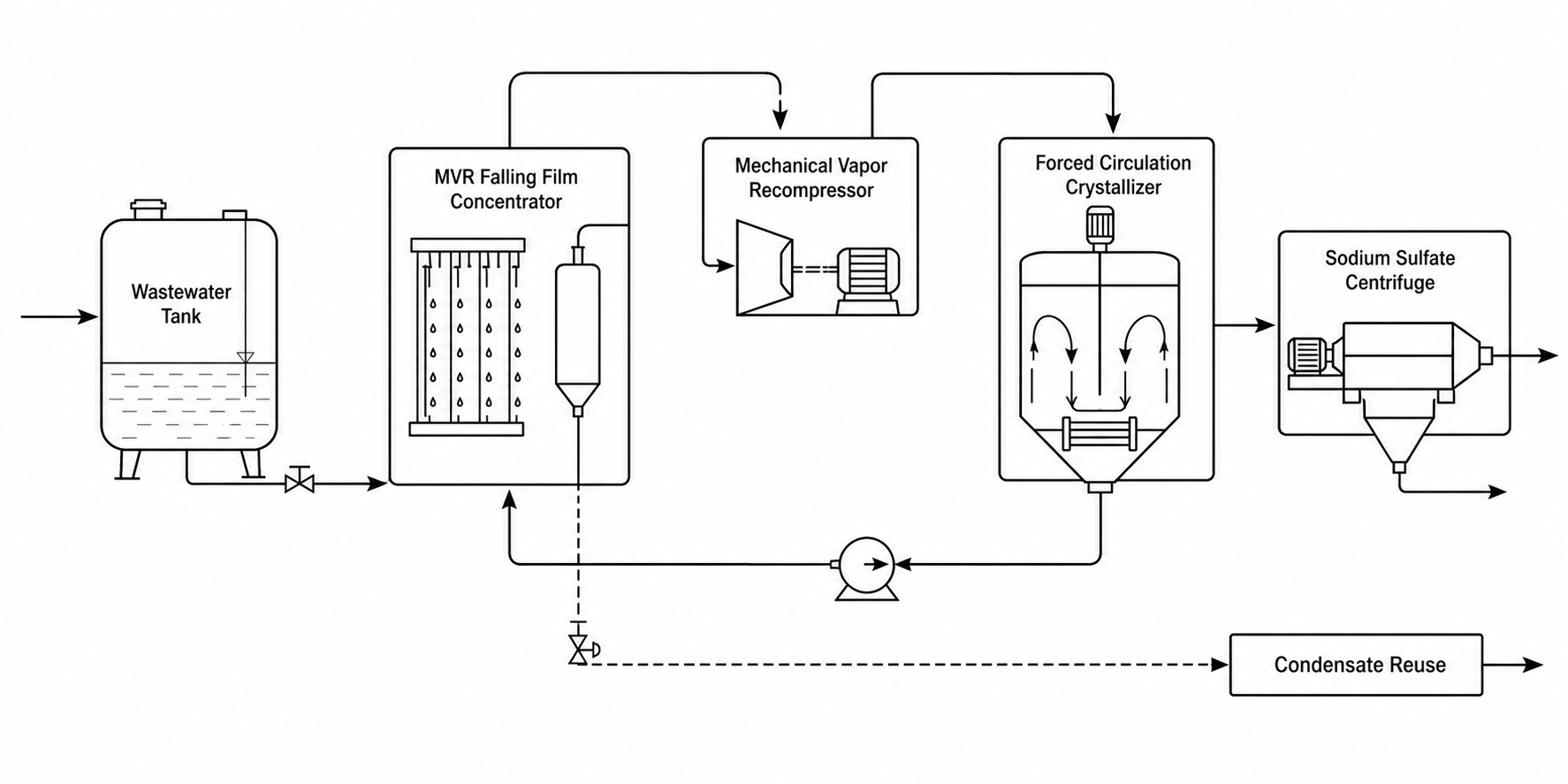
The polished sodium sulfate brine is then concentrated in the MVR train. At 82 t/h the thermal duty is large enough that the efficiency of the drive dominates the operating cost: mechanical vapor recompression delivers the heat electrically, with specific consumption per tonne of water far below steam-heated alternatives. The concentration section works across falling-film and forced-circulation services — falling film where the liquor is dilute and clean and heat transfer is cheapest, forced circulation as sulfate saturation approaches and the duty shifts to a crystallizing, fouling-prone regime that demands pumped circulation velocity.
At saturation, sodium sulfate crystallizes in the forced-circulation crystallizer under controlled supersaturation. Crystal growth is managed for a coarse, dewaterable product; the slurry reports to a centrifuge where the salt is washed to strip adhering mother liquor. The dewatered sodium sulfate leaves as by-product, with trace impurity content governed by the upstream metal-recovery step.
Mother liquor recycles to the evaporator feed with a purge controlling the build-up of trace species; condensate from the train — the largest single output stream by mass — is collected hot and clean and returned to the precursor plant’s washing circuit. The water loop of the whole complex closes here.
Equipment Configuration
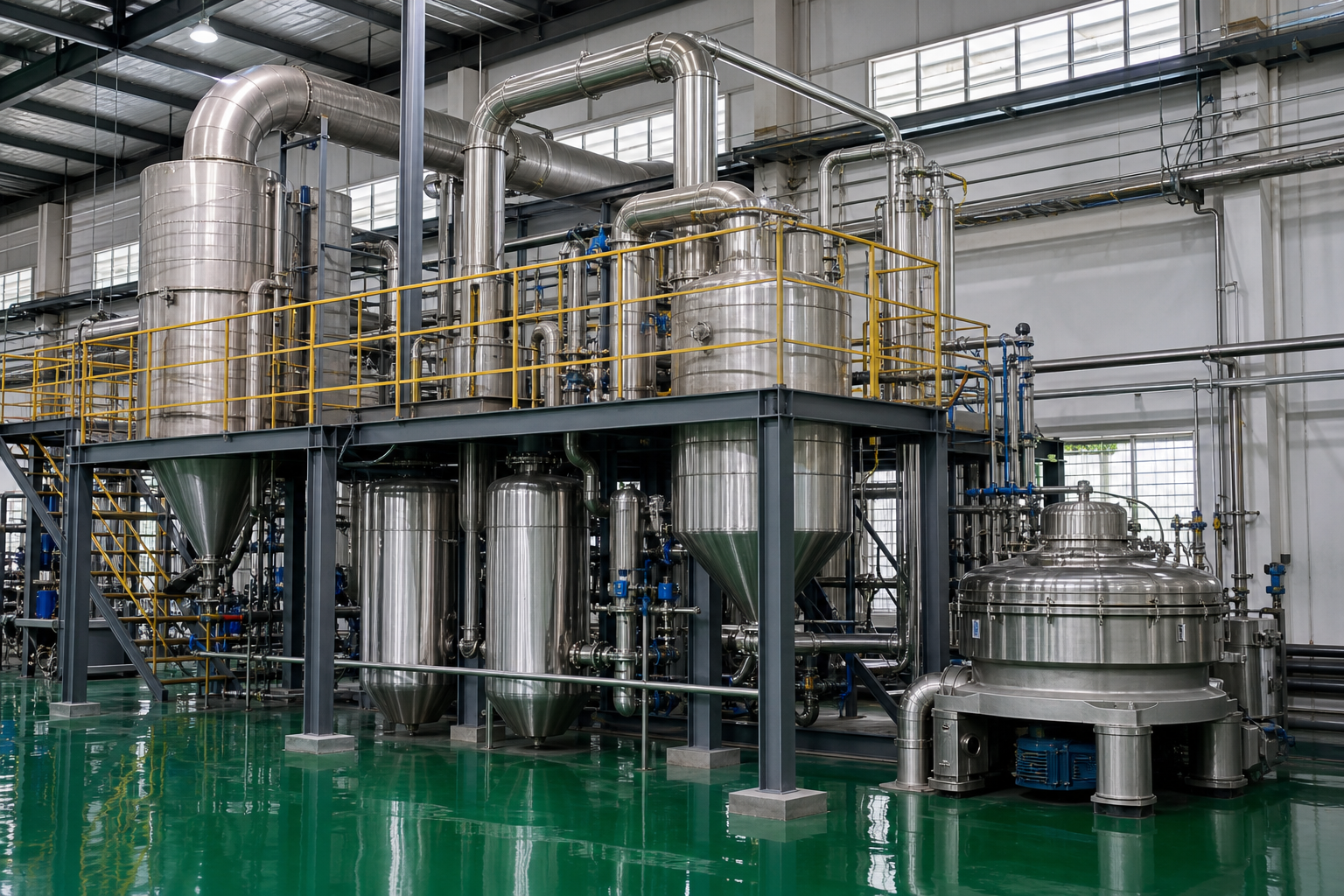
One set of the following equipment is typical for this duty:
- Equalization and metal-recovery polishing (precipitation / ion exchange) ahead of evaporation
- MVR evaporation train: falling-film concentration bodies with forced-circulation finisher, mechanical vapor recompressor
- Forced-circulation crystallizer for sodium sulfate with classified withdrawal
- Centrifuge with salt washing; by-product salt handling and loading
- Mother-liquor return and purge control; condensate tankage and reuse pumping to the washing circuit
- DCS control of train density, crystallizer inventory and compressor load at full 82 t/h duty
Performance & Outcome
Compiled from published industry project data, indicative: trains of this class close the water balance of very large precursor plants, recovering the sodium sulfate load as washed by-product salt and returning condensate at flow rates that displace the majority of fresh water demand. Specific energy and salt purity are quoted per project.