Project Parameters
| Parameter | Value |
|---|---|
| Process route | Multi-effect falling-film evaporation of clarified pectin juice |
| Industry | Pectin / hydrocolloid production (Chongqing, Southwest China) |
| Feed type & key components | Clarified juice from pectin extraction: dilute pectin solution, sugars, organic acids |
| Evaporation capacity | 21.78 t/h |
| Construction materials | SS316L wetted parts (food-grade finish) |
Representative process configuration compiled from published industry project data. Indicative values, not a process guarantee.
Project Description
Pectin production starts with acid extraction of the hydrocolloid from citrus peel or apple pomace, which yields a very dilute clarified juice — pectin at a fraction of a percent in water. Everything downstream of that point is a water-removal problem: the juice must be concentrated many times over before alcohol precipitation or direct dehydration can finish the product, and the pectin must arrive at that concentration with its molecular chain — the gel-forming structure that is the entire commercial value — intact. The published project for this duty is a 21.78 t/h evaporation train at a pectin producer in Chongqing.
The design tension is the same one that governs all hydrocolloid concentration: pectin solutions are viscous, heat-sensitive and quick to degrade when held hot. Gel grade falls with thermal abuse; color rises. The train&rsquos job is to remove water fast in thin films at low temperature — and then get the concentrate out and cooled without a hot hold anywhere in the path.
Process Technology
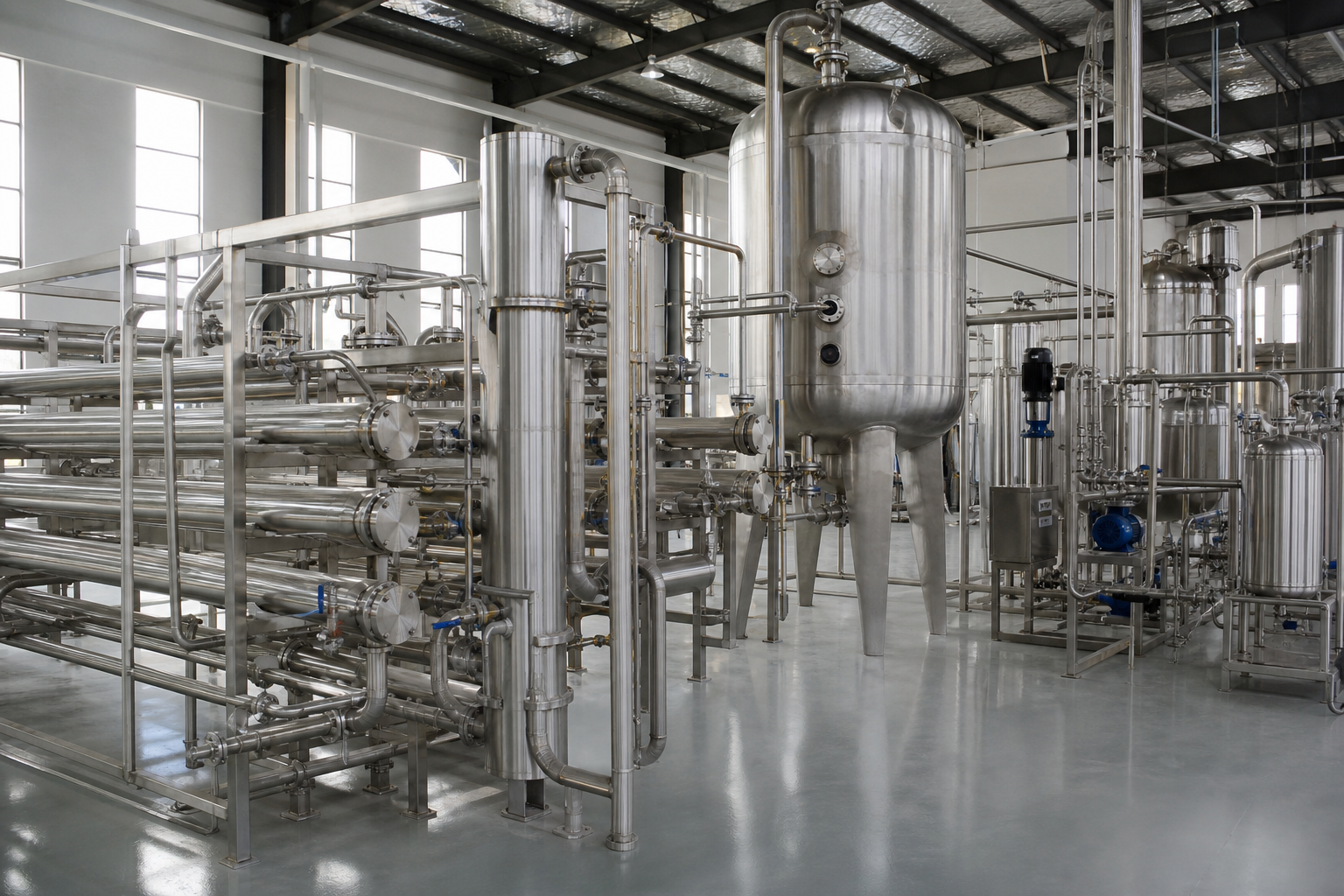
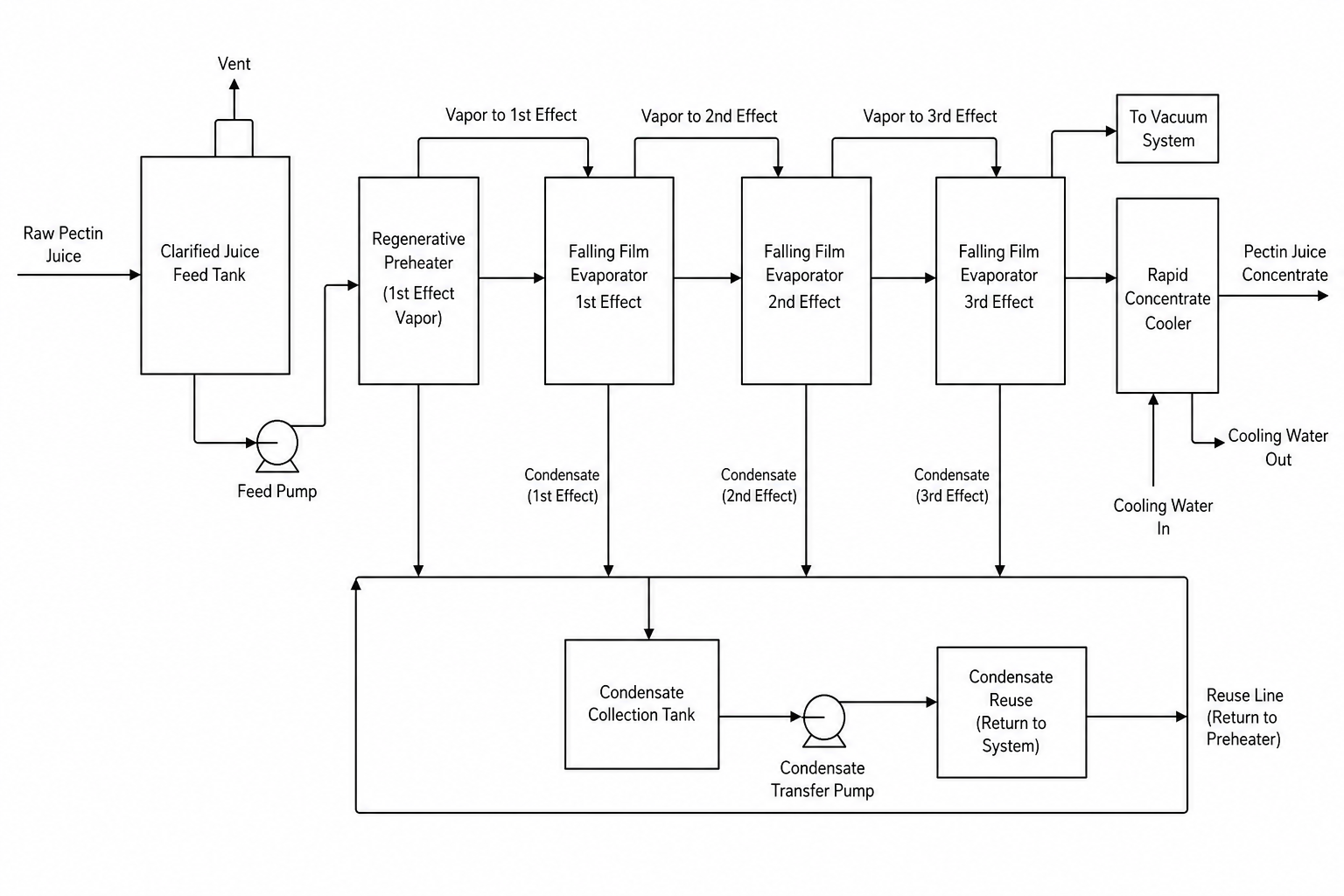
Clarified pectin juice from extraction and filtration is preheated regeneratively against outgoing condensate and fed to the multi-effect falling-film train. In the calandria tubes the liquor descends as a thin film evaporating under vacuum at low temperature difference; residence time in the hot zone is seconds, and the vacuum level is set to keep the boiling temperature in the band where the pectin chain is stable. Viscosity is the working constraint as concentration climbs — the effect arrangement and the final concentration target are balanced so the film stays distributable to the end of the duty.
Multiple effects step the duty down in temperature and pressure, each effect boiling on the vapor of the one before — the steam economy that makes a dilute-feed, high-water-removal process affordable. Where the site&rsquos steam and product economics favor it, a thermocompressor (TVR) boosts the first effect; published configurations of this product family span both plain multi-effect and TVR-assisted trains.
Concentrated pectin liquor is withdrawn at target concentration, cooled immediately, and forwarded to precipitation or drying. Condensate from the effects is hot, clean water reused for extraction make-up and plant cleaning. A small clarified-juice side stream controls calcium and ash carryover that would otherwise build in any recycle arrangement.
Equipment Configuration
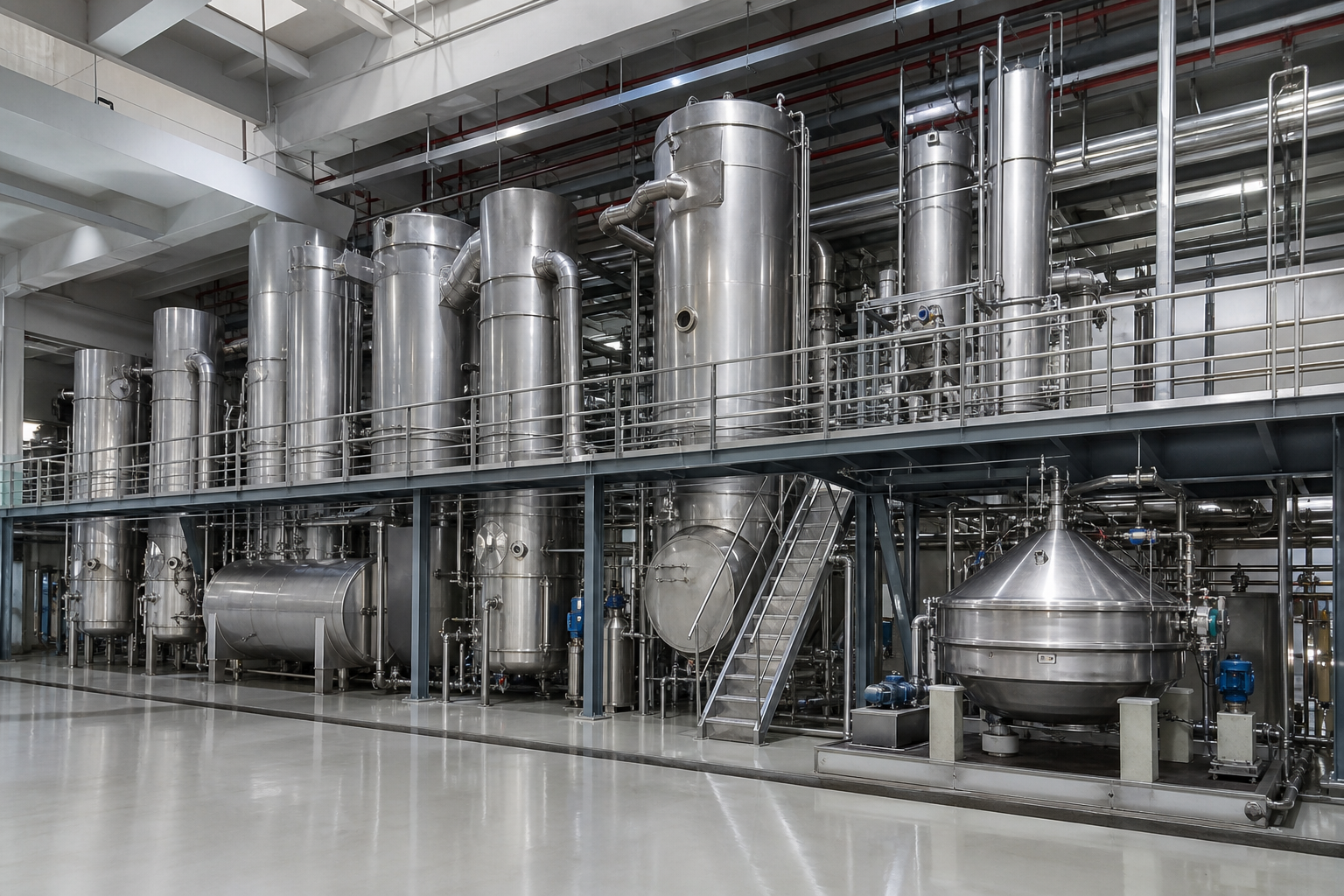
One set of the following equipment is typical for this duty:
- Clarified juice feed tank with regenerative preheating
- Multi-effect falling-film evaporation train, vacuum operation, food-grade SS316L
- Optional TVR thermocompressor on the first effect per site steam economics
- Rapid concentrate cooling and forwarding to precipitation / drying
- Condensate collection and reuse; CIP system for product-contact surfaces
- PLC control of effect temperatures, vacuum and concentrate density
SS316L with food-grade surface finish is the reference construction throughout product contact.
Performance & Outcome
Compiled from published industry project data, indicative: trains of this class concentrate clarified pectin juice at 21.78 t/h on multi-effect steam economy while holding the low-temperature, short-residence regime that protects gel grade. Concentration factor and steam per tonne of water are quoted per project.
Readers comparing technologies may also find Food and Beverage Evaporation Solutions useful.