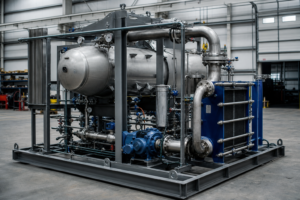
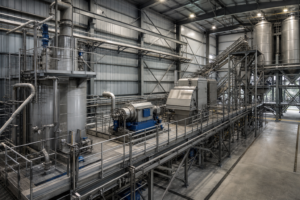
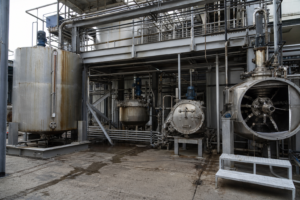
A forced circulation (FC) evaporator uses a circulation pump to drive liquor through the heat exchanger at high velocity—typically 2–3.5 m/s in the tubes in evaporator-concentration service (crystallizer duty runs lower, typically 1.5–2.5 m/s, see our FC crystallizer article)—and it exists for one reason: to evaporate liquors that defeat every other evaporator type. Concentrated, viscous, scaling, crystallizing, particle-laden feeds are its home territory. The design’s trick is geometric: the liquor is heated under pressure inside the tubes without boiling, then flashes to vapor in a separate separator, so scale-forming supersaturation never develops on the heat-transfer surface. The price is pump energy and a heat-transfer coefficient below that of falling film—FC trades efficiency for robustness. It is the finishing machine in most zero-liquid-discharge trains and salt crystallization plants, usually combined with MVR for energy recovery. This guide covers the working principle, design parameters, applications, and the honest limits of the technology — the evaporation-concentration view. When the duty is crystallization itself (supersaturation control, crystal size distribution, slurry management), that is the FC crystallizer article‘s territory.
What It Is and Where It Fits
Among tubular evaporators—falling film, rising film, natural circulation, forced circulation—the forced circulation evaporator is the heavy-duty end of the family. Where film evaporators rely on gravity or vapor shear to move liquor gently past the heating surface (see the falling film vs rising film comparison for that side of the family), the FC design puts a pump in the loop and forces the liquor through at whatever velocity the duty demands. Nothing about its performance depends on liquor wettability, viscosity behavior, or careful distribution; the pump guarantees the flow.
That makes FC the machine engineers reach for when three signals appear: the liquor is viscous, it scales, or it crystallizes. In practice FC is the fallback that accepts duties film evaporators refuse—concentrated salt liquors near saturation, slurries with suspended crystals, fouling organic liquors—and keeps running where other configurations would be down for cleaning within days.
The Four Building Blocks
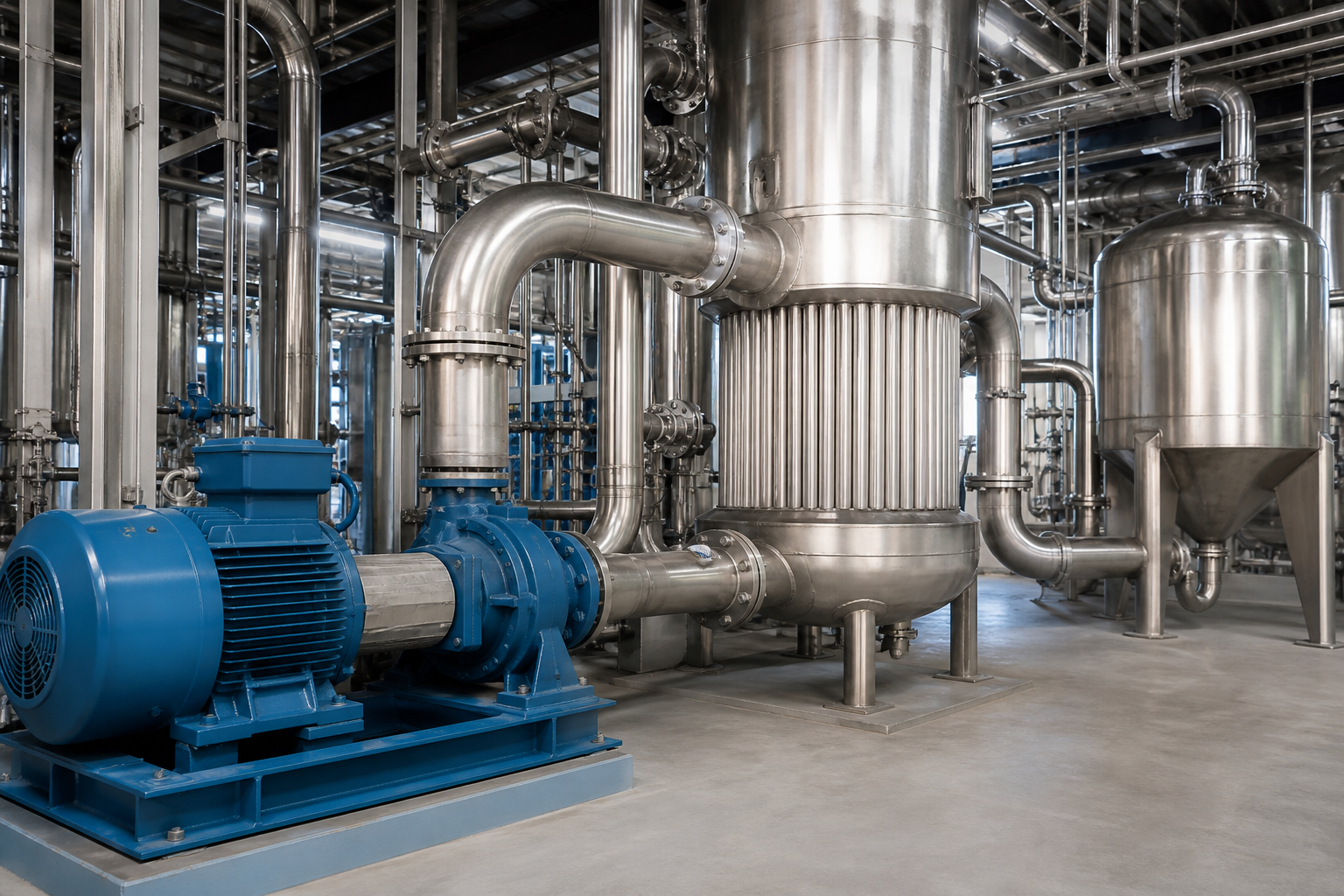
An FC evaporator assembles from four components. The separator (vapor body) is a vessel providing vapor-liquid disengagement space where flashing and boiling actually happen. The heater is a shell-and-tube heat exchanger—usually vertical, sometimes two passes—where liquor picks up sensible heat under elevated pressure. The forced circulation pump, the heart of the system, moves the liquor around the loop; its power draw is a first-order design decision, not an afterthought. And in MVR-configured units, a steam compressor closes the energy loop by recompressing the vapor generated in the separator and returning it to the heater as heating steam.
Working Principle: Heat Without Boiling, Flash Without Surface
The operating cycle separates heating from boiling, and this separation is the entire anti-scaling strategy. The circulation pump pushes liquor through the heater at 2–3.5 m/s. Inside the tubes the liquor is under enough static and friction pressure that it heats as a liquid without boiling—it leaves the heater a few degrees hotter than it entered, still subcooled relative to its own saturation pressure at that point. When the liquor passes the throttle into the separator, pressure drops and the superheated liquor flashes instantly to vapor at the liquid surface, in the body of the separator, away from any heat-transfer surface.
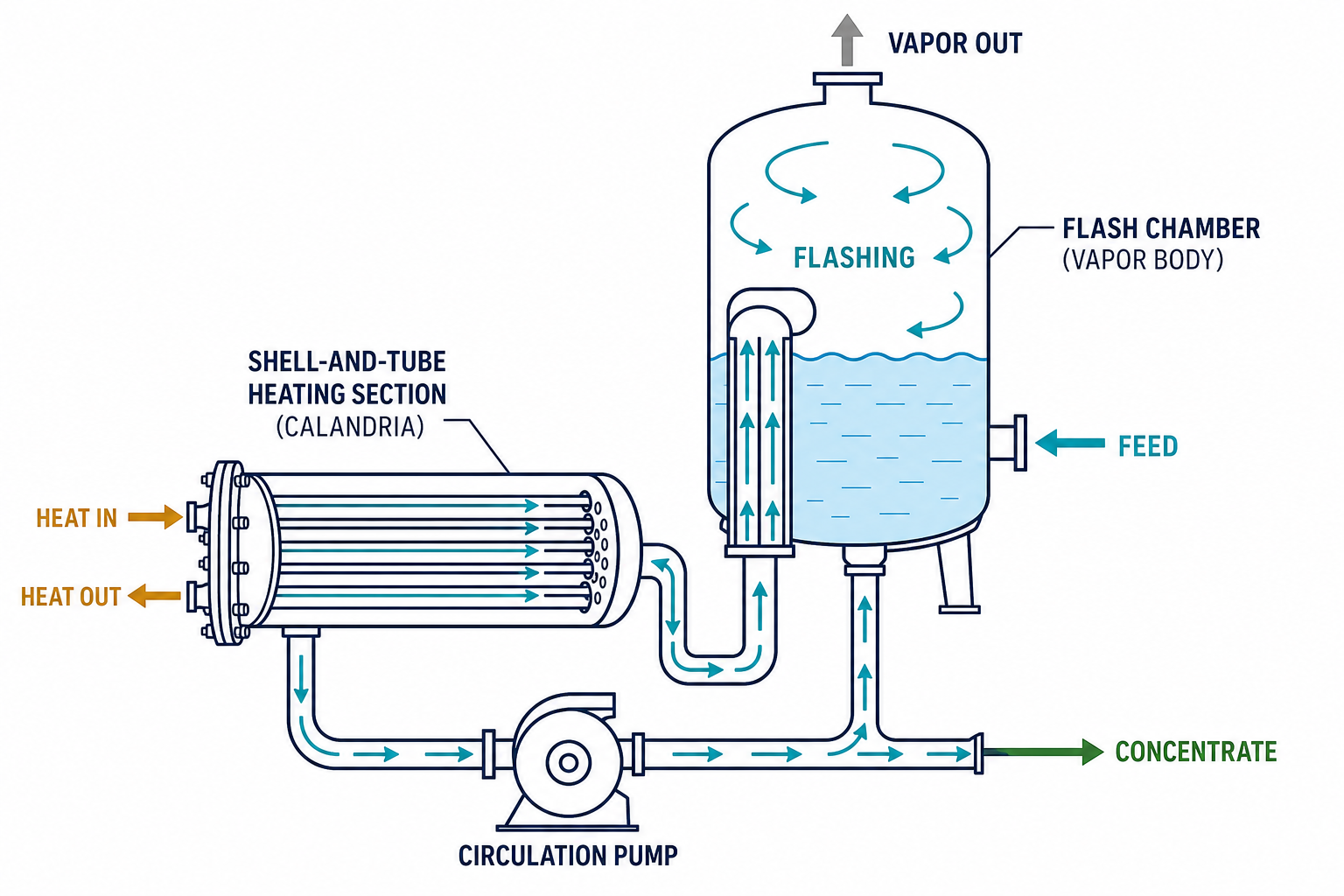
Two anti-fouling mechanisms work together here: high tube velocity mechanically scrubs the wall, and suppressed boiling means supersaturation — the thermodynamic driver of scaling — develops only in the separator, where there is no heated wall to deposit on. The full engineering treatment of this dual mechanism — velocity and temperature-rise envelopes, liquid level above the tube sheet, bend radii, vapor residence time — is maintained in our FC crystallizer article; this page keeps to the evaporation-concentration duty.
Contrast this with natural circulation designs, which depend on the density difference between heated and cooler liquor to sustain flow—a mechanism that grows feeble exactly when viscosity rises—and with film designs, which depend on distribution and wetting that viscous liquors defeat. The FC loop simply pumps harder.
Design Parameters That Matter
| Parameter | Typical practice | Why it matters |
|---|---|---|
| Tube velocity | 2–3.5 m/s (evaporator-concentration service; crystallizer duty typically 1.5–2.5 m/s) | Below ~2 m/s the scrubbing action weakens and fouling risk climbs; higher velocities cost disproportionate pump power and erosion |
| Per-pass temperature rise | Controlled, modest (a few °C) | Keeps the liquor safely subcooled in the tubes so no boiling starts on the heat surface |
| Circulation ratio | Large—circulating flow many times the feed | Dilutes the concentration increase per pass, keeping supersaturation in the separator gentle and controlled |
| Separator vapor space | Sized for disengagement, entrainment control | Boiling and flashing happen here; inadequate space sends droplets (and product) into the vapor path |
| Heater configuration | Vertical or horizontal shell-and-tube; sometimes dual | Material and geometry follow liquor corrosivity and crystal loading |
The Costs You Pay for Robustness
FC’s virtues are purchased, and the invoice has three lines. The circulation pump consumes real power continuously—its motor is often among the largest loads in the plant—and the sensible-heat approach means a lower effective temperature difference for evaporation than film designs exploit, so heat-transfer area per ton of evaporation runs higher. First cost is correspondingly higher per unit capacity than a falling-film body. And the design has its own no-go zones: strongly foaming liquors fight the separator, and very low-temperature-difference duties (deep vacuum, heat-sensitive products) inflate the heat exchanger uneconomically. For heat-sensitive, clean, low-viscosity liquors, falling film remains the better machine; FC earns its keep on the difficult end of the feed spectrum.
Where It Runs: Applications
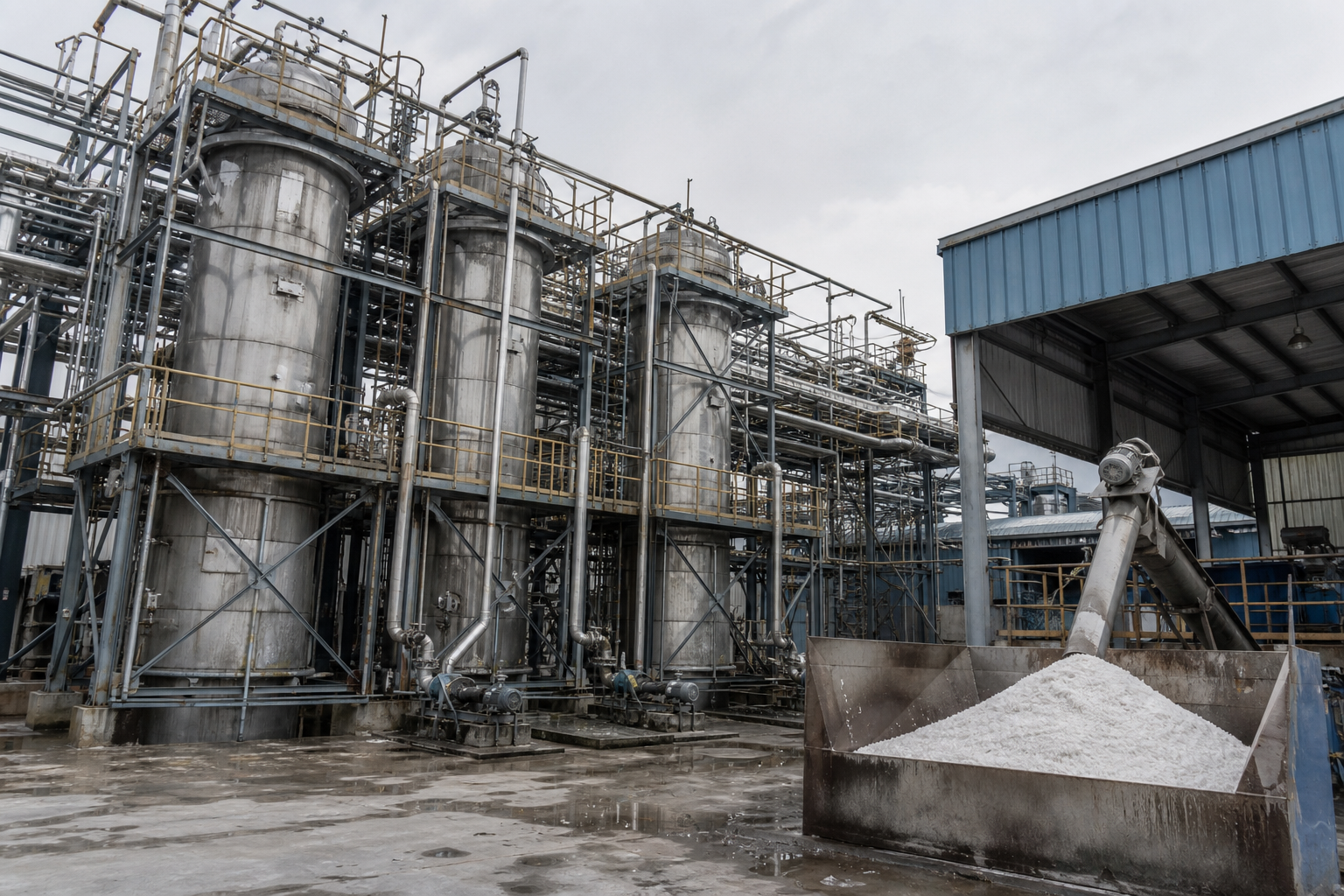
The application list reads as a catalog of difficult liquors. Inorganic salt crystallization—ammonium sulfate, sodium chloride, sodium sulfate—is classic FC territory: the liquor concentrates to saturation and beyond, crystals grow in the separator volume, and the slurry discharges to drying and packing. High-salinity wastewater ZLD trains use FC as the concentrator-crystallizer that takes the brine from reverse-osmosis-reject concentration to solid salt, described further, as an illustrative application, on the ZLD systems page. Salt production from brine, hydrometallurgical leach solutions in the rare-earth and metals sector, FGD wastewater from power plants, and mother-liquor finishing in chemical plants all follow the same logic: when the liquor is near saturation and must crystallize, FC is the body that survives.
Within multi-effect trains, FC also plays its signature supporting role: the final, most concentrated effect of a multi-effect evaporator is very often a forced-circulation body precisely because that is where scaling and crystallization concentrate—a configuration covered in the multi-effect design guide.
FC + MVR: The Standard ZLD Configuration
Pairing forced circulation with mechanical vapor recompression combines the most robust evaporator body with the most efficient energy scheme, and the combination has become the default architecture for high-salinity wastewater and ZLD projects: the MVR compressor recovers the separator’s vapor as heating steam (savings in the 70–90% range reported for MVR applications in published industry data — external references, not project guarantees), while the FC loop tolerates the crystallizing, solids-bearing liquor that high concentration inevitably produces. The result is a machine that both sips energy and swallows solids. The quantified FC-MVR energy economics — the steam-to-electricity conversion figures, OPEX comparison and payback — are carried once in our FC crystallizer article, alongside the crystallizer-side design detail; the configuration page sits under forced-circulation crystallizers.
Recent Design Directions
Current engineering practice is squeezing more out of the concept along four lines. Computational fluid dynamics (CFD) modeling of the circulation loop optimizes flow paths and velocity distributions at the design stage, predicting dead zones and local fouling risk before steel is cut. Smart CIP (clean-in-place) systems replace fixed cleaning calendars with cleaning-on-demand triggered by measured fouling indicators, cutting chemical consumption and unplanned downtime. Energy optimization—variable-speed pump drives, better heat integration, MVR coupling—attacks the technology’s one historic weakness. And advanced materials, including duplex and higher-alloy steels, extend life in abrasive and corrosive liquors.
Operating Discipline
FC plants reward operators who respect one component above all: the circulation pump. Its condition—seals, bearings, vibration signature—is the plant’s vital sign, and monitoring it continuously is cheaper by orders of magnitude than a failure. Maintaining tube velocity above the fouling threshold under all operating cases, including turndown, protects the heat exchanger; velocity that drifts low in practice is the quiet beginning of a fouling campaign. Separation performance (entrainment carryover) and crystal slurry density round out the daily checklist. None of this is exotic; it is the ordinary discipline of keeping a robust machine robust.
FAQ
When should I choose a forced circulation evaporator?
Choose FC when the liquor is viscous, scaling, or crystallizing—concentrated salt solutions, slurries with suspended solids, fouling organics. It is the standard choice for crystallizing duties and the final effect of ZLD trains. For clean, low-viscosity, heat-sensitive liquors, falling film is more efficient and more gentle.
Why doesn’t a forced circulation evaporator scale inside the tubes?
Two mechanisms act together: the liquor circulates at 2–3.5 m/s, high enough to scrub deposits off the tube wall, and it is heated under pressure without boiling in the tubes—so the supersaturation that drives scaling develops only in the separator, away from any heated surface.
What does a forced circulation evaporator cost in energy compared with falling film?
FC pays for robustness with energy: the circulation pump is a continuous load, and the sensible-heat approach yields a lower effective temperature difference, so heat-transfer area per ton of capacity runs higher than falling film. Many plants accept this only for the difficult final concentration step, pairing FC with more efficient bodies upstream or with MVR to recover the energy.
Why is MVR plus forced circulation so common in ZLD systems?
ZLD takes brine all the way to solid salt, so the evaporator must both save energy and survive crystallizing, solids-laden liquor. MVR supplies the energy efficiency (savings of 70–90% versus live steam reported for MVR applications in published industry references) and the FC loop supplies the solids tolerance—each covering the other’s weakness, which is why the pairing is the default ZLD architecture.
What are the limits of forced circulation evaporators?
Strongly foaming liquors overwhelm the separator; deep-vacuum, low-temperature-difference duties inflate the heat exchanger uneconomically; and clean thin liquors waste the design’s robustness. FC is a specialist for difficult feeds—applied outside that territory it simply costs more than the alternatives.