Project Parameters
| Parameter | Value |
|---|---|
| Process route | Plate-type MVR evaporation + crystallization + concentration |
| Industry | Hydrometallurgy raffinate treatment (Vietnam, Southeast Asia) |
| Feed type & key components | Sulfate raffinate: Na₂SO₄ 2.5%, pH 7–8, COD 7,500 ppm, Cl⁻ ≤ 100 ppm, fluoride-free, ambient feed |
| Evaporation capacity | 2 t/h |
| Product output | Sodium sulfate crystal, approx. 50 kg/h discharge rate |
| Construction materials | SS316L wetted parts (indicative for neutral, fluoride-free sulfate service) |
Representative process configuration compiled from published industry project data. Indicative values, not a process guarantee.
Project Description
Every solvent-extraction circuit in hydrometallurgy leaves a raffinate behind: the metal values have moved on, but the sulfate stays, and at 2.5% sodium sulfate the stream is too dilute to discharge and too salt-rich to reuse. The reference configuration is a Vietnamese plant that answered the problem with a 2 t/h plate-type MVR evaporator-crystallizer, concentrating the raffinate and pulling roughly 50 kg/h of sodium sulfate crystal out of a stream that would otherwise be a liability.
The water arithmetic explains the machine choice. At 2.5% salt, crystallizing 50 kg of sodium sulfate means evaporating about two tonnes of water per hour — a 40:1 water-to-product ratio. On live steam that ratio is an operating cost problem; on MVR it is an electricity line item, which is why dilute-feed crystallization in Southeast Asia runs mechanical vapor recompression almost without exception. The raffinate is also neutral (pH 7–8) and fluoride-free with chloride under 100 ppm — a benign chemistry that lets standard SS316L serve where a chloride-heavy stream would force titanium or duplex.
Process Technology
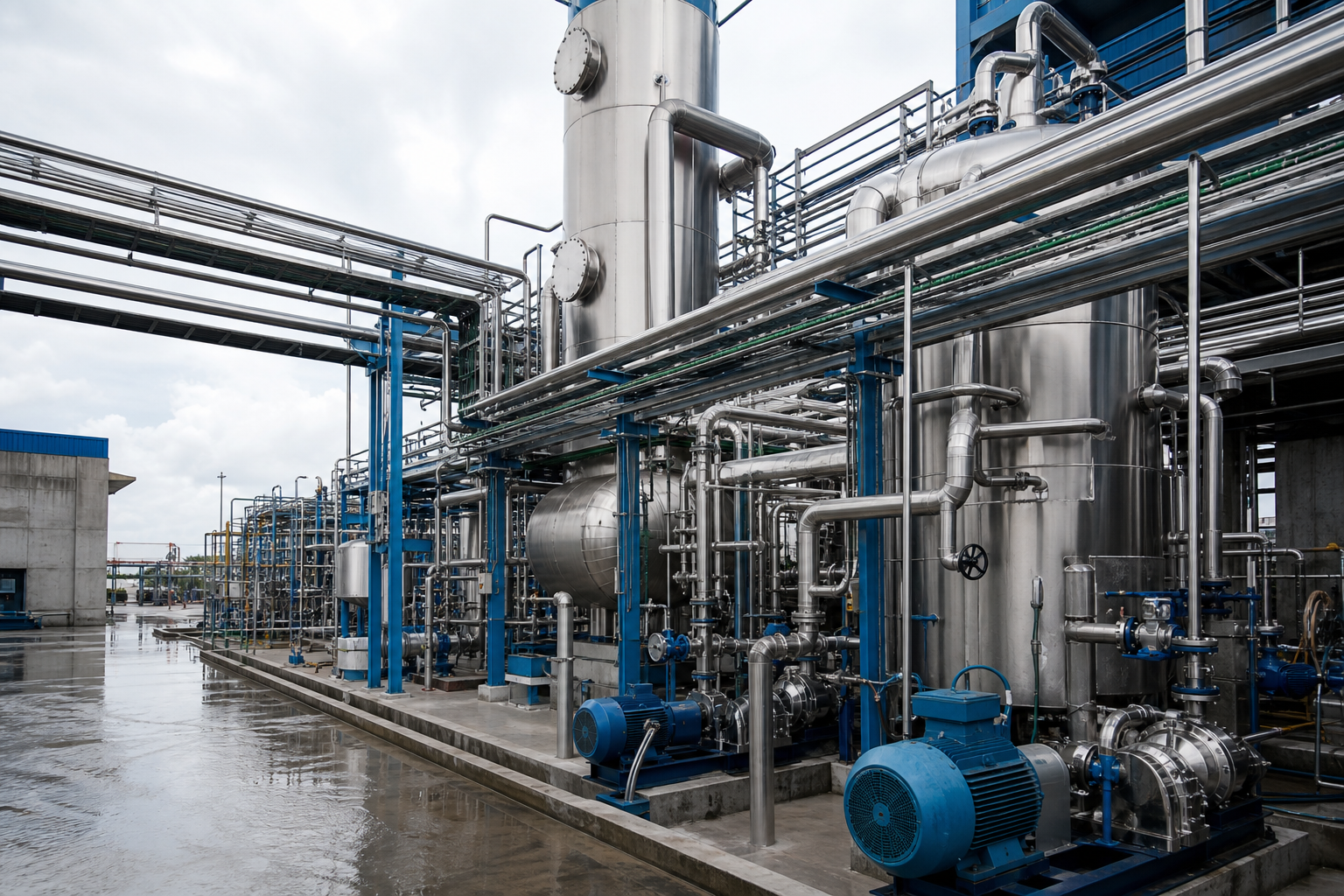
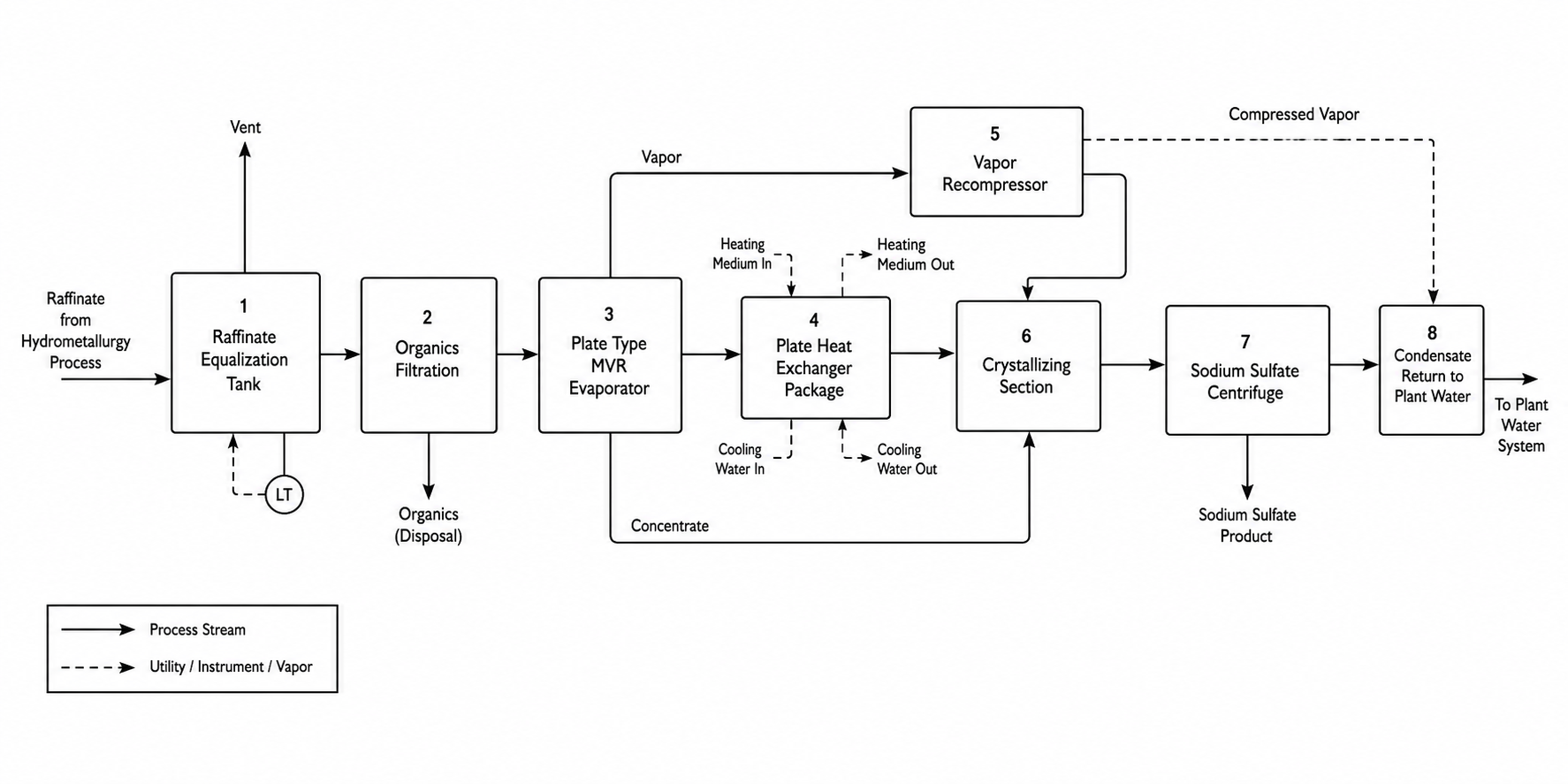
The raffinate equalizes and filters for entrained organics — extraction solvent traces that ride over with the stream and would both foam the evaporator and discolor the salt. The feed enters the plate-type MVR evaporator: evaporation runs across a corrugated plate pack at low temperature difference, driven by the centrifugal recompressor recycling secondary vapor. Plate geometry is the scale-efficient choice here — high heat transfer density keeps a 2 t/h train compact, and the pack opens for cleaning in a way shell-and-tube surfaces at this duty do not.
As concentration climbs past saturation, sodium sulfate crystallizes from the circulating liquor; the crystal slurry draws off continuously, centrifuges to a dry cake, and the salt leaves as by-product sodium sulfate. Mother liquor recycles to the evaporator body with a purge that carries the COD-bearing organics out of the circuit in a small, concentrated bleed — the 7,500 ppm COD never sees the crystal face because the organics partition to the mother liquor and exit at the purge. Clean condensate — roughly two tonnes per hour of it — returns to the plant water systems, closing the loop that made the raffinate a problem in the first place.
Equipment Configuration
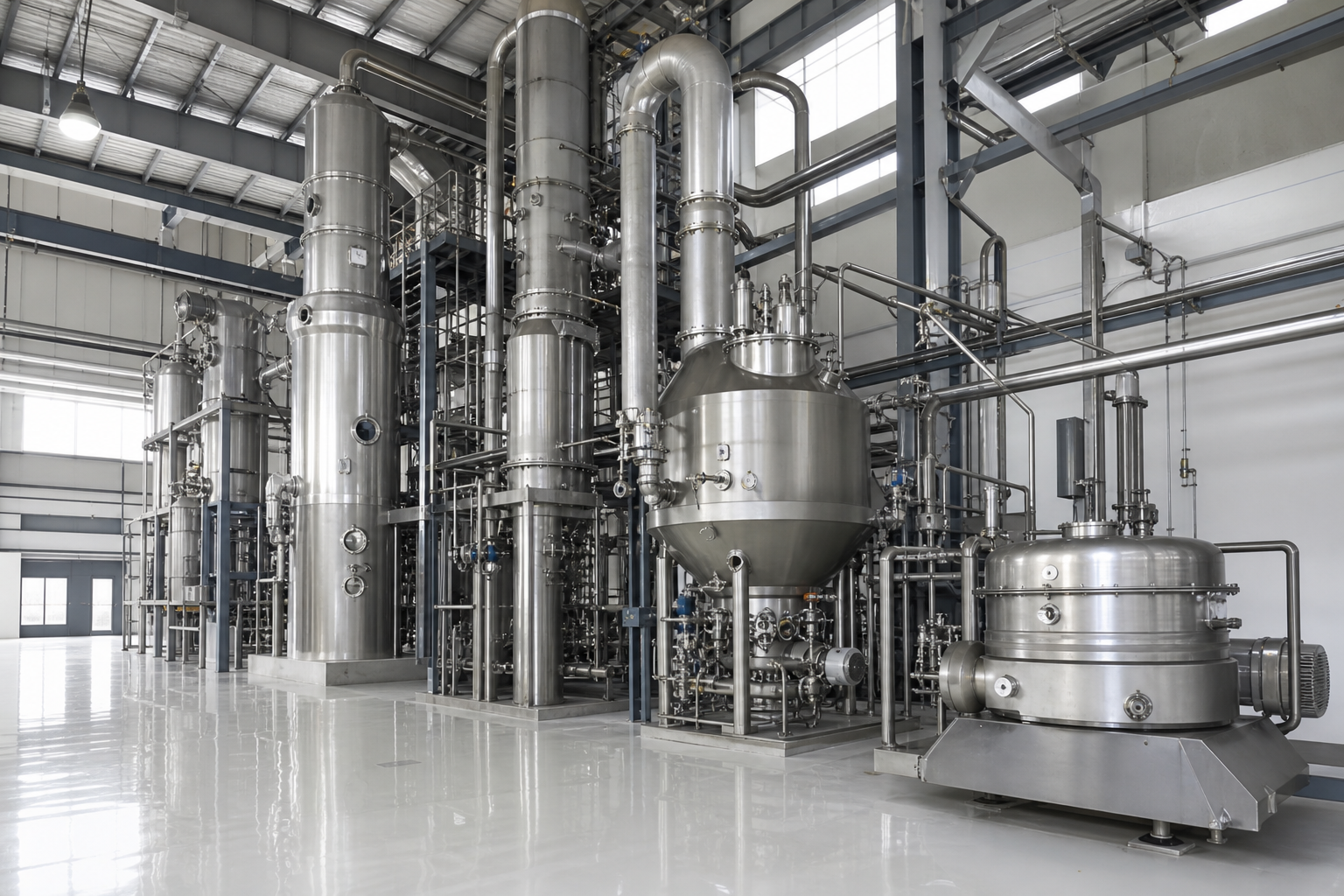
One set of the following equipment is typical for this duty:
- Raffinate equalization and fines/organics filtration
- Plate-type MVR evaporator with centrifugal vapor recompressor
- Crystallizing section with continuous salt slurry draw-off
- Centrifuge for sodium sulfate dewatering
- Mother liquor return with COD purge line
- Condensate tank and return to plant water systems
- PLC control of concentration endpoint and crystal discharge
Performance & Outcome
Compiled from published industry project data, indicative: the train evaporates 2 t/h at ±10% design tolerance, discharging roughly 50 kg/h of sodium sulfate crystal while returning condensate for reuse. The organic load (COD 7,500 ppm) is managed by pretreatment and mother-liquor purge rather than by evaporation itself.
Simplified PFD
The simplified process flow diagram above shows raffinate filtration, plate MVR evaporation crystallization, salt centrifuging and condensate return.