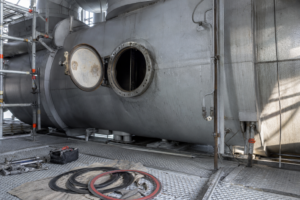
Evaporator selection is decided by four variables — wastewater characterization (salinity, corrosivity, boiling-point elevation, fouling tendency, heat sensitivity), treatment scale, local energy economics (the steam-to-electricity price ratio), and annual operating hours — and resolved through a five-step method: full water analysis, concentration-factor and capacity sizing, energy-condition assessment, lifecycle-cost comparison of candidate technologies, and pilot verification with vendor reference checks. The recurring decision is between multi-effect evaporation (MEE), thermal vapor recompression (TVR), and mechanical vapor recompression (MVR): as a working rule, MVR pays back its capital premium in roughly 14–22 months when annual operation exceeds ~6,000 hours and electricity is competitively priced against steam. This guide walks the full framework, including the material-grade and TDS-band shortcuts that prevent the most expensive mistakes.
Selection Is a Process Decision, Not an Equipment Purchase
Plants that buy “an evaporator” and plants that buy “a concentration process” get different outcomes. The technology you choose defines your energy contract exposure, your cleaning downtime, your operator skill requirement, and your expansion headroom. Four inputs drive everything downstream:
- Wastewater characterization — salinity and crystallization tendency, corrosive ions (especially chloride), organic load, boiling-point elevation (BPE), fouling propensity, foaming, and heat sensitivity;
- Treatment scale — evaporation capacity in t/h, which sets whether you are buying a skid or a structure;
- Energy economics — the ratio of steam price to electricity price at your site is the single most decisive number in MEE-versus-MVR selection;
- Operating pattern — continuous 24/7 duty rewards efficiency; batch or seasonal duty rewards low capital.
The Five-Step Selection Method
Step 1: Complete water analysis
Demand a full characterization before any vendor conversation: TDS and individual scaling ions (Ca, Mg, silica, sulfate), chloride for material selection, COD for pretreatment sizing, BPE at target concentration, and suspended solids. Every later decision inherits the quality of this dataset.
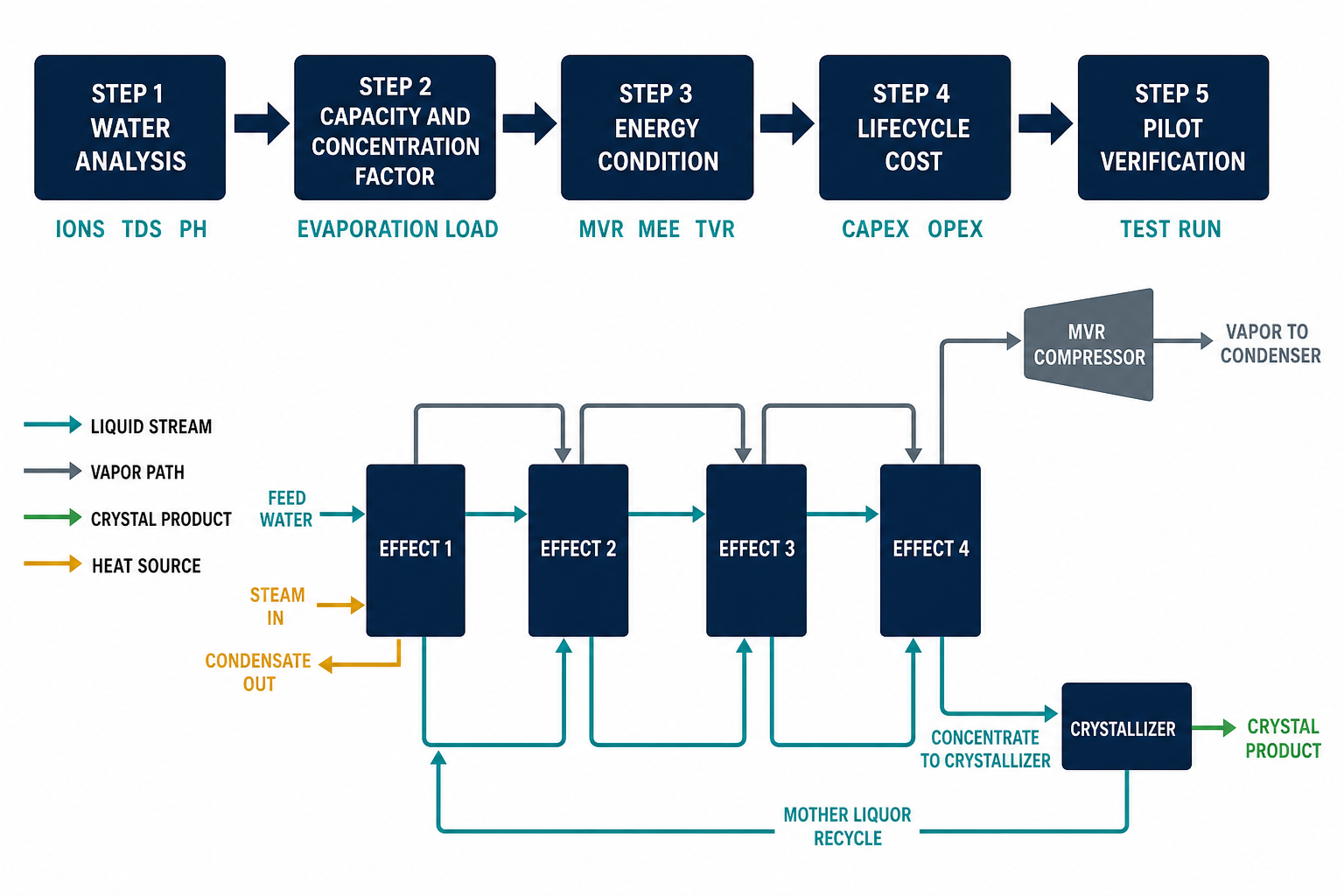
Step 2: Concentration factor and capacity sizing
Define feed rate, target concentration or crystal product, and distillate quality requirement. These three fix the evaporator duty and reveal whether crystallization is in scope — a concentration-only duty and a crystallizing duty point at different equipment.
Step 3: Energy-condition assessment
Price out the site’s options: fresh steam (and whether CHP or waste steam exists), electricity tariff and demand charges, available waste heat (hot water, thermal oil, flue gas), and cooling-water availability. This converts the technology choice from preference to arithmetic.
Step 4: Lifecycle-cost comparison
Compare candidates on CAPEX + OPEX over the investment horizon — energy, maintenance, cleaning chemicals and downtime, membrane or compressor overhauls — not on quoted equipment price. A lower bid that ignores operating cost is the most expensive mistake in this market.
Step 5: Pilot verification and reference checks
For any novel or high-fouling stream, run bench or pilot evaporation to confirm heat-transfer assumptions, scaling rates, and distillate quality. Then audit vendor references at similar duty — installed base in your industry predicts delivery and commissioning performance better than any brochure.
Match the Technology to Your Feed
Salinity and crystallization tendency
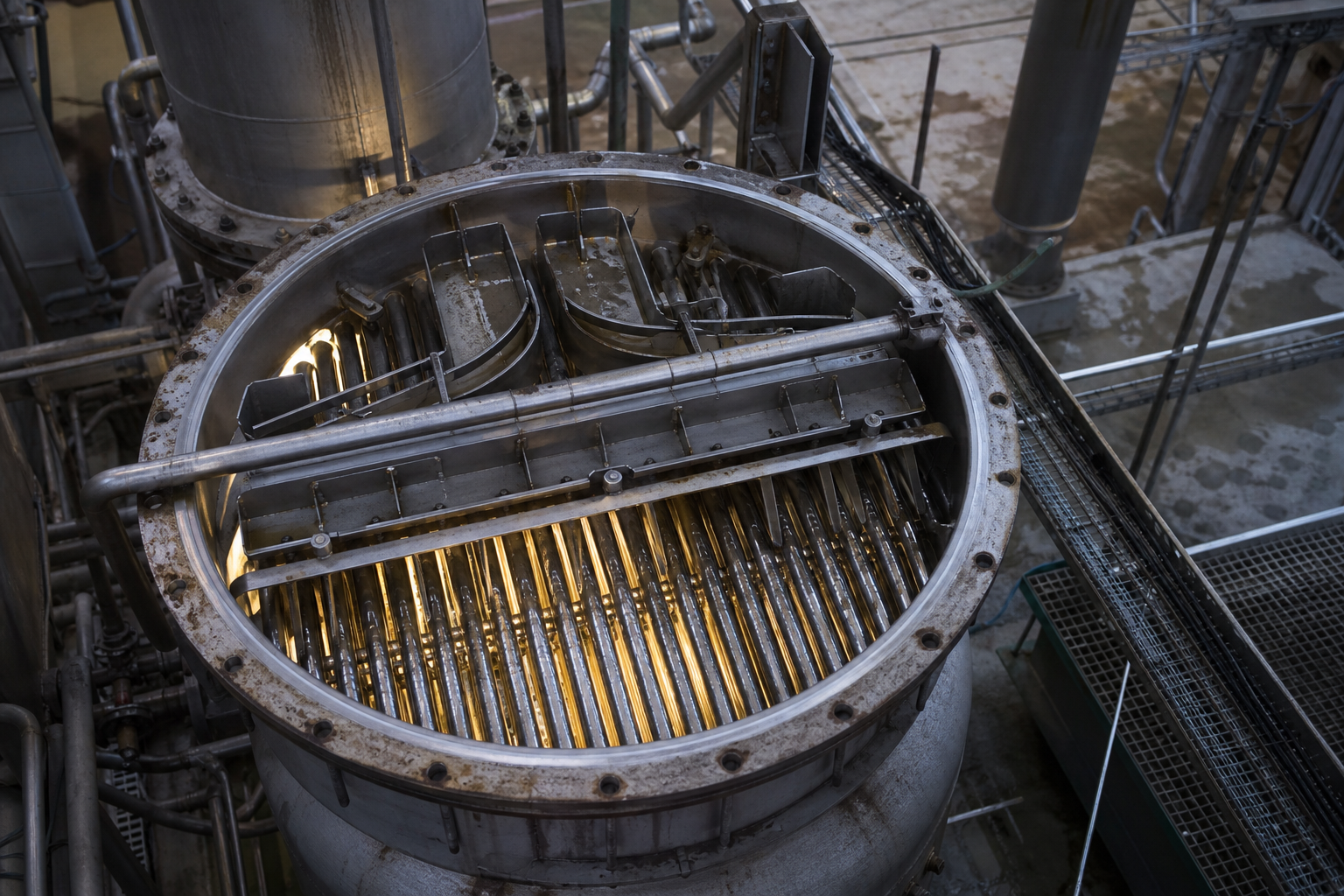
High-salinity feeds with crystallizing salts require forced-circulation (FC) evaporators or dedicated crystallizers: high tube velocity suppresses wall deposition while solids grow. Low-scaling, clean feeds suit falling-film designs with their high heat-transfer coefficients and short residence time. The forced-circulation evaporator and falling-film evaporator pages detail each configuration.
Corrosivity and material grades
| Material | Service condition | Typical selection trigger |
|---|---|---|
| Stainless 304 | Low corrosivity | Neutral, low-chloride streams |
| Stainless 316L | Moderate corrosivity | General wastewater duty with modest Mo-resistant needs |
| Duplex 2205 | High chloride service | Chloride roughly 100–5,000 ppm |
| Titanium / Hastelloy | Extreme corrosivity | Chloride above roughly 5,000 ppm, or high chloride + low pH / oxidizing chemistry |
The selection keys off chloride concentration, pH, and oxidizing species together — a mildly acidic high-chloride stream can demand titanium where a neutral one survives on 316L.
Boiling-point elevation and compressor duty
BPE rises with dissolved solids and directly consumes the temperature lift an MVR compressor can deliver — compressor selection against the stream’s BPE curve is the single most critical step in MVR design. As a screening rule, BPE above about 15°C at target concentration argues against a single-stage MVR; the remedies are two-stage compression or an auxiliary heat source.
Viscosity, foaming, and heat sensitivity
High-viscosity fluids (hundreds of cP and above) need forced circulation to maintain heat transfer and stable flow. Foaming streams demand de-entrainment design and demister sizing. Heat-sensitive products — food, pharma, organics — go to low-temperature vacuum falling-film service, where MVR’s low temperature profile is an advantage rather than a constraint.
TDS bands: the quick route map
| Feed TDS | Preferred route | Notes |
|---|---|---|
| Below ~1% (10,000 mg/L) | Biological / membrane treatment first | Evaporation is rarely economic for dilute water removal |
| 1–5% | Membrane concentration + evaporation finish | Hybrid chains shrink the thermal stage |
| Above ~5% | Direct evaporation (MEE or MVR) | Osmotic pressure and discharge cost both favor thermal |
MEE vs. TVR vs. MVR: The Energy Decision
Three architectures dominate industrial concentration:
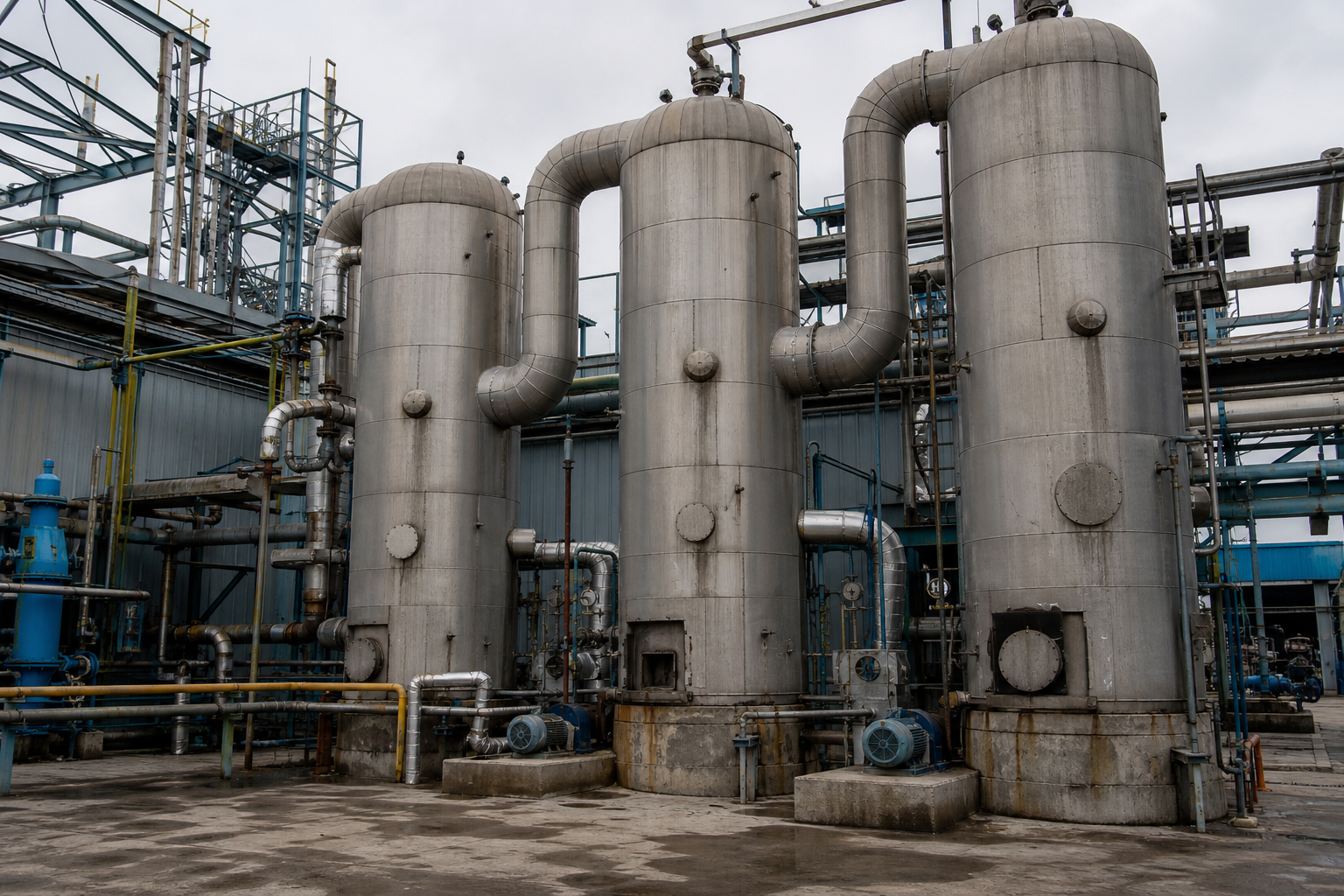
- MEE — each effect uses the previous effect’s vapor as its heat source; more effects, less steam. Mature, reliable, tolerant of variable water quality, low electricity demand — but steam consumption remains significant and cooling-water load is large. Effect count is limited by temperature-difference losses. Best where steam is cheap (CHP plants) or electricity is expensive.
- TVR — a steam ejector recompresses part of the vapor flow using high-pressure motive steam; a small recompression effect at minimal capital, no moving parts, no electricity for compression. Requires an existing high-pressure steam system and accepts a limited temperature lift.
- MVR — an electric compressor lifts secondary vapor by up to about 20°C and recycles it as heating steam; at steady state, fresh steam approaches zero and specific consumption falls to roughly 20–40 kWh per tonne of water. Lowest operating cost and no cooling tower, against the highest capital and sensitivity to BPE.
The decision variable is the steam-to-electricity price ratio at your site. Where electricity is cheap and steam dear, MVR wins; where steam is cheap and power dear, MEE wins. Annual runtime then sets the payback: beyond roughly 6,000 hours per year of continuous duty, MVR’s capital premium is typically recovered in 14–22 months of steam savings. Detailed side-by-side numbers, including a 16 t/h worked comparison, are in the companion piece Evaporator Types Compared: Pros and Cons; the underlying technologies are covered under MVR and multi-effect evaporation.
Is Your Stream Suitable for Evaporation at All?
Before comparing technologies, confirm the stream fits evaporation economics. Screening criteria consistent with industry-reported practice for installed evaporation systems:
- Water content ≥70% — streams of 70–99% water are strong candidates; economics degrade steadily as water fraction falls below that line;
- pH — standard materials handle moderate acidity/alkalinity; low pH with high chloride requires pH adjustment or corrosion-resistant alloy; streams below pH 2 or above 12.5 fall under corrosive-waste definitions (RCRA in the US) and should be adjusted toward neutral before evaporation;
- Solids content — sludges and viscous slurries call for drum evaporators or slurry dryers with indirect heating that keeps heating elements out of the waste;
- Flash point and VOCs — combustible components demand explosion-rated equipment and vapor handling;
- Scaling chemistry — calcium, magnesium, silica, and sulfate concentrations set the operating temperature, materials, cleaning regime, and antiscalant program.
Streams routinely processed by evaporation span electroplating and metal-finishing rinse waters, landfill leachate, compressor condensate with trace oil, RO concentrates, ion-exchange regeneration brines, parts-washing detergent water, food and beverage CIP effluent, pharmaceutical aqueous waste, and general aqueous chemical streams. When in doubt, a two-liter sample plus basic stream data (composition, volume, current disposal cost, treatment goal) is enough for an application team to assess suitability and recommend technology and materials.
Trends: Hybrid and Integrated Systems
Two integration patterns now shape selection. First, hybrid MEE–MVR flowsheets combine MEE’s capital lightness with MVR’s operating efficiency, balancing CAPEX and OPEX on mid-size duties. Second, MVR-based integrated systems chain evaporation with downstream treatment — for example, evaporation-crystallization trains coupled with sodium-responsive processing and catalytic wet oxidation to degrade organics, concentrate salts, and serve zero liquid discharge objectives in one coordinated plant. Selection today means choosing an architecture with connection points, not a box.
Common Selection Mistakes
- Awarding on lowest quotation — ignoring OPEX hands the real cost to operations for twenty years;
- Ignoring BPE — discovering post-installation that the compressor cannot span the temperature lift is a rebuild, not a tune-up;
- Underestimating fouling — optimistic scaling assumptions convert a continuous plant into a cleaning-cycle plant; check CIP frequency assumptions against comparable references;
- No expansion headroom — selecting exactly today’s capacity forecloses the modular addition tomorrow’s production plan implies.
Verify Before You Believe: Post-Selection Metrics
Hold vendors to measurable guarantees: specific energy consumption (kWh or kg steam per tonne evaporated), concentrate density or salt-product quality, CIP cycle length, continuous runtime between cleanings, and automation level. These five numbers, guaranteed in the contract, are what separate a selected evaporator from a delivered one.
FAQ
How do I choose between MVR and multi-effect evaporation?
Use the steam-to-electricity price ratio and annual runtime. Cheap steam or expensive electricity favors MEE; cheap electricity with steam above roughly the $20-per-tonne class favors MVR. Beyond about 6,000 operating hours per year, MVR’s higher capital is typically paid back in 14–22 months of steam savings (industry-reported working rule; actual payback follows local steam and electricity prices).
What feed properties matter most in evaporator selection?
Salinity and crystallization tendency, chloride level (for material grade), boiling-point elevation (for compressor selection), fouling propensity (for configuration and CIP design), viscosity, and heat sensitivity. Together they determine whether you need a falling-film concentrator or a forced-circulation crystallizing evaporator.
When is boiling-point elevation a problem for MVR?
When BPE at target concentration approaches the compressor’s available temperature lift — as a screening rule, above roughly 15°C a single-stage MVR becomes risky. Options are two-stage compression or hybrid designs with auxiliary thermal effects.
Which material should a high-chloride evaporator use?
From roughly 100 to 5,000 ppm chloride, duplex 2205 is the usual upgrade from 316L; above roughly 5,000 ppm — or with high chloride plus low pH or oxidizing chemistry — titanium or Hastelloy is the safe specification. Material choice driven by a complete water analysis is far cheaper than retubing.
Is my waste stream even suitable for evaporation?
If it is 70–99% water and free of unmanageable VOC or corrosive-waste characteristics (below pH 2 or above 12.5), it is a strong candidate — the classic examples being rinse waters, leachate, RO concentrates, regeneration brines, and CIP effluent. A two-liter sample with basic stream data is enough for a professional suitability assessment.