
Project Parameters
| Parameter | Value |
|---|---|
| Process route | Forced circulation evaporation in titanium (TA2) construction |
| Industry | Raw / muscovado cane sugar production (Philippines, Southeast Asia) |
| Feed type & key components | Raw cane sugar juice, high impurity and colloidal load, scaling-prone |
| Evaporation capacity | 6 t/h |
| Construction materials | Titanium TA2 wetted parts |
Representative process configuration compiled from published industry project data. Indicative values, not a process guarantee.
Project Description
Small-scale cane sugar in the Philippines — the muscovado and raw sugar sector that supplies both domestic food industry and premium export markets — works with juice that big refineries would call dirty. Direct crushing of cane with minimal clarification carries soil, colloids, color bodies, and a full deck of scaling salts into the evaporator, and the traditional open-pan boiling that defines the product also defines its limits: fuel-hungry, batch-bound, and capped in throughput. The reference configuration is a 6 t/h forced circulation evaporator in titanium at a Philippine raw sugar plant, moving the concentration duty into continuous, controllable territory.
Two properties of raw juice pick both the geometry and the metal. Fouling: unclarified juice scales heat transfer surfaces aggressively — calcium salts, oxalates and baked-on organics — and a film evaporator on this duty would spend its life shut down for cleaning. Corrosion: cane juice, particularly at the acidity and temperature profile of tropical processing, attacks stainless steel’s weak points; titanium is the sugar industry’s established answer for the hottest, most corrosive duties.
Process Technology
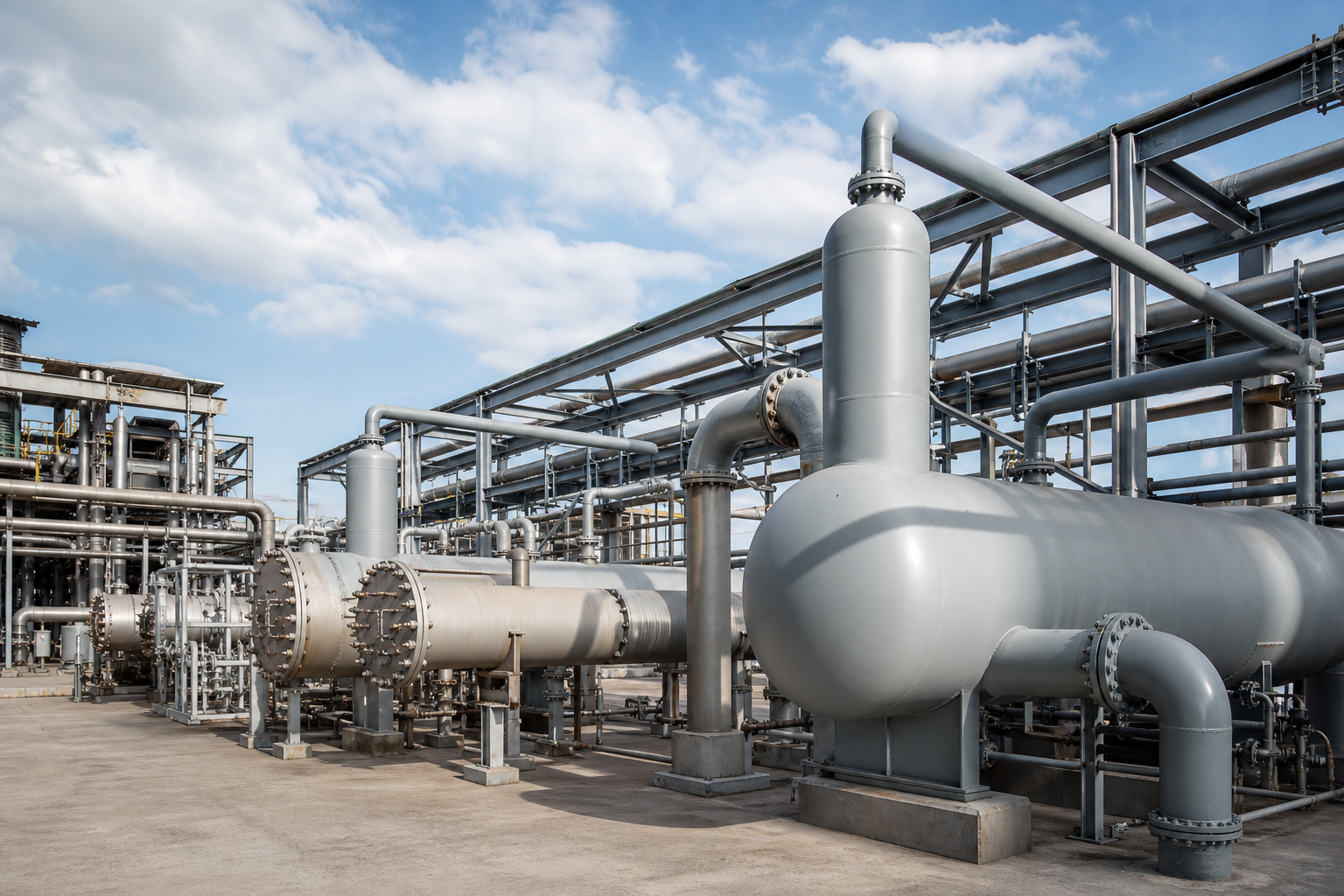
The forced circulation evaporator moves juice through the heating tubes at high velocity, driven by a circulation pump rather than by natural convection or film flow. Boiling is suppressed in the tubes themselves — the liquor arrives at the vapor separator above the boiling point and flashes there — so the heat transfer surface sees single-phase liquid at velocity, the configuration most resistant to scaling of any evaporator geometry. What scale does form stays swept and tolerable between cleanings, which on raw juice is the difference between an operable plant and a shutdown rotation.
Titanium TA2 construction carries the duty the geometry protects: immunity to chloride stress corrosion, inertness to the juice’s acidity, and a fouling-resistant surface that cleans back to bare metal. Evaporation proceeds under vacuum at controlled temperature, concentrating the raw juice toward crystallization or toward the dense syrup that traditional sugar boiling finishes into muscovado and raw sugar product; the color and flavor profile that defines those products is preserved by temperature control that open-pan boiling could never hold.
Vapor condenses to hot process water for cane washing and boiler feed preheating; the thermal energy economy of the train replaces a fraction of the fuel the open pans burned. Comparable published raw and cane sugar configurations across the Philippines, Thailand and Indonesia run titanium or high-alloy forced circulation at 5–20 t/h scales on exactly this logic.
Equipment Configuration
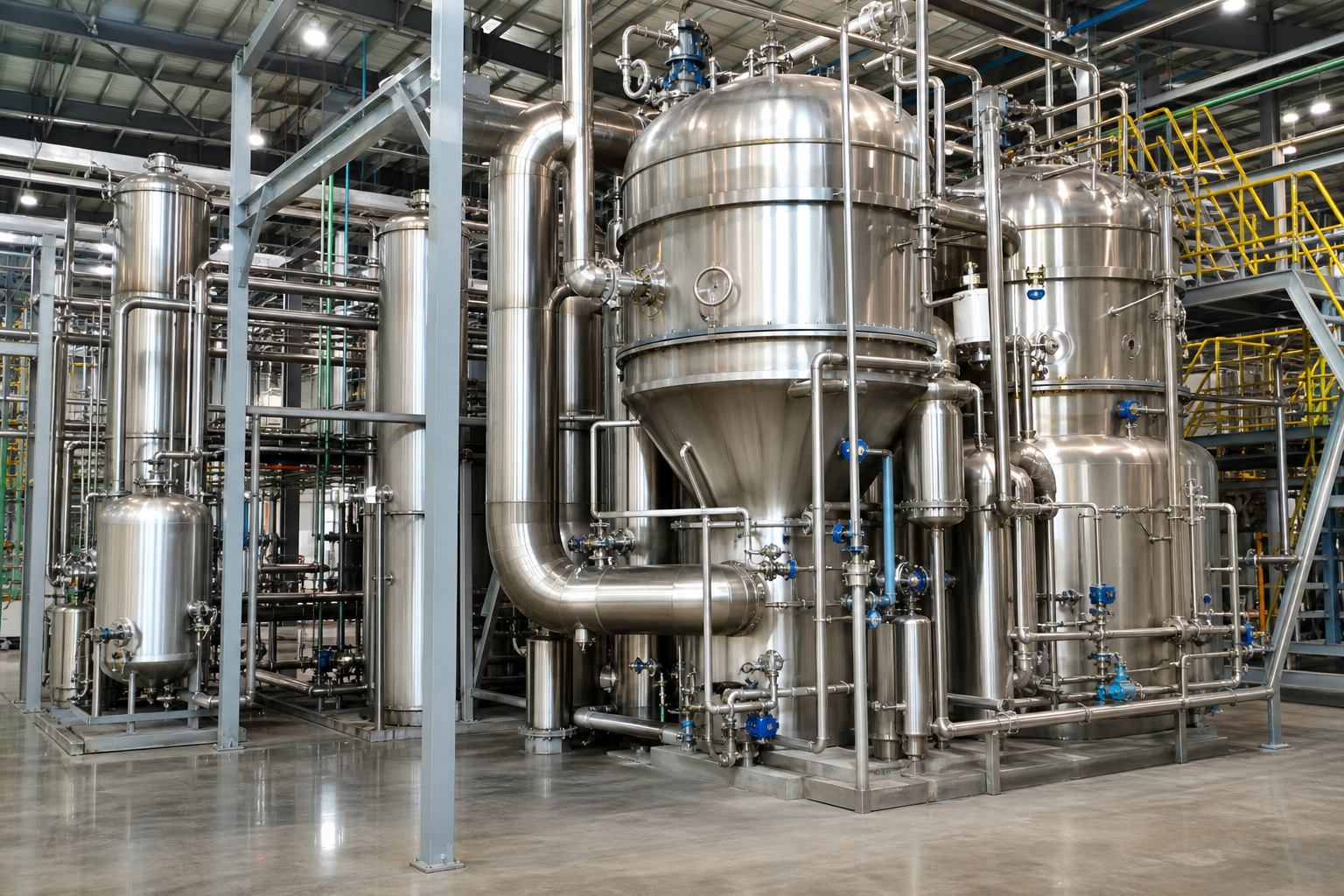
One set of the following equipment is typical for this duty:
- Raw juice screening and crud removal
- Forced circulation evaporator body with circulation pump, TA2 wetted parts
- Vapor separator with demister
- Vacuum system and condenser with hot water recovery
- Syrup discharge to sugar boiling / crystallization pan
- CIP for scheduled scale removal
- PLC control of vacuum, temperature and syrup density
Performance & Outcome
Compiled from published industry project data, indicative: titanium forced circulation trains of this class concentrate high-impurity raw sugar juice at 6 t/h continuously, with run times between cleanings that film geometries cannot reach on this feed. Steam economy and syrup quality are quoted per project juice analysis.
Simplified PFD
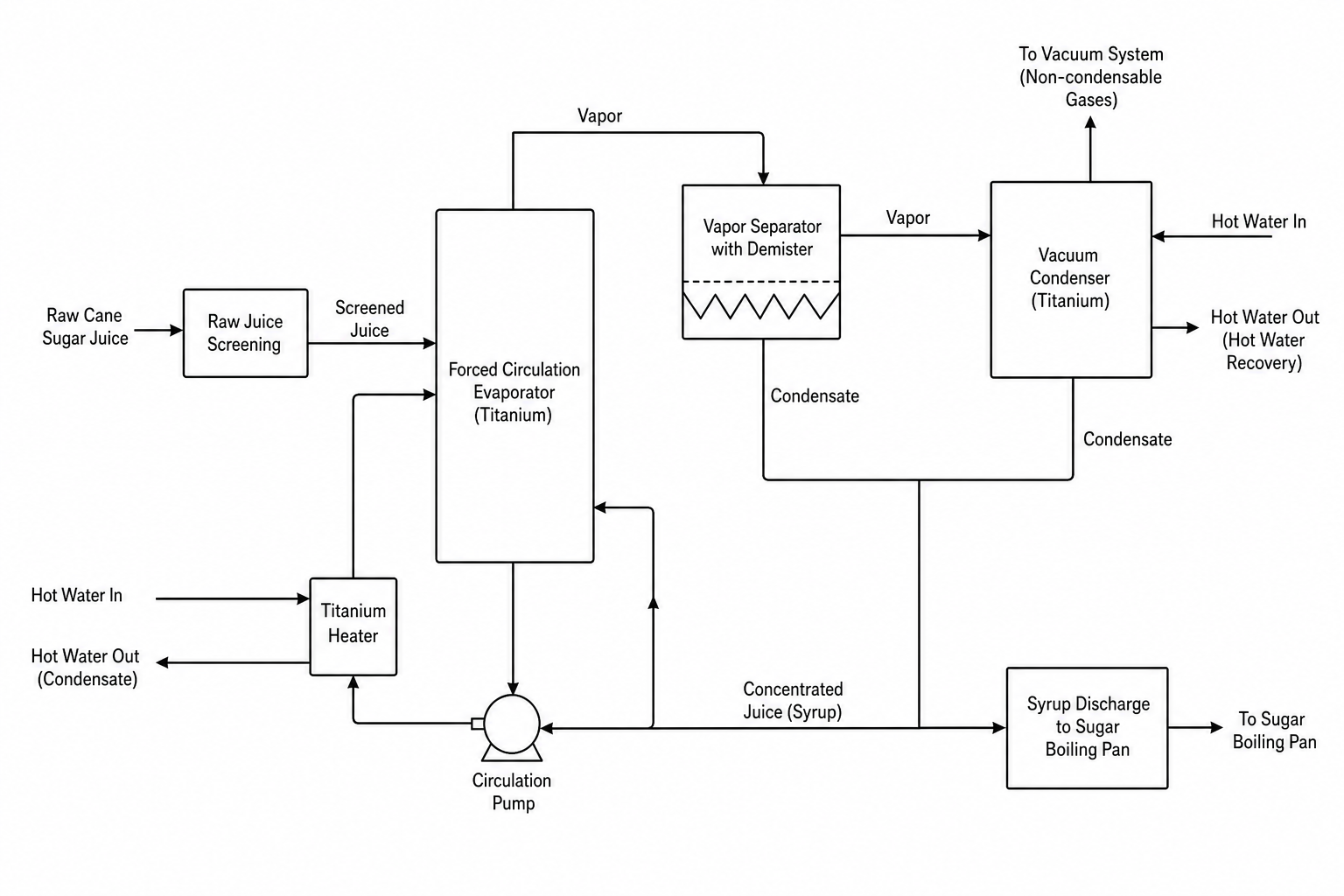
The simplified process flow diagram above shows raw juice screening, forced circulation evaporation in titanium, vapor separation with condenser, and syrup discharge to sugar boiling.


