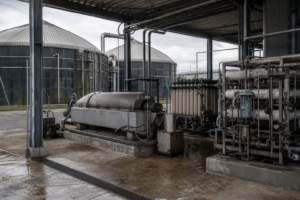
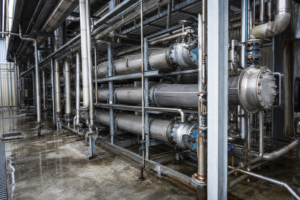
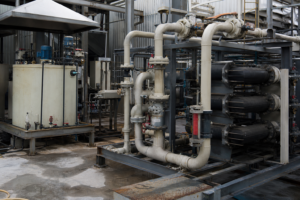
Livestock farm wastewater — the mixture of manure, urine, and washing water flushed from swine, dairy, and poultry operations — can be closed to zero liquid discharge with a mechanical vapor recompression (MVR) evaporation train that separates it into three streams: clean condensate returned to the barn for flushing, a nutrient-rich concentrate, and (when biogas is recovered upstream) energy that helps power the evaporator itself. The typical process chain is solid-liquid separation, optional anaerobic digestion, ammonia management, then MVR forced-circulation evaporation that concentrates the liquid fraction typically 5- to 10-fold into an organic-fertilizer feedstock. Because the effluent is strongly fouling and ammonia-laden, the decisive design items are not the compressor brand but scale control, ammonia routing, and heat-transfer surface selection. Done correctly, the farm stops discharging to waterways or hauling thin slurry to distant fields, and recycles most of its water on site. Ranges quoted in this article form an illustrative envelope from published livestock-effluent characterizations, not a project datasheet.
Why Conventional Livestock Wastewater Routes Run Out of Room
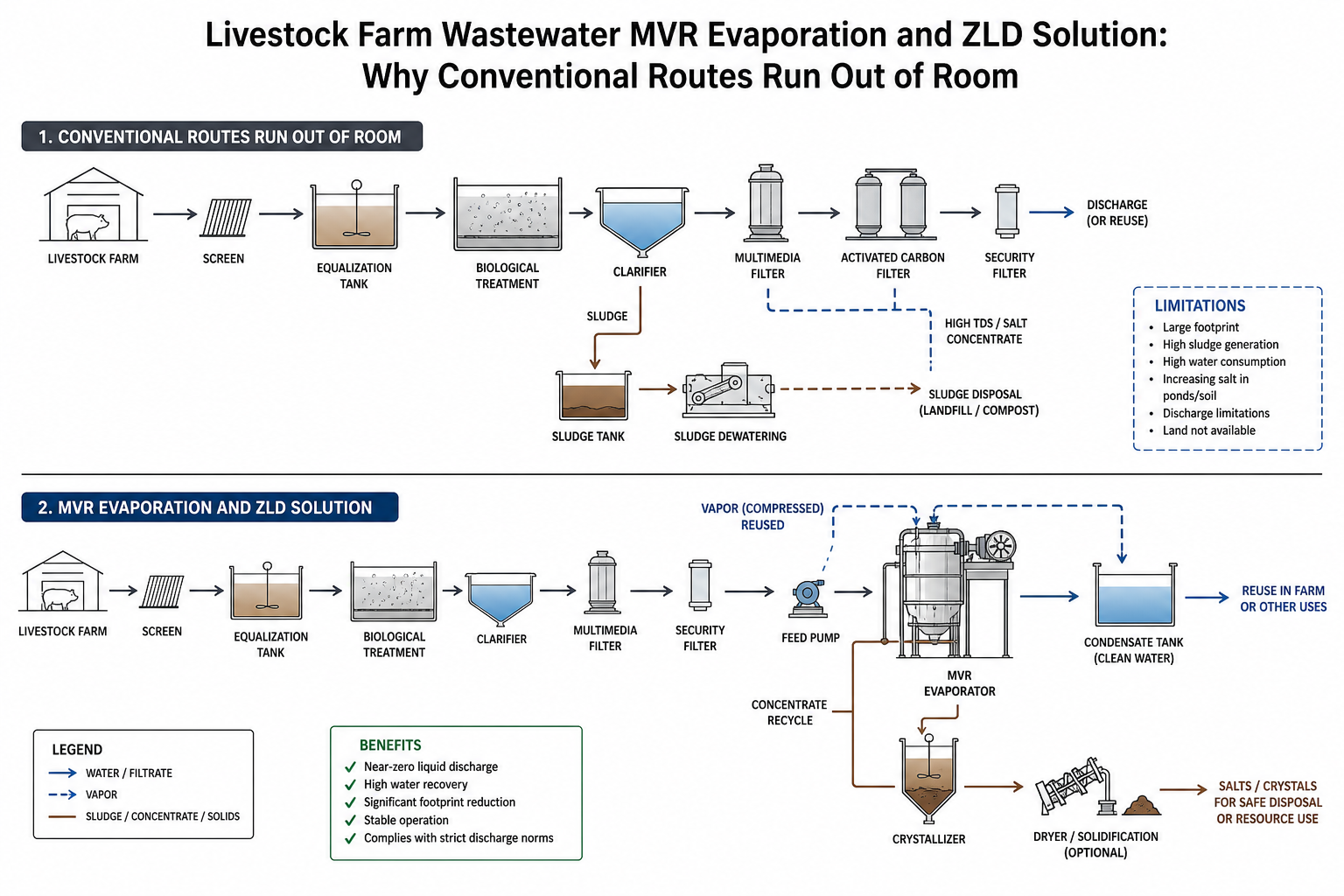
The traditional route is land application: separate the coarse solids, store the slurry in lagoons, and spread it on cropland. It fails for predictable reasons:
- Transport economics. Thin slurry is typically more than 90% water; hauling it beyond a short radius from the barn costs more than its nutrient value. Large concentrated operations simply do not own enough nearby acreage.
- Nutrient imbalance. Slurry N:P:K ratios rarely match crop uptake, so phosphorus accumulates in soils near the farm while regulations tighten on both nitrogen runoff and ammonia emissions.
- Lagoon liabilities. Open storage emits ammonia and methane, and liners eventually leak; groundwater nitrate compliance is an existential risk for many sites.
- Flush-water demand. Barns that flush or scrape need a continuous water supply that is increasingly expensive or restricted in dry regions.
Raw livestock flushing liquor typically carries COD in an industry-reported range of 8,000–30,000 mg/L and ammonium-nitrogen in the low thousands of mg/L — far too strong for direct discharge, and too dilute to be economical as fertilizer without concentration.
The Process Chain
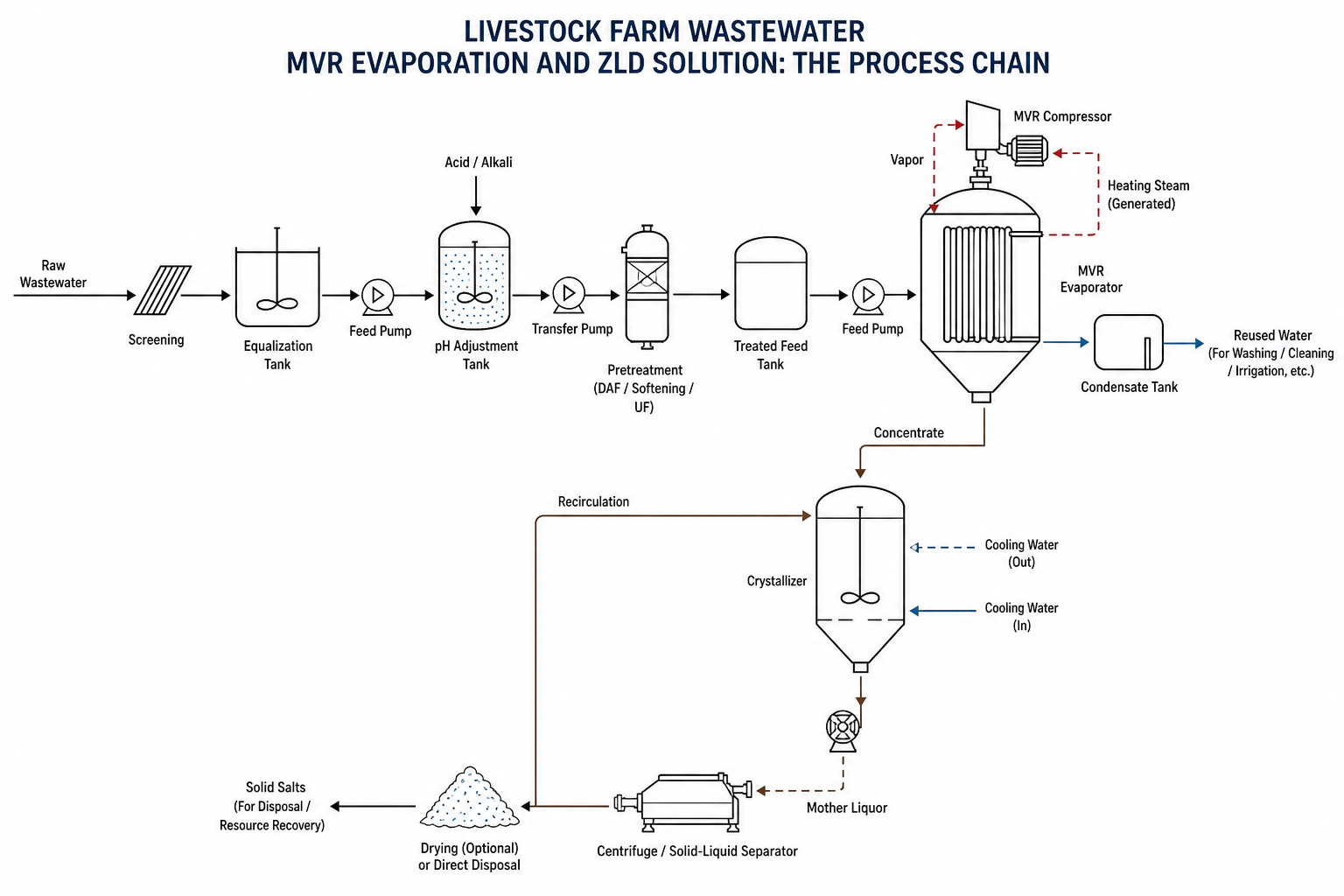
Stage 1: Solid-liquid separation
Screw presses or decanting centrifuges lift the coarse fiber fraction to a stackable cake (typically 20–30% dry matter), which composts or dries into bedding or soil amendment. The liquid fraction — still carrying dissolved organics, ammonium, potassium, and phosphorus — is the evaporator feed.
Stage 2: Anaerobic digestion (optional but synergistic)
Where a digester exists, it removes a large share of the soluble COD and returns biogas. The biogas can fire a boiler for evaporator startup steam or, via a gen-set, supply electricity to the MVR compressor — in favorable cases covering a substantial fraction of total evaporation energy from waste heat streams that were previously flared. The digestate liquor reaching the evaporator is warmer, thinner in organics, and cheaper to concentrate than raw slurry.
Stage 3: Ammonia management
This is the stage that separates working systems from failed ones. Livestock liquor is ammonium-rich, and ammonia is volatile: sent straight into an evaporator, a meaningful share of the nitrogen distills with the water vapor and contaminates the condensate. Two countermeasures are used, alone or combined:
- Stripping before evaporation — raise pH and strip ammonia in a packed column, recovering it as ammonium sulfate solution, a saleable liquid fertilizer.
- Condensate polishing after evaporation — accept some ammonia carryover and strip or acid-wash it from the condensate before the water is reused for flushing.
Choosing between them is an energy-and-product balance: stripping cold liquor avoids ammonia fouling of the evaporator but adds a column; polishing condensate keeps nitrogen in the concentrate but demands tighter evaporator control.
Stage 4: MVR forced-circulation evaporation
The liquor is concentrated in a forced-circulation evaporator, where pumped flow suppresses tube-side boiling and keeps scaling compounds moving past the heat transfer surface rather than baking onto it. The MVR compressor lifts the evaporated water vapor back to heating duty, so live steam is a startup-only consumer; electricity becomes the main energy input, typically tens of kWh per tonne of water evaporated for this class of duty. Depending on the farm’s water balance, the train concentrates the liquor to a pumpable 15–30% solids fertilizer base or further toward a pasty concentrate for drying.
Stage 5: Concentrate handling and water reuse
The concentrate is a balanced N-P-K organic fertilizer feedstock — as liquid for local spreading at greatly reduced volume, or dried and granulated where distance to market justifies the extra step. The condensate, after ammonia polishing, returns to flush channels, recovering the majority of the farm’s water demand in a closed loop.
At procurement level the chain resolves into four core modules:
| Module | Candidate Equipment Types | Selection Rationale | Indicative Operating Envelope |
|---|---|---|---|
| Solid-liquid separation | Screw press or decanting centrifuge | Removes fiber that blinds heat exchangers; cheapest protection | Cake near 20–30% DM; liquid onward |
| Ammonia management | Packed stripping column; condensate polisher | Volatile ammonia contaminates condensate unless routed | pH-raised stripping; acid-wash condensate polishing |
| MVR evaporation | Forced-circulation body with vapor recompressor | Suppresses tube-side boiling; keeps struvite moving | Tens of kWh per tonne; 15–30% solids endpoint |
| Concentrate and water reuse | Drier-granulator; flush-water loop | Fertilizer market fit decides liquid versus granular | Volume cut 5–10x; condensate returns to barn |
Configuration, materials, and ranges depend on actual feed, corrosion review, fouling behavior, utilities, and project capacity.
Stream Summary
| Stream | Destination | Notes |
|---|---|---|
| Separator cake (typically 20–30% DM) | Compost / bedding / soil amendment | Fiber-rich, stackable |
| Biogas (if digester installed) | Boiler for startup steam, or gen-set power for the MVR compressor | Converts a flared waste into evaporation energy |
| Stripped ammonium sulfate | Liquid nitrogen fertilizer sales | Optional product, depends on ammonia routing |
| Evaporator concentrate (N-P-K bearing) | Liquid organic fertilizer base, or dried granular fertilizer | Volume typically cut 5–10x versus feed |
| Polished condensate | Barn flushing reuse | The ZLD closure point |
The Scaling Problem Nobody Budgets For: Struvite
Anaerobically digested livestock liquor sits near saturation with magnesium, ammonium, and phosphate. Warm it, raise its pH, or flash off CO2 — all things an evaporator does — and struvite (MgNH4PO4·6H2O) crystallizes onto heat exchanger tubes, elbows, and pump casings as a rock-hard scale. Unmanaged, it throttles heat transfer and can shut a train down within weeks. Working designs respond with some combination of:
- Forced-circulation bodies that keep flow velocity high and boiling out of the tubes;
- Controlled struvite harvest — deliberately crystallizing it in a fluidized-bed reactor ahead of the evaporator, where it becomes fertilizer instead of scale;
- Cleaning-in-place circuits with mild acid programmed on heat-transfer-coefficient trending rather than the calendar;
- Pipeline hygiene — large-radius bends, no dead legs, and strainers ahead of pumps.
Plants that treat struvite as a design input recover it as product; plants that treat it as a maintenance surprise budget for downtime.
Sizing and Economics
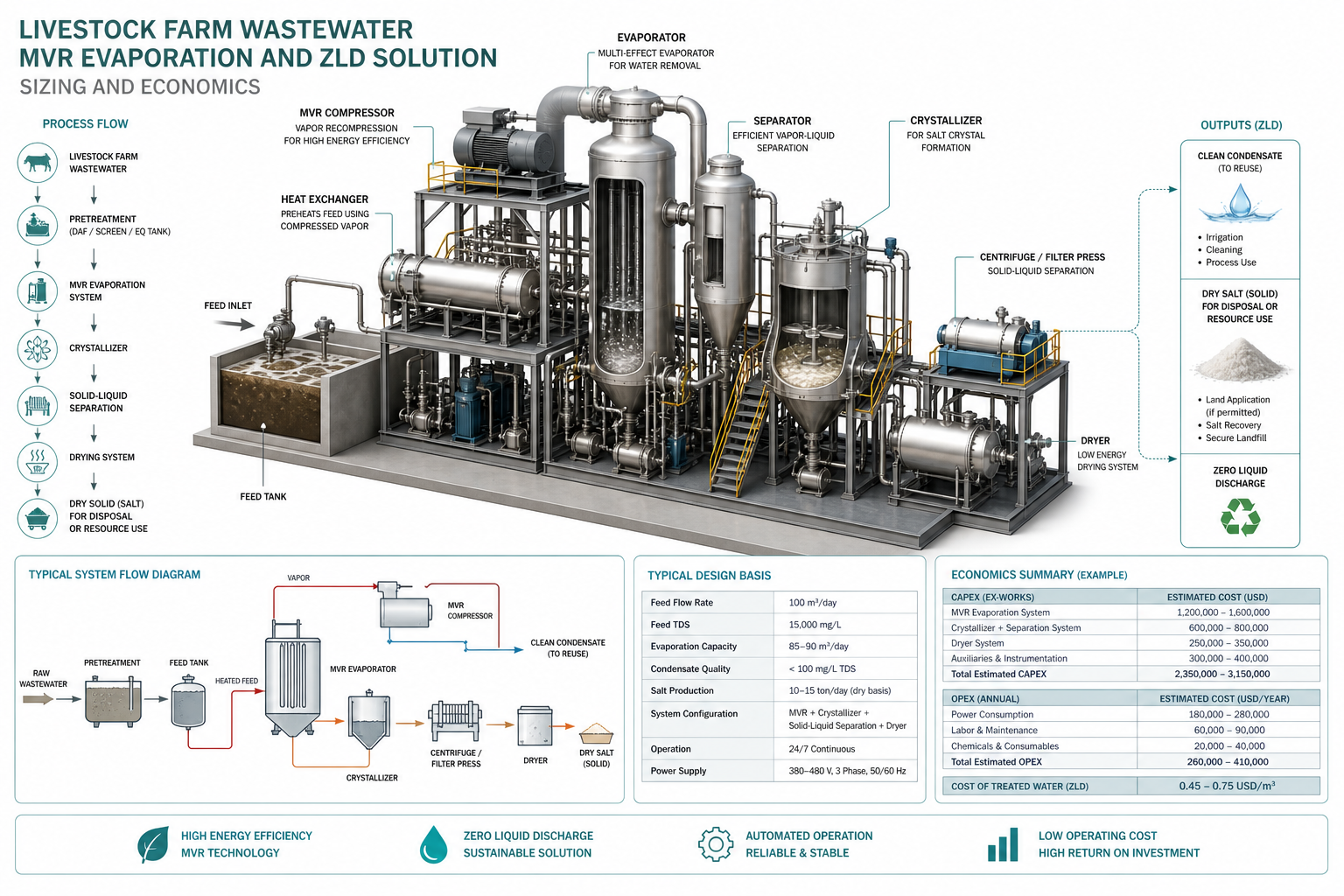
Evaporation duty is set by the flush-water balance: scrape systems generate a smaller, thicker stream; flush systems generate a larger, thinner one. Trains in this service are typically dimensioned in the tens to low hundreds of cubic meters per day of water removal — modular MVR units can be added in parallel as herd size or regulation tightens. The economic case rests on four levers, in descending order of impact:
- Avoided slurry hauling — the dominant saving wherever cropland is scarce;
- Avoided discharge penalties and lagoon liabilities;
- Fertilizer and ammonium-sulfate revenue from the concentrate and stripping products;
- Energy integration with biogas and, where grids allow, off-peak electricity for the compressor.
Background on the evaporation technology itself is in MVR evaporation systems, and the end-to-end closure philosophy is described in zero liquid discharge solutions. Concentrate-to-granule processing follows the same drying and packing route used for other organic fertilizers, including the vinasse concentrate described in our molasses distillery wastewater recovery solution.
Who This Solution Fits
The strongest candidates are concentrated animal operations in water-stressed or tightly regulated regions: large swine finisher complexes replacing lagoons, dairies under nutrient-management orders, and integrators who already operate digesters and want the water back. The weakest candidates are small pasture-based farms with ample spreading acreage close to the barn — for them, hauling and conventional storage remain cheaper than any evaporator. A useful screening question is what the farm currently pays, per cubic meter, to move water off site; when that number approaches the energy cost of evaporating it, MVR deserves a heat-and-material balance.
Five Failure Modes in Livestock ZLD Projects
- Skipping solid-liquid separation. Fiber-laden slurry blinds heat exchangers; the separator is not optional pre-treatment, it is the evaporator’s first stage.
- Ignoring ammonia. High-ammonium feed evaporated without stripping or condensate polishing yields condensate too contaminated to reuse — the water loop never closes.
- Underestimating struvite. See above; the failure appears between commissioning and the second cleaning cycle.
- Sizing for the average day. Flush volumes swing with season, herd rotation, and barn washing; trains without turndown margin flood or starve the distributor.
- No market for the concentrate. A ZLD system that produces fertilizer nobody can transport just moves the storage problem into a smaller, more concentrated — and more odorous — tank.
Validation focus. Figures in this article reflect industry-reported practice and published effluent characterizations, not EvapCryst deliveries — indicative, not a project guarantee. Before committing this route, characterize the actual flush liquor (COD, ammonium, potassium, phosphorus, magnesium), confirm the struvite saturation margin after digestion, and test concentrate fertilizer market uptake within hauling distance. The checklist below consolidates these gates.
When This Route May Not Fit
This route struggles where land remains cheap: pasture-based operations with ample spreading acreage near the barn keep hauling and lagoon storage well below the cost of any evaporator, and adding MVR there destroys value. It also fits poorly when the concentrate has no market — a ZLD train that produces fertilizer nobody within hauling distance can accept merely relocates the storage problem into a smaller and more odorous tank. Projects without anaerobic digestion should check the electricity line first: raw slurry carries more COD fouling and ammonia load than digestate, and the economic case weakens when biogas cannot offset compressor power. And where discharge rules are loose and water unmetered, the regulatory driver that usually justifies closure may never arrive, leaving the plant a solution awaiting a problem.
What Must Be Verified
Before a livestock ZLD project is committed, the following must be verified against site data rather than the indicative envelope above. A full characterization of the actual flush or digestate liquor — COD, ammonium, potassium, phosphorus, and magnesium — because struvite risk and ammonia routing both follow from these numbers. A seasonal water balance covering herd rotation and barn-washing peaks, since trains without turndown margin flood or starve. Struvite saturation margins after digestion, confirmed by calculation or jar tests. Condensate reuse quality against flush-water requirements, including ammonia polishing trials. A signed or credibly surveyed offtake for the concentrate and any stripped ammonium sulfate within realistic hauling distance, because fertilizer revenue assumptions decide the economics and granulation energy where drying is planned.
Frequently Asked Questions
Can MVR evaporation really achieve zero liquid discharge on a livestock farm?
Yes, in the practical sense that no process liquid leaves the site: solids leave as cake or fertilizer, nitrogen leaves as stripped ammonium salt or in the concentrate, and the evaporated water returns as polished condensate for barn flushing. The design hinges on solid-liquid separation upstream and ammonia control on both the feed and the condensate side.
What is the main energy input, and can biogas cover it?
MVR shifts the main energy input from steam to electricity, typically tens of kWh per tonne of evaporated water for this class of liquor. Farms with anaerobic digestion can route biogas to a gen-set or boiler, covering a substantial share of that demand with energy that would otherwise be flared.
Why does struvite form, and how is it controlled?
Digested livestock liquor is rich in magnesium, ammonium, and phosphate and sits near struvite saturation. Evaporation warms the liquor and flashes CO2, both of which trigger crystallization. Controls include forced-circulation heat exchangers, deliberate struvite harvest in a fluidized bed reactor (turning scale into fertilizer), acid CIP keyed to heat-transfer-coefficient trending, and hygienic piping.
What happens to the nitrogen in the manure?
It splits between three outlets depending on the design: stripped and recovered as ammonium sulfate solution before evaporation, carried with the water vapor into the condensate (then polished out), or retained in the N-P-K concentrate sold as organic fertilizer. Ammonia routing is the single most consequential process decision in the flowsheet.
Is the condensate clean enough to reuse in the barns?
After ammonia polishing, yes — the target is flush-water quality, not potable quality. Segregating condensate from the cleanest effect and polishing the remainder keeps the reuse loop practical without over-treating the entire stream.
Next step: send your flush-liquor analysis, herd size or daily water balance, and reuse targets, and receive a first-pass screening of the process direction and boundary conditions — inputs exchanged for engineering direction.