Project Parameters
| Parameter | Value |
|---|---|
| Process route | MVR evaporation concentration + cooling crystallization (~40 °C) + centrifuge with mother-liquor return |
| Industry | Stainless steel surface treatment / pickling (Handan, Hebei, North China) |
| Feed type & key components | Stainless pickling wastewater at ~28% ammonium chloride with dissolved iron values |
| Evaporation capacity | 100 t/d |
| Construction materials | Titanium wetted parts for hot ammonium chloride service |
Representative process configuration compiled from published industry project data. Indicative values, not a process guarantee.
Project Description
Stainless steel pickling has been migrating away from mixed-acid chemistry. For many surface treatment lines the working bath is now an ammonium chloride-based process, and it runs in a loop: the bath loads with dissolved iron and spent salt until it stops pickling, and then the whole volume is a waste stream — at the reference site, a 28% ammonium chloride liquor produced at a continuous 100 t/d by a stainless processor in Handan.
At that concentration the stream is not really wastewater; it is a crude feedstock with a disposal problem attached. The representative configuration treats it as the former: evaporate the water, crystallize the salt, keep the loop closed.
Process Technology
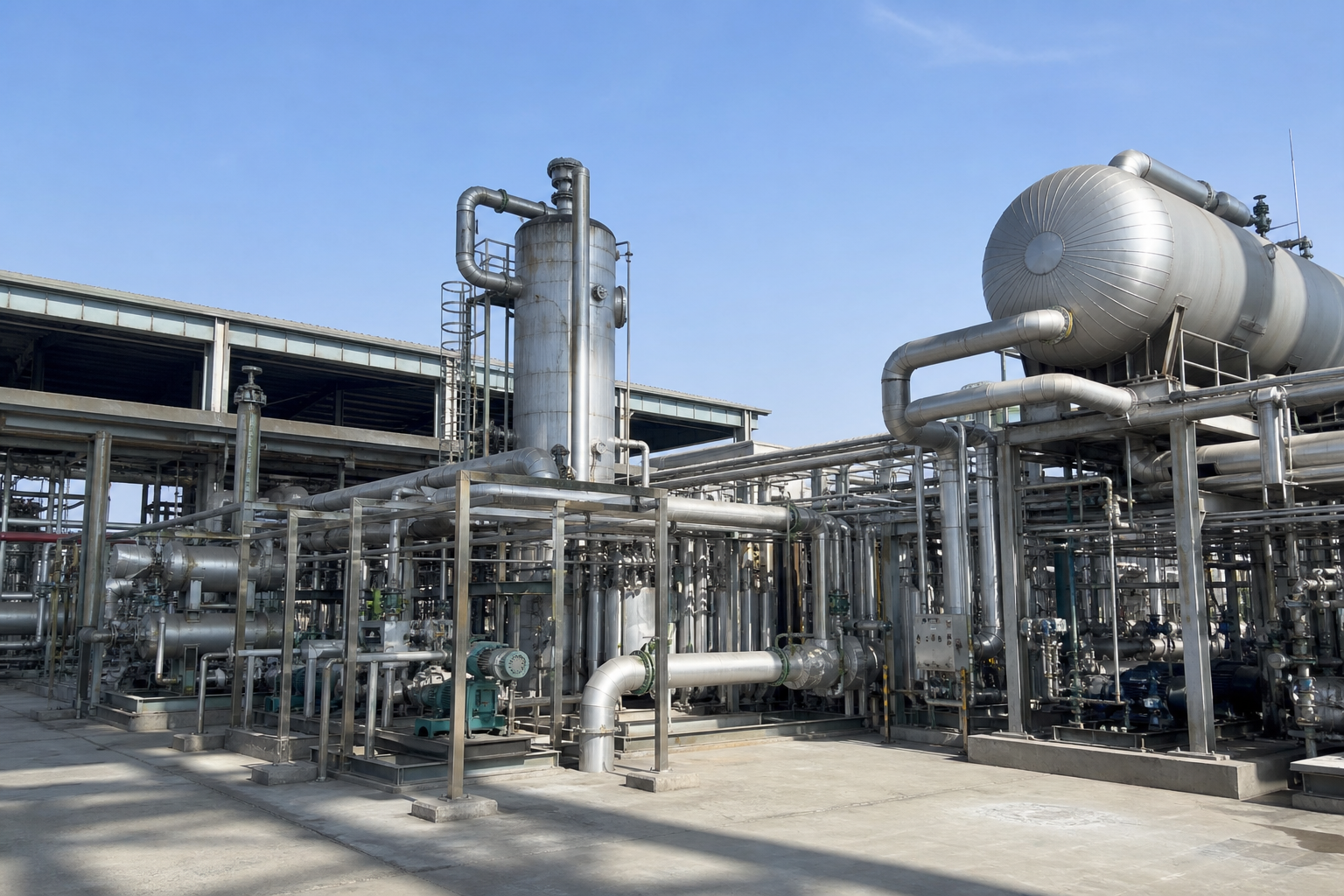
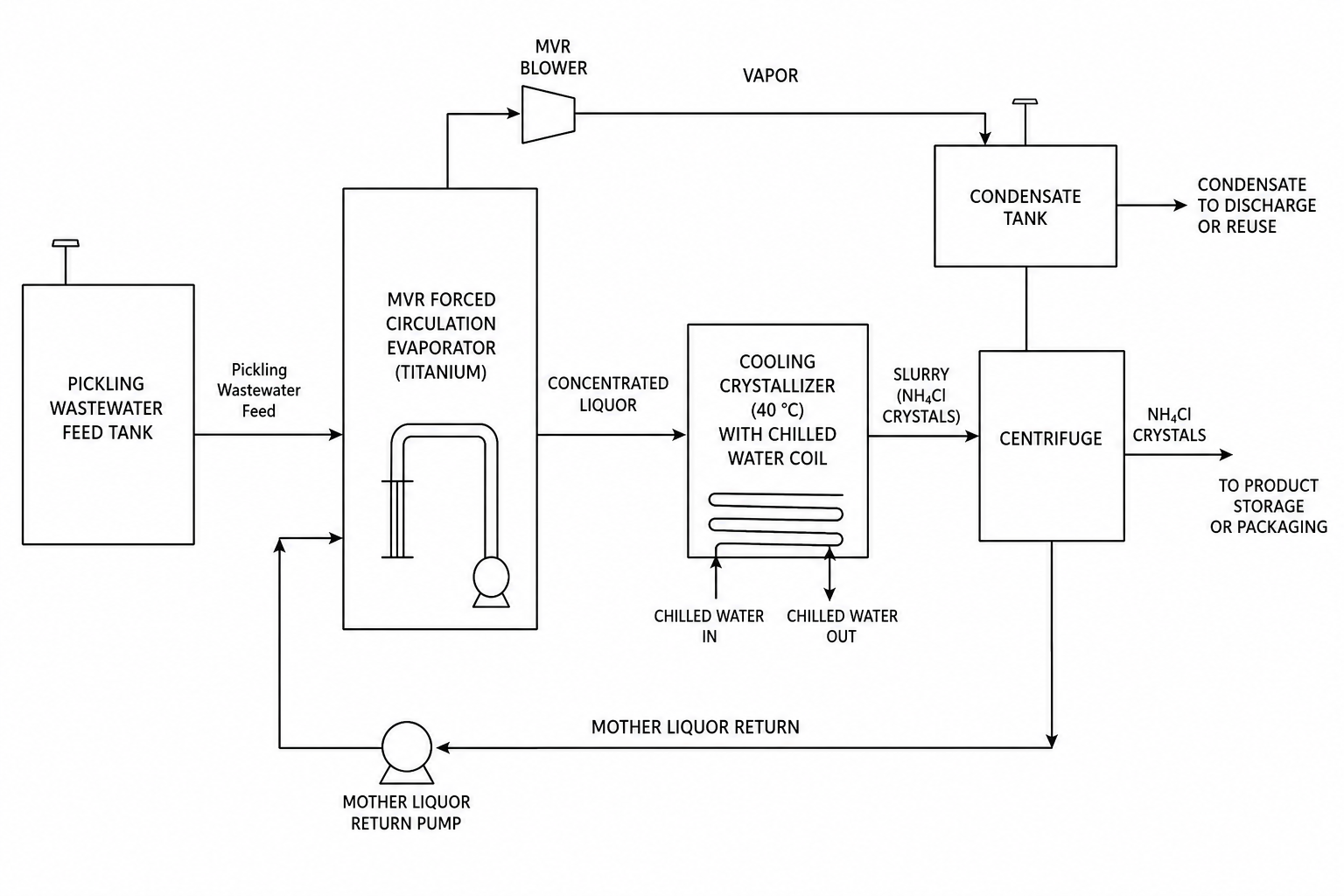
MVR evaporation takes the 28% liquor up toward crystallizing strength. The train runs forced circulation under mechanical vapor recompression — electric drive, no continuous live steam — with the heat transfer circuit in titanium: hot ammonium chloride is among the more aggressive chloride services, and titanium is the reference selection that keeps this train a long-life asset rather than a corrosion maintenance program.
The process choice specific to this salt is what happens at the top of the concentration curve. Ammonium chloride’s solubility falls steeply as the liquor cools — far more steeply than sodium chloride’s — so instead of driving all the way to boiling-point crystallization, the train discharges concentrated hot liquor into a cooling crystallizer chilled to around 40 °C. At that temperature NH4Cl drops out of solution readily and grows as clean crystal in the cooled liquor, on less energy than forcing the last water out thermally. It is the same solubility physics that Glauber’s salt recovery exploits, applied to an ammonium system.
The chilled slurry centrifuges into dewatered ammonium chloride — in the reference configuration the salt sludge reports at no more than 10% moisture, a figure that matters because moisture is what disposal is priced on, and because a dry enough salt has offtake potential as fertilizer-grade or industrial material. Mother liquor from the centrifuge carries the dissolved iron and residual salt back to the MVR train for another pass; a purge on that loop is where the iron inventory ultimately leaves.
Condensate from the evaporation train returns to the pickling line’s rinse and bath make-up duties — the cleanest water in the plant, returned to the process that generated the waste.
Equipment Configuration
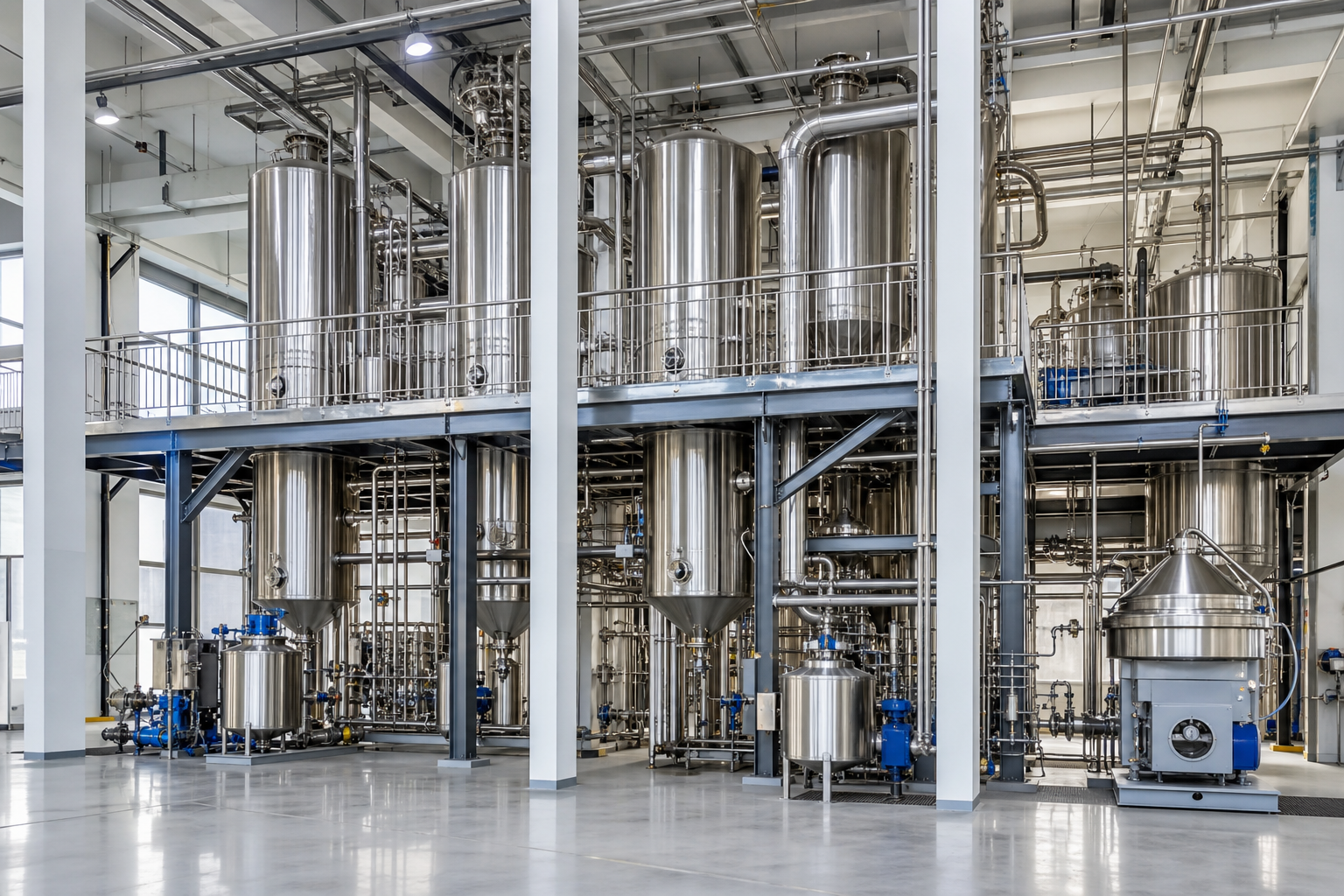
One set of the following equipment is typical for this duty:
- Pickling wastewater receiving and iron-tolerant feed handling
- MVR forced-circulation concentration train, titanium wetted parts
- Cooling crystallizer operating near 40 °C with chilled-water interface
- Centrifuge dewatering NH4Cl to ≤10% moisture
- Mother-liquor return to MVR feed with iron purge
- Condensate reuse to pickling rinse; PLC control of temperature and slurry
Performance & Outcome
Compiled from published industry project data, indicative: 100 t/d trains of this class convert 28% ammonium chloride pickling liquor into ≤10%-moisture dewatered salt and reuse condensate, exploiting NH4Cl’s cooling crystallization window instead of paying full thermal crystallization energy. Salt grade and specific energy are quoted per iron content.
Simplified PFD
The simplified process flow diagram above shows the titanium MVR concentrator, the 40 °C cooling crystallizer, centrifuge dewatering and the mother-liquor return loop.