Evaporation plant economics are dominated by operating cost, not purchase price: over a ten-year life, OPEX typically accounts for more than 70% of total cost of ownership, so a cheaper capital quote that raises steam or electricity consumption is almost always the expensive choice. For orientation, market pricing for a standard 5 t/h MVR evaporator system has recently fallen in the USD 450,000-850,000 range (industry-reported figures), with specific energy consumption (SEC) of roughly 15-22 kWh per tonne of evaporated water for well-designed systems. This guide breaks down where the money goes — CAPEX structure, materials price ladders, OPEX formulas, payback calculation, hauling-cost avoidance, retrofit economics — and shows how to build the decision on lifetime numbers instead of quotation documents.
CAPEX: What You Are Actually Buying
An evaporation or crystallization plant quotation bundles six major blocks. The vapour compressor is usually the single largest item — commonly above 30% of equipment value in MVR plants — and its type matters: high-speed centrifugal fans suit large duties with low vapour density, roots-type blowers suit small flows with high boiling-point elevation, and multi-stage centrifugal machines (increasingly mainstream, roughly 15-20% higher initial cost but isentropic efficiency above 80%) sit in between. The heat exchangers are priced mainly by materials selection (below). Separators, crystallizers, and vessels follow corrosion duty; automation (PLC/DCS, remote diagnostics) is quoted up front but reduces staffing and downtime; process design and engineering; and auxiliaries plus installation, commissioning, and training. One external vendor analysis puts compressor technology, anti-corrosion materials, and intelligent control together at roughly 40% of finished-system cost.
Two variables dominate the quotation more than any other: throughput (t/h of water evaporated) and concentration ratio (feed TDS to product TDS). Higher throughput and higher concentration ratio demand more heat-transfer area, a larger compressor, and larger crystallizers — which is why two plants of identical evaporative capacity can differ widely in price. Two further escalators deserve attention: boiling-point elevation above roughly 15-20°C pushes a single centrifugal stage beyond its temperature lift, forcing two-stage compression or a TVR supplement and raising CAPEX by more than 25%; and a fully automated PLC package with remote fault diagnosis and energy-recovery modules may add on the order of USD 55,000 while cutting electricity use by around 8% per year.
The Materials Price Ladder
Corrosion-driven materials selection is the most visible CAPEX lever. Using stainless steel as the 1.0× baseline, wetted-part cost climbs in steps set by chloride level and pH — a ladder that should be matched to the worst point in the train, not the average feed.
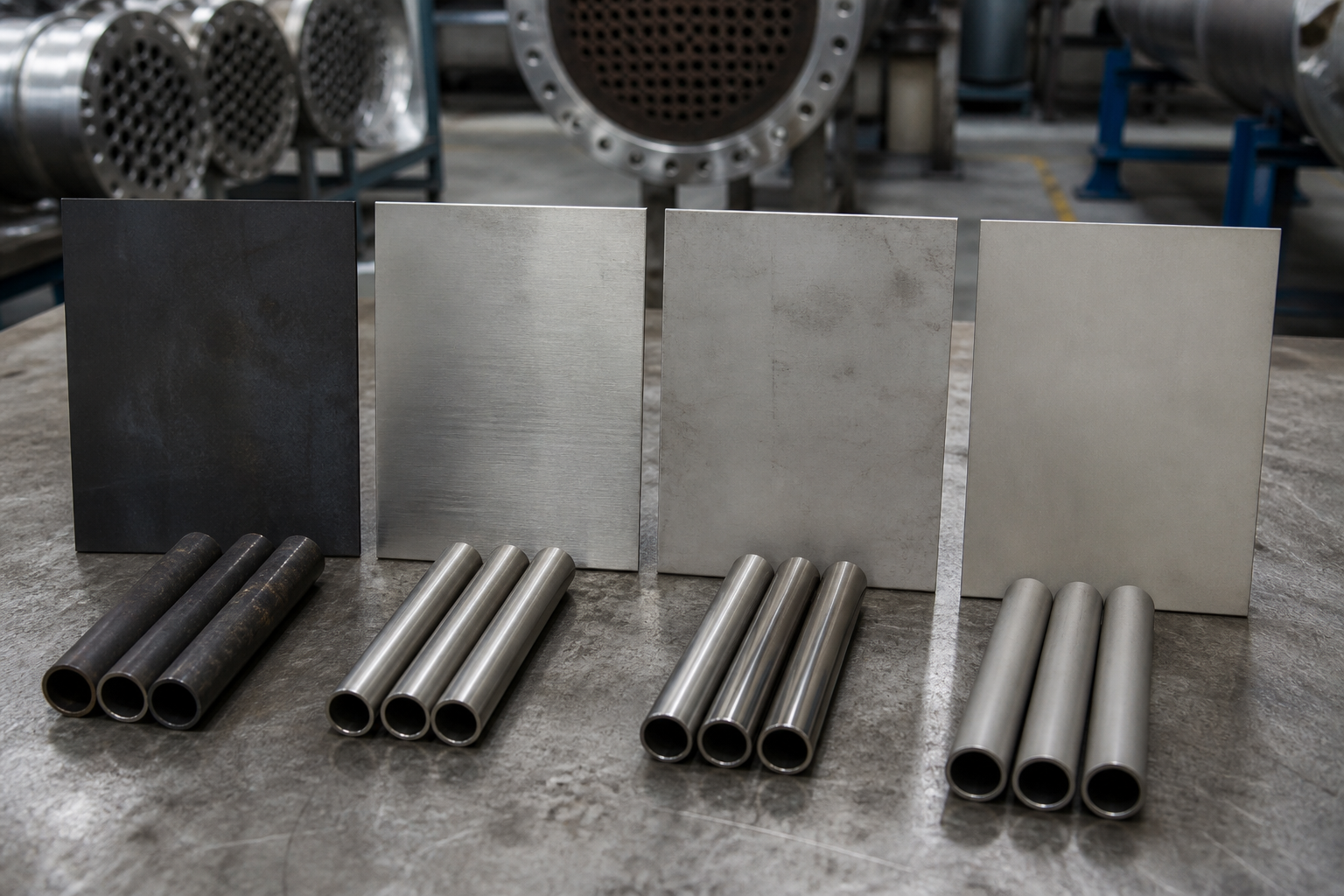
| Liquor condition (guideline) | Material class | Indicative cost multiplier | Lifetime effect |
|---|---|---|---|
| Chloride < ~100 ppm | SS304 / 316L | 1.0× (baseline) | Standard service life |
| Chloride ~100-5,000 ppm | Duplex 2205 / 2507 | ~1.6-2.2× | Resists pitting and stress-corrosion cracking; higher mechanical strength |
| Chloride > ~5,000 ppm, or high acid/oxidizing | Titanium Gr.2/TA2, Hastelloy C-family | ~3.5-5.0× | Longest life in severe brines; often the only workable choice |
The upgrade is not gold-plating: in high-chloride brines, 304/316L can develop pitting and stress-corrosion cracking within months, and one unplanned tube replacement erases the savings from specifying it. Full criteria for materials selection by chloride, pH, and velocity are covered in the construction materials and corrosion protection guide.
OPEX: The Formula That Decides Everything
A practical operating-cost model for an evaporator is: total OPEX ≈ electricity price × SEC + chemicals + periodic cleaning + labour allocation, plus waste-salt disposal where applicable. In MVR plants, electricity commonly represents 60-70% of operating cost, with maintenance around 10-15% and labour 5-10%; specific consumption for well-designed systems lands in the 15-22 kWh/tonne band (standard systems 22-28, VFD-optimized systems 16-20 have been reported). SEC is the single number to demand from every vendor — it converts directly into annual cost and, unlike price, it is verifiable in operation. The calculation methods behind these numbers, including worked energy balances, are laid out in the companion article on steam and electricity consumption calculation.
Energy price structure decides the technology. Where steam is expensive and electricity reasonable — much of Europe and North America, with industrial steam recently in the USD 35-50 per tonne range (market-reported) — an MVR evaporator can carry an initial cost 50% above a triple-effect system and still recover the difference through energy savings in roughly 14-22 months. The same arithmetic explains when MVR is not the answer: cheap by-product steam (for example, surplus from a CHP) or very high electricity prices push the balance back toward multi-effect evaporation or TVR.
Payback: How to Compute It Honestly
The standard method is simple: payback (years) = total initial investment / annual combined savings, where annual savings should include all four streams — energy reduction, recovered water or condensate reuse, reduced chemical and hazardous-waste disposal, and any applicable subsidies or tax incentives for zero-discharge or energy-saving upgrades. Reported MVR paybacks typically fall in the 1-3 year band, with four factors moving the result: treatment scale (larger is faster), the local electricity-to-steam price ratio, annual operating hours (continuous production accelerates payback), and the liquor itself (boiling-point elevation, corrosion, and fouling raise both capital and maintenance).
For an illustrative worked example based on an external vendor reference: saving 5 tonnes of steam per hour, at RMB 200 per tonne over 7,200 operating hours per year, yields an annual energy benefit of RMB 7.2 million — the kind of number that turns a “premium” MVR quotation into the cheap option. Always run this calculation at your steam and electricity tariffs before comparing bids, or use the ROI calculator to structure the inputs.
The Energy-Technology Ladder
Energy saving in evaporation is a ladder, and each rung trades capital for consumption. Multi-effect evaporation: each added effect lowers energy consumption but raises heat-transfer area and cost, with diminishing returns — brine duties rarely justify more than three, at most four, effects. Thermal vapour recompression (TVR) adds roughly the equivalent of one extra effect using a steam ejector with no moving parts. MVR compresses the entire secondary vapour stream electrically and is often described in industry literature as performing like a ten-effect system. Beyond the vapour side, heat recovery — feed preheating against hot condensate and distillate, flash recovery, and insulation — trims the residual load. The retrofit version of this ladder is covered below.

Hauling Economics: The Hidden Case for Evaporation
For wastewater generators, the alternative to an evaporator is usually hauling — and hauling is priced by volume, even though industrial wastewater is typically 90-99% water. One external vendor-published case: a plant producing 1,000 gallons per week of contaminated rinse water, hauled at USD 0.50 per gallon, pays about USD 500 per week, roughly USD 26,000 per year before surcharges. Reducing volume by 95% with evaporation cuts that to about USD 1,300 per year — an annual saving in the order of USD 24,700, before counting cradle-to-grave liability: under regimes such as the US RCRA, the generator remains responsible for waste even after the hauler takes it, so every gallon not shipped is also risk not shipped. Where hauling is the main alternative, evaporator paybacks of 1-3 years are routinely reported, and MVR systems with operating costs down to USD 0.01 per gallon suit larger flows.
| Situation | Recommended approach | Rationale |
|---|---|---|
| Need < 12 months, or new waste stream still being characterized | Rent / pilot first | Discovering foaming or scaling problems in a USD 100,000-class rented unit is far cheaper than in a permanent one |
| 12-24 months horizon | Run the full cost comparison | Annual hauling spend vs. installed cost + energy + maintenance |
| > 24 months, hauling at USD 2,000-5,000+/month | Buy | Typically reaches break-even in 18-36 months; hard-to-treat streams needing custom materials also rule out standard rental units |
Hidden Costs, Cheap Quotes, and Salt Disposal
Low quotations have a structure: vendors who win on price commonly economize on exactly the components that fail expensively — non-condensable gas extraction systems and circulation-pump seals. Once heat-exchanger tubes foul or cavitate because of these corners, a single day of unplanned downtime can consume the entire purchase saving, and one vendor reports that more than 40% of its customers had previously selected the wrong compressor type on price (a supplier-published claim, not an independent statistic). Due diligence items that cost little at tender stage: verify the non-condensable extraction design, the seal plan for chloride slurries, the compressor type against your boiling-point elevation, and what the SEC guarantee actually covers.
Salt disposal is the other sleeping cost. Whether crystallized salt is a hazardous waste depends entirely on the raw-water composition: compliant mixed salt can be handled as general industrial solid waste — sometimes even sold — while non-compliant salt must be paid for as hazardous waste. In zero liquid discharge (ZLD) projects this single classification can swing total cost of ownership more than the evaporator choice itself, so it belongs in the earliest feasibility work, not in commissioning week.
Lifetime, Maintenance Budget, and the Retrofit Path
Planning horizons should match equipment life. Compressors typically serve 15-20 years with an overhaul around year 5-8 costing roughly 10% of a new machine; heat-exchanger bodies normally exceed 10 years. A realistic maintenance reserve therefore scales with severity of duty rather than with purchase price.
Finally, existing multi-effect plants do not need to be scrapped to join the ladder. Retrofit schemes that keep the existing shells and add an MVR compressor with new controls have been reported to cut operating cost by 40-70%, with published case results varying by liquor — a gelatin (donkey-hide glue) plant at roughly 70% energy saving, a chemical wastewater plant at 43%, and an ethanol-extraction plant at 64%. The spread is the lesson: retrofit economics depend on the existing temperature differences, shell condition, and materials — feasibility requires checking that existing heat-transfer area can work with the compressor’s temperature lift and that shells and materials pass re-rating, which is why retrofit assessments start with an energy balance of the installed system.
Frequently Asked Questions
How much does an MVR evaporation system cost?
Recent market pricing for a standard 5 t/h system falls around USD 450,000-850,000, driven mainly by throughput, concentration ratio, materials (chloride-driven), and compressor type. Boiling-point elevation above roughly 15-20°C adds two-stage compression and can raise CAPEX by more than 25%.
What is the payback period of an MVR evaporator?
Typically 1-3 years. Compute it as initial investment divided by annual combined savings — energy, recovered water, avoided disposal, and subsidies. Faster payback comes with large scale, favourable electricity-to-steam price ratio, and continuous operation.
Why does OPEX matter more than CAPEX in an evaporation plant?
Because over a ten-year life, operating cost typically exceeds 70% of total cost of ownership. A USD 100,000 saving on purchase price can be repaid several times over by 2-3 kWh/tonne of extra specific energy consumption across years of operation.
Is it cheaper to rent or buy a wastewater evaporator?
Under about 12 months of need, rent; over 24 months, buy — plants hauling at USD 2,000-5,000 per month typically break even on purchase within 18-36 months. Between those horizons, run the direct comparison of annual hauling cost against installed cost plus energy and maintenance.
Can an existing multi-effect evaporator be converted to MVR?
Yes — keeping the shells and adding a compressor and controls has cut operating costs by a reported 40-70% in published cases (43-70% depending on the liquor). Feasibility hinges on the existing temperature differences, heat-transfer area, shell pressure rating, and wetted materials.