Project Parameters
| Parameter | Value |
|---|---|
| Process route | MVR falling-film evaporation, two parallel trains |
| Industry | Salt lake lithium extraction / battery materials upstream |
| Feed type & key components | Lithium chloride brine from salt-lake extraction; LiCl with associated boron and magnesium management upstream |
| Evaporation capacity | 80 t/h total (2 × 40 t/h trains) |
| Construction materials | SS316L wetted parts (indicative for LiCl service; higher alloys per chloride concentration) |
Representative process configuration compiled from published industry project data. Indicative values, not a process guarantee.
Project Description
A salt-lake lithium operation in Western China’s Qinghai province requires its lithium chloride stream — already upgraded from the lake brine by adsorption or membrane concentration — to be raised further in lithium concentration before precipitation of lithium carbonate in the downstream plant. The site conditions are shaped by the location: high altitude, wide diurnal temperature swings, scarce fresh water and long logistics lines that penalize anything shipped in. Water itself is a process asset in the basin — evaporating it to atmosphere is both wasteful and regulated — so the concentration train is also a water recovery unit.
The reference configuration is an 80 t/h MVR falling-film evaporation plant arranged as two 40 t/h trains. The two-train arrangement is deliberate: it halves the impact of a compressor trip on upstream extraction, allows maintenance without a full lithium plant shutdown, and matches the modular capacity steps by which salt-lake projects are built. Comparable published configurations operate the same duty in the same region at 80 t/h single-line scale, confirming the route as segment standard for LiCl concentration.
Process Technology
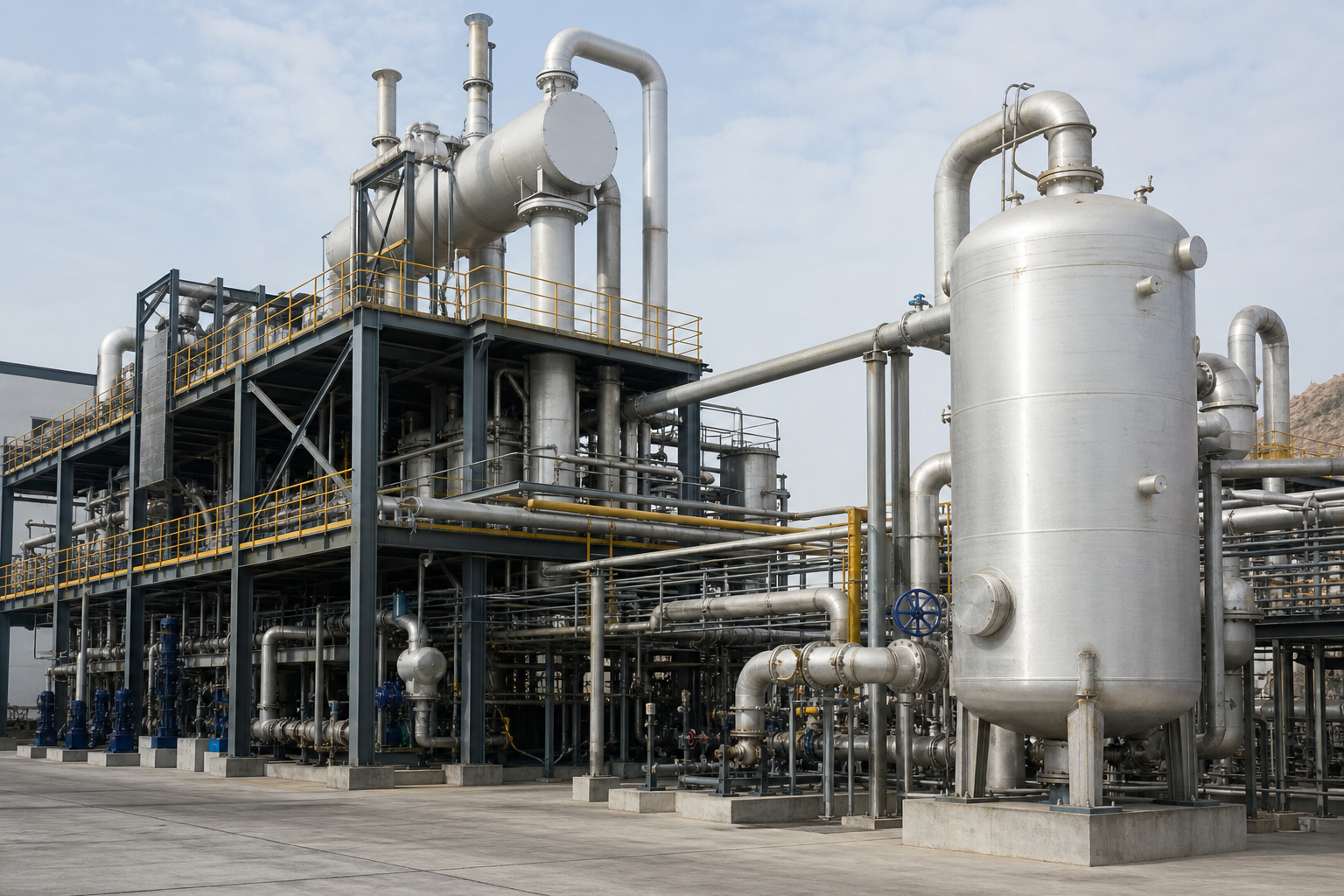
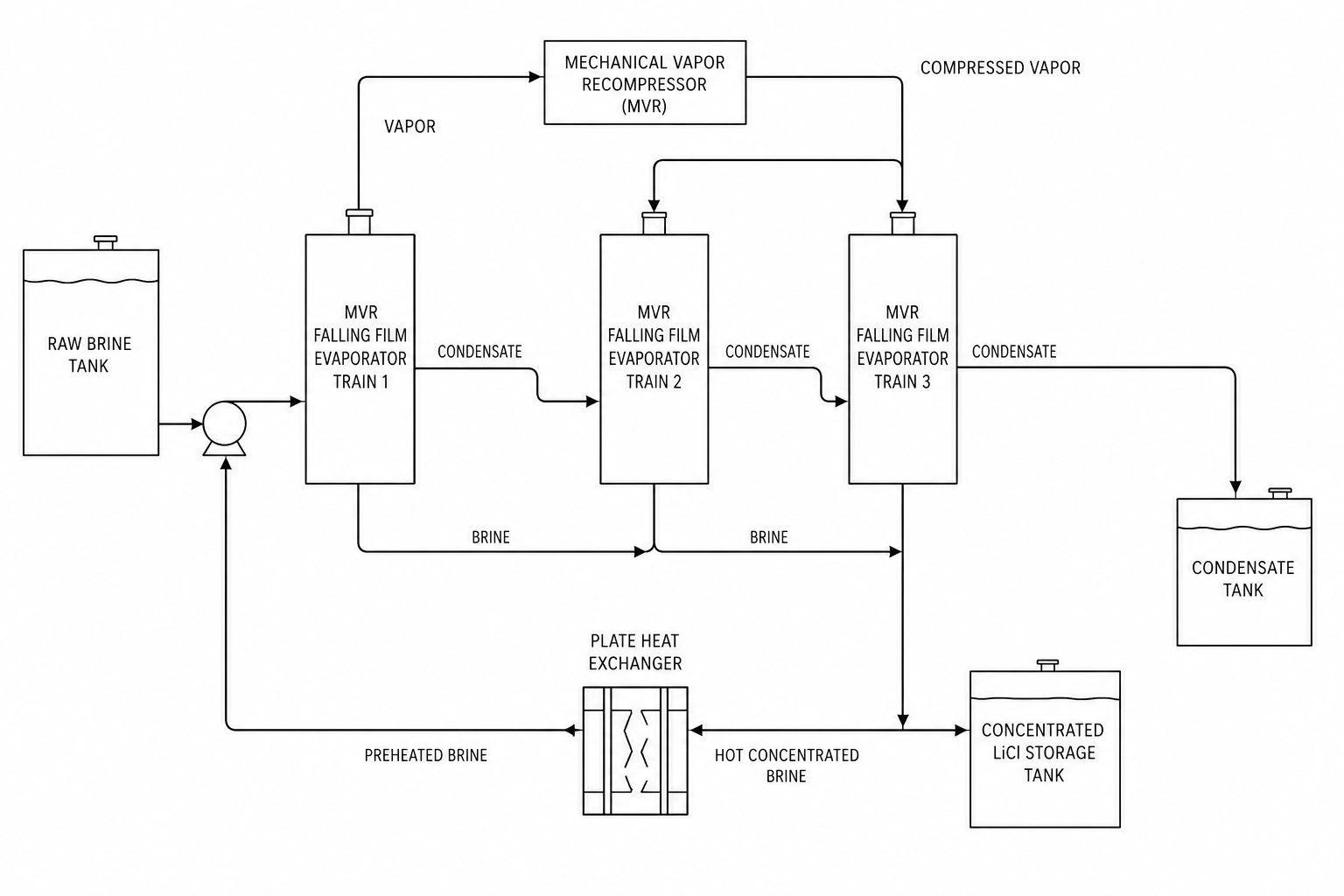
Clarified lithium chloride brine from the extraction plant is polished through filtration and degassing, then distributed to the falling-film trains. Falling film is the matched evaporator type for this liquor at the concentration stage: the feed is a clear, low-suspension brine whose viscosity remains moderate through the concentration window, and the thin-film regime achieves high heat transfer coefficients at low temperature difference — gentle heating that avoids localized wall concentration of lithium chloride and the scaling that follows it.
Each train is driven by its own mechanical vapor recompressor. Secondary vapor from the separator is compressed to a usable condensing temperature and returned to the shell side of the falling-film calandria as heating steam. The result is a train that runs on electrical power with a specific energy consumption far below a steam-heated evaporator — the decisive economics at a remote Qinghai site where electric power is available but process steam is not.
Concentrated LiCl liquor is drawn from each train at controlled density and routed to the downstream lithium precipitation plant. Overhead vapor condenses in surface condensers; because the feed is a relatively clean brine, the condensate is recovered in quantity and reused across the salt-lake site — for brine management, equipment washing and cooling make-up — rather than being discarded, which is the standard water-balance practice in the basin. A small purge from the brine circuit controls the accumulation of boron and other impurities that ride with the LiCl.
The two trains share feed and product tankage and are controlled as one unit: density and level control loops on each calandria, compressor load management, and automatic wash sequences that periodically clean the film surface of accumulated scale.
Equipment Configuration
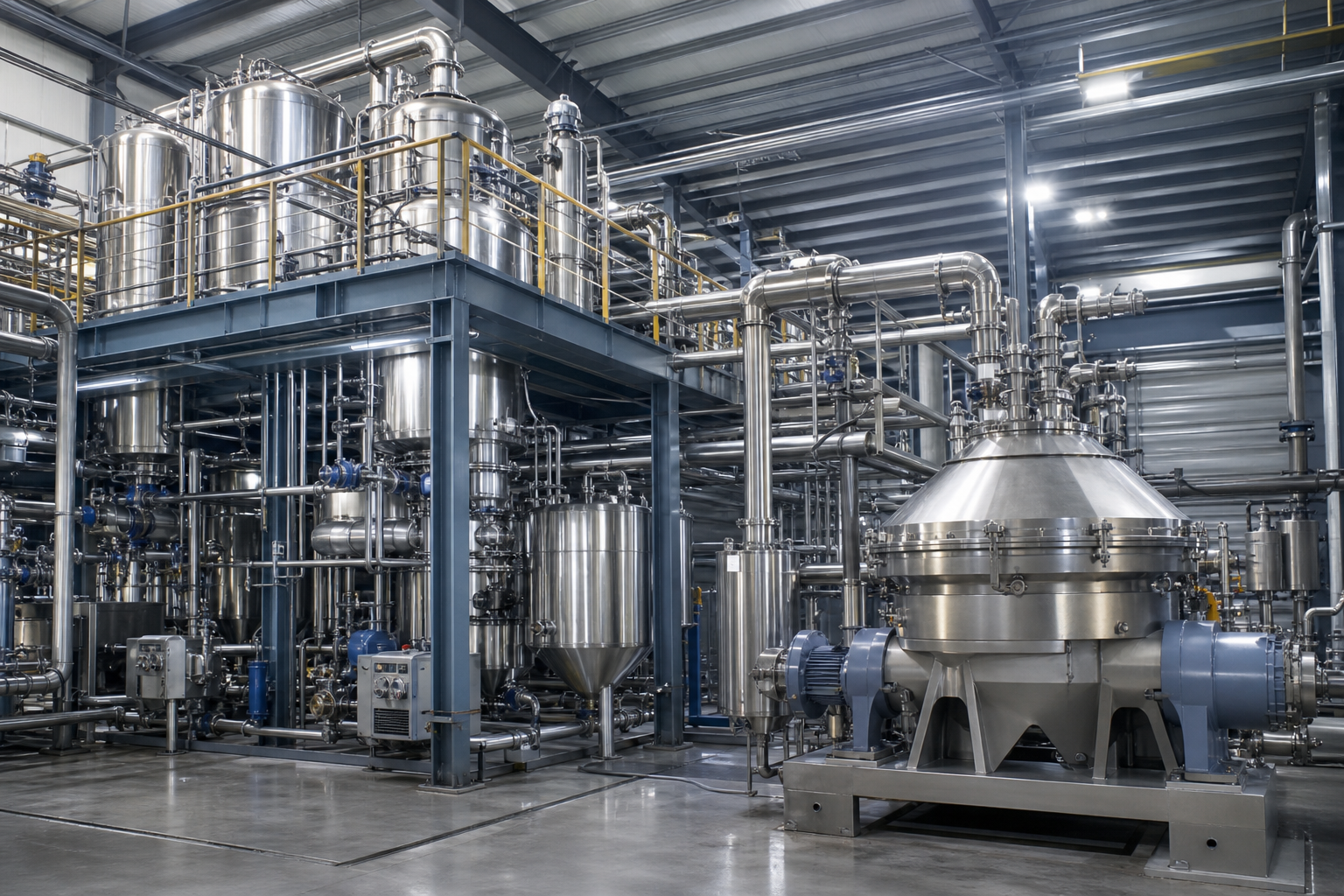
One set of the following equipment is typical per train (two trains total for this duty):
- Feed filtration, degassing and distribution to both trains
- Falling-film evaporator calandria with liquor circulation and distribution system
- Mechanical vapor recompressor with inlet droplet separation and anti-surge control
- Surface condenser, condensate collection and site reuse pumping
- Concentrated LiCl product tankage with density-based transfer control
- PLC/DCS control of train density, compressor load and cleaning-in-place sequences
SS316L is the indicative reference for LiCl service in the moderate concentration range; wetted parts in the highest-chloride zones are upgraded alloy per the chloride-temperature envelope of the specific project.
Performance & Outcome
Compiled from published industry project data, indicative: trains of this class concentrate lithium chloride brine to downstream precipitation specification with electric-only thermal energy, recover condensate for site reuse, and hold availability figures typical of two-train redundant arrangements. Specific energy and concentration uplift are quoted per project.