
Project Parameters
| Parameter | Value |
|---|---|
| Process route | MVR plate falling-film evaporation |
| Industry | Inorganic chemicals — barium salt production by-product recovery |
| Feed type & key components | Sodium sulfide liquor co-generated as by-product in barium sulfate production |
| Evaporation capacity | 30 t/h water removal |
| Construction materials | SS316L minimum, higher alloys for sulfide service (indicative) |
Representative process configuration compiled from published industry project data. Indicative values, not a process guarantee.
Project Description
A barium chemicals producer in Xinji, Hebei Province, North China, operates barium sulfate lines in which barite is reduced and converted, and sodium sulfide liquor is co-generated as an unavoidable by-product stream. The by-product is not a waste in the ordinary sense: sodium sulfide is itself a marketable product, supplied as liquid flake feedstock to the leather, mining and chemical industries. But it comes off the process dilute, and hauling low-strength liquor means hauling water. The commercial task is to concentrate the by-product liquor to sale-strength sodium sulfide at the lowest possible operating cost, turning an environmental liability line into a revenue line.
The reference configuration is a 30 t/h mechanical vapor recompression (MVR) evaporation train built on plate falling-film bodies. The choice is economics-driven: a by-product stream earns its concentration cost or it does not, and MVR — running on electrical power with near-zero live steam — is what makes by-product upgrading pay at this site.
Process Technology
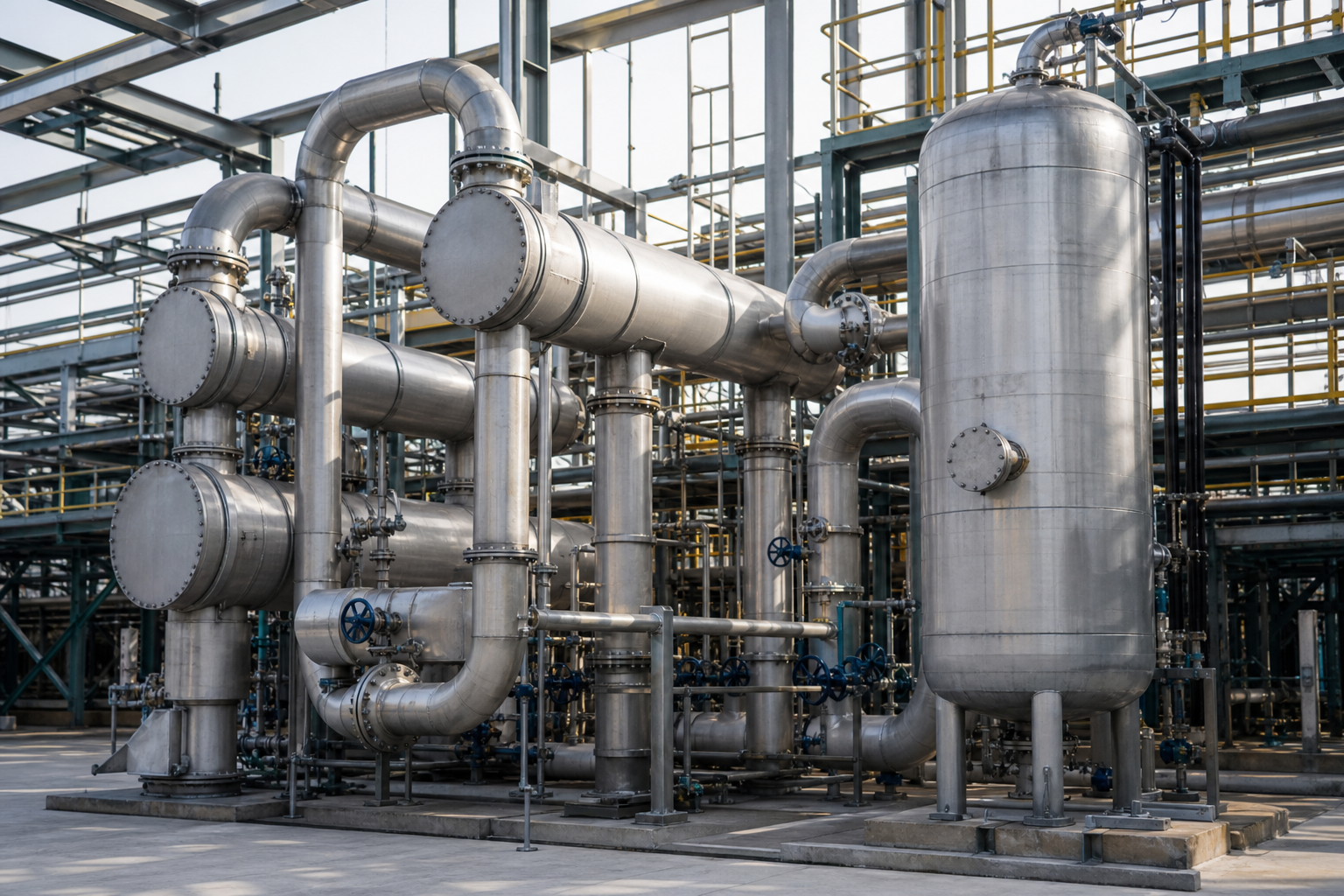
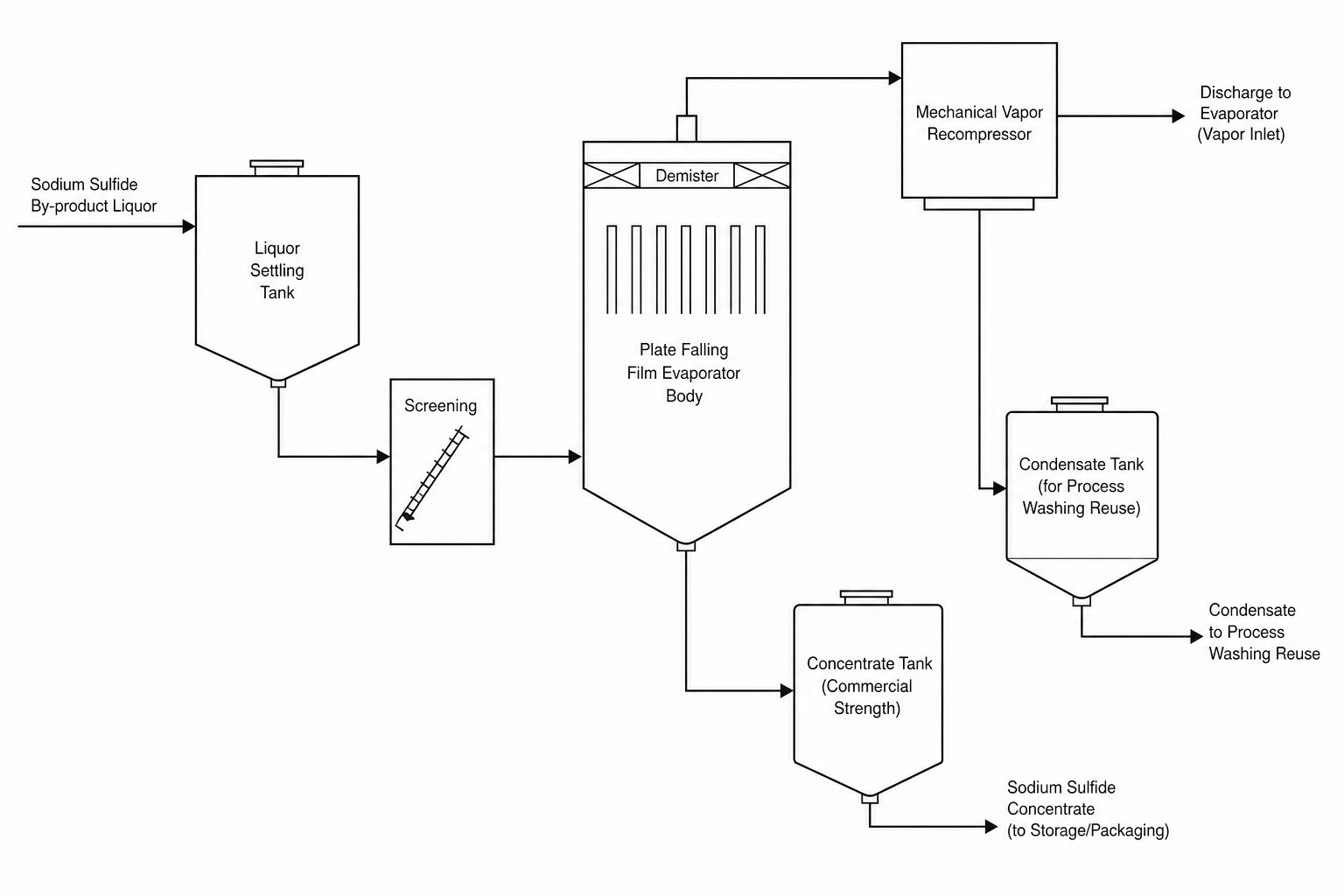
By-product liquor is settled and screened to remove barium-bearing solids and carbon fines, then held in covered equalization tanks — sulfide liquor releases hydrogen sulfide if disturbed by acid carryover, so pH is monitored and controlled ahead of evaporation. The liquor is preheated against condensate and fed to the plate falling-film bodies.
Plate falling-film heat transfer suits this duty on three counts. First, the corrugated plate channels sustain high coefficients with the moderate viscosity typical of sulfide liquor through most of the concentration range. Second, the compact plate pack holds a small liquid inventory, limiting both residence time and the volume of sulfide liquor resident at temperature — relevant to limiting oxidation of sulfide to thiosulfate, which consumes product value. Third, plates are opened and cleaned quickly, and sulfide service with its scaling and fouling profile makes cleanability a first-order economic variable rather than a maintenance detail.
The train runs under MVR: vapor boiled off in the separators is demisted, compressed electrically, and returned to the plate pack as the heating medium. Concentration proceeds under vacuum at moderate temperature, with density control taking the liquor to the commercial strength of liquid sodium sulfide required by the offtake — or to the feed specification of the flaking route where solid product is made. Condensate, stripped of sulfide traces by the demister train, is collected; after a polish check it returns to the barium process as washing water.
Equipment Configuration
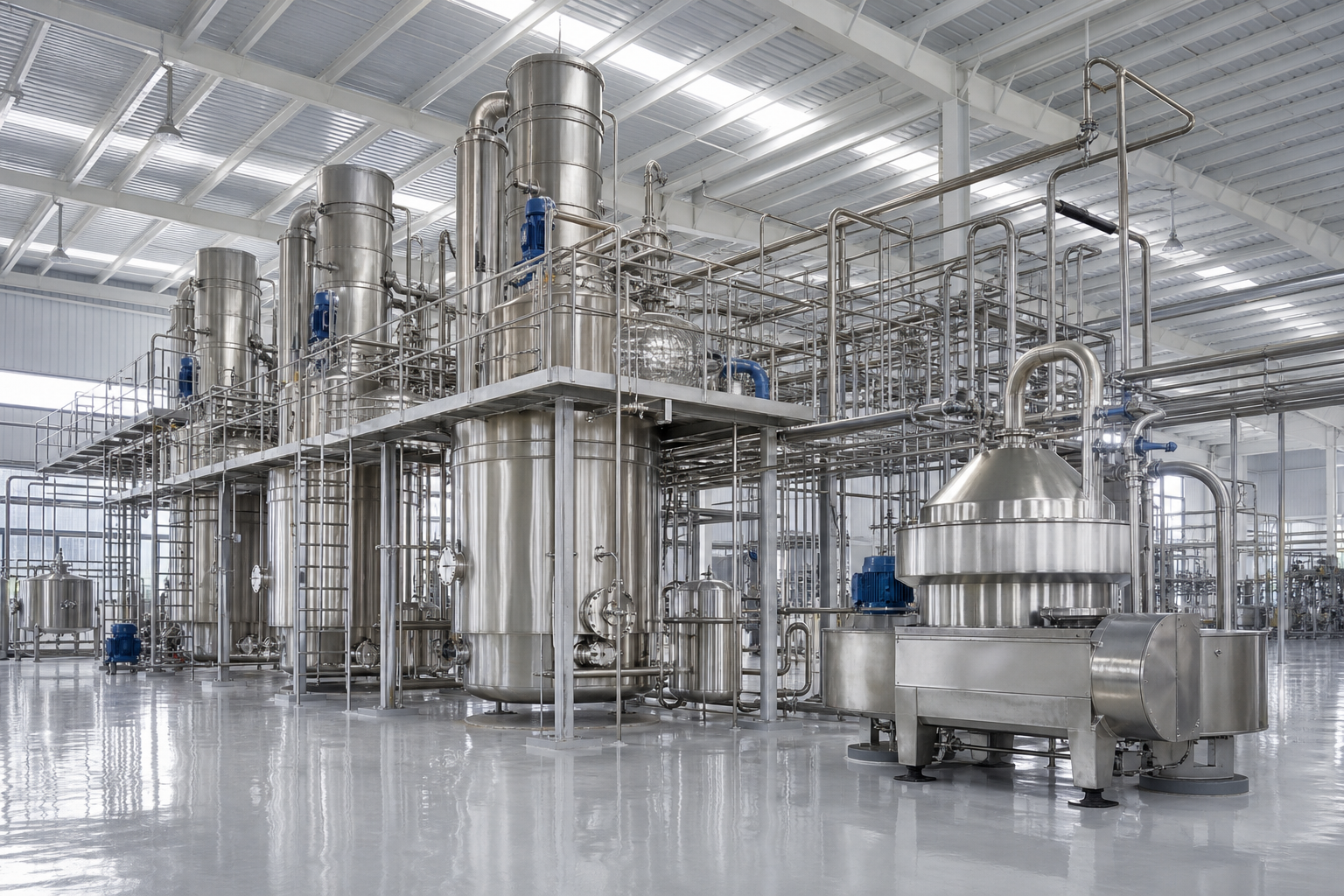
One train of this class comprises:
- Covered settling and screening of by-product liquor with pH monitoring ahead of the train
- MVR plate falling-film bodies with demisters and cleanable plate packs
- Mechanical vapor recompressor with variable-frequency drive and anti-surge control
- Concentrate forwarding at commercial strength, with flaking interface where solid product is made
- Condensate tank with sulfide polish check and routing to process washing
- Density- and temperature-based automatic control with CIP sequences
SS316L is the indicative minimum for sulfide liquor; wetted parts are upgraded where sulfide concentration and temperature combine aggressively.
Performance & Outcome
Compiled from published industry project data, indicative: MVR trains of this class upgrade by-product sodium sulfide liquor at capacities around 30 t/h water removal to sale-strength product on electrical energy, with condensate returned to the process. Product strength, specific power and payback depend on feed strength and offtake pricing and are quoted per project.
A parallel deployment on a related wastewater stream is documented in High Salinity Wastewater ZLD & Salt Crystallization.


