Project Parameters
| Parameter | Value |
|---|---|
| Process route | Triple-effect, four-stage forced-circulation evaporation; complete line including preheating, aroma recovery and aseptic filling interface |
| Industry | Food processing — tomato paste production |
| Feed type & key components | Fresh tomato juice (break and pulped); heat-sensitive solids, acids and volatile aromatics |
| Capacity | 6,750 t/d raw tomato processing (4 × 1,500 t/d + 1 × 750 t/d lines) |
| Construction materials | SS304 / SS316L food-grade wetted parts |
Representative process configuration compiled from published industry project data. Indicative values, not a process guarantee.
Project Description
Xinjiang’s river valleys grow the tomato that fills a material share of world tomato paste trade, and the harvest is a 60-day sprint: lines run around the clock at full rate, then stop until next season. The reference configuration is a complete evaporation plant for this industry — four 1,500 t/d lines and one 750 t/d line, 6,750 t/d of fresh tomato processing in total — engineered for seasonal campaign intensity, product quality and the water economics of a region where every cubic meter counts.
Tomato paste evaporation is a heat-sensitivity problem at industrial scale. The product darkens and cooks if held hot; the solids climb from roughly 5° Brix in juice to 28–30° Brix (and higher for cold-break paste destined for reprocessing); and the volatile aromatics that carry fresh tomato character boil off early unless recovered deliberately. Comparable published configurations run the same duty at the same 6,750 t/d aggregate scale in the same region, confirming this as the segment’s standard plant size.
Process Technology
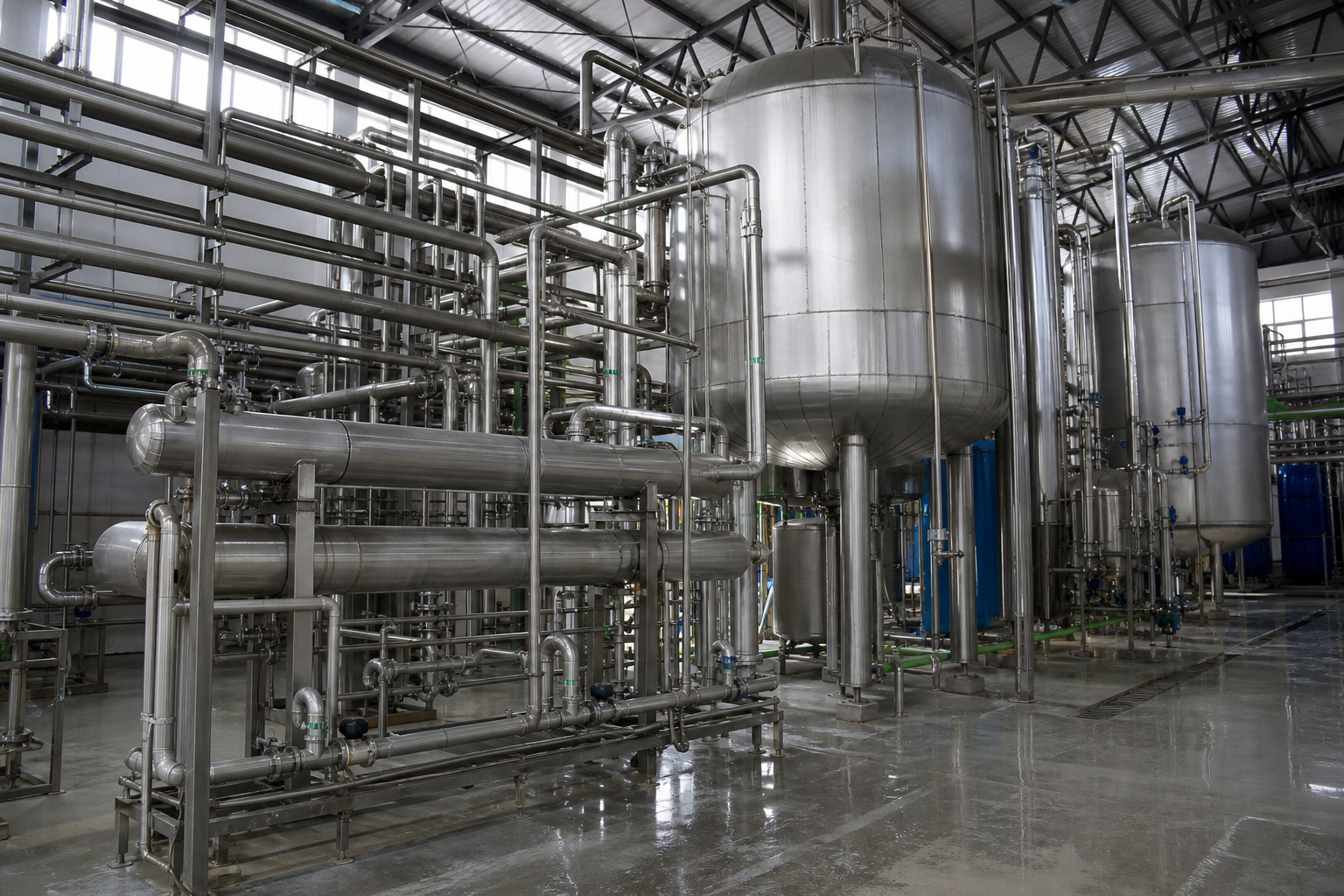
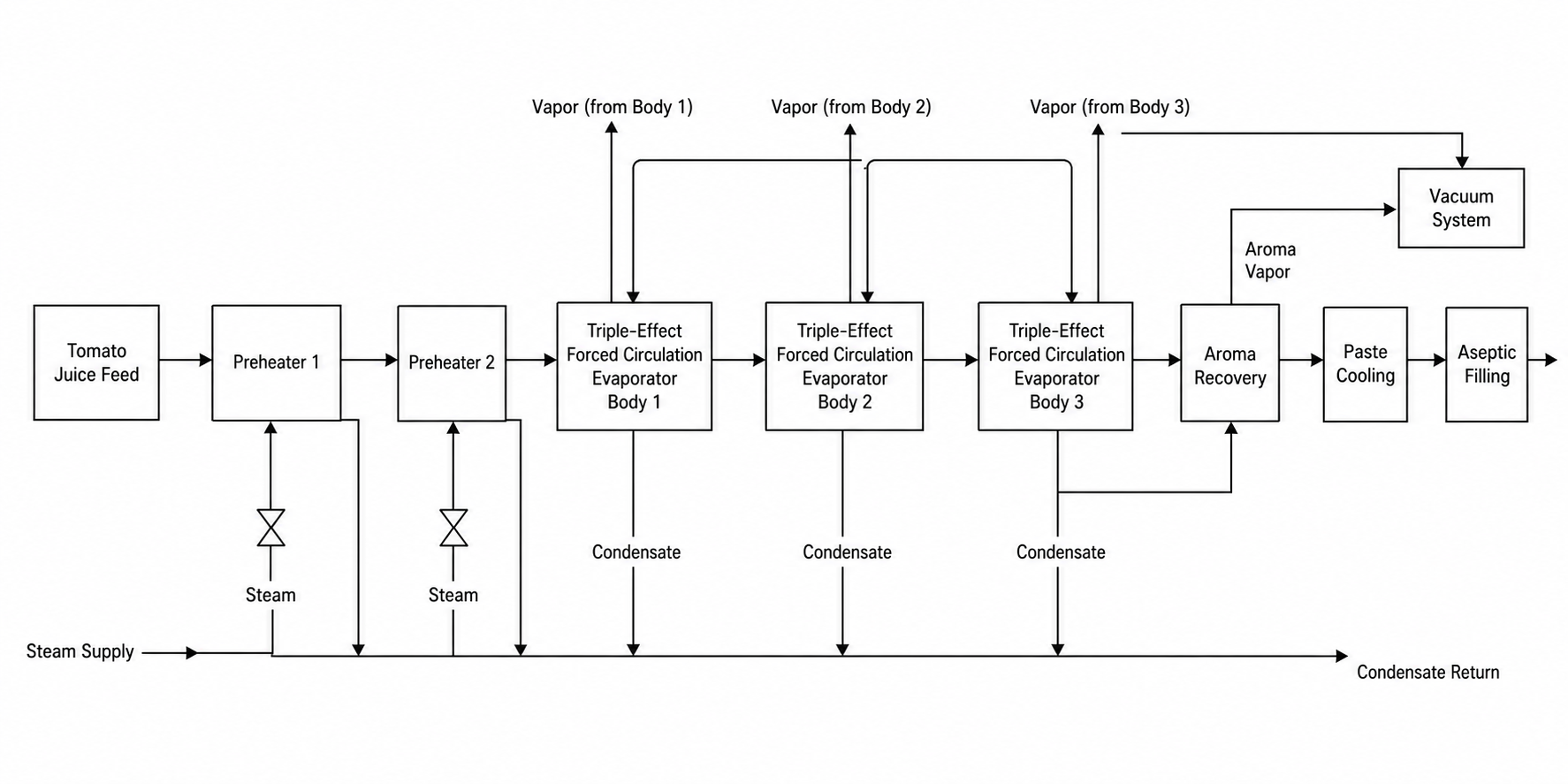
Tomatoes are washed, broken (hot-break or cold-break per product spec), pulped and sieved into juice. The juice is preheated — hot-break service holds it at break temperature for enzyme inactivation — and enters the evaporation line.
The line runs triple-effect, four-stage concentration. Three effects supply the steam economy: live steam drives the first effect, and each subsequent effect boils at lower temperature and pressure on its predecessor’s vapor. The four-stage arrangement distributes concentration across bodies so that each stage works within a narrow solids band — the design response to viscosity, which climbs steeply as paste approaches final Brix; the finishing stage runs in forced-circulation service to move the thickening product and hold heat transfer at high solids.
Temperature discipline protects color: the effects operate under vacuum, boiling well below atmospheric temperature, and short residence bodies keep product contact brief. Aroma recovery is engineered at the first vapor draw — volatile aromatics are condensed in a dedicated fraction and returned to the final paste, restoring the fresh character that plain evaporation strips.
The finished paste at target Brix is cooled through regenerated heat exchange — against incoming juice, recovering energy in the same step — and routed to aseptic filling into bag-in-box and drums for export. Condensate from the effects is warm, clean water reused in the plant for washing and CIP; during campaign, the plant’s water balance is a daily operating metric.
Between campaigns, the plant drains and CIP-circulates every product line; the engineering acceptance test for a tomato line is readiness for the first hour of next season at full rate.
Equipment Configuration
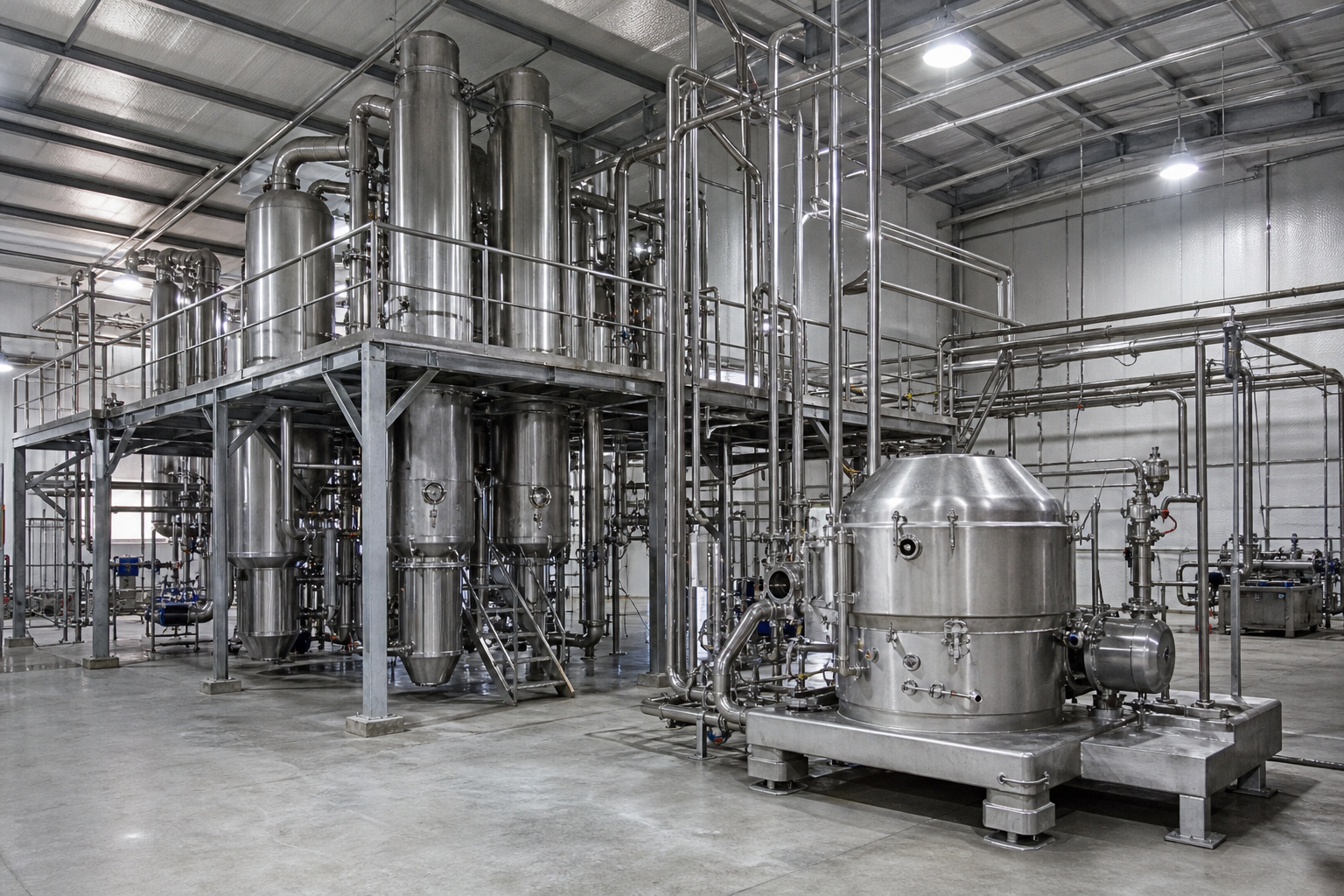
One set of the following equipment is typical per line (five lines for this plant):
- Feed balance tank, preheating and enzyme-control (break) interface
- Triple-effect, four-stage evaporation train with forced-circulation finishing stage
- Vacuum system and surface condenser; aroma recovery condenser with return to final paste
- Regenerative paste cooling against incoming juice
- Aseptic filling interface for bag-in-box and drum packing
- Food-grade SS304/316L; PLC control of Brix profile with CIP between campaigns
Performance & Outcome
Compiled from published industry project data, indicative: lines of this class concentrate tomato juice to 28–30°+ Brix paste on triple-effect steam economy with aroma recovery and color protection, at campaign rates of 750–1,500 t/d per line. Steam per ton and color retention are quoted per project product specification.
A parallel deployment on a related wastewater stream is documented in Food & Beverage Evaporation Solutions.