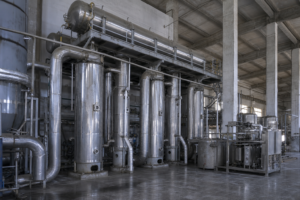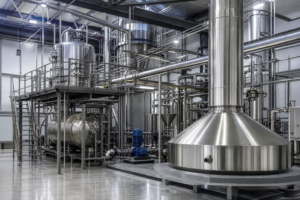
Lecithin production is a viscosity management problem wrapped around a food safety compliance problem. The solution chain runs from water degumming of crude vegetable oil through centrifugal separation of the gum, then concentration and thin-film vacuum drying — and the equipment that succeeds is the equipment engineered for a fluid that becomes dramatically more viscous with every percent of water removed. Commercial lines today – per supplier-published capacity ranges, indicative and not a project guarantee – cover capacities from 3 to 150 tons per day and four product grades (feed, food, transparent and powder), each with its own downstream purification route: acetone extraction for powder, hexane extraction for transparent grades.
Where Lecithin Comes From and Why the Drying Step Is Hard
Lecithin is the phospholipid-rich gum separated during degumming of crude soybean, rapeseed or sunflower oil. Water is added to the crude oil to hydrate the phospholipids, the hydrated gums are separated in a centrifuge, and these gums — typically wet, sticky and 35–50% oil plus water — are the raw material for everything downstream. Feed-grade lecithin is essentially these gums dried; food-grade production starts from filtered crude oil for higher purity before degumming.
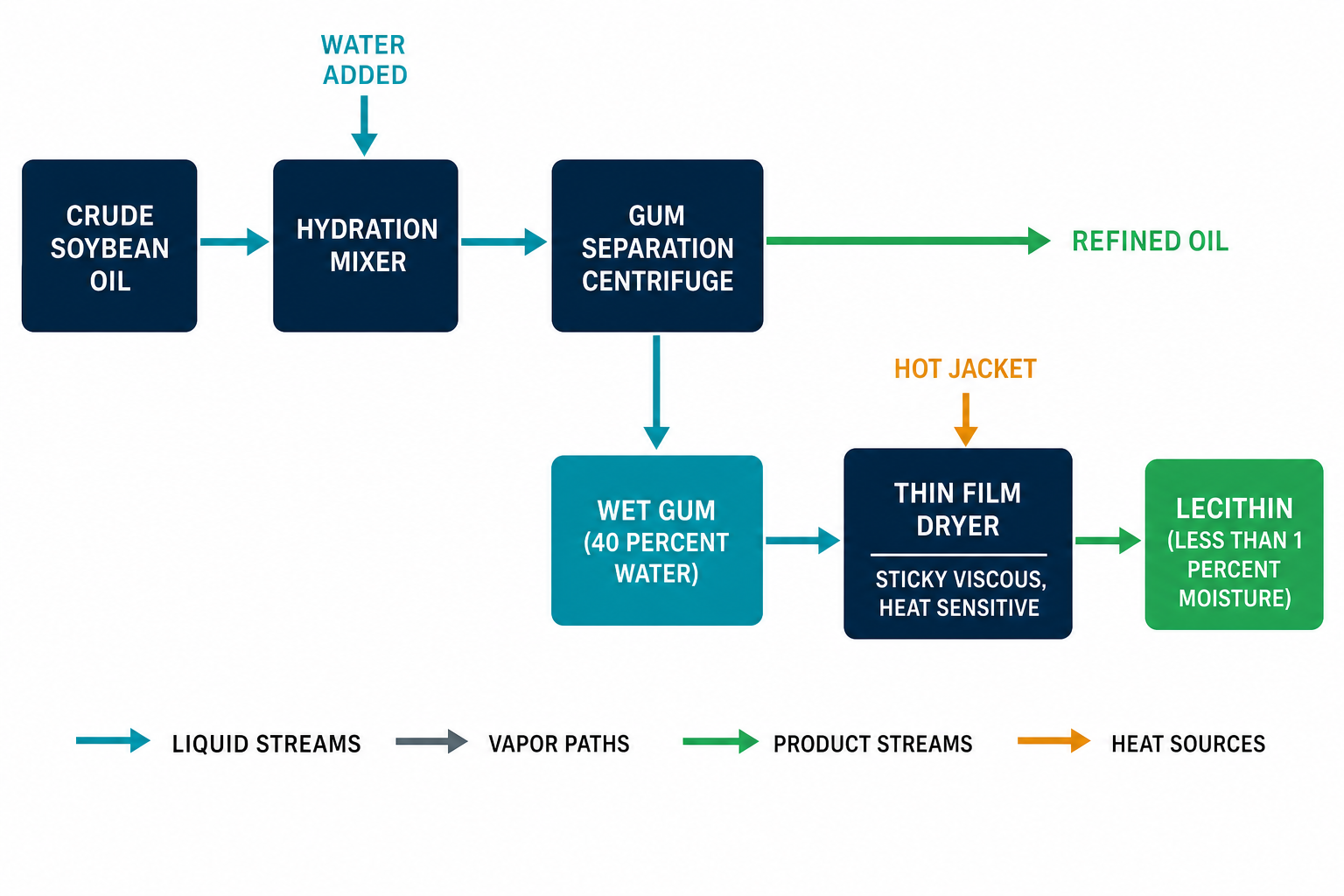
The difficulty concentrates in the dryer. As water is removed under vacuum, lecithin viscosity climbs steeply — the material moves like heavy paste, wets poorly on heated surfaces, and any stagnation zone darkens the product and degrades acid value. This is why horizontal thin-film (scraped-surface) dryers dominate the application rather than falling-film or natural-circulation designs: mechanical scrapers continuously renew the evaporation interface and prevent the baked-on film that would otherwise limit run time and color quality.
Four Product Grades, Four Process Routes
The market splits lecithin into four grades, and each defines a distinct process train beyond the common degumming front end. Understanding this split is the fastest way to scope a plant correctly, because the equipment scope — and the capacity class — differ between them.
| Grade | Typical Line Capacity | Route After Degumming | Primary Applications |
|---|---|---|---|
| Feed grade | 3–150 t/d | Water degumming of crude oil → gum separation → drying | Animal feed emulsifier, digestibility enhancer |
| Food grade | 3–150 t/d | Filtered crude oil → degumming → centrifugation and filtration purification → drying | Bakery, chocolate, margarine, dressings, infant formula |
| Transparent lecithin | 5–50 t/d | Hexane extraction removes hexane-insoluble impurities → thin-film evaporation | Beverages, clear emulsions where appearance is critical |
| Powder lecithin | 5–50 t/d | Acetone extraction removes triglycerides → desolventizing → fluidized bed or hot-air drying | Dry mixes, supplements, high acetone-insoluble powders |
The pattern is clear: each additional purification step increases product purity, functionality and price. Liquid lecithin is simply dried gums; powder lecithin undergoes acetone extraction to strip triglycerides and isolate the phospholipids; transparent lecithin uses hexane extraction to remove insoluble impurities for clarity and stability. Plants planning multi-grade flexibility should note that solvent handling — recovery, residuals control, explosion protection — adds more engineering scope than the drying step itself.
Food Safety Specifications That Drive Equipment Design
Food-grade lecithin is specified against national and international frameworks — China’s GB 1886.358-2022, plus FDA and EFSA alignment for export markets — and two parameters dominate the evaporator design brief: acetone-insoluble matter at or above 60%, and acid value at or below 36 mg KOH/g. Beyond the specs themselves, the process target that validates dryer design is drying loss (residual moisture/volatiles) at or below 1.0% — a figure that must be achieved consistently, batch after batch, in a high-vacuum, high-viscosity environment.
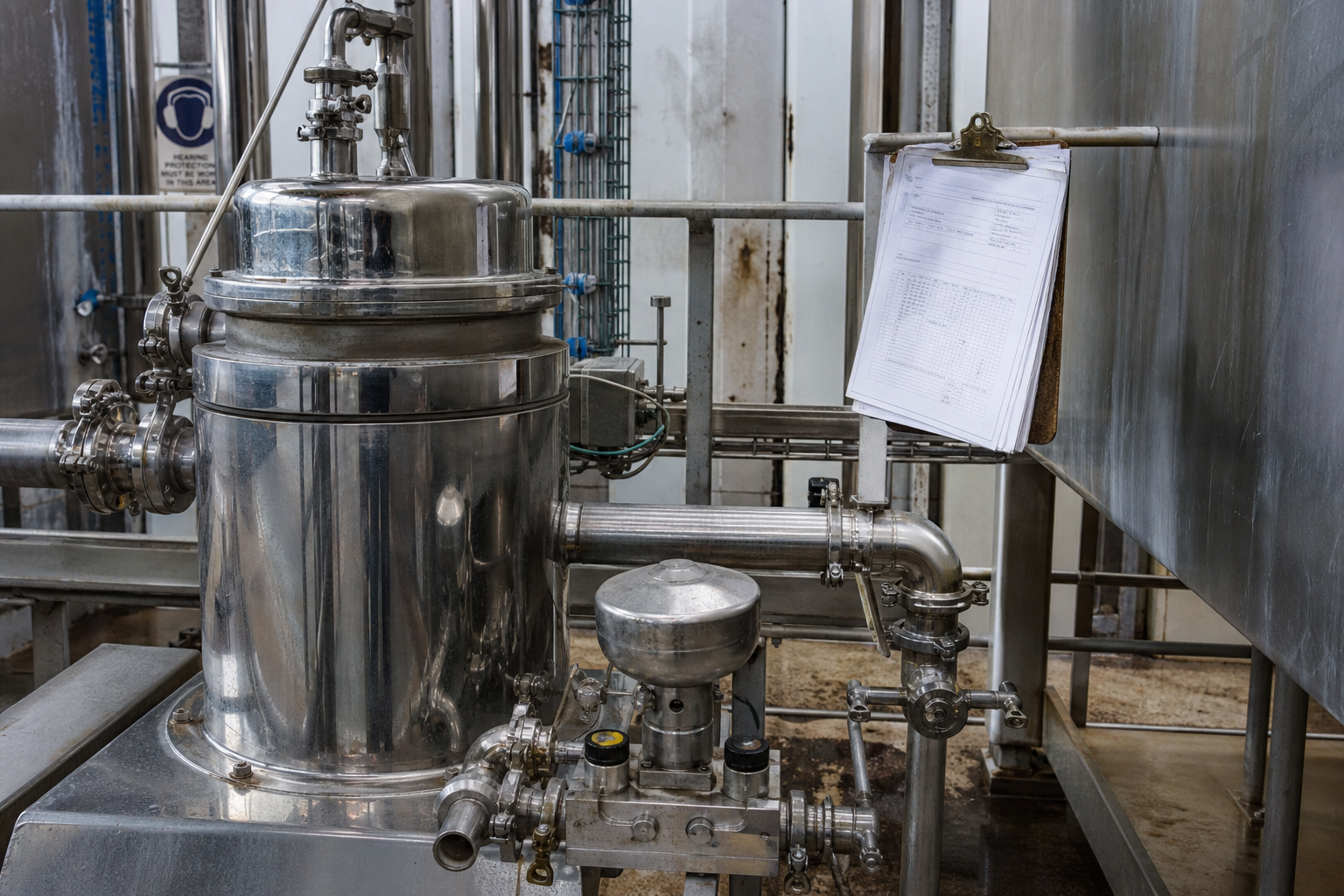
Meeting these numbers repeatably is an equipment engineering exercise, and the features that matter on a lecithin thin-film dryer are specific:
- Mirror-polished stainless steel wetted surfaces to minimize flow resistance for viscous material and prevent product hold-up that darkens color.
- Mechanically forced film formation — six-scraper rotor designs with precisely cut blade ends maintaining uniform scraper-to-cylinder gaps — so the evaporation interface is continuously renewed at consistent speed for maximum water removal.
- Integrated vapor–liquid and foam separation using rotor centrifugal force to knock down liquid foam entrained in the secondary vapor, protecting the vacuum system downstream.
- High-precision bearing systems and customized mechanical seals sized for stable long-term operation under high vacuum, where seal failure is the classic cause of unplanned downtime.
For solvent-based grades, desolventizing is engineered together with solvent recovery: controlled temperature and vacuum remove residual hexane or acetone to compliant levels while the recovered solvent returns to the extraction loop. The drying and solvent-recovery systems should always be specified as one integrated package, not as separate equipment purchases.
Market Demand Context
The commercial backdrop explains sustained investment in lecithin capacity. Per published market-research estimates, the global lecithin market was valued around USD 2.3 billion in 2024 and is forecast to grow at roughly 4.3% CAGR to about USD 3.6 billion by 2032, driven by clean-label emulsifier demand in processed food. Within that, food-grade lecithin was projected to reach about USD 1.02 billion by 2024 growing near 6.15% annually through 2029, while feed-grade lecithin was valued near USD 175 million in 2023 with projections around USD 250 million by 2030. Application growth is strongest where lecithin’s wetting and dispersing functionality is newly critical — plant-based dairy alternatives, instant beverages, and functional meat products.
Regional demand also shapes equipment specification. Chocolate and confectionery producers in humid tropical markets push hard on moisture and packaging specs; infant formula producers in the EU and North America push hardest on purity and documentation. A production line built to the strictest of these — mirror finishes, validated CIP, full traceability — serves all of them without rework.
Selecting the Concentration and Drying Train
For gum conditioning ahead of the dryer, gentle pre-concentration in a falling-film evaporator can raise solids while viscosity is still manageable, but the final drying to ≤1.0% drying loss belongs in a scraped-surface thin-film evaporator — effectively the same machine family described on the solvent recovery and distillation technology page when acetone or hexane streams are in scope. Vacuum systems deserve explicit sizing attention: lecithin dryers operate under deep vacuum with foam-laden vapor, so the separator design and condenser train determine whether the vacuum pump survives the first month.
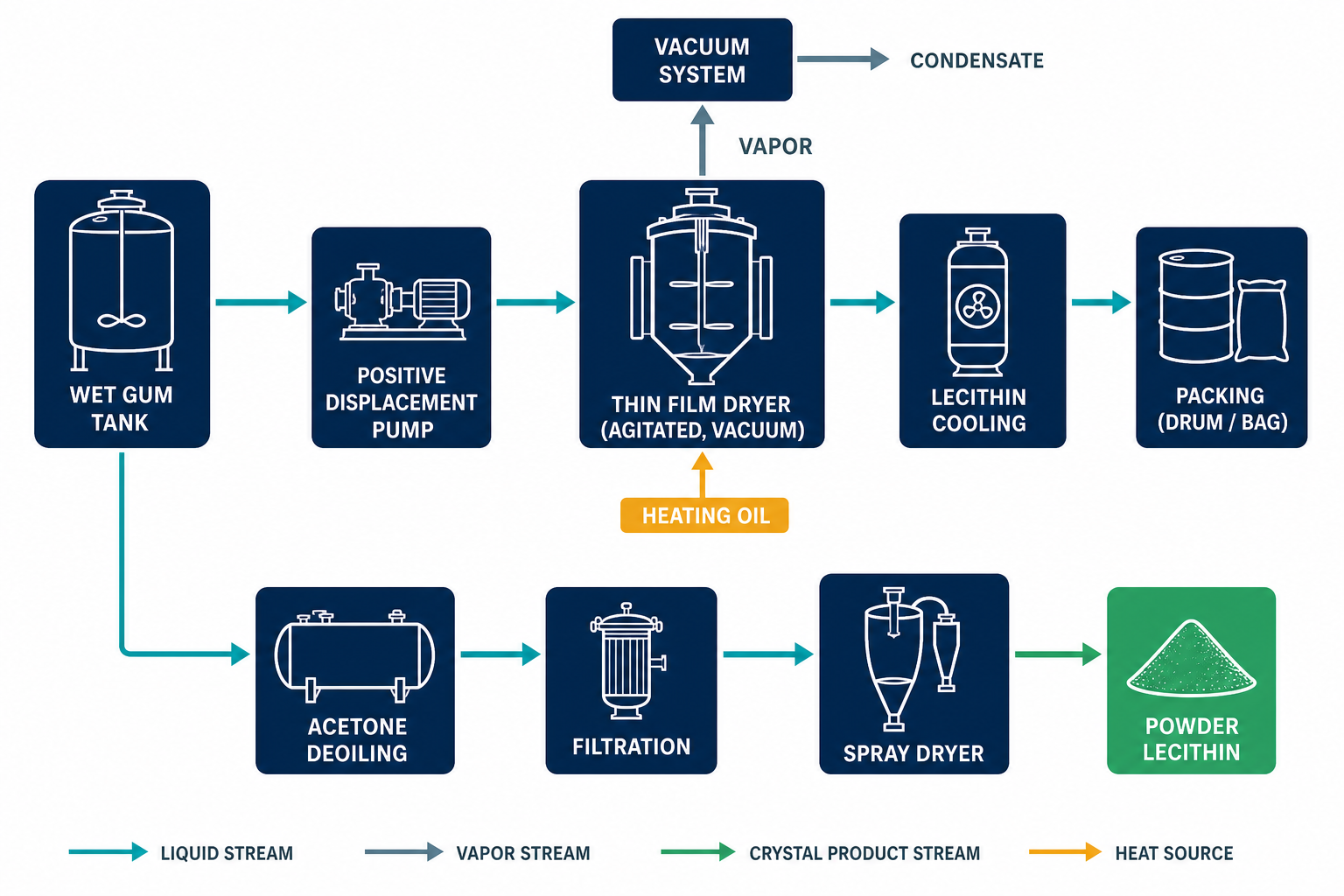
Capacity decisions should follow grade mix. A 3–150 t/d feed- or food-grade train is a different engineering class from a 5–50 t/d transparent or powder line — the latter carries solvent recovery, explosion-proof electrical classification and stricter residual limits. Plants already operating oilseed crushing can usually integrate lecithin recovery into the existing degumming section with modest modification; greenfield multi-grade plants should size the degumming and centrifuge front end for the largest planned grade and add solvent islands in phases.
Assembled for a chosen grade mix, the line decomposes into standard process modules:
| Process module | Equipment candidates | Selection basis | Indicative envelope |
|---|---|---|---|
| Degumming & separation | Water hydration; gum centrifuge | Gum quality sets all downstream grades | Per crude-oil rate |
| Pre-concentration | Falling-film evaporator | Gentle solids raise while viscosity is manageable | Per gum survey |
| Final drying | Scraped-surface thin-film vacuum dryer | Viscosity ceiling; color and acid-value protection | Drying loss ≤1.0% target |
| Solvent extraction & desolventizing | Acetone or hexane extraction; desolventizer | Powder and transparent grades only | Per residual-solvent limit |
| Solvent recovery | Distillation loop with explosion-proof classification | Solvent losses run into cash cost | Per solvent selected |
Configuration, materials, and operating ranges for each module depend on the actual feed, temperature, pressure, corrosion review, fouling behavior, utilities, and project capacity.
What End Applications Demand From the Production Line
Application requirements translate directly into process parameters, which is why grade strategy and equipment specification cannot be separated. In margarine production, lecithin stabilizes oil-water emulsions and reduces splattering during frying — a surface-activity function that depends on phospholipid integrity preserved through gentle thermal treatment. In chocolate manufacturing, lecithin controls crystallization behavior and viscosity, prevents sticking and extends shelf life, a requirement that peaks in humid tropical markets where moisture control through the dryer and packaging line is decisive. In infant formula, lecithin supports neural development during early growth and is governed by the strictest nutritional regulations in the EU and North America — full traceability and validated cleaning regimes are entry conditions, not differentiators.
The fastest-growing demand pockets are functional: instant beverages and plant-based dairy alternatives in Asia-Pacific and Latin America lean on lecithin’s wetting and dispersing functionality, while functional meat products use it to prevent fat leakage and improve dispersion in baked goods. What all of these share is low tolerance for batch-to-batch inconsistency — emulsifier performance failures surface as customer-visible product defects downstream, not as laboratory numbers. This is the commercial argument for over-specifying the drying train: a dryer that holds drying loss consistently at or below 1.0% protects every downstream customer specification simultaneously.
Engineering Delivery: Control Systems and Site Adaptation
A lecithin line is only as repeatable as its control layer. Modern trains run under PLC/DCS-based automatic control with key parameters — vacuum level, material flow rate, drying temperature curve — converted into real-time production insight rather than operator judgment. For powder grades especially, the drying temperature curve is a customized variable: it is tuned to the target application’s texture and performance requirements, and scraper configuration is strengthened for high-viscosity materials. These are not catalogue options; they are the tailoring decisions that determine whether a line hits specification on commissioning or after months of trial.
Site conditions deserve equal attention in the design brief. Lecithin equipment ships globally — from extreme heat in Middle East locations to high-altitude sites in South America — and vacuum system sizing, motor derating and cooling water design all shift with ambient conditions. Delivery scope should be evaluated as a package: 3D process design covering piping and instrumentation, in-house manufacturing of the core scraper dryer, installation supervision, commissioning and operator training. Suppliers that manufacture the thin-film dryer in their own facility (rather than sub-contracting the heart of the process) carry the quality accountability for the one component where surface finish and scraper geometry decide product color and acid value.
Validation Focus
Because no public third-party case data is cited for this duty on this page, the route should be validated directly rather than by reference. Start with a bench drying study on the actual gum: a viscosity-versus-moisture curve on the client’s own material fixes the scraper dryer’s temperature and residence settings before any capital commitment. Follow with a pilot thin-film drying run measuring drying loss, color, and acid value across consecutive batches – the three parameters the market audits. For solvent grades, validate residual-solvent compliance against the target market’s framework on pilot-extracted material. For food-grade lines, run and document the CIP regime on the pilot assembly: cleaning validation is an entry condition in export audits.
When This Route May Not Fit
Very small gum arisings – a crushing plant whose degumming section produces under a ton per day – are better sold wet to a toll dryer than dried on site with food-grade capital. Plants whose crude-oil supply or quality swings widely cannot hold lecithin specifications at all; specification failure traces back to the oil, and no dryer fixes it. Sites without the safety infrastructure for hexane or acetone handling should not attempt powder or transparent grades – the solvent island, not the dryer, is the project. Where the target market is feed-grade only and moisture specs are loose, a simpler drying arrangement may meet the specification at lower cost.
What Must Be Verified
Before this route is committed, verify the inputs that size it. First, the crude-oil and gum characterization: phospholipid content, oil-plus-water fraction, and variability across suppliers, because the front end is sized to the worst gum, not the average. Second, the target grade slate and its governing specifications – acetone-insoluble content, acid value, drying loss, residual solvents – mapped to the actual destination market’s framework, GB, FDA, or EFSA. Third, the site realities: steam and cooling capacity for deep vacuum, ambient extremes that derate motors, and space for the solvent island if powder or transparent grades are in scope. Fourth, capacity utilization: the 3-150 t/d envelope only pays where the gum supply supports it.
FAQ
How is lecithin produced from crude vegetable oil?
Water is added to crude oil to hydrate phospholipids, the hydrated gums are separated by centrifuge during degumming, and these gums are then concentrated and dried. Feed-grade lecithin is the dried gums directly; food-grade starts from filtered crude oil for higher purity before the same degumming and drying route.
Why is thin-film evaporation used for transparent lecithin?
Thin-film evaporation spreads lecithin into a thin film over heated surfaces under vacuum, removing moisture efficiently while preserving quality. For transparent lecithin it follows hexane extraction — which removes hexane-insoluble impurities — and delivers the clarity and stability that beverages and clear emulsions require.
What capacity ranges are available for lecithin production lines?
Feed- and food-grade lecithin lines are built from 3 to 150 tons per day. Transparent and powder lecithin lines, which carry solvent extraction and desolventizing scope, typically run 5 to 50 tons per day.
What are the key quality parameters for food-grade lecithin?
The governing specifications are acetone-insoluble (phospholipid) content at or above 60% and acid value at or below 36 mg KOH/g, alongside drying loss at or below 1.0% controlled by the vacuum dryer. Compliance frameworks include GB 1886.358-2022 plus FDA and EFSA alignment for export markets.
What is the main technical challenge in lecithin drying?
Viscosity. Lecithin thickens steeply as water is removed, so the dryer must continuously renew the heated surface film — via scraper rotors with uniform blade-to-wall gaps — while suppressing foam in the vapor stream to protect the vacuum system. Stagnation anywhere in the wetted path degrades color and acid value.
To scope a lecithin line for a specific plant, share the crude-oil source and gum availability, the target grade slate, and the site utility analysis – enough for an initial process-direction assessment.