Project Parameters
| Parameter | Value |
|---|---|
| Process route | MVR falling-film evaporation, five parallel trains |
| Industry | Biomass refining — corncob-based xylitol / sugar chemistry |
| Feed type & key components | Xylitol solution from hydrogenation and purification; heat-sensitive polyol |
| Evaporation capacity | 161 t/h total: 2 × 50 t/h + 2 × 17 t/h + 1 × 26.7 t/h |
| Plant context | Integrated biomass refining complex, expansion phase |
| Region | East China (Shandong) |
Representative process configuration compiled from published industry project data. Indicative values, not a process guarantee.
Project Description
Corncob-based biomass refining is China’s distinctive sugar-chemistry industry: the hemicellulose in corncobs becomes xylose, and hydrogenated, xylose becomes xylitol — the sweetener, the polyol, the flagship product. The published project behind this configuration is the evaporation complex of such a refinery’s expansion phase in East China: five MVR falling-film trains totaling 161 t/h, sized as two 50 t/h workhorses, two 17 t/h duty trains and one 26.7 t/h specialist train.
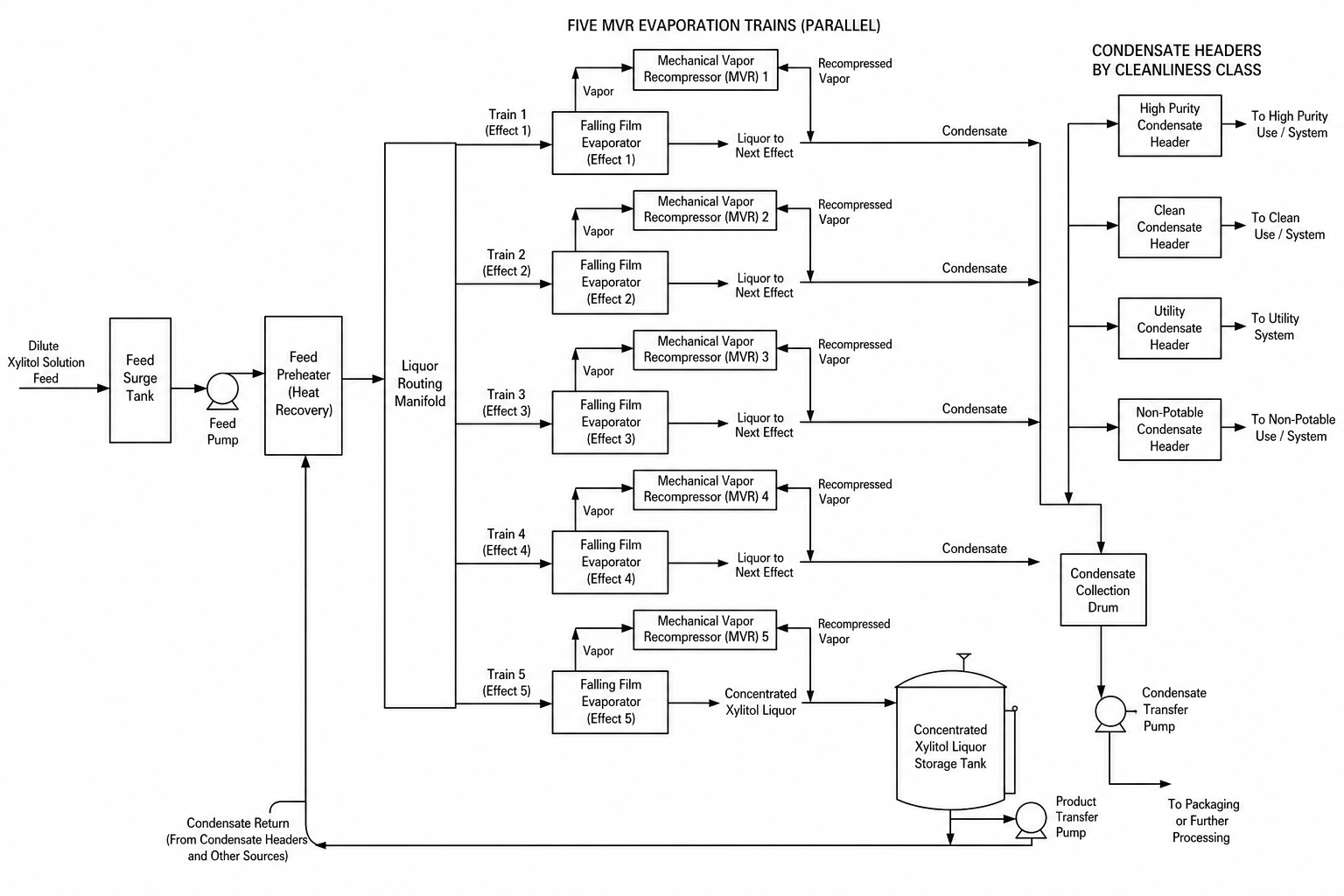
The five-train architecture is the interesting engineering. A single 161 t/h body would be a monolith — all-or-nothing availability, one fouling event idling the refinery’s sugar loop. The published split gives the complex operational granularity: trains wash on rotation, the refinery turns down by train instead of by line, and different liquors — crude xylose liquors versus refined xylitol solution — can be routed to the trains whose metallurgy and cleanliness class suit them. It is the same logic refineries apply to crude units, imported into sugar chemistry.
Process Technology
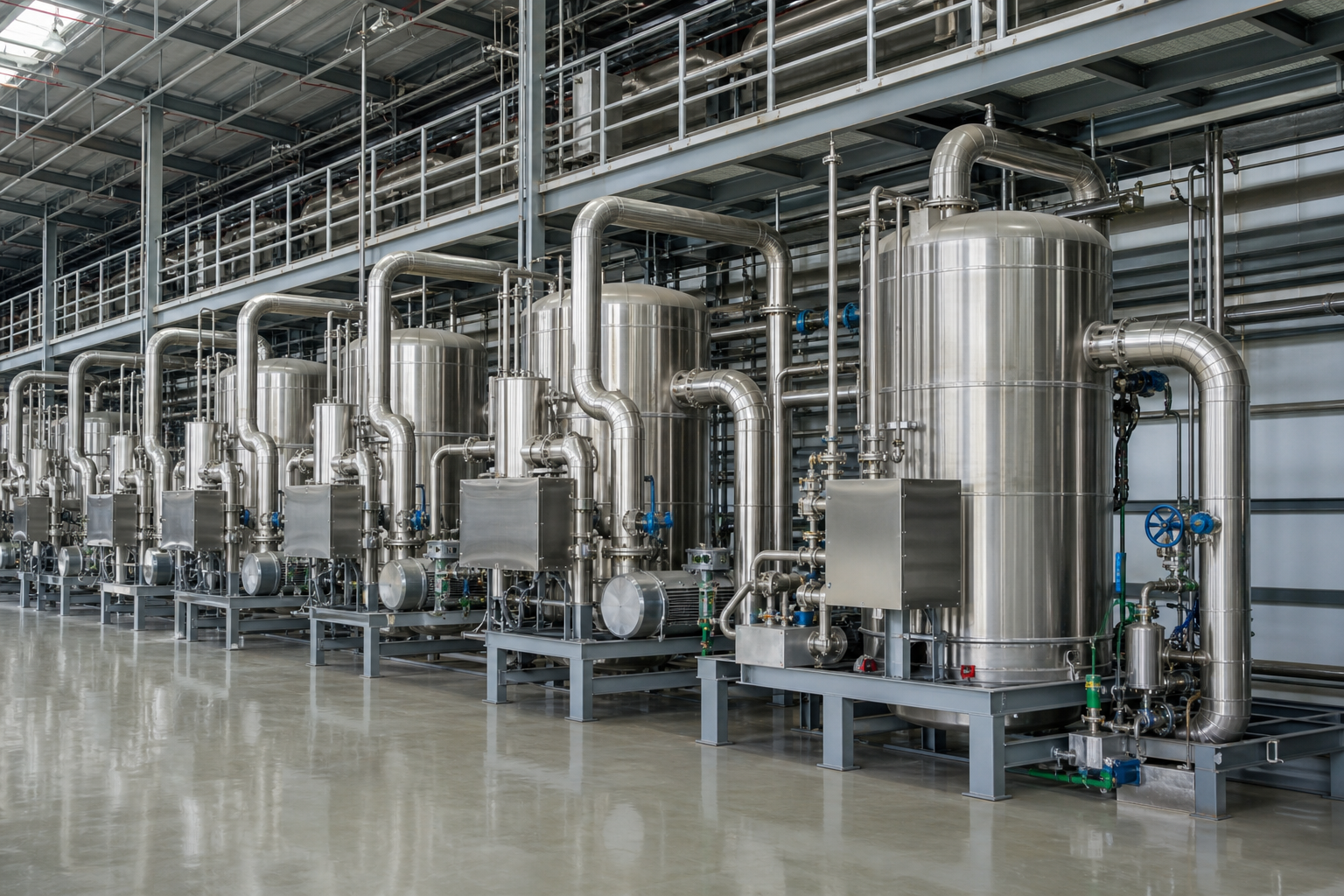
Xylitol solution is a gentle-feed duty with hard economics. Gentle, because polyols are stable but quality-conscious: food and pharma grades of xylitol punish color and degradation products, so the evaporation runs under vacuum at low temperature difference in falling-film geometry — seconds of hot-surface residence, generous liquid distribution, wide-body vapor separation. Hard economics, because 161 t/h of water removal is the complex’s single largest energy line item.
MVR answers the economics. Each train pairs its falling-film body with a mechanical vapor recompressor that lifts the separator vapor and returns it as heating steam: electric energy in, five-plus effects’ worth of steam economy out, no boiler capacity consumed by evaporation. In a biomass refinery — where the hydrogenation loop and utility boiler already compete for steam — moving evaporation off the steam balance onto the electric meter is capacity liberation for the core process.
The train sizes map to the refinery’s liquor spectrum. The 50 t/h trains carry the bulk concentration of the main xylitol liquor stream; the 17 t/h trains handle smaller, possibly dirtier or more viscous streams — mother liquors, mid-purity cuts — where smaller bodies keep velocities and washing cycles manageable; the 26.7 t/h train fills the duty profile with its own dedicated service. The published configuration describes them as one coordinated evaporation block serving the expansion’s full liquor slate.
Condensate recovers by cleanliness class across all five trains — the clean front condensates return to the refinery’s pulp washing and process water; tail condensates with volatile organics segregate to treatment. Between campaigns the trains clean in place on rotation, the five-train architecture making CIP invisible to the refinery’s throughput.
Equipment Configuration
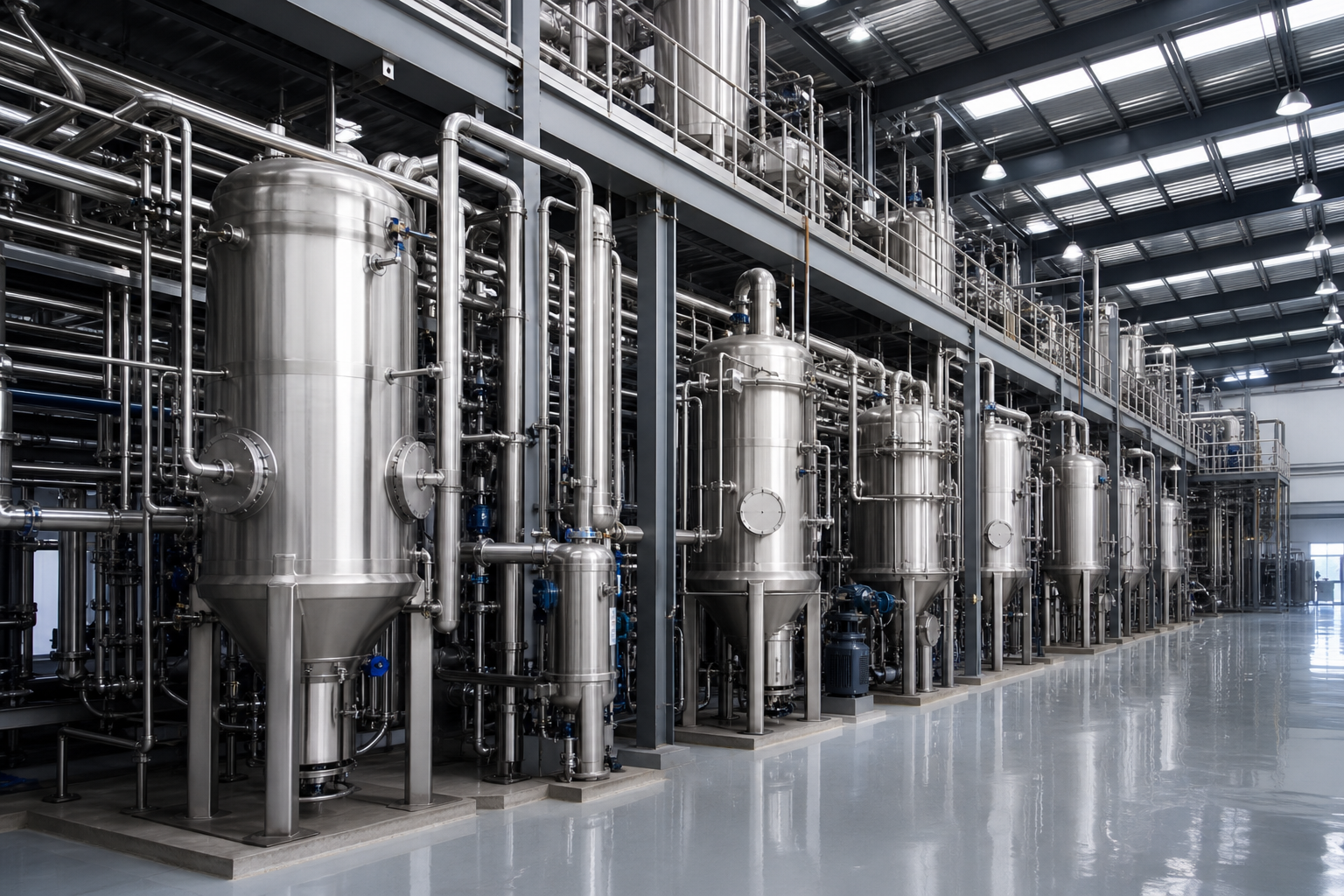
One set of the following equipment is typical for this duty:
- Liquor routing manifold across five evaporation trains
- 2 × 50 t/h MVR falling-film evaporator trains
- 2 × 17 t/h MVR falling-film evaporator trains
- 1 × 26.7 t/h MVR falling-film evaporator train
- Mechanical vapor recompressors with condensate and vacuum systems per train
- Segregated condensate headers by cleanliness class
- Coordinated PLC/DCS control with train-rotation CIP
Performance & Outcome
Compiled from published industry project data, indicative: five-train MVR complexes of this class evaporate 161 t/h of xylitol and associated liquors on electric energy, holding vacuum falling-film conditions that protect polyol quality while freeing the site steam balance. Per-train economies and availability figures are quoted per project liquor slate.
Simplified PFD
The simplified process flow diagram above shows the liquor manifold, the five MVR falling-film trains with their recompressors, and condensate recovery by class.