Project Parameters
| Parameter | Value |
|---|---|
| Process route | MVR evaporation crystallization + freeze (cooling) crystallization + drying |
| Industry | Municipal/industrial wastewater plant salt-separation backend (China) |
| Feed type & key components | Sodium sulfate concentrate from an upstream salt-separation process; design feed 32 m³/h; acceptance anchors are product salt grade, condensate quality and system energy |
| Salt output | ≥ 3.58 t/h at 98% purity |
| Product standard | T/CCT 001-2019 coal-chemical by-product sodium sulfate, Grade A first-class |
| Condensate | Meets the plant’s reuse water quality requirements; off-gas meets discharge standards |
| Construction materials | SS316L wetted parts (indicative for sulfate service) |
Representative process configuration compiled from published industry project data. Indicative values, not a process guarantee.
Project Description
Zero liquid discharge programs live or die on their backend: membranes and softening can concentrate and split salts all day, but somewhere a crystallizer must turn the final sulfate concentrate into a solid the plant can sell rather than landfill. The reference configuration is that backend — a 32 m³/h sodium sulfate crystallization train at a Chinese wastewater plant, sized to take the sodium sulfate leg of an upstream salt-separation system and discharge ≥ 3.58 t/h of by-product salt at 98% purity.
The specification is the story: the salt must meet T/CCT 001-2019, the coal-chemical by-product sodium sulfate standard, at Grade A first-class — the grade that buyers of by-product sodium sulfate actually quote against. A first-class salt certificate converts the ZLD backend from a cost center into a revenue line, and every design decision downstream of the feed flange is subordinated to holding that grade continuously rather than episodically.
Process Technology
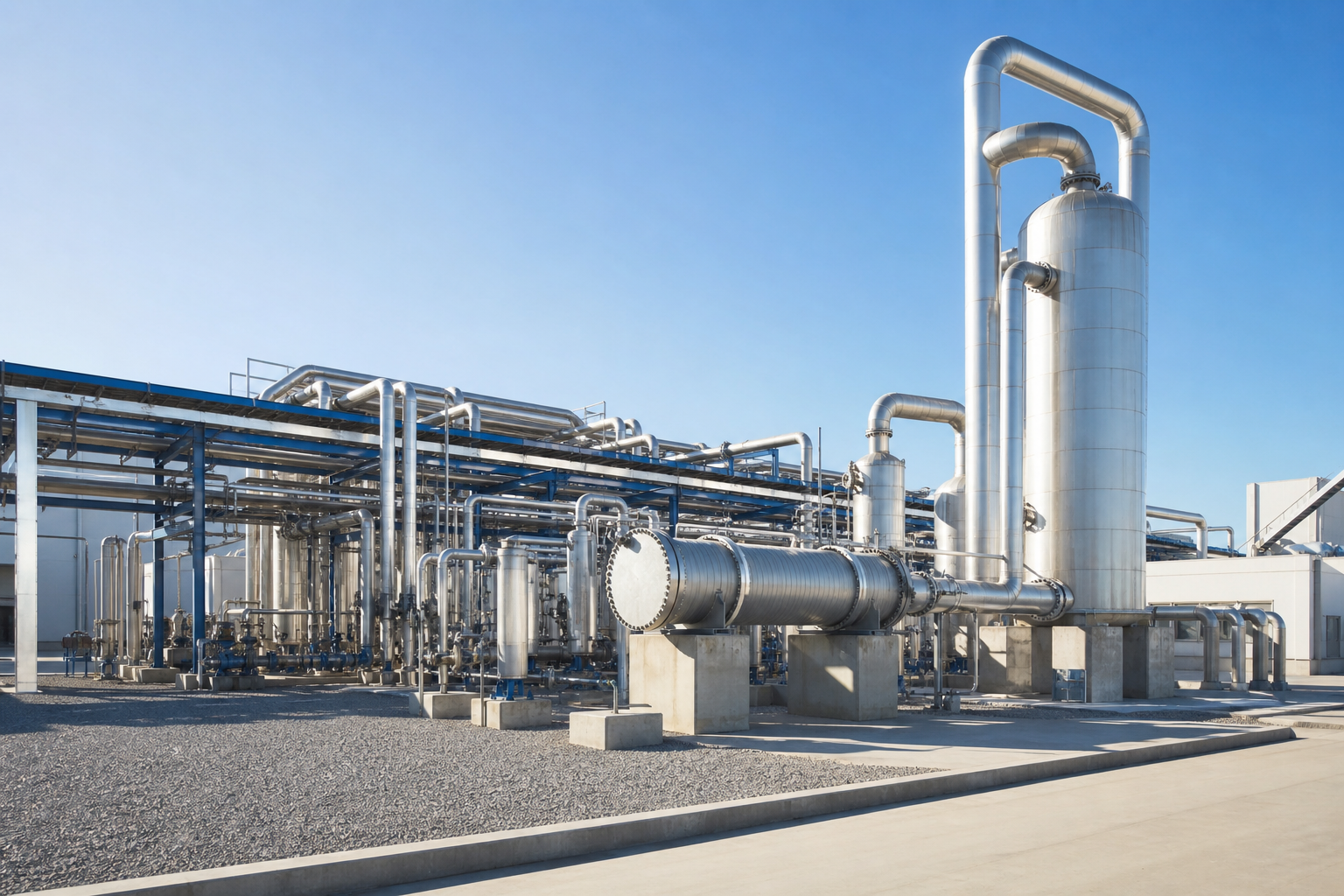
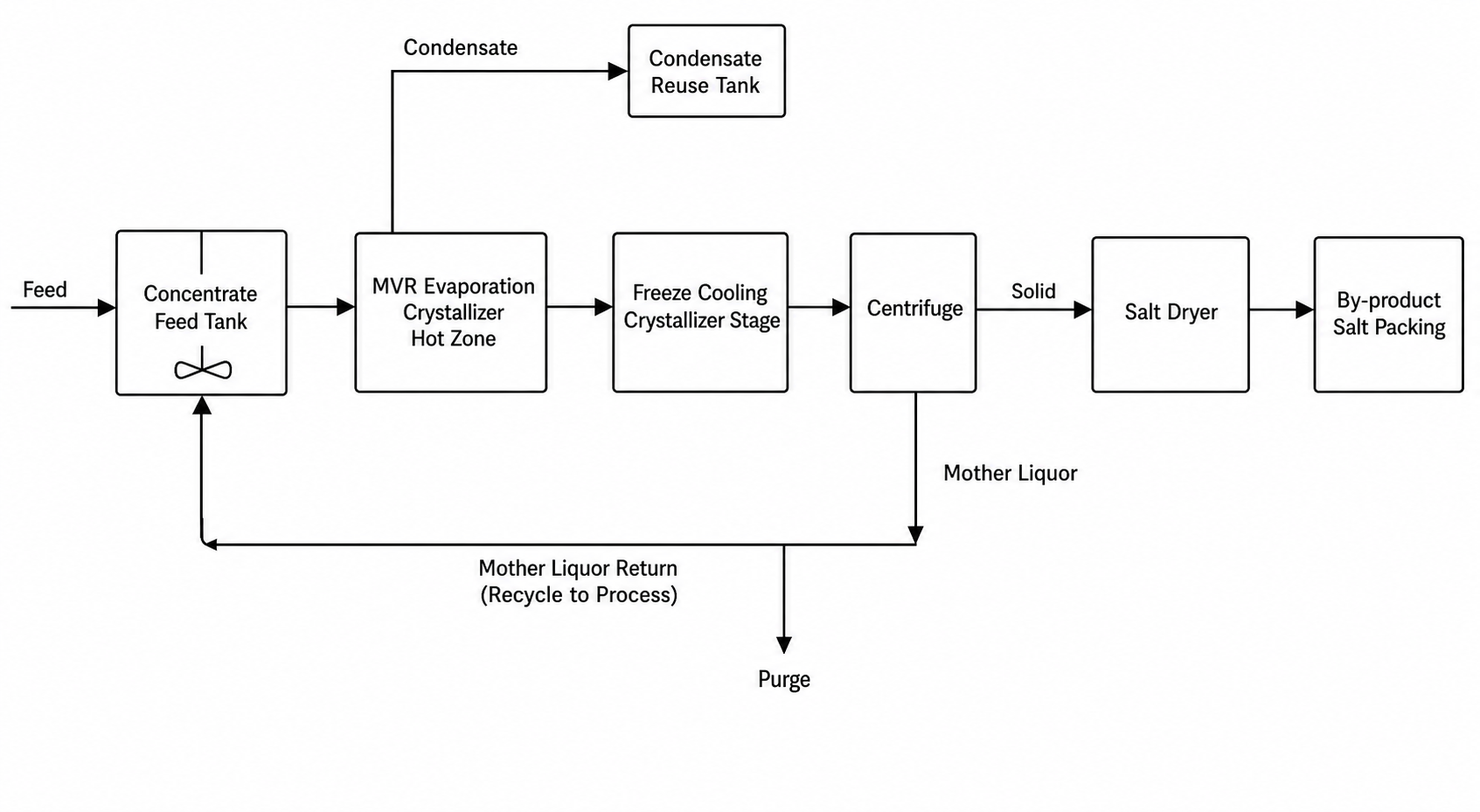
The concentrate feeds the MVR evaporation crystallizer, where mechanical vapor recompression drives the boiling on electricity. Sodium sulfate’s chemistry rewards a two-temperature harvest: in the hot zone the liquor concentrates and crystallizes, while a substantial share of the yield waits in the cooling curve — sodium sulfate solubility falls steeply as temperature drops, so a freeze (cooling) crystallization stage extracts crystal from the mother liquor without spending another kilojoule of evaporation. The MVR stage sizes for concentration; the freeze stage harvests the rest.
Crystal slurry from both stages centrifuges to low free moisture and passes to drying, packing as first-class by-product salt. Mother liquor recycles between the two crystallization temperatures with a purge that keeps trace impurities from climbing toward the salt face; condensate from the vapor system returns at reuse water quality — audited against the plant’s requirements rather than assumed — and the off-gas stream holds within discharge standards. The performance contract for a train like this is written on three lines: salt grade, condensate quality, system energy per tonne; this configuration answers all three.
Equipment Configuration
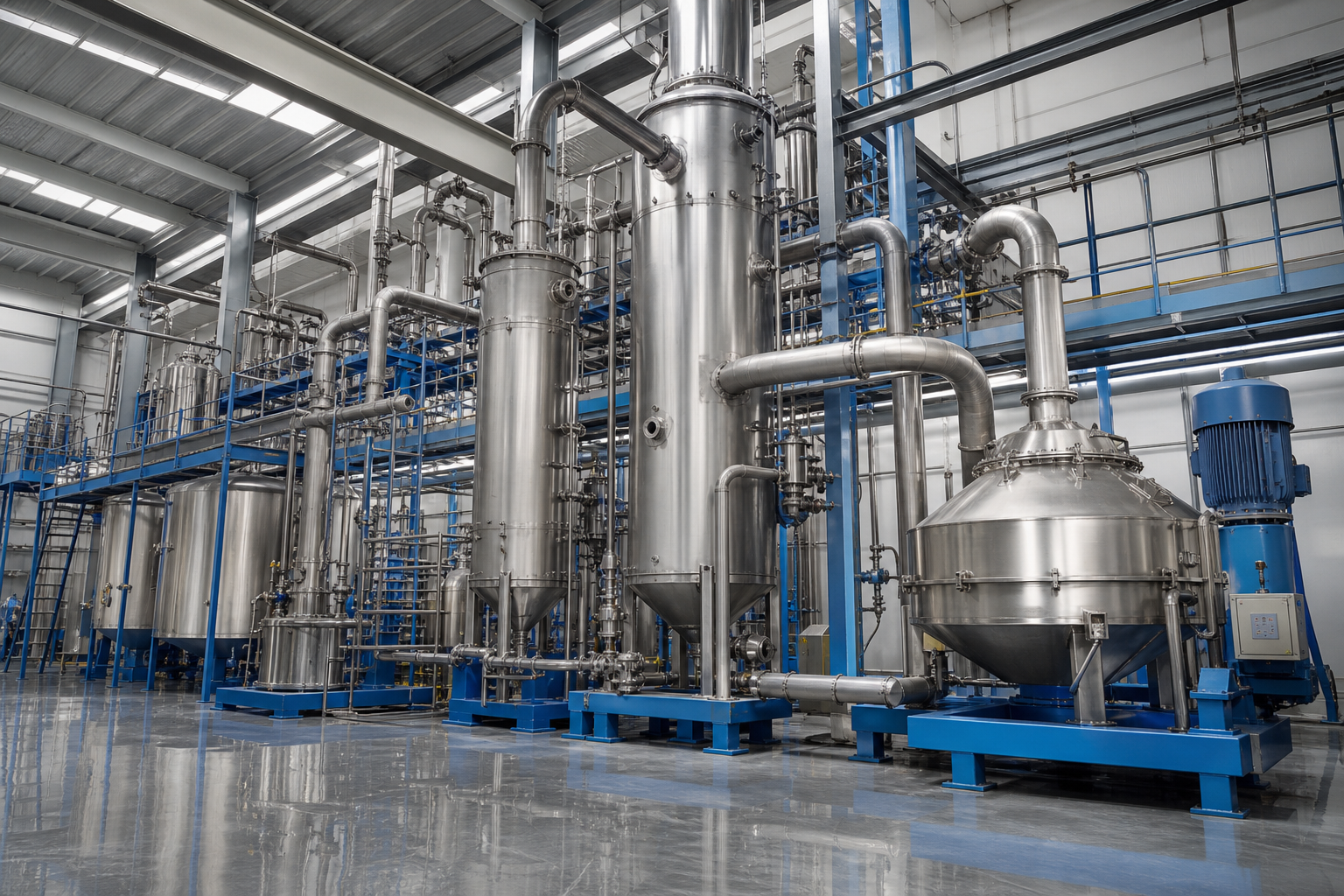
One set of the following equipment is typical for this duty:
- Concentrate feed tank and filtration
- MVR evaporation crystallizer with centrifugal vapor recompressor (hot zone)
- Freeze / cooling crystallization stage for sulfate yield harvest
- Centrifuge and dryer for by-product salt finishing
- Mother liquor return and purge between temperature stages
- Condensate tank and reuse-quality monitoring
- Off-gas treatment to discharge standards
- PLC control of both crystallization temperatures and salt grade endpoints
Performance & Outcome
Compiled from published industry project data, indicative: the train processes a design 32 m³/h concentrate, producing ≥ 3.58 t/h of sodium sulfate at 98% purity meeting T/CCT 001-2019 Grade A first-class, with condensate at reuse quality and off-gas compliant.
Simplified PFD
The simplified process flow diagram above shows concentrate feed, MVR hot-zone crystallization, freeze-stage yield harvest, salt drying and condensate reuse.