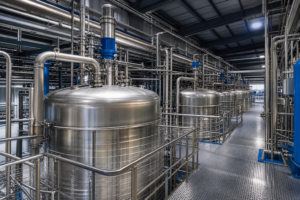
Aluminum sulfate — alum, Al2(SO4)3, the workhorse coagulant of municipal and industrial water treatment — is produced by dissolving an aluminum-bearing raw material in sulfuric acid and then, for solid product, running the clarified liquor through a six-step chain of reaction, clarification, evaporation concentration, cooling solidification, crushing, and packing. The commercial product splits into two forms: liquid alum, commonly shipped at around 8% Al2O3 (roughly a 48–50% solution), and solid aluminum sulfate, typically 15–17% Al2O3 as the octadecahydrate, sold as block, granule, or powder. The evaporation-and-crystallization section is where both the product grade and the plant economics are decided: it must handle a hot, acidic, steeply viscous liquor without fouling, control free acid and iron content to specification, and — in modern high-volume plants — do it with MVR evaporation instead of burning live steam. This article walks the full solution: process chain, equipment selection, boundary conditions, and the failure modes that separate a premium-grade plant from a commodity one. Numeric ranges here form an illustrative envelope from published product specifications and solubility data, not a project datasheet.
Two Products, Two Finishing Routes
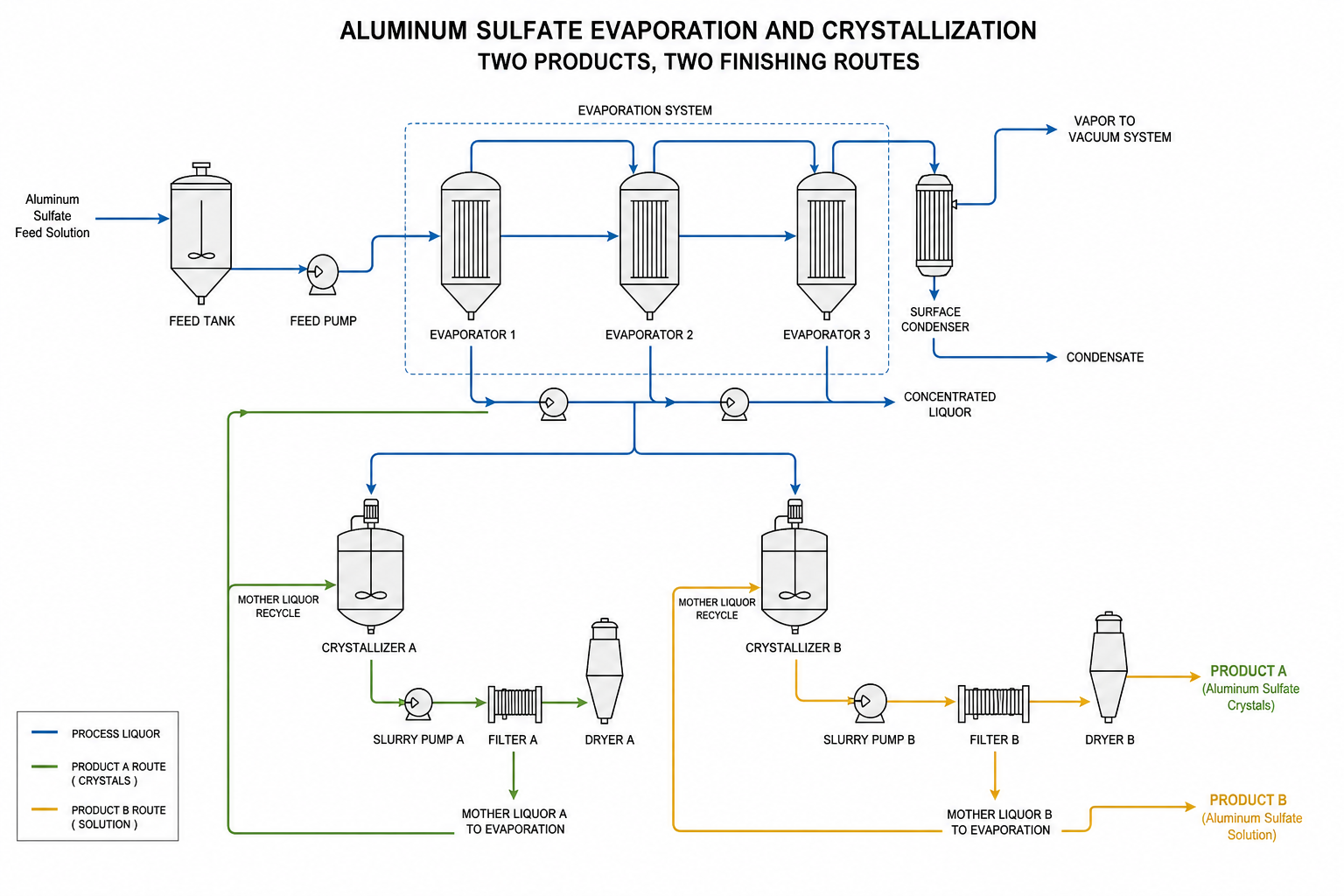
Before equipment can be selected, the plant must decide what it is selling, because liquid and solid alum diverge after the clarification step:
| Attribute | Liquid Alum | Solid Aluminum Sulfate |
|---|---|---|
| Typical strength | ~8% Al2O3 (about 48–50% solution) | Typically 15–17% Al2O3 as Al2(SO4)3·18H2O |
| Finishing after evaporation | Adjust concentration, cool, tank and dispatch | Deep concentration, cooling solidification, crushing, packing |
| Logistics | Bulk tanker or IBC to nearby users | Bag/big-bag, long-distance and export capable |
| Best-fit market | Municipal plants near the production site | Remote utilities, export, seasonal dosing, resellers |
Many plants build both: the same clarified liquor feeds a liquid line with modest concentration and a solid line with deep concentration and solidification. The evaporation system is therefore specified against the most demanding duty — the solid route — and turndowns to serve the liquid one.
The Six-Step Process Chain
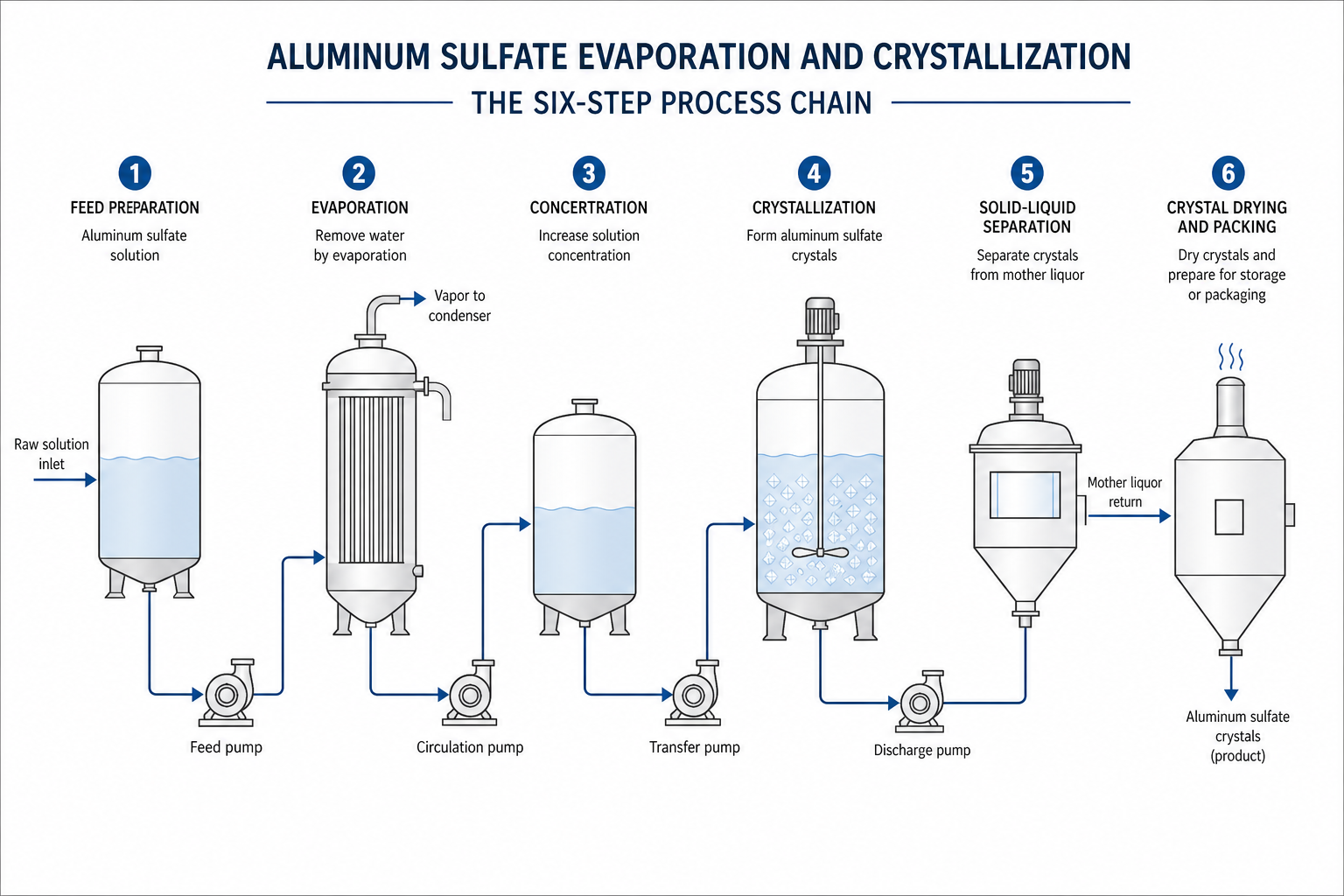
| Step | Equipment | Key Control |
|---|---|---|
| 1. Acid dissolution | Jacketed stirred reactor, batch or continuous | Acid dose and temperature; reaction is exothermic and industry-reported practice runs well above 100°C at atmospheric or slight pressure |
| 2. Settling and polishing | Clarifier/thickener plus filter | Removal of unreacted silica and mineral residue that would otherwise foul the evaporator |
| 3. Evaporation concentration | Forced-circulation or falling-film evaporator; MVR for large trains | Concentration to commercial strength (liquid) or near-saturation slurry (solid) |
| 4. Cooling solidification | Cooled flaker, cooling table or pans | Controlled crystallization of the octadecahydrate on a chilled surface as it solidifies |
| 5. Crushing and sizing | Cage mill / crusher, screen | Granule or powder cut to customer specification |
| 6. Packing | Bagging line, big-bag station | Moisture-tight packaging — the hydrate weathers and lumps if exposed |
At procurement level the chain resolves into four core modules:
| Module | Candidate Equipment Types | Selection Rationale | Indicative Operating Envelope |
|---|---|---|---|
| Acid dissolution | Jacketed stirred reactor, batch or continuous | Exothermic attack on bauxite or hydroxide; sets free-acid and iron ceiling | Industry-reported temperatures above 100 °C at near-atmospheric pressure |
| Clarification | Clarifier/thickener plus polishing filter | Cheapest fouling control ahead of the evaporator | Hot clarified liquor, insolubles trimmed before concentration |
| Evaporation concentration | Forced-circulation bodies; falling film lead effects; MVR for large trains | Steep viscosity rise and boiling-point elevation favor pumped wetted surfaces | Vacuum operation to commercial strength or near-saturation slurry |
| Solidification and finishing | Cooled flaker or cooling table, crusher, screen, bagging | Hydrate freezes on a chilled surface, not in suspension | Chilled surface; moisture-tight packing of the octadecahydrate |
Configuration, materials, and ranges depend on actual feed, corrosion review, fouling behavior, utilities, and project capacity.
Step 1: Acid dissolution sets the product ceiling
Two raw-material routes define product quality. The low-cost route attacks bauxite (or other aluminous ores) with sulfuric acid; it carries iron and other ore impurities into the liquor, which shows as a yellow-to-green tint in the final product and constrains use in paper and premium water-treatment grades. The high-purity route reacts aluminum hydroxide with acid; feed cost is higher but the liquor is clean, and free-acid and iron specifications for premium grades are reachable without extra purification. The acid step is strongly exothermic, and well-run plants recover that heat for feed preheating.
Step 2: Clarification protects the evaporator
Undissolved silica and mineral fines are the main fouling cargo of alum liquor. A clarifier followed by polishing filtration removes them before concentration; every gram that slips through deposits somewhere in the evaporator train. This is the cheapest fouling control in the whole plant.
Step 3: Evaporation — where MVR changes the economics
The clarified liquor is concentrated under vacuum. Two physical properties dominate the design:
- Viscosity rises steeply with concentration. Near the solid-route endpoint the liquor becomes a thick slurry; forced-circulation bodies with pumped tube-side flow (or scraped-surface equipment at the very end of the train) are the standard answer, keeping the heat transfer surface wetted and scoured.
- Significant boiling point elevation. As a strong electrolyte solution, concentrated alum liquor boils meaningfully above water’s saturation temperature, which compresses the available temperature difference per effect and must be checked against compressor lift when MVR is applied.
For large plants, MVR evaporation — recompressing the secondary vapor with an electrically driven compressor so live steam is a startup-only consumer — replaces multi-effect steam evaporation and moves the main energy input to electricity, the same lever described in MVR evaporation systems. Smaller plants, or sites with cheap steam, often stay with double-effect evaporation; the process chemistry does not change, only the energy bill.
Step 4: Cooling solidification is crystallization on a surface
Solid alum is not made by growing crystals in a suspension but by freezing a near-saturated slurry onto a chilled surface: a cooled rotating flaker or a cooling table solidifies the octadecahydrate as a thin cake that is then broken. The engineering points are crust management on the cooling surface and steady feed concentration — a thin swing in solids ahead of the flaker shows up instantly as sticky cake or brittle dust.
Steps 5–6: Crushing and packing
The cake is crushed and screened to the granule or powder cut the market wants, then packed in moisture-tight bags. Aluminum sulfate hydrate is hygroscopic: exposed product loses crystal water (weathers) and lumps, so storage and packaging discipline are part of product quality, not housekeeping. The finishing line is covered in drying and packing systems.
Specification Boundaries That Drive the Flowsheet
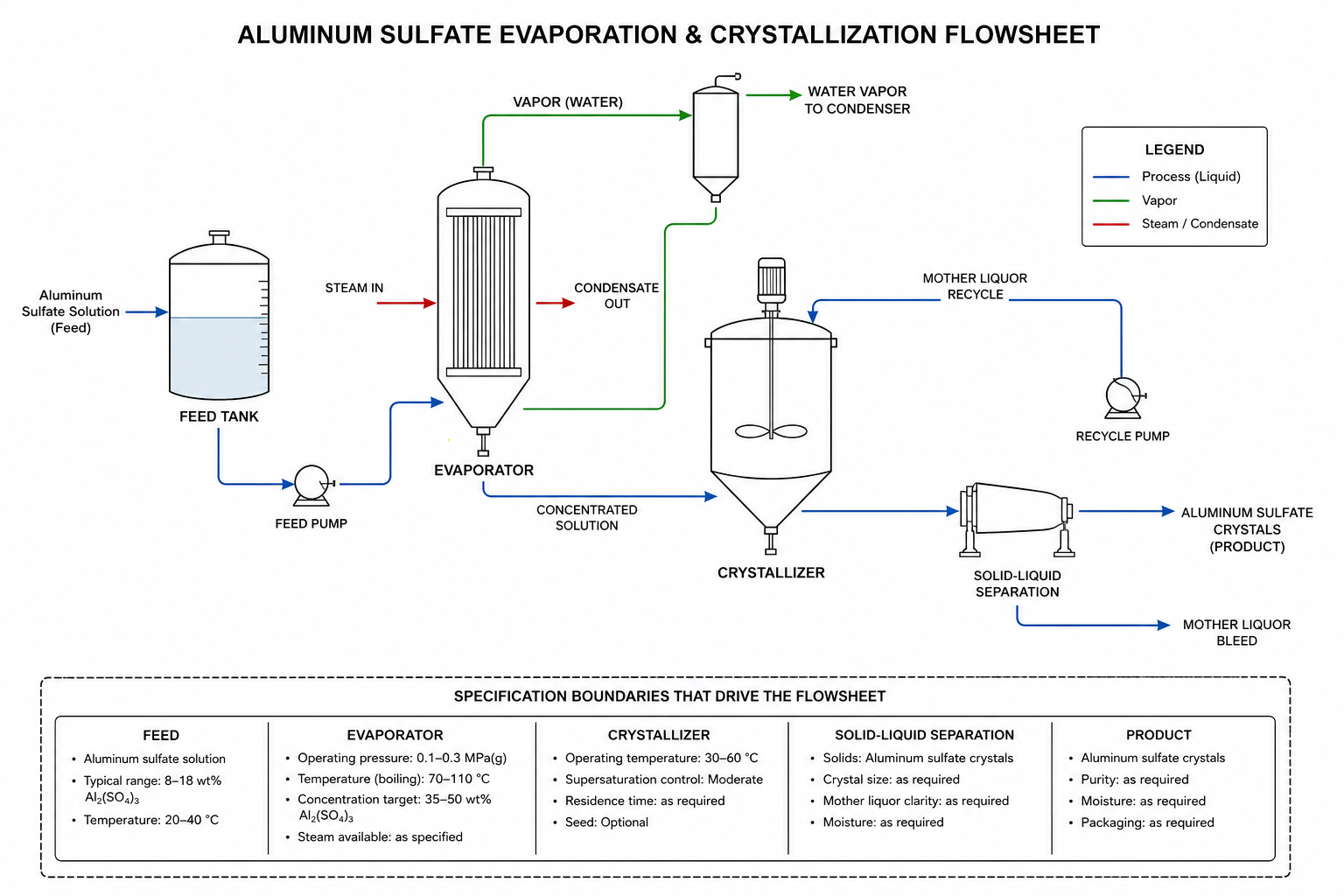
- Free sulfuric acid in the finished product is held low — commercial specifications commonly require it well under one percent — by controlling the acid-to-alumina ratio in step 1, not by back-blending at the end.
- Iron content separates commodity from premium grade. Ore-route plants live with a yellow product; hydroxide-route plants sell into paper and potable-water grades. Buyers sorting on color are sorting on iron.
- Insolubles are a clarification metric; failures here surface as dosing-pump and feeder complaints at the water utility, the customer who never complains twice.
- Water treatment compatibility: alum is the front-end coagulant for the turbidity and phosphate removal trains described in our zero liquid discharge solutions, and consistent dissolution behavior — not just Al2O3 assay — is what those users actually buy.
Materials of Construction
Hot, acid-bearing alum liquor is unforgiving of cheap alloys. Practical selection follows the service:
- Cool, dilute, near-neutralized liquor: SS316L gives good service.
- Hot concentrated liquor with free acid: higher alloys such as 904L or duplex stainless, or lined carbon steel — this is the default for reactors and evaporator bodies in acid-rich duty.
- Vapor and condensate circuit: stainless with attention to condensate acidity, since carryover acid attacks carbon-steel condensate lines quickly.
The recurring procurement mistake mirrors other inorganic-salt projects: specifying one alloy for the whole train to simplify purchasing, then paying for it at the hottest, most acidic point. Alloy zoning by service temperature and acid concentration is standard engineering practice for this plant.
Five Failure Modes
- Fouling the evaporator with insolubles. Under-clarified liquor plates silica onto tubes; the fix belongs in step 2, not in more CIP.
- Concentration runaways at the solid route endpoint. Viscosity turns nonlinear; trains without a robust density or solids instrument at the discharge over-concentrate and block discharge lines.
- Flaker crust build-up. Cooling-surface fouling quietly shrinks capacity; it is an operating variable to monitor, not a season-end deep clean.
- Free-acid drift. Acid ratio errors in the reactor surface days later as corrosion in customers’ dosing systems and failed certificates.
- Weathered product in the warehouse. Poor packaging turns on-spec hydrate into lumps; the product is hygroscopic and must be treated that way from the bagger onward.
Validation focus. Figures in this article reflect industry-reported practice and published product specifications, not EvapCryst deliveries — indicative, not a project guarantee. Before committing this route, analyze the actual liquor in full (Al2O3, free acid, iron, insolubles), measure viscosity near the solid-route endpoint, and confirm clarification on the real feed. The checklist below consolidates these gates.
When This Route May Not Fit
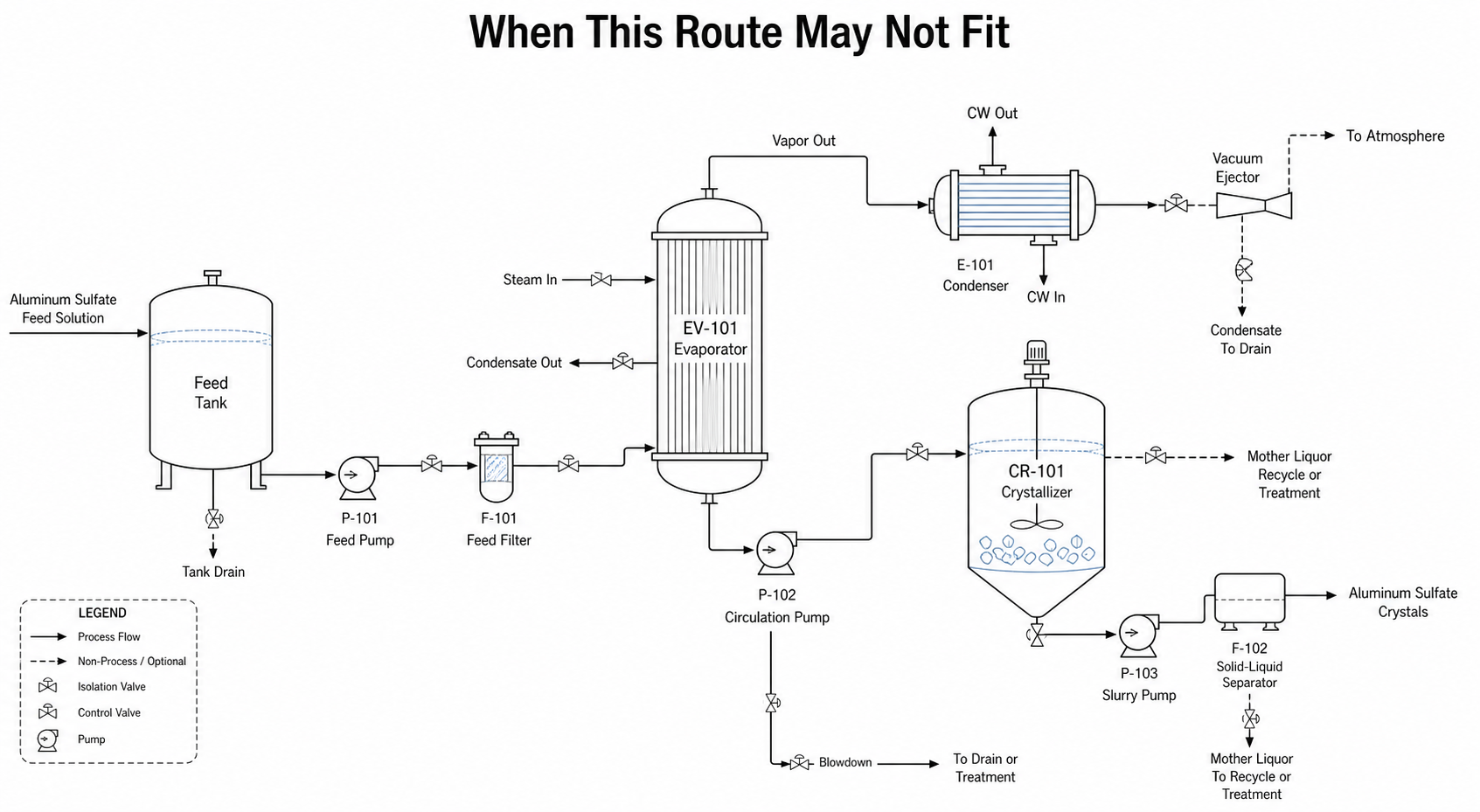
This route earns its capital only when solid product is required. If tanker logistics serve nearby users, deep concentration, chilled-surface solidification, crushing, and packing add cost without product value, and a liquid-alum line alone is the better scope. The route fits poorly where ore economics are unfavorable: a bauxite carrying heavy iron and silica pushes clarification duty, fouling management, and achievable product grade downward together, and no evaporator choice recovers that. Sites with dependable low-cost steam and modest capacity may find a double-effect train simpler, since the chemistry is unchanged and only the energy source differs. And inconsistent raw materials should not be committed to premium-grade specifications, since free-acid and iron limits are set in the reactor, not rescued downstream.
What Must Be Verified
Before a full-scale plant is committed, the following must be verified against project data rather than the indicative envelope above. A complete liquor analysis from the actual raw material — Al2O3 content, free sulfuric acid, iron, and insolubles — since these four numbers set the flowsheet boundaries. Measured viscosity-versus-concentration curves across the intended endpoint, since forced-circulation design margins depend on real rheology. Boiling point elevation at target concentration, checked against available compressor lift wherever MVR is contemplated. Clarification trials proving insolubles removal ahead of the evaporator. A packaging and storage audit against the hygroscopic weathering of the octadecahydrate, so on-spec product does not lump in the warehouse before it reaches the customer.
Frequently Asked Questions
Is aluminum sulfate produced by evaporation crystallization like other salts?
Partly. The liquor is produced by dissolving bauxite or aluminum hydroxide in sulfuric acid, clarified, then concentrated by vacuum evaporation. Solid product is finished not by suspension crystallization but by cooling solidification — freezing the near-saturated slurry onto a chilled flaker or cooling table as the octadecahydrate, which is then crushed and screened. Liquid product skips solidification entirely and ships at around 8% Al2O3.
What is the difference between liquid alum and solid aluminum sulfate?
Liquid alum is commonly about 8% Al2O3 (a roughly 48–50% solution) and is tanker-shipped to nearby users. Solid product, typically 15–17% Al2O3 as the 18-hydrate, is bagged for transport over longer distances and export. The production route is identical up to the evaporation step; only the finishing differs.
Can MVR evaporation be used on aluminum sulfate liquor?
Yes, in large-capacity plants it replaces multi-effect steam evaporation, cutting live steam to startup-only and moving the main energy input to electricity. Design checks specific to this liquor are the boiling point elevation of the concentrated electrolyte against available compressor lift, and forced-circulation bodies to handle the steep viscosity rise near the solid-route endpoint.
Why does some aluminum sulfate look yellow?
Iron carried in from the bauxite or ore route. The hydroxide raw-material route yields a clean, low-iron product acceptable to paper and premium water-treatment grades; the ore route is cheaper but the iron tint marks it as commodity grade.
What causes caking in stored aluminum sulfate?
The octadecahydrate is hygroscopic: exposed to humid air it loses or gains crystal water, weathers, and lumps. Moisture-tight bagging, dry storage, and granule (rather than fine powder) cuts minimize it — the same flowability logic that governs any water-soluble salt product.
Next step: send liquor analysis, target grade, and capacity, and receive a first-pass screening of process direction and boundary conditions — inputs exchanged for engineering direction.