Falling film and rising film evaporators are the two workhorses of thin-film evaporation, and the difference between them comes down to one design choice: what force drags the liquid into a film. A falling film evaporator feeds liquor over a distributor at the top of the tubes and lets gravity draw it down as a thin film—it runs at very low temperature differences (typically 3–8°C), offers the shortest residence time of any industrial evaporator, and is the configuration of choice for heat-sensitive products and for MVR systems. A rising film (climbing film) evaporator feeds liquor at the bottom of the tubes and lets the shear of boiling vapor drag the film upward—it needs a larger temperature difference to generate the vapor velocity that powers the film, tolerates somewhat higher viscosity and foaming, and its simpler construction (no liquid distributor) keeps cost down. Choose falling film for gentle, low-temperature concentration of clean, low-to-medium viscosity liquors; choose rising film when the liquor foams, tolerates heat, or the budget favors simplicity. This guide compares both across mechanism, performance, and application fit.
One Family, Two Driving Forces
Both designs belong to the thin-film family, whose shared idea is to spread liquor into a very thin moving film on a heated surface. A thin film lowers the heat resistance on the liquid side and shortens the time any molecule spends at the hot wall—hence high heat-transfer coefficients and gentle product treatment. The family splits on the question of film movement.
In a falling film evaporator, gravity does the work. In a rising film evaporator, boiling does: vapor bubbles nucleate on the tube wall, accelerate up the tube, and the vapor core’s shear and drag pull the liquid film up behind them. This single distinction cascades into almost every performance difference that follows—temperature difference requirement, residence time, sensitivity to viscosity, and suitability for mechanical vapor recompression.
How a Falling Film Evaporator Works, Step by Step
The operating cycle has six steps. Feed is pumped to the top of the tube bundle and enters a liquid distributor; the distributor spreads it uniformly across every tube; the liquor falls as a thin film under gravity along the inner tube walls; heating steam on the shell side evaporates solvent from the film; vapor and concentrated liquid separate in the body below the bundle; and the concentrate leaves while the vapor exits to a condenser or a compressor. The liquor passes through the tubes essentially once, with little or no recirculation.
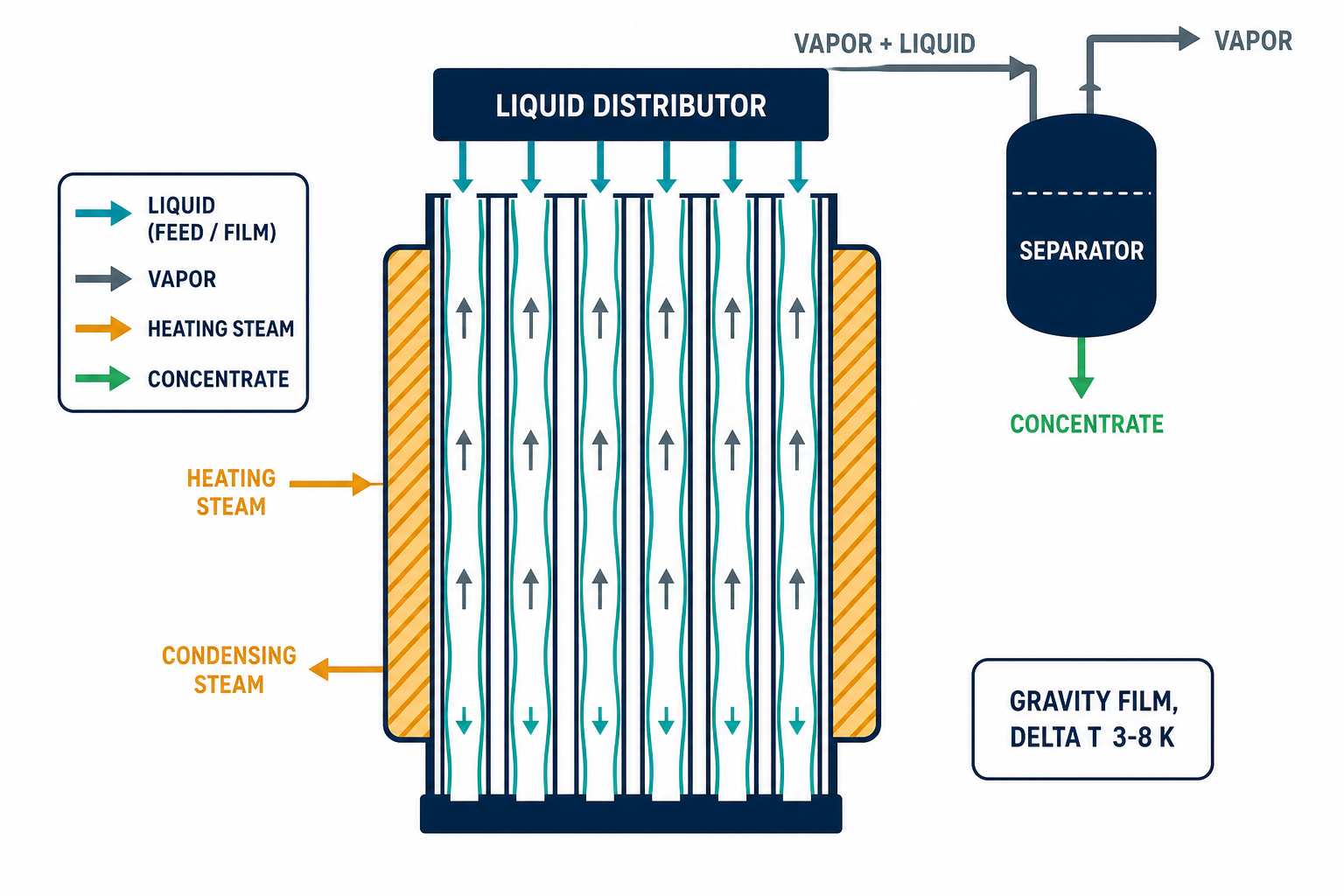
The liquid distributor is the component on which the whole machine stands or falls. If distribution is uneven, some tubes run partially dry—scaling at the dry spots—while others carry too much liquid and transfer heat poorly; maldistribution is the leading cause of falling-film performance loss in practice. Distributor design, wetting rate (the minimum flow per tube perimeter to keep the wall fully wetted), and honest attention to turndown limits are what separate reliable installations from troublesome ones.
How a Rising Film Evaporator Works
The rising film inverts the geometry: liquor enters at the bottom of the tubes, and heating on the shell side brings it to boil partway up the tube. The vapor generated expands as it rises, reaching high velocity, and the two-phase flow regime transitions from bubble flow to annular flow—the vapor core dragging a liquid annulus up the wall. The machine is elegantly simple: no liquid distributor, a single pass in co-current flow, and long tubes that give the film a generous heat-transfer path.
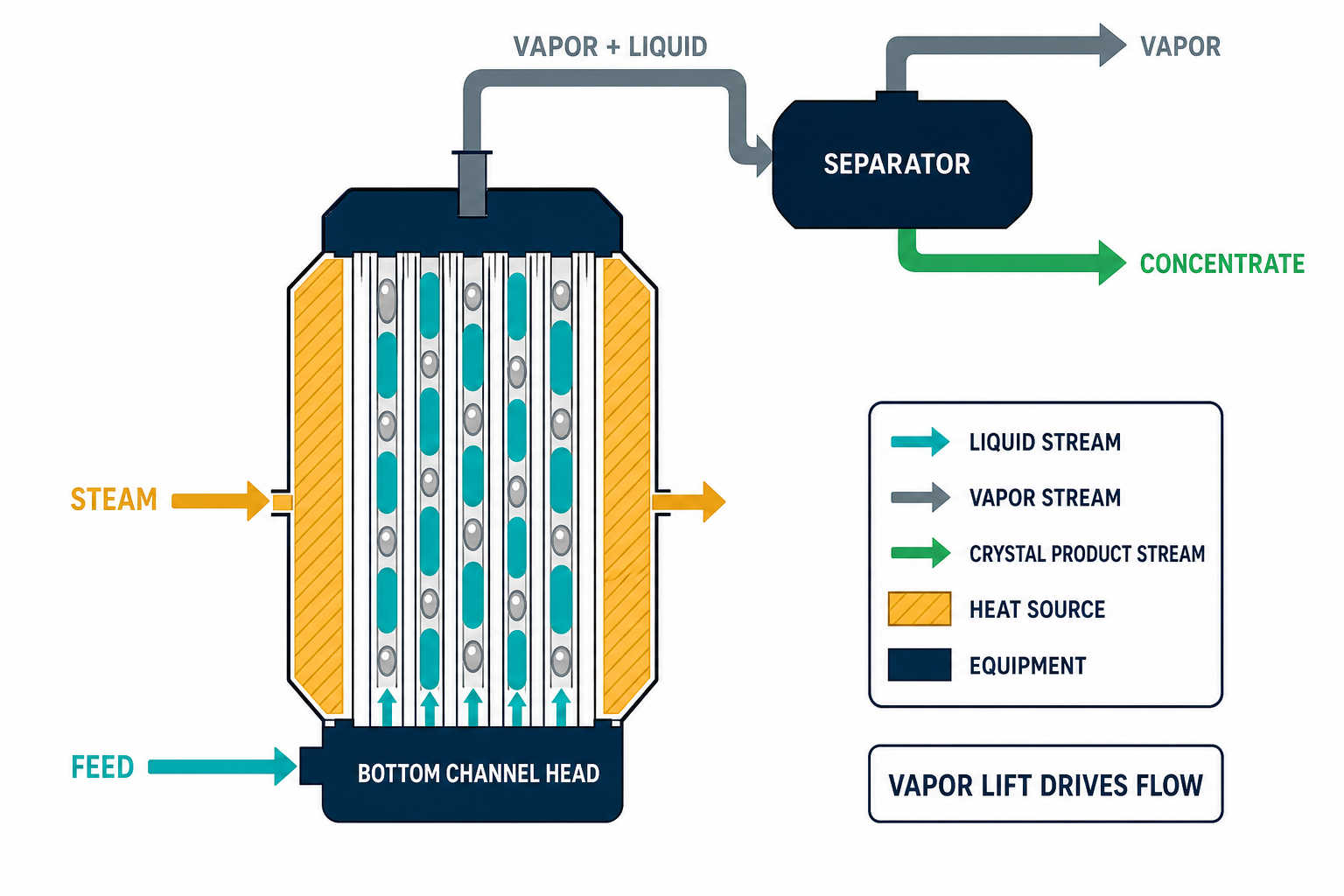
The design’s dependency is vapor velocity. Without enough boiling—without enough temperature difference to drive it—the film never fully forms and the tubes run wet in slug flow with poor heat transfer. Rising films therefore demand larger driving temperature differences than falling films, and their performance is less flexible at deep turndown.
Performance Comparison
| Attribute | Falling Film | Rising Film |
|---|---|---|
| Film driving force | Gravity | Vapor shear from boiling |
| Required temperature difference | Low: typically 3–8°C | Higher: sufficient boiling velocity must develop |
| Residence time | Shortest of industrial evaporators—seconds to tens of seconds | Longer, but still single-pass |
| Liquid holdup | Very small; no static liquid column, hence no boiling point elevation from liquid head | Higher holdup; liquid head at the tube bottom adds to the effective boiling point |
| Viscosity tolerance | Low to medium viscosity, clean liquors | Somewhat higher viscosity and foaming tolerance |
| Concentration ratio per pass | Modest—typically within about 2–3×; higher ratios need multiple stages in series or another evaporator type | Similar order; both are concentrators, not crystallizers |
| Fouling posture | Sensitive—dry patches at the tube bottom are the classic fouling initiation point | Sensitive—both foul more readily than forced circulation |
| Mechanical complexity | Distributor adds precision (and cost) | Simplest construction of the film family |
Heat Sensitivity and Residence Time
For heat-sensitive products, the falling film is the leading choice among tubular evaporators. Residence time is measured in seconds to tens of seconds, liquid holdup is minimal, and—because there is no static liquid column above the heat surface—the liquor boils at its own saturation temperature without the extra boiling point elevation that a liquid head imposes. Proteins, enzymes, pharmaceutical solutions, and fruit concentrates (illustrative applications) survive falling-film concentration with measurably less thermal damage.
The rising film treats product somewhat less gently: residence time is longer, the liquor enters at the bottom and progressively heats as it climbs, and the liquid column adds a hydrostatic boiling point elevation. For liquors that tolerate heat well—many inorganic solutions, sugar juices, brines (illustrative applications)—these differences are immaterial, and the simpler machine wins on capital cost.
Why Falling Film Is the Default Partner for MVR
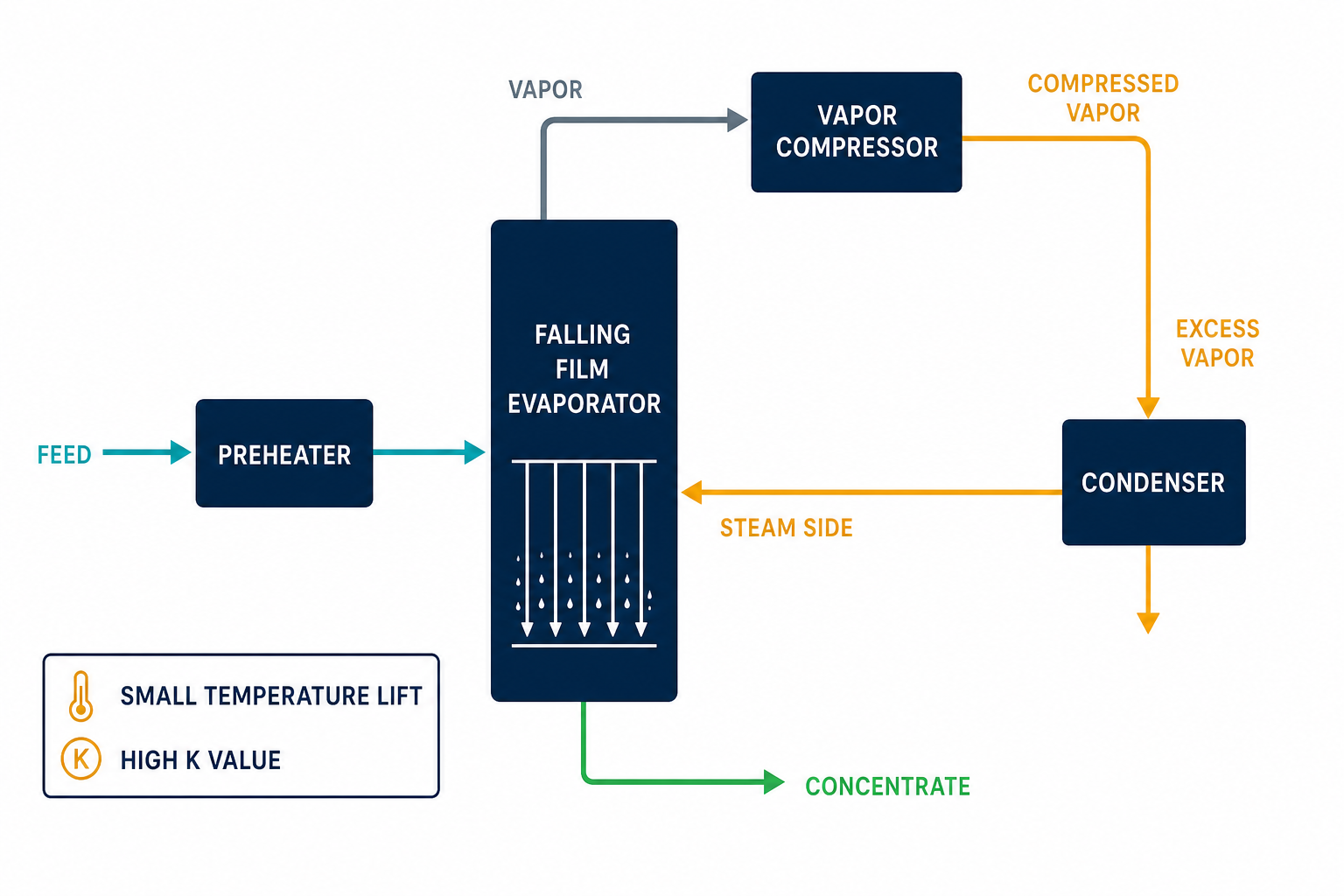
MVR systems live and die by temperature lift: every Kelvin the compressor must add costs electrical power. Because a falling film evaporates efficiently across a 3–8°C driving difference, it demands the smallest possible compressor lift—which is why falling film is the standard evaporation body for mechanical vapor recompression systems, from wastewater concentration to food and pharma duties. The rising film’s appetite for larger temperature differences pushes the compressor toward higher compression ratios, eroding MVR’s energy advantage. The economics of this coupling, with per-ton energy figures, are developed in our MVR vs multi-effect comparison.
Know the Limits: Viscosity, Solids, Concentration Ratio
Neither film evaporator is a fouling-duty machine. Falling films want low-to-medium viscosity, essentially solids-free liquors—a viscous or particle-laden feed plugs distributors and starves tube walls; rising films cope somewhat better with viscosity and foaming but still scale when solids precipitate. When the liquor concentrates toward crystallization, or fouling rates climb, the correct machine is a forced-circulation evaporator, whose high-velocity pumped flow accepts viscous, scaling, crystallizing liquors at the cost of pump energy. Many plants stage the technologies—falling film for the bulk water removal, forced circulation for the crystallizing finish—and the same logic applies within multi-effect trains, as described in our multi-effect design guide.
Concentration ratio per pass is the second limit. A single falling-film pass typically concentrates within roughly two- to three-fold; pushing further risks incomplete wetting and dryout at the tube end. High concentration ratios are achieved by staging bodies in series, by partial recirculation, or by handing the duty to forced circulation once viscosity and supersaturation take over.
Application Map by Industry
The industries divide along heat sensitivity and liquor behavior (an indicative pattern rather than a rule for every project). Falling film dominates dairy (milk and whey concentration), fruit juice, tea and plant extracts, pharmaceutical solutions, ethanol and solvent recovery, and desalination—duties where product quality or the low-temperature-difference coupling with MVR governs. Rising film retains ground in sugar juice concentration, calcium chloride and brine concentration, inorganic salt solutions, and waste acid recovery—duties where heat tolerance is good, foaming occurs, and mechanical simplicity is valued. Solvent duties in particular pair naturally with solvent recovery and distillation systems, while food-sector installations (illustrative applications) align with the requirements covered under food and fermentation processing.
Operating Issues and Their Diagnosis
Most field problems in film evaporators trace back to the film itself, and each failure has a signature. In falling-film units, a gradual decline in heat-transfer coefficient usually means the distributor: fouled or misaligned distributor plates starve tubes of liquor, and inspection of the tube sheet—looking for dry, scaled patches at specific positions—identifies which distribution paths are failing. Falling outlet temperature difference at constant steam pressure points to fouling on the evaporating side; rising pressure drop in the vapor path points to demister or piping fouling instead. Corrective action is distributor cleaning or re-alignment plus a review of the wetting rate against current feed flow, not simply more steam.
In rising-film units, the signature problem is insufficient vapor velocity: if the driving temperature difference decays—because steam pressure drops or the last-effect vacuum degrades—the film slumps, heat transfer collapses, and capacity falls faster than the temperature difference alone would explain. The remedy is restoring the temperature difference (steam pressure, vacuum integrity, non-condensable venting) rather than pushing more feed. For both machines, scheduled CIP cleaning calibrated to the liquor’s fouling rate keeps heat-transfer coefficients—and therefore energy per ton of water—close to design values, which is the cheapest performance insurance available.
Selection Summary
Run the choice as a four-question filter. Is the product heat-sensitive and low-to-medium viscosity? Falling film, almost always—and if the plant is electrically driven or MVR-coupled, falling film without further debate. Does the liquor foam, carry moderate viscosity, and tolerate heat? Rising film offers capable performance at lower mechanical complexity. Does the liquor scale, crystallize, or carry solids? Neither—go to forced circulation. And if the concentration ratio target exceeds what one pass can deliver, plan staged falling-film bodies or a forced-circulation finish from the outset, because retrofitting concentration capability into a film machine that has reached its wetting limit is an expensive way to learn this particular lesson.
FAQ
Which evaporator is better for heat-sensitive products?
The falling film evaporator. Its residence time is the shortest of any industrial evaporator (seconds to tens of seconds), liquid holdup is minimal, and there is no static liquid column adding boiling point elevation—so dairy, juice, pharmaceutical, and enzyme liquors see the least thermal stress.
Why does a falling film evaporator suit MVR systems?
MVR energy consumption rises with every Kelvin of compressor temperature lift. Falling film evaporates efficiently across only 3–8°C of driving difference, the smallest demand among evaporator types, which keeps the required compression ratio—and electricity bill—low. Rising film needs a larger temperature difference and pushes the compressor harder.
What happens if a falling film evaporator handles high-viscosity or fouling liquor?
Performance degrades quickly: viscous feeds distribute poorly, tube walls run partially dry, and dryout spots scale first—the classic failure mode. Solids-laden liquor plugs distributors. These duties belong to forced-circulation evaporators, which trade pump energy for fouling tolerance.
What concentration ratio can a falling film achieve in one pass?
Typically within about two- to three-fold concentration per pass. Beyond that, wetting rates become difficult to maintain and dryout risk rises; standard practice is multiple bodies in series or a forced-circulation finish effect for the final concentration step.