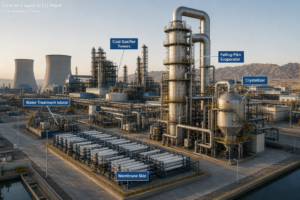
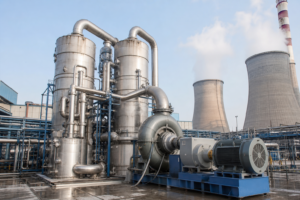
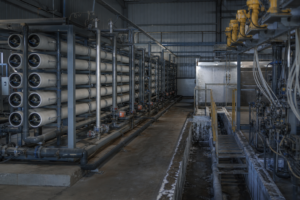
Anaerobic digester wastewater (digestate liquor) rarely needs one treatment — it needs a correctly scoped train. The liquid fraction behind a biogas plant typically carries three problem groups at once: fine suspended solids, high ammonia nitrogen, and dissolved salts, alongside residual BOD and COD. The engineering answer is a staged architecture: solids removal first, then ammonia management matched to the actual nitrogen concentration, then desalination through reverse osmosis, with thermal evaporation and crystallization reserved as the closing step where zero liquid discharge (ZLD) is required. Industry-reported membrane performance: a seawater RO stage operating at up to 1,200 psi recovers roughly 80% of digestate water as clean permeate; ultra-high pressure RO at up to 1,800 psi can push brine toward 140,000 mg/L TDS — concentrating volume about three times more energy-efficiently than thermal evaporation before the final evaporator-crystallizer finishes the job (external industry reference, not an EvapCryst delivery).
What Digestate Liquor Actually Contains
Biogas digesters degrade organic matter — municipal organic waste, livestock manure, poultry waste, food-processing residues — into methane and carbon dioxide, leaving a digestate slurry of residual solids and a liquid phase with dissolved inorganic salts. After mechanical solids separation (used as fertilizer or sent for disposal), the remaining liquor usually cannot be reused directly or discharged to a public sewer. Constituents of concern in an illustrative digestate envelope include:
- Total suspended solids (TSS) — fine colloidal biomass that scales and plugs downstream equipment.
- Ammonia nitrogen — often the binding discharge constraint, in concentrations from hundreds to tens of thousands of mg/L depending on feed.
- Total dissolved solids (TDS) — salts that limit reuse options and corrode equipment.
- BOD and COD — residual organics that carry aquatic-life and surcharge consequences.
This is an illustrative envelope constructed from published digestate characterizations, not a customer or project dataset. Because these characteristics track the digester feed, no two liquors are alike; treatment scope should follow a full water chemistry review, not a template.
Step 1 — Suspended Solids Removal
Solids control is not optional: everything downstream — strippers, membranes, evaporators — degrades in the presence of fine suspended material. Two proven routes exist:
- Coagulation-flocculation with ferric chloride and polymer, followed by clarification/sedimentation and media filtration of the overflow — the traditional, chemistry-led approach.
- Ceramic ultrafiltration (UF), which removes suspended solids without dosing coagulant, concentrates particulate into a dense slurry, and offers a compact, highly automated, low-footprint alternative where simplicity and low maintenance dominate the selection.
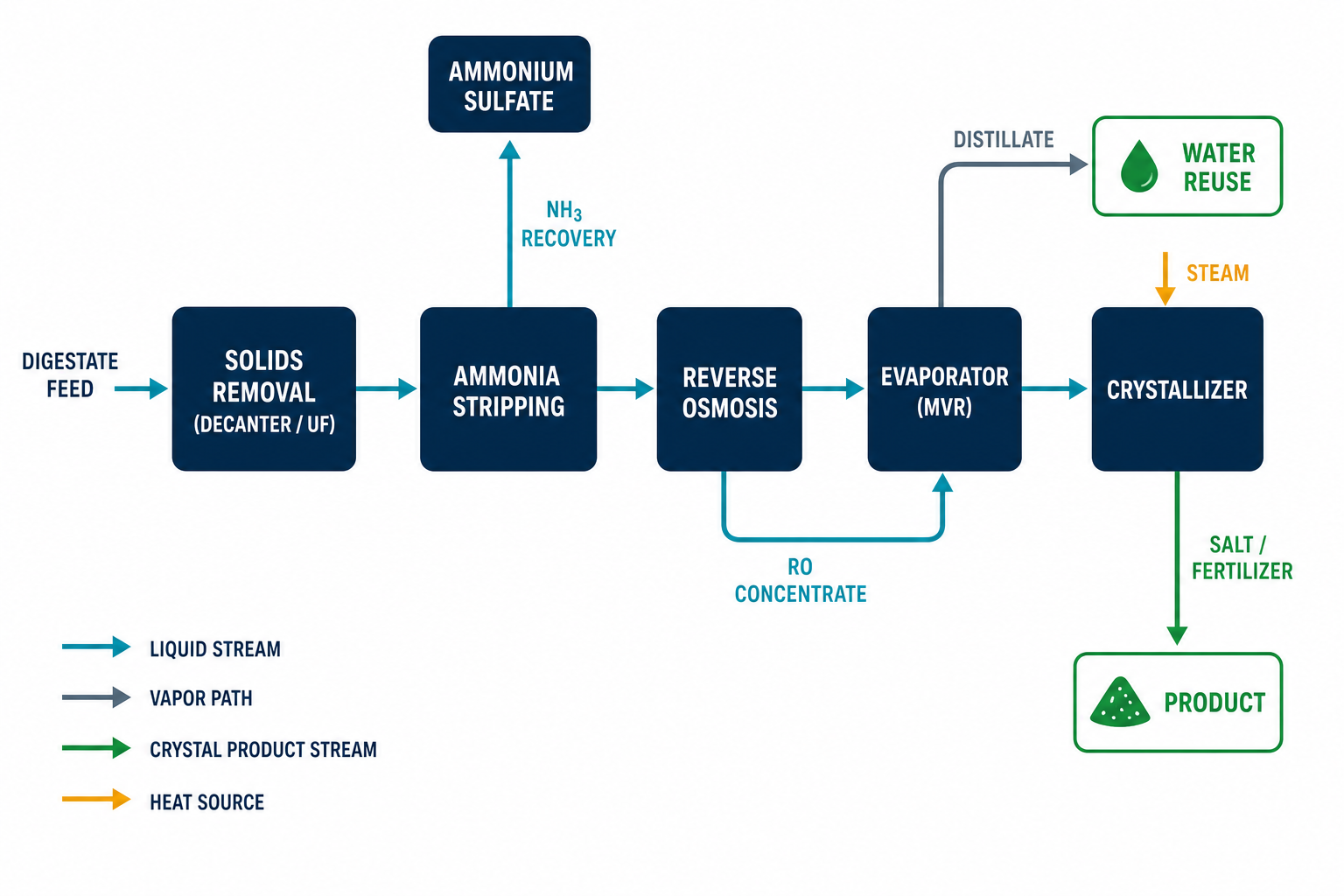
Step 2 — Ammonia Removal: Match the Method to the Concentration
Ammonia selection is the single most consequential choice in digestate treatment, and it is fundamentally a concentration question. The comparison below reflects established practice across the technology families.
| Technology | Best-Suited Ammonia Range | Key Considerations |
|---|---|---|
| Air stripping | >2,000 mg/L N | Recovers ammonium sulfate fertilizer; small footprint; acid/base consumption high; CaCO3/CaSO4 scaling risk in the column |
| Steam stripping | >20,000 mg/L N | Recovers ammonium bicarbonate / ammonia solution without chemicals; also cuts TDS; energy-intensive; can be compacted with MVR |
| Biological nitrification-denitrification | <500 mg/L N | Converts ammonia to N2; also removes organics and phosphorus; large footprint; significant sludge |
| Anammox | 500–2,000 mg/L N | Direct anaerobic conversion to N2; energy-efficient, low sludge; slow startup, temperature-sensitive |
| Breakpoint chlorination | Low ammonia, low organics | Fast and simple; bleach cost high and organics consume reagent |
| Struvite precipitation | High-phosphate liquors | Recovers magnesium ammonium phosphate as fertilizer; smaller product market |
For strong liquors, stripping routes recover nitrogen as a saleable fertilizer instead of leaving it in a brine, and steam stripping can be thermally integrated with mechanical vapor recompression to shrink its energy penalty. For dilute liquors, biological routes avoid creating any ammonia-based salt at all. The wrong-sized choice — stripping a dilute stream or biologically treating a concentrated one — dominates lifetime cost more than any equipment brand decision.
Step 3 — Desalination: RO First, Evaporation Last
For dissolved solids, reverse osmosis and evaporators are the two workhorses, and their correct order is RO first. RO offers wide availability, low cost and high energy efficiency, so it removes the bulk of the water volume; evaporation then treats only the concentrated brine.
In a typical biogas-plant configuration, digestate liquor enters a seawater RO (SWRO) system operating at pressures up to 1,200 psi (industry-reported service envelope). At around 80% permeate recovery, SWRO produces a high-quality permeate reusable inside the plant or safe to discharge, and a brine stream near 70,000 mg/L TDS. That brine can go to composting of the digestate solids, to a disposal well, or onward to further concentration — depending on which economics favor.
Ultra-High Pressure RO as the Brine Concentrator
Where minimal or zero liquid discharge is required, spiral-wound ultra-high pressure RO systems operating up to 1,800 psi concentrate the SWRO brine further — reaching brine TDS on the order of 140,000 mg/L under suitable conditions (published membrane-system data, external industry reference). Critically, this membrane concentration step is roughly three times more energy-efficient per unit of volume reduction than thermal evaporation, so every cubic meter the UHP RO removes is energy saved on the evaporator that follows. Automated flux monitoring and self-cleaning cycles keep the membranes ahead of organic fouling — the specific failure mode of digestate service.
Step 4 — Thermal Evaporation and Crystallization for ZLD
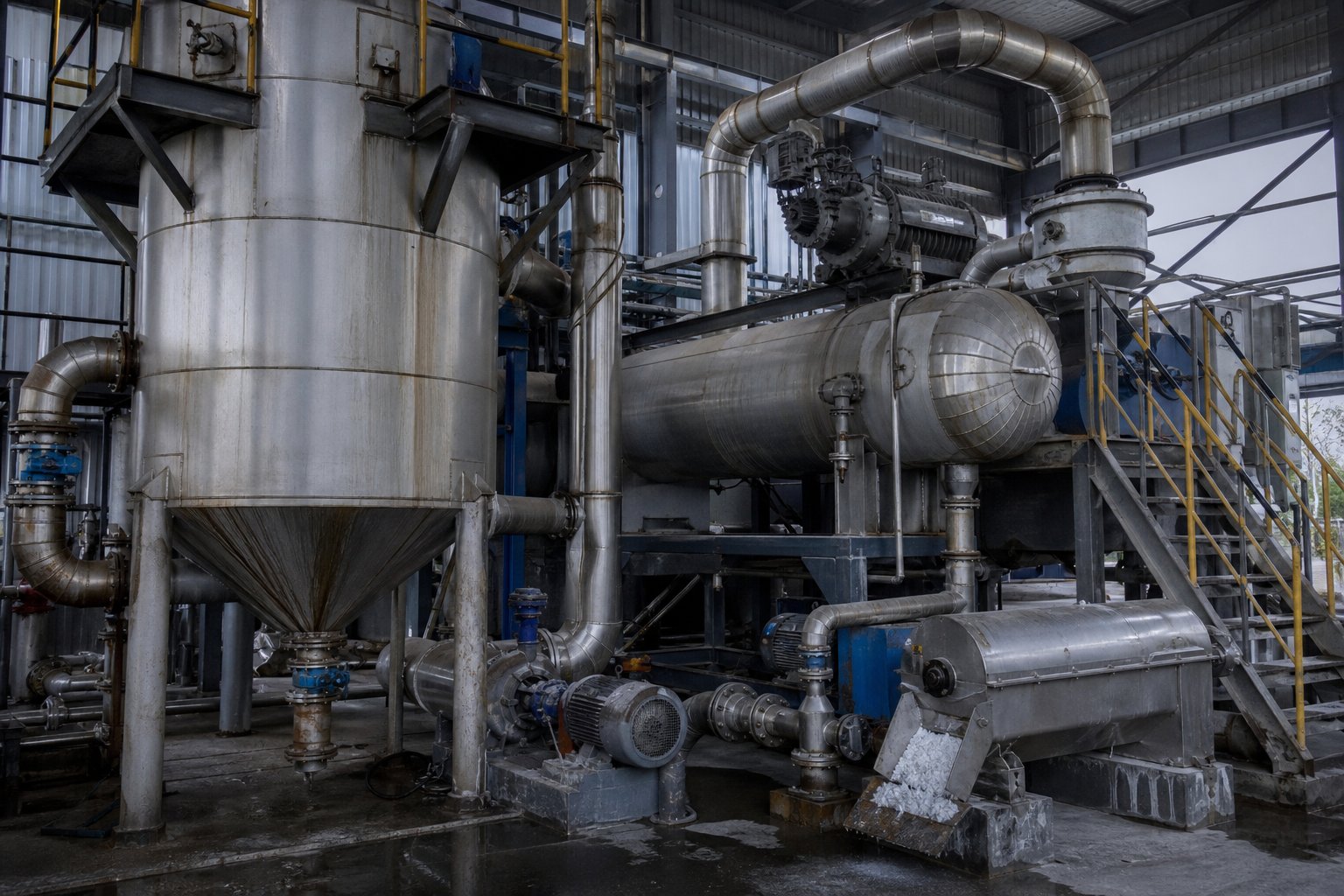
The final brine enters a thermal evaporator-crystallizer — electrically driven MVR or thermally driven multi-effect configurations are both practiced. The distillate is high quality, reusable in the plant or discharged; all remaining contaminants leave as a minimal liquid volume or as solids for disposal or land application. This closing step is what converts a treatment train into a true closed-loop plant: no liquid leaves the site boundary.
| Module | Candidate Equipment Types | Selection Rationale | Indicative Operating Envelope |
|---|---|---|---|
| Solids removal | Coagulation-clarification plus media filtration; ceramic ultrafiltration | Chemistry-led route versus footprint and automation | Coagulant dosing, or coagulant-free UF |
| Ammonia removal | Air or steam stripper; biological stage; struvite reactor | Set by ammonia band and fertilizer offtake | Sub-500 to above 20,000 mg/L N by method |
| Primary desalination | SWRO spiral-element skid | Bulk water removal at lowest energy | Up to 1,200 psi; ~80% recovery indicative |
| Brine concentration | Ultra-high pressure RO | Cuts thermal duty on the brine | Up to 1,800 psi; toward 140,000 mg/L TDS |
| ZLD closing step | MVR or multi-effect evaporator-crystallizer | Clean distillate plus disposable solids | Sized on brine BPE and volume |
Configuration, materials, and operating ranges depend on the actual feed, water chemistry, corrosion review, fouling behavior, site utilities, and project capacity.
Scoping the Right-Sized Train
Not every digestate needs the full stack. The decision logic follows the chemistry and the discharge target:
| Situation | Indicative Train Scope |
|---|---|
| Only ammonia exceeds the discharge limit | Solids removal plus the ammonia unit matched to concentration (see table above) |
| Salts and ammonia both limiting, discharge to sewer available | Solids removal + ammonia + SWRO; brine to approved disposal |
| Water reuse mandated, disposal costs high | SWRO + UHP RO brine concentration for maximum permeate recovery |
| ZLD required by permit or economics | Full train through evaporator-crystallizer; solids to disposal or land application |
Nutrient Recovery and the Fertilizer Loop
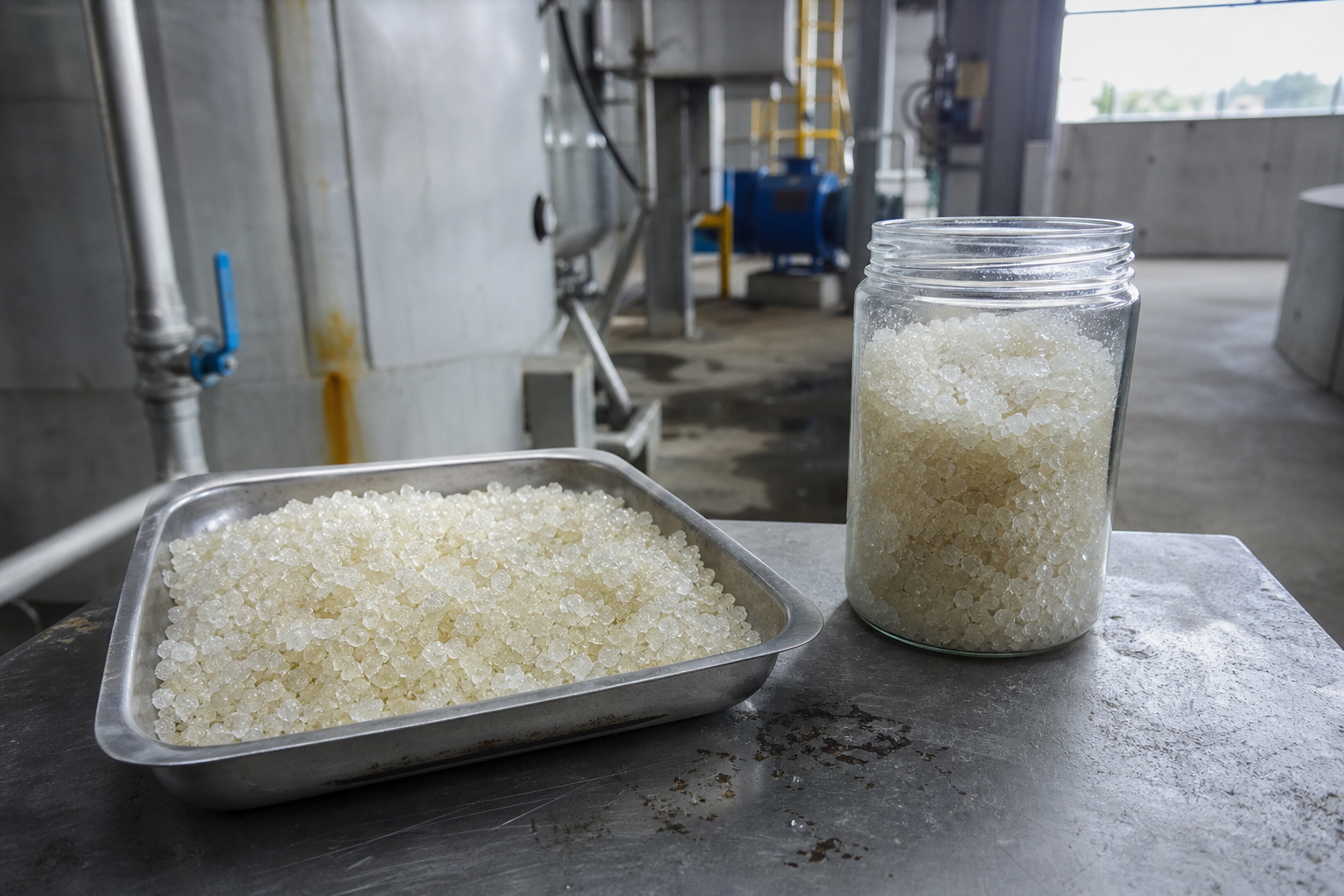
Digestate is not only a liability — it is a nutrient stream, and the treatment train decides whether that value is captured or washed into a brine. Land application of raw digestate is limited by both logistics and agronomy: transporting water-dominated liquor is expensive, and nitrogen and phosphorus loading limits cap how much a given land bank can accept. Concentration changes that arithmetic. Air stripping converts ammonia into ammonium sulfate, a solid fertilizer with an established market; steam stripping recovers ammonium bicarbonate or ammonia solution without reagent input; struvite precipitation simultaneously removes phosphate and ammonia as a slow-release magnesium ammonium phosphate fertilizer, attractive where the liquor is phosphate-rich. Meanwhile the RO permeate returns as clean process water and the concentrated brine can carry potassium and other nutrients back to the composting or solid-fertilizer stream. Industry-reported experience: plants designing for recovery rather than mere compliance find fertilizer revenue plus avoided disposal fees paying for a substantial share of the treatment train.
Integration With the Biogas Plant Itself
The best-performing plants treat the digester and the water train as one energy system. Biogas produced on site fuels a boiler or CHP engine, and its jacket heat and flue gas can drive thermal stripping or provide seed heat to the evaporator, displacing purchased energy. Steam stripping integrated with MVR recovers the latent heat of the ammonia-water vapor instead of condensing it to waste. Permeate from the RO stages returns to slurry dilution or CIP duty, closing the site water balance. These integrations are inexpensive to plan at the design stage and expensive to retrofit, so the water treatment supplier should be inside the project from the earliest heat-and-mass balance — not after the digester design is frozen.
Validation Focus
No project dataset is cited on this page; the performance figures are external industry references, indicative rather than guaranteed. Validation before commitment should cover a full seasonal liquor characterization, jar tests or pilot UF runs on the actual liquor, membrane fouling probes for the RO stages, and a boiling-point-elevation check on the final brine.
When This Route May Not Fit
A full membrane-plus-thermal train is over-scoping where the liquor only marginally exceeds one parameter: a single ammonia unit, or even simpler land-application logistics, may close the permit at far lower cost. Where digestate solids already have a stable land-application outlet and hauling distances are short, concentrating the liquor destroys value instead of creating it. High-organic, high-fouling liquors that defeat RO pretreatment push the economics toward direct thermal treatment, skipping membranes. Where grid power is weak and biogas is abundant, an electrically driven MVR train wastes the site’s own heat, and thermally driven evaporation fits better. UHP RO assumes well-clarified feed; feeding it raw liquor buys fouling, not concentration. The route also assumes a discharge or reuse target that actually justifies ZLD economics.
What Must Be Verified
Each digestate project must verify its own basis before equipment is fixed. Required checks: a full seasonal liquor characterization (TSS, particle size, TDS ionic makeup, ammonia, phosphorus, BOD/COD), because digester feed swings move every number; jar tests or UF pilot runs on the real liquor for the solids stage; ammonia selection re-checked against the measured concentration band rather than assumed; membrane fouling and cleaning trials for SWRO and UHP stages; and boiling-point elevation plus scaling tendency of the final brine, which sizes the evaporator-crystallizer. Fertilizer offtake for recovered ammonium sulfate or struvite should be confirmed in writing before recovery steps are justified. Where digestate chemistry is unusual, pilot the membrane stages before committing full-scale capital.
FAQ
Can digester wastewater be discharged without treatment?
Usually not. Even after solids separation, the liquor typically carries TSS, TDS, ammonia, BOD and COD above what public sewers or direct discharge permits allow. The required scope ranges from selective ammonia removal alone up to full ZLD, decided by the water chemistry and the discharge target.
Which ammonia removal method fits digestate liquor?
Concentration decides: nitrification-denitrification below ~500 mg/L N, anammox at 500–2,000 mg/L, air stripping above ~2,000 mg/L, and steam stripping above ~20,000 mg/L. Co-contaminants, energy sources and fertilizer marketability refine the choice.
Why put reverse osmosis before the evaporator?
RO removes water at a fraction of the energy cost of thermal evaporation. Concentrating the SWRO brine to ~70,000 mg/L TDS, and further toward ~140,000 mg/L with UHP RO at up to 1,800 psi, shrinks the evaporator duty — membrane concentration is roughly 3× more energy-efficient per volume removed.
What does ZLD leave behind at a biogas plant?
High-quality distillate reusable on site, plus a minimal solid residue — mixed salts and any removed contaminants — for final disposal or, where regulations and chemistry allow, land application.
Coagulation-clarification or ceramic UF for solids removal?
Coagulation-flocculation with ferric chloride and polymer followed by clarification and media filtration is the traditional route and copes with high, variable solids loads. Ceramic ultrafiltration eliminates coagulant dosing, concentrates solids into a dense slurry, and suits projects that prioritize small footprint, automation and low maintenance; the choice usually follows chemical cost versus capital on the specific liquor.
Can biogas plant energy run the treatment train?
Substantially, yes. CHP jacket heat and flue gas can drive thermal ammonia stripping or seed the evaporator, and steam stripping can be compacted with MVR to recover latent heat. Integrating the water train with the site energy balance at design stage is one of the largest lifecycle-cost levers available.
How do digestate liquors differ from landfill leachate?
Both are high-ammonia, high-salt organics-bearing wastewaters and share much of the same treatment logic, but digestate chemistry tracks the digester feed (manure, food waste, municipal organics) while leachate tracks landfill age and composition. The train architecture is similar; the sizing and chemistry controls differ.
EvapCryst engineers digestate treatment trains from ammonia selection through high-salinity ZLD systems and MVR evaporation, and applies the same chemistry-first discipline on neighboring high-strength streams such as landfill leachate and livestock farm wastewater. See the full complex wastewater treatment capability overview.
To start a first-pass screening of your digestate train, send the liquor analysis, throughput, and discharge or reuse target; in return you receive an indicative train architecture and stage sizing logic, before any detailed engineering.