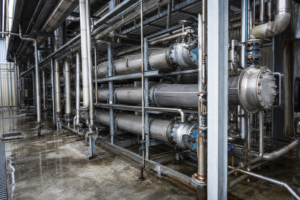
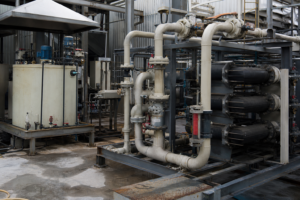
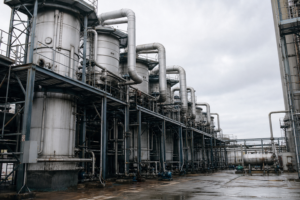
Landfill leachate defeats most single-technology treatment trains because it concentrates everything a landfill contains — dissolved organics, inorganic macro-components, heavy metals, and xenobiotic organic compounds — in a stream whose chemistry shifts as the landfill ages. Evaporation solves the endgame: it tolerates that variability better than membrane or chemical processes, and in modern configurations (MVR evaporation plus forced-circulation crystallization) it converts leachate concentrate into greater than 85% reusable distilled water and a dewaterable solid — full quantification, zero liquid discharge. Externally published references cover a wide size band — from 24 t/d MVR zero-liquid-discharge units to a 150 m³/d full-quantification train, and a supplier-published Chinese project treating leachate concentrate with COD above 80,000 mg/L using exactly this MVR + forced-circulation crystallizer combination at 100 t/d (external industry references, not EvapCryst deliveries, indicative rather than project guarantees).
What Is Actually in Landfill Leachate
Leachate is the runoff generated when moisture percolates through waste — from operational or closed landfills — flowing slowly on dry days and in spikes when rainfall combines with it. Four contaminant groups define the treatment problem:
- Dissolved organic matter — the bulk of the COD load, including refractory humic fractions that resist biological treatment.
- Inorganic macro-components — ammonia, chloride, sodium, potassium, and sulfate at gram-per-liter levels.
- Heavy metals — site- and waste-dependent.
- Xenobiotic organic compounds — trace persistent organics; hazardous-waste landfills carry all of the above plus RCRA-regulated species.
Composition depends on the site, its design, the waste it accepted, its operating mode — and critically its age. Young landfills, under roughly five years, run lower pH with higher COD, BOD, and heavy metals; stabilized older sites shift toward refractory organics. Ammonia and salinity stay high at every age. The engineering consequence: a treatment process selected for a young landfill’s profile may fit poorly ten years later, and regulators (EPA’s MSWLF rules in the United States, and increasingly strict leachate standards in China and the EU) require collected leachate to be treated regardless.
The Recirculation Dead-End: Why ZLD Arrived
The conventional leachate plant is biological treatment followed by reverse osmosis, often with disc-tube RO (DTRO) on the biological effluent. Its unresolved stream is the RO reject — typically 20–30% of the feed, carrying the salt and refractory organics the membranes removed. Historically the answer was recirculation: pump the concentrate back into the landfill.
That loop is now closing. A supplier-published case at a Chinese municipal landfill — an external industry reference, not an EvapCryst delivery — shows the mechanism: the site treated raw leachate with biology plus conventional RO plus DTRO, returned the DTRO reject to the landfill — and watched leachate TDS climb year over year, because recirculated salt returns with interest. With new regulations expected to forbid the practice, the site ran an end-to-end ZLD pilot on the concentrated brine, targeting clean water and solids at the lowest total cost of ownership. This is the structural reason evaporator-crystallizer trains entered leachate: they are the only unit operations that eliminate the residual stream instead of relocating it.
Route 1: Direct Evaporation on Free Landfill Energy
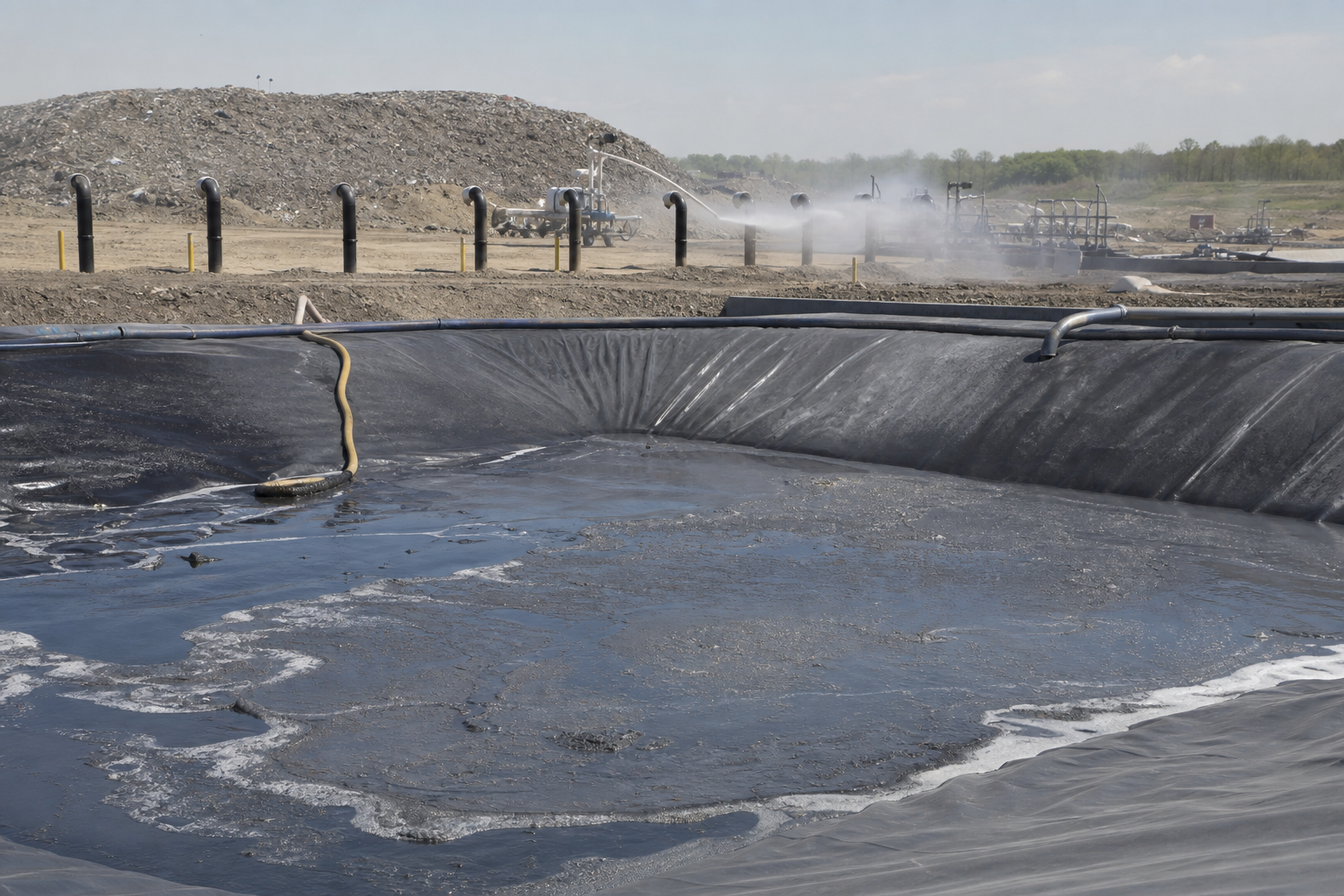
Where leachate volumes and concentrations allow, the most economical configuration evaporates leachate directly — and landfills hold a unique energy advantage: naturally occurring landfill gas. Off-spec landfill gas that cannot fuel the site’s engines, waste heat from the flare, and exhaust from on-site power generation are all free heat sources for thermal evaporation:
- Landfill gas firing: thermal evaporators burn off-spec gas at a rate matched to leachate generation, disposing of a waste gas and a wastewater in one unit.
- Flare and engine exhaust: hot exhaust ducted to the evaporator replaces purchased fuel entirely.
Direct evaporation to atmosphere removes a very high percentage of the water volume without a discharge permit for distillate. Its constraint is regulatory and air-side: the vapor stream and any emissions must satisfy local air rules, and the residue still requires management as a concentrated waste.
Route 2: Membrane Train with Evaporation on the Concentrate
At higher volumes, the economical architecture puts evaporation only where it earns: a pretreatment and membrane train handles the bulk water, and the evaporator treats the reject. A representative configuration is filtration and softening, ultrafiltration or reverse osmosis for bulk separation, then an MVR evaporator — with two stages of heat recovery — evaporating the membrane reject and recovering distillate. The distillate quality from MVR evaporation of leachate concentrate is suitable for reuse; the residual brine proceeds to crystallization.
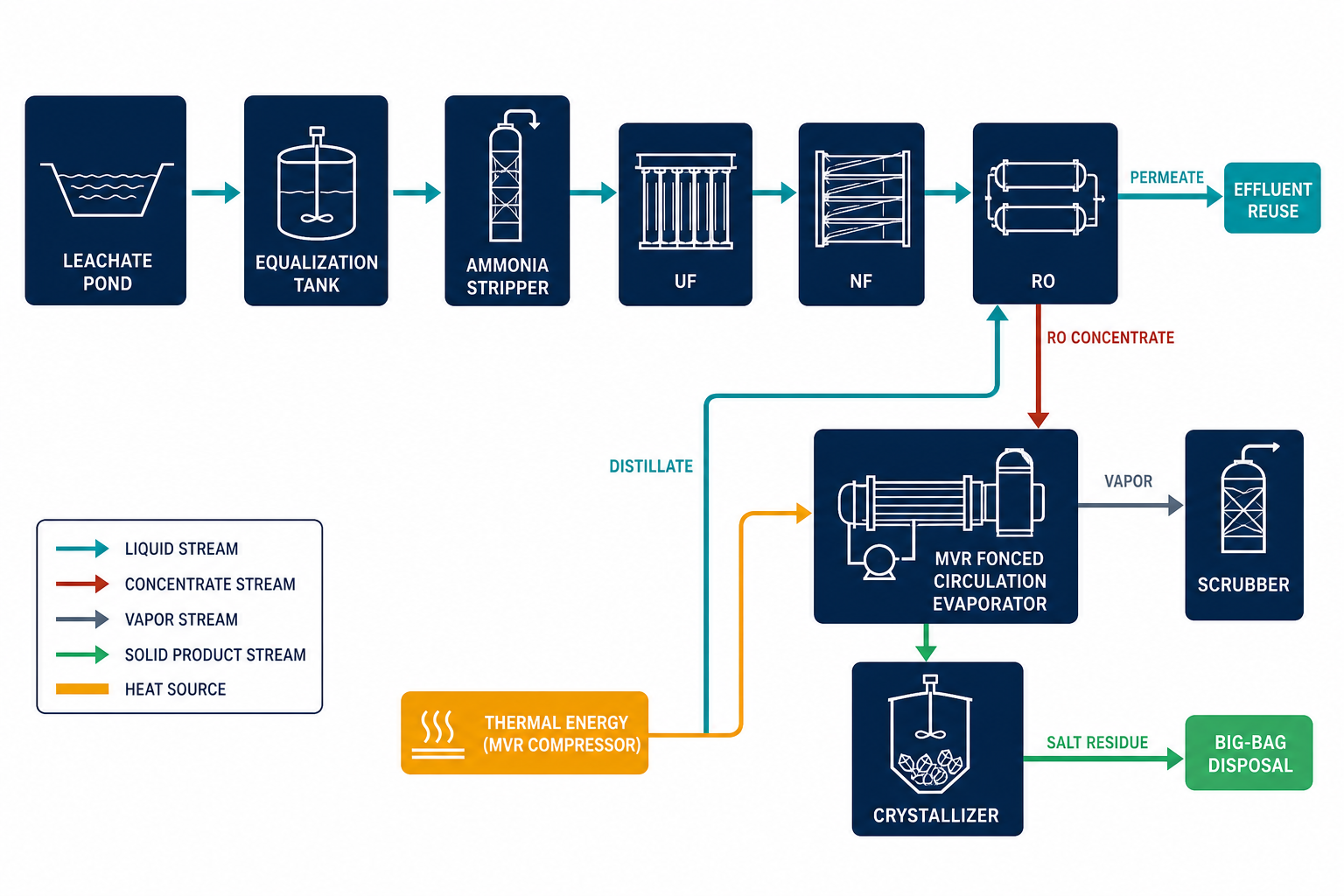
The division of labor is economic: membranes remove water at the lowest cost per cubic meter while the feed is dilute, and evaporation takes over near the osmotic limit where membrane recovery stalls. Evaporation’s tolerance for feed variability — composition swings that would foul or exceed an RO train — is the second reason it holds the back-end position.
Working at the Extreme: High-COD Concentrate at 80,000 mg/L
The hardest duty in this field is the leachate concentrate itself — the material a recirculation ban leaves stranded. The vendor-published Chuzhou project (Anhui, China) — an external industry reference, not an EvapCryst delivery, indicative rather than a project guarantee — treats leachate concentrate at a domestic waste treatment center with COD exceeding 80,000 mg/L and high salinity, under a full-quantification requirement with zero liquid discharge and salt resource recovery. The plant configuration:
| Parameter | Value / design choice |
|---|---|
| Feed | Landfill leachate concentrate, COD > 80,000 mg/L, high salt |
| Train | MVR evaporator + forced-circulation crystallizer |
| Capacity | 100 t/d of concentrate |
| Fresh-water reuse rate | > 85% of distillate |
| Energy measure | Cascaded waste-heat utilization, ~35% energy reduction |
| Key design features | Anti-fouling evaporator geometry for high-organics service; continuous automatic salt discharge; cloud-based remote monitoring |
Three transferable lessons sit in that table. The anti-scaling, high-shear forced-circulation crystallizer is what makes continuous salt discharge possible on a stream that would blind finer equipment. Cascaded heat use — reusing vapor heat across stages — is where the 35% energy reduction comes from, the same logic described in our waste-heat evaporation solutions. And cloud monitoring addresses a leachate-specific operational reality: these plants sit on remote sites with no resident process engineers.
Choosing Between the Routes
| Criterion | Route 1: Direct evaporation | Route 2: Membranes + MVR evaporation |
|---|---|---|
| Best-fit site | Smaller leachate volume, available landfill gas or flare heat | Higher volume, power available, distillate reuse valued |
| Energy source | Free landfill gas / flare / engine exhaust | Electricity (MVR), industry-reported ~25–45 kWh per tonne water |
| Water product | Evaporated to atmosphere (no liquid product) | Distillate recovered for reuse (>85% in reference plants) |
| Residue | Concentrated waste for disposal | Solid salt from crystallizer, dewaterable |
| Air-side consideration | VOC management on the vapor stream | Closed system; VOCs concentrate in small streams |
| Regulatory posture | Volume elimination | True ZLD / full quantification |
| Process Module | Candidate Equipment Types | Selection Rationale | Indicative Operating Envelope |
|---|---|---|---|
| Pretreatment & softening | Filtration, softening, pH control | Conditions the feed and manages ammonia ahead of thermal duty | Set by leachate age and salinity |
| Bulk water removal | UF / RO or disc-tube RO train | Moves dilute water at lowest cost per cubic meter | Reject typically 20–30% of feed |
| MVR evaporation | MVR evaporator with two-stage heat recovery | Takes over at the osmotic limit; tolerates feed swings | Industry-reported ~25–45 kWh per tonne water |
| Crystallization | Forced-circulation crystallizer with continuous salt discharge | Handles high-organics, high-salt brine without blinding | Reference duty: COD > 80,000 mg/L at 100 t/d (vendor-published) |
| Distillate polishing | Stripping, adsorption, or oxidation | Meets ammonia and VOC reuse limits | Per reuse specification |
| Direct-fired option (Route 1) | Thermal evaporator on landfill gas or flare heat | Eliminates volume on free site energy | Subject to local air-side permitting |
Configuration, materials, and operating ranges depend on actual feed, temperature, pressure, corrosion review, fouling behavior, utilities, and project capacity.
Skid-Mounted Delivery for Landfill Sites
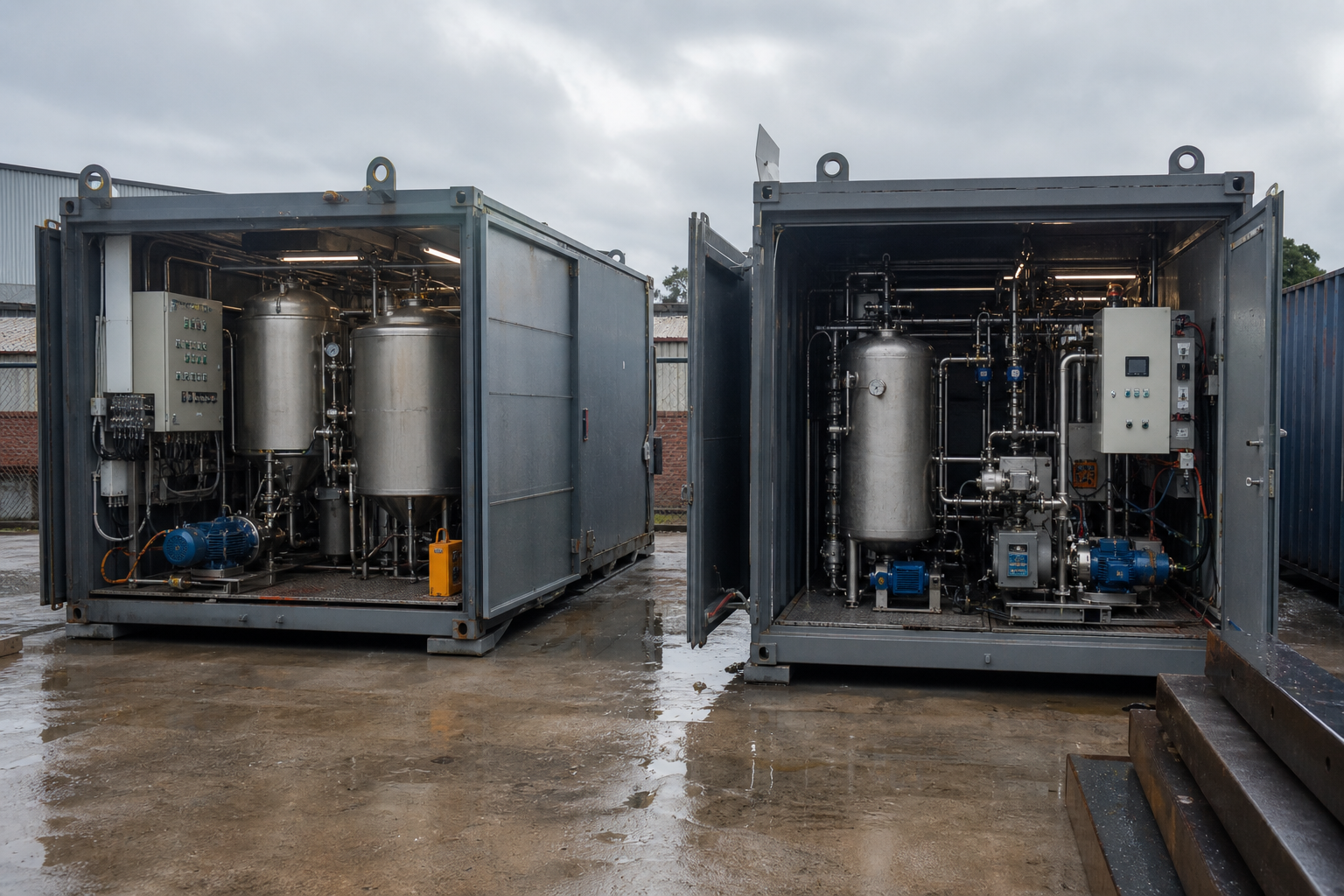
Leachate plants share the logistics of remote infrastructure: limited crane access, thin site labor, and schedules tied to landfill operations. Skid-mounted evaporation units answer all three — factory-assembled, tested, and shipped as modules that are set and piped rather than erected — and are an established delivery format for leachate concentration in this market. Modularization also matches capacity growth: a site can begin with one train and add units as leachate generation or regulation demands. Our skid and modular systems page covers the delivery format in detail.
Scale Range and Integration
Reference plants in this field span from 24 t/d MVR zero-liquid-discharge units on municipal landfills to 150 m³/d full-quantification trains, with the 100 t/d high-COD Chuzhou project illustrating the top of the difficult-feed range. Integration follows the standard ZLD pattern described on our zero liquid discharge page — MVR evaporation (technology detail) followed by crystallization and solids handling — applied to a feed that is more organic and more variable than most industrial brines. Related duties are covered under complex wastewater solutions and in our crystallizer selection guide.
Ammonia and VOC Management: The Overlooked Design Front
Because ammonia stays high in leachate at every landfill age, and trace volatile organics ride the vapor, the condensate side of a leachate evaporator needs deliberate design — this is where projects quietly fail their discharge permits. The engineering responses are layered: pH control ahead of or inside the train suppresses ammonia carry-over into the vapor; distillate polishing (stripping, adsorption, or oxidation) catches residual ammonia and trace VOCs where the reuse standard demands it; and closed MVR architectures concentrate volatile species into small, treatable side streams instead of dispersing them, which modern designs treat as a built-in advantage over open atmospheric evaporation. Air-side permitting for direct-fired Route 1 units follows the same logic — the vapor stream is characterized and managed rather than assumed clean. Specifiers should require ammonia and VOC fate analysis as a deliverable in every leachate evaporation proposal, not as an afterthought at commissioning.
Conclusion
Leachate treatment has converged on evaporation for the same structural reason across three continents: membranes and biology stall on a stream that concentrates against them, and recirculation returns the problem with interest. Direct evaporation on free landfill energy eliminates volume at the lowest possible cost where air-side rules allow; MVR evaporation with forced-circulation crystallization delivers true zero liquid discharge — over 85% water reuse, continuous salt discharge, and service at COD levels above 80,000 mg/L in published references.
When This Route May Not Fit
Evaporator-crystallizer trains are not the answer for every site. Small landfills with cheap off-site disposal or a nearby municipal treatment plant willing to accept leachate can truck it for years below the capital cost of thermal closure. Closed sites without landfill gas, flare heat, or reliable power have no energy source to run either route. Where air-side permits will not accept the VOC and odor burden of direct-fired evaporation, Route 1 is dead on arrival regardless of economics. If the dewatered salt or concentrate residue has no compliant disposal or recovery outlet, full quantification merely relocates the liability into a solid. And where recirculation remains legally permitted and accepted, the regulatory driver for ZLD weakens accordingly.
What Must Be Verified
Validation focus: a seasonally and age-resolved sampling campaign — COD, ammonia, chloride, heavy metals across dry and wet seasons and landfill age — because the train is sized for the swing, not the average. Ammonia and VOC fate must be quantified against the distillate reuse or discharge target before the condensate design is fixed. For Route 1, landfill-gas quantity and calorific value, plus the local air permit’s VOC limits, decide feasibility. The residue needs early classification and an accepting outlet. For Route 2, fix the membrane recovery and reject TDS at the interface, and run the energy arithmetic on real electricity prices versus free site heat.
FAQ
Why can’t RO reject simply be recirculated into the landfill?
Because the salt returns: recirculated concentrate re-enters the leachate, and TDS climbs year after year — a documented pattern at sites running DTRO with reject recirculation. Regulations in several jurisdictions now restrict or forbid the practice, which is what drives ZLD adoption.
What recovery can evaporation achieve on leachate?
Reference MVR + crystallizer plants report fresh-water reuse above 85% of distillate, with the balance leaving as dewaterable salt. Direct thermal evaporation on landfill gas eliminates the water volume to atmosphere instead of recovering it.
Can evaporation handle COD above 80,000 mg/L?
Yes — the externally published Chuzhou plant treats concentrate at COD above 80,000 mg/L and high salinity at 100 t/d using an MVR evaporator with forced-circulation crystallization and anti-fouling geometry.
What does a leachate evaporation plant cost to run?
The dominant variable is energy. MVR-based trains consume electricity on the order of 25–45 kWh per tonne of water evaporated; direct-fired units can run on free landfill gas or flare heat, and cascaded heat use has delivered about 35% energy reduction in reference plants.
Is leachate chemistry stable enough for evaporation?
Leachate changes with landfill age — young sites run higher COD, BOD, and metals; ammonia and salinity stay high throughout. Evaporation tolerates this variability better than membrane or chemical treatment, which is precisely why it holds the back-end position in leachate trains.
Scoping leachate closure? Send the leachate or concentrate analysis (COD, ammonia, chloride, metals), daily volume, and site energy situation (landfill gas, power) — in exchange you will receive a first-pass screening of the route — direct evaporation versus membrane-plus-MVR crystallization — and the residue disposition it implies.