Project Parameters
| Parameter | Value |
|---|---|
| Process route | MVR evaporation concentration and crystallization of mixed nickel-cobalt sulfate liquor |
| Industry | Lithium battery recycling, nickel-cobalt recovery (China) |
| Feed type & key components | Mixed nickel-cobalt solution from recycled battery streams: pay-metal sulfates in dilute liquor |
| Evaporation capacity | 20 t/h |
| Construction materials | SS316L wetted parts baseline for sulfate service (indicative) |
Representative process configuration compiled from published industry project data. Indicative values, not a process guarantee.
Project Description
The economics of battery recycling live in the pay metals, and in China’s recycling flowsheets the nickel and cobalt exit leaching as a mixed sulfate liquor — valuable, dilute, and voluminous. Downstream buyers and precipitation circuits want it concentrated: every ton of water evaporated from the liquor is a ton not shipped, not stored, and not re-pumped. The reference configuration is a 20 t/h MVR evaporation crystallization train taking that mixed nickel-cobalt solution and driving it toward the concentration and crystallization points where battery-grade nickel sulfate and cobalt sulfate products are made.
This is evaporation as value concentration rather than waste treatment — the same MVR machinery the industry runs on wastewater, pointed at a stream where every cubic meter carries metal worth recovering. The design brief differs accordingly: purity protection matters more here than in any waste duty, because the evaporator touches product.
Process Technology
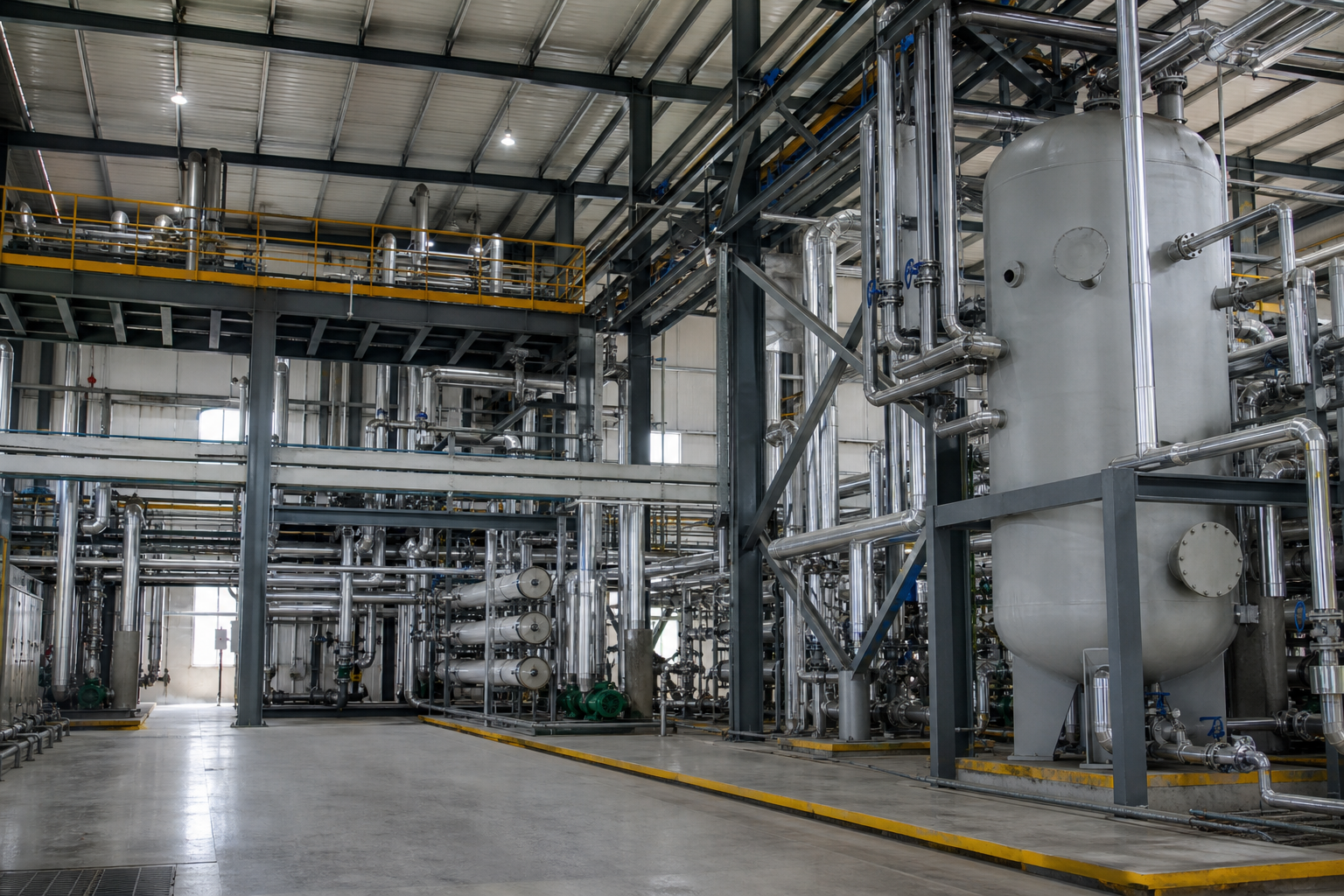
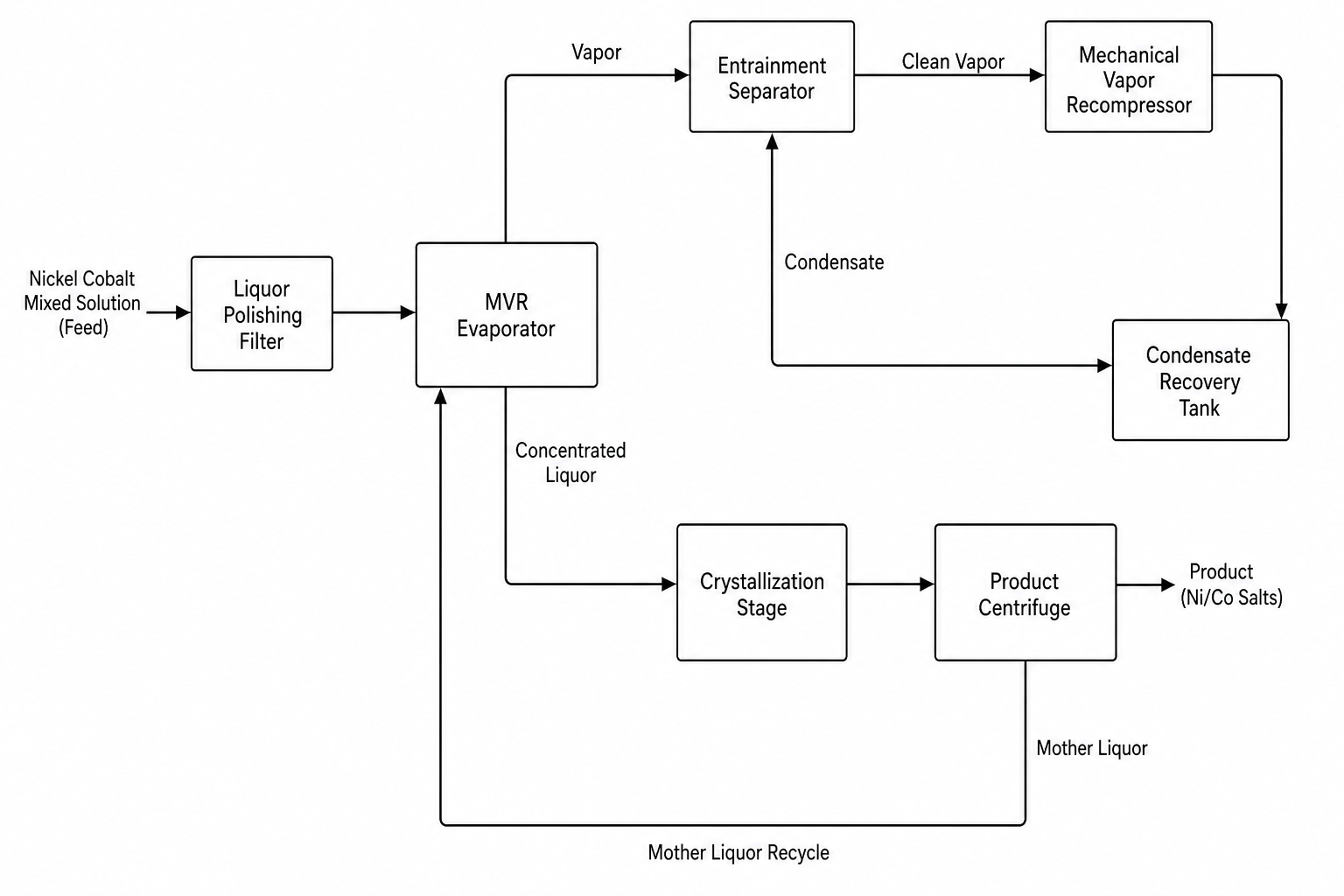
The liquor is received, polished for suspended solids and entrained organics from the upstream extraction circuit, and fed to the MVR concentration train. Mechanical vapor recompression drives the evaporation electrically; the train concentrates the mixed sulfate liquor stepwise toward the crystallization regime, with vapor separation designed for entrainment control — sulfate droplets carried into the condensate are pay metal lost, and every stage of the train is built with that accounting in mind.
Crystallization behavior decides the product routing. Nickel sulfate hexahydrate crystallizes cleanly from concentrated liquor at controlled temperature — it is one of the more cooperative salts in the battery materials chain — and cobalt sulfate follows a similar concentration-temperature logic on its own line where the flowsheet splits the metals upstream. In the mixed-liquor reference configuration, the train delivers a concentrated liquor to the downstream separation and crystallization circuits, and the product-side crystallizers (whether on this train’s footprint or the host plant’s) turn it into battery-grade salt with the crystal size distribution the cathode chain specifies.
Mother liquor management is the purity discipline: a controlled recycle keeps the crystallizer fed at steady supersaturation, and a purge bounds the accumulation of sodium, magnesium and calcium that always ride along in recycling liquors — the impurities that would otherwise report to the product crystal and fail a cathode specification.
Condensate — twenty tons per hour of it — returns to the recycling plant’s leaching, washing and extraction duties, closing the water loop around the metals loop. Published configurations across the segment run mixed and single-metal sulfate trains from cobalt liquor concentration with downstream cooling crystallization to 25 t/h lithium-sodium and 82 t/h sodium sulfate duties — one thermal architecture spanning the recycling flowsheet.
Equipment Configuration
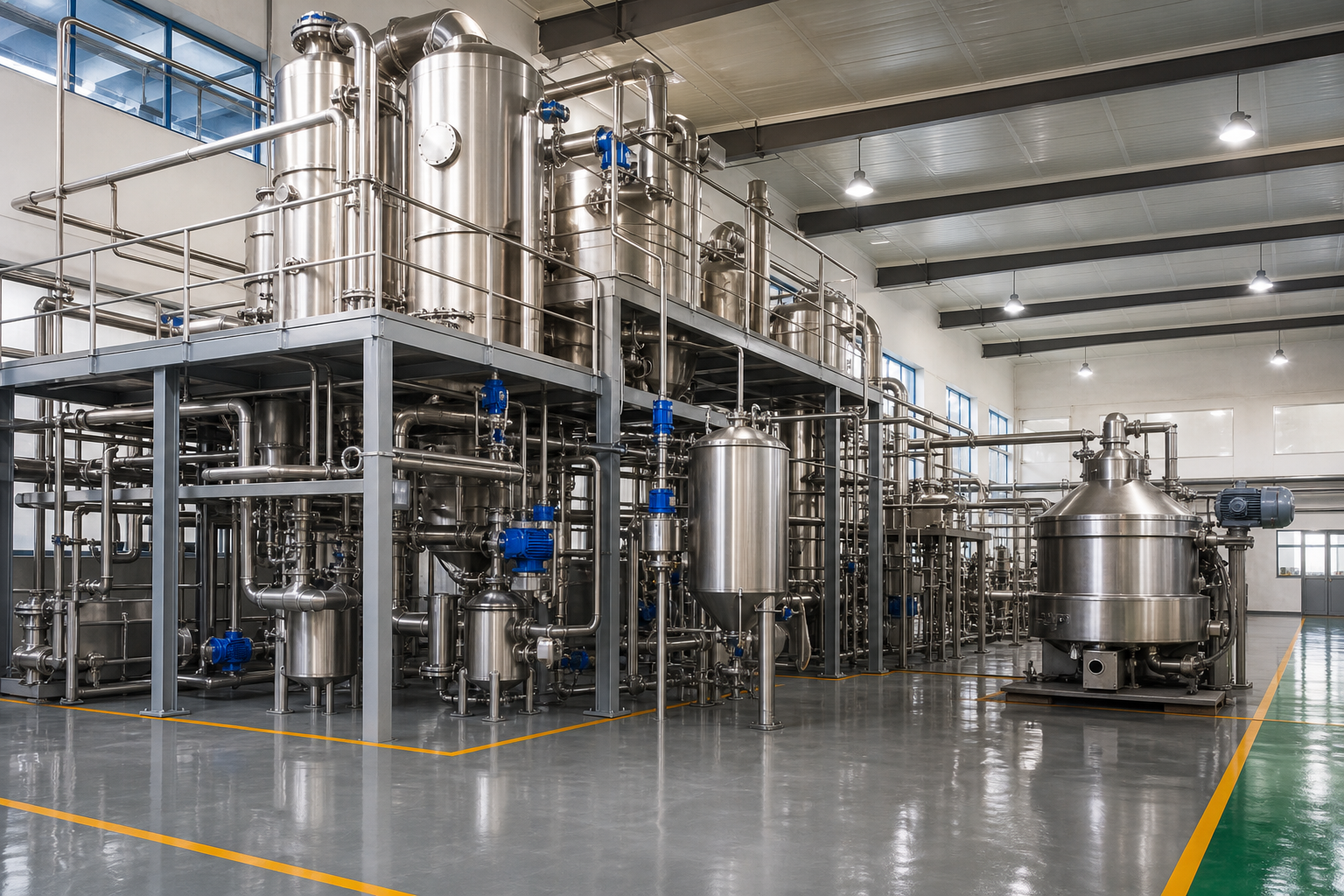
One set of the following equipment is typical for this duty:
- Mixed Ni-Co liquor receiving and polishing filtration
- MVR evaporation concentration train with entrainment control
- Crystallization stage toward battery-grade sulfate salt products
- Centrifuge and drying interface for product crystal handling
- Mother-liquor recycle with impurity purge management
- Condensate recovery to leaching and washing; DCS control of metal inventories
Performance & Outcome
Compiled from published industry project data, indicative: 20 t/h trains of this class concentrate nickel-cobalt mixed sulfate liquor from recycling into battery-materials product chains on electrically driven MVR energy, protecting pay-metal yield through entrainment control and purge discipline. Product grade and specific energy are quoted per liquor matrix.
Simplified PFD
The simplified process flow diagram above shows liquor polishing, the MVR concentration train with entrainment control, crystallization toward battery-grade sulfates, product centrifuging and condensate recovery.