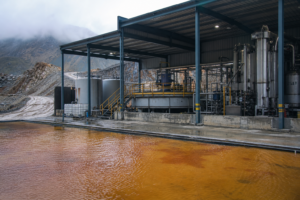
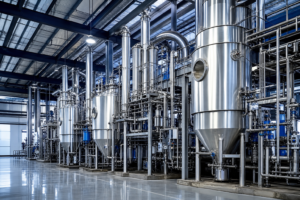
Sebacic acid (decanedioic acid, C10 dicarboxylic acid) is purified industrially by cooling crystallization, not evaporation: it melts at approximately 134.5 °C, is sparingly soluble in cold water, and its solubility rises steeply with temperature — dissolving the crude acid hot and crystallizing on controlled cooling removes soluble and insoluble impurities in one step. Because most commercial sebacic acid originates from alkaline cleavage of castor oil, the feed carries residual fatty acids, higher homologues, and colored organics — the system succeeds or fails on how well it manages that matrix. Continuous cooling crystallizers are the core unit at scale because they hold a stable supersaturation profile around the clock — what uniform size and repeatable purity require.
Where Sebacic Acid Comes From, and Why It Matters for Crystallization
Practically all commercial sebacic acid comes from caustic fusion (alkaline cleavage) of castor oil or ricinoleic derivatives, with 2-octanol and glycerine as co-products. After acidification, crude sebacic acid precipitates with the impurity suite above. The purification train is conventionally: redissolution in hot water or dilute alkali, activated-carbon decolorization, hot polish filtration, cooling crystallization, centrifugation or filtration, and low-temperature drying.
This chemistry has two direct consequences. First, decolorization and polish filtration must finish before the liquor cools: carbon fines and resinous carryover nucleate uncontrolled fines and lock colored bodies into the lattice. Second, mother liquor accumulates soluble homologues and degradation products with every recycle, so a purge stream and make-up water balance belong in the flowsheet, not after it.
Cooling Crystallization Versus Evaporation Crystallization
The choice of supersaturation generation method follows from the solubility curve and thermal stability of the product. For sebacic acid the case is unambiguous:
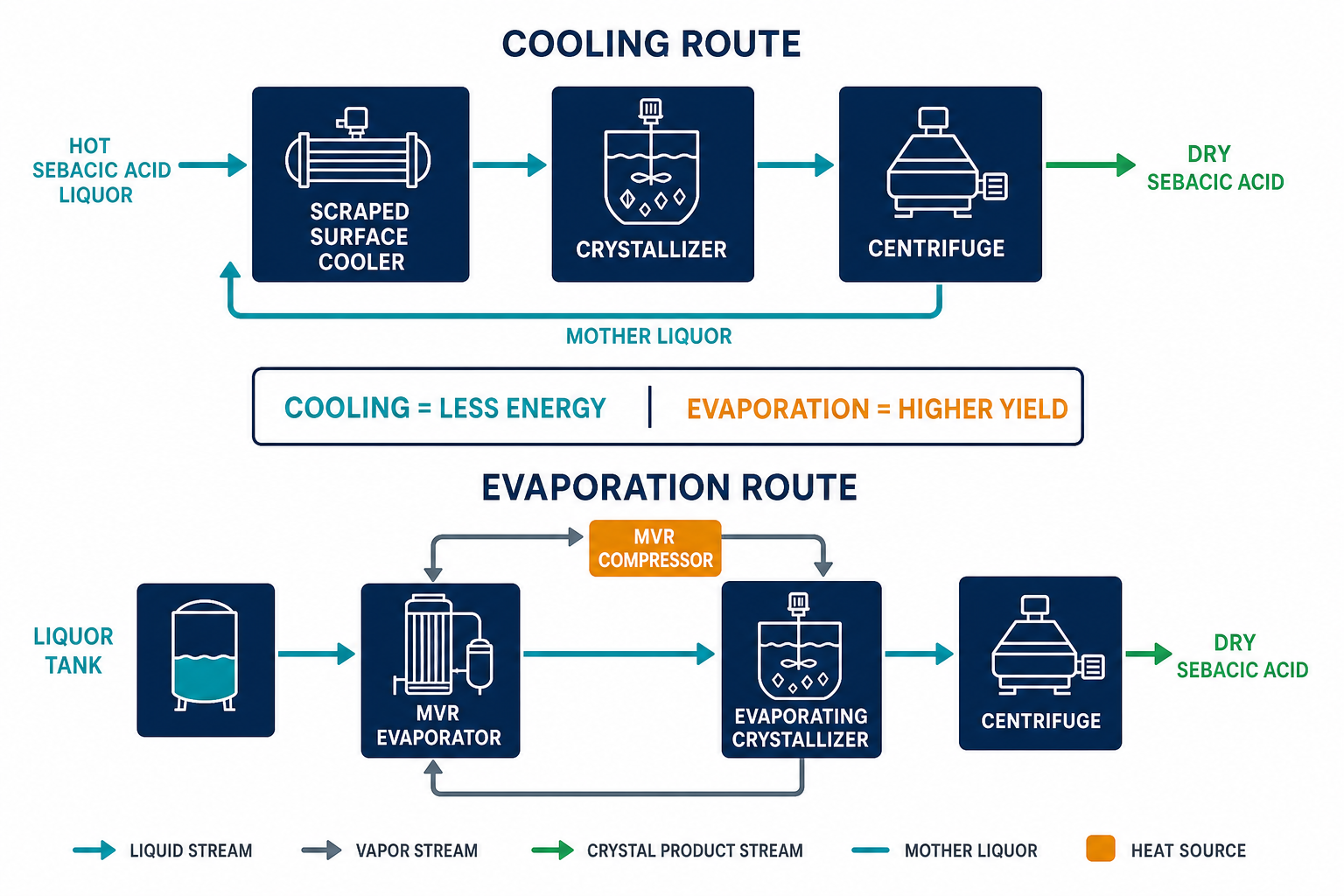
- Evaporative crystallization would boil off large water quantities from a liquor with heat-sensitive organics, spending steam on solvent that cooling removes for the cost of circulating water.
- The strong positive temperature coefficient means the cooling span between hot saturation and final mother-liquor temperature converts directly into yield, the last few degrees mattering most.
- The product is thermally robust but its color specification is not: prolonged hot holding darkens the liquor by slow oxidation, so the goal is dissolve hot, filter hot, then leave the high-temperature zone fast.
General criteria for choosing among cooling, evaporative, and precipitation routes are discussed on our crystallization technology page.
Continuous Versus Batch Cooling Crystallization
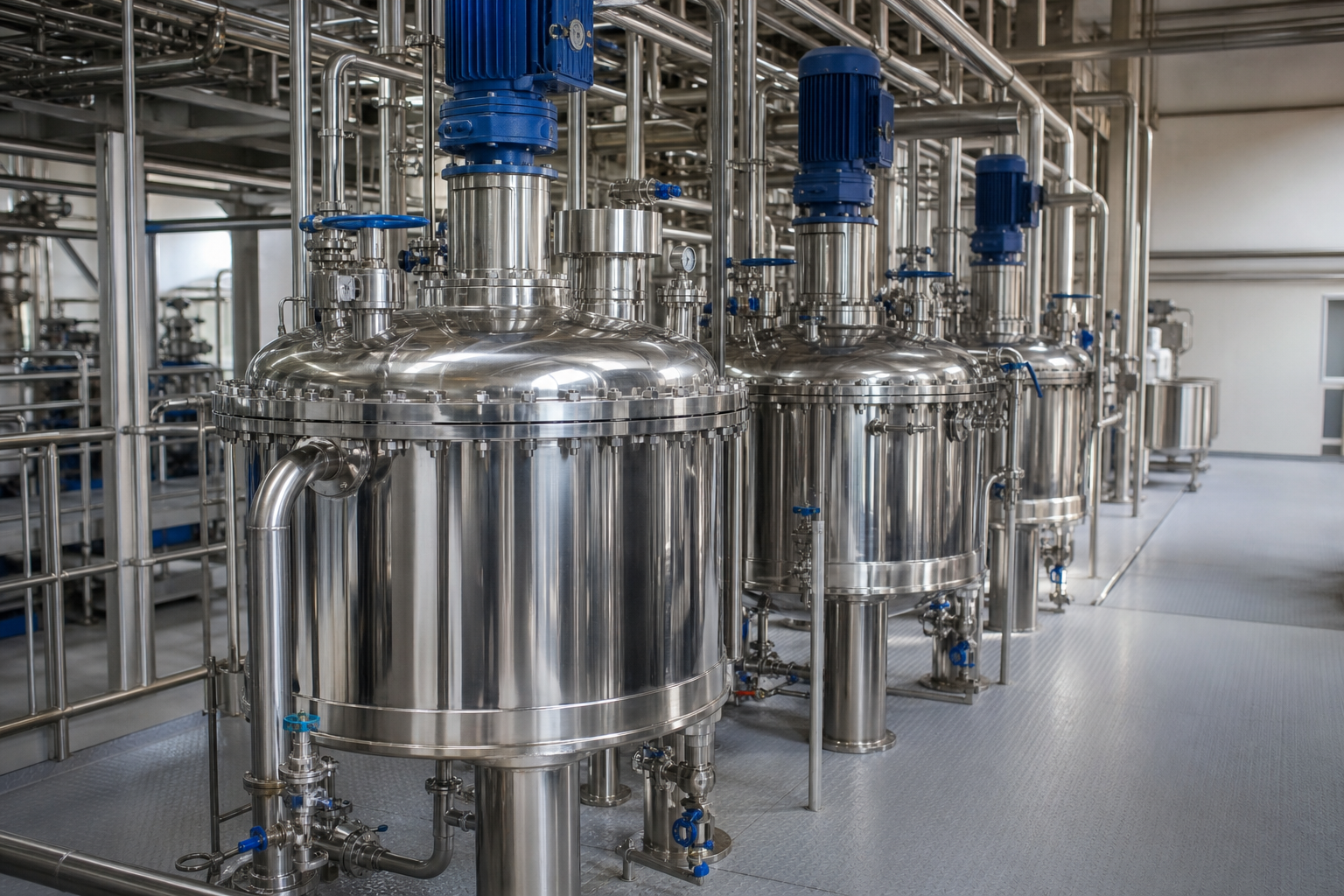
Batch cooling crystallizers dominate small-volume and campaign production, but sebacic acid plants above pilot scale increasingly specify continuous operation. The engineering comparison is straightforward:
| Criterion | Batch cooling crystallizer | Continuous cooling crystallizer |
|---|---|---|
| Temperature profile | Follows a programmed batch curve; transient at start and end of every batch | Steady gradient along the crystallizer train; each zone held at design temperature indefinitely |
| Crystal size distribution | Varies between batches; start-of-batch fines common | Narrow and repeatable; classified product removal smooths the distribution |
| Purity consistency | Operator and batch dependent | Fixed residence time at fixed supersaturation; impurity rejection is steady |
| Scale-up route | Larger vessels, slower heat removal per volume | Longer or parallel trains; heat-transfer area scales with stages |
| Utilities and labor | Peaks in cooling demand at batch start; high attention per batch | Flat cooling load sized once; automated, unattended steady state |
In continuous service the body is a staged agitated series or fluidized-bed classified crystallizer, heat removed through external surface against cooling or chilled water. Agitation is a compromise: enough shear to suspend crystals and prevent local overheating at cooling surfaces, not so much that crystals abrade into fines. Where particle size is a specification item, a fluidized-bed design such as the Oslo-type crystallizer lets crystals grow in a gentle suspended bed while the fines loop returns small crystals to the growth zone; draft-tube designs (our DTB crystallizer page) add internal classification for tighter control.
Cooling Curve Design: The Variable Competitors Under-Engineer
The most common cause of poor sebacic acid crystal quality is not the vessel but the cooling program. Natural (uncontrolled) cooling is fastest at the start, exactly where the liquor is hottest and most supersaturation-tolerant — producing early nucleation bursts and slow late growth: small, variable crystals. The correct program reverses it: cool slowly through the high-temperature metastable zone where nucleation is easy, then faster near the end where the curve flattens and existing crystal area absorbs the supersaturation. In practice, track a profile following the saturation curve at fixed offset, not a straight line from dissolution to final temperature.
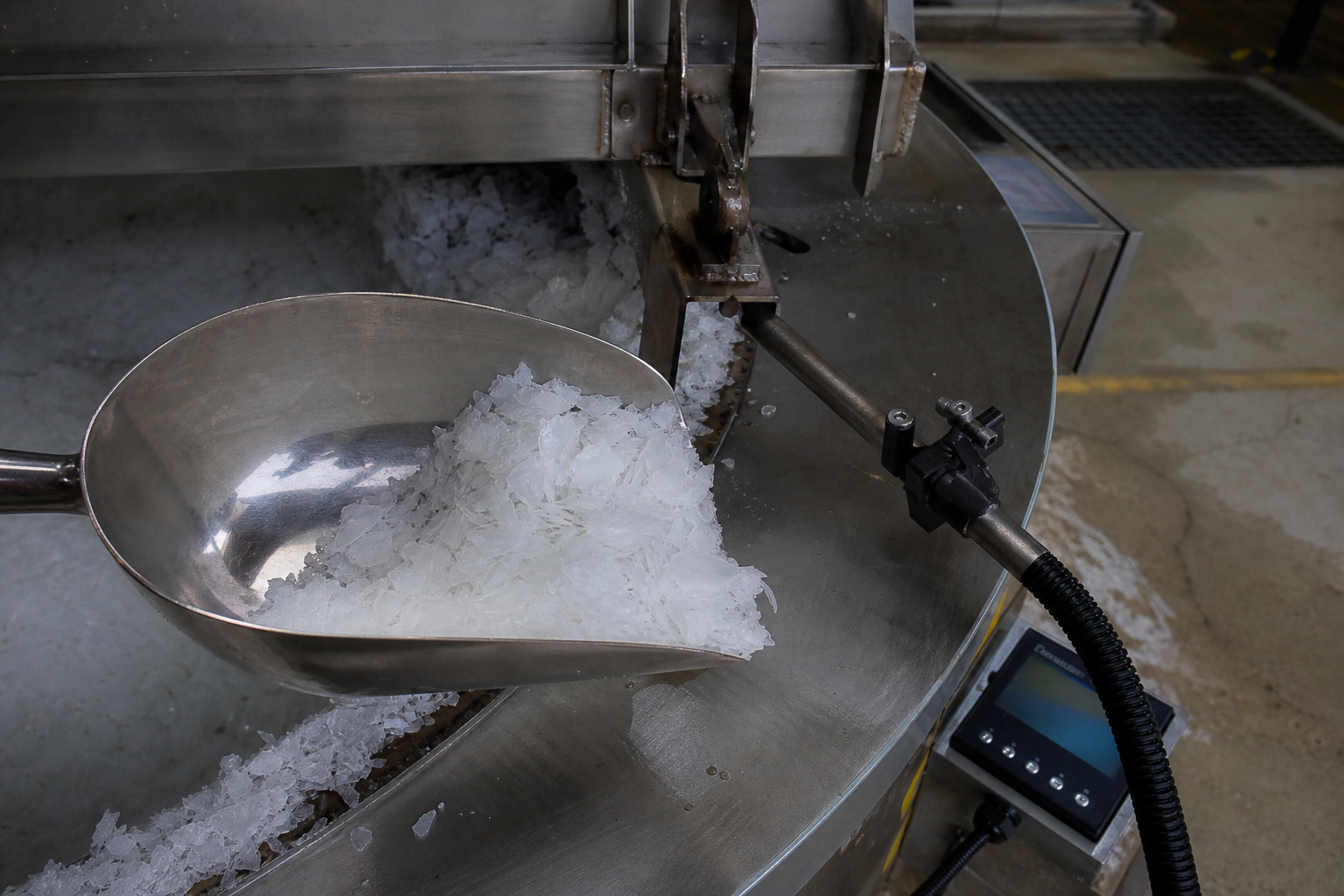
Seeding is the second lever. A measured charge of well-formed seed at first supersaturation gives growth sites instead of forcing nucleation, stabilizing batch-to-batch size distribution and cutting the fines load reaching the centrifuge. Continuous plants achieve the same with a fines-destruction loop dissolving crystals below target size and recycling them as solute for growth on the survivors.
Mother Liquor Management and Yield
Final mother-liquor temperature sets theoretical yield: cold-end solubility is what stays behind in solution. Plants push toward chilled-water finals in winter and against cooling-water limits in summer — why summer output can fall without a chiller in the design. Between impurity purge and the solubility floor at final temperature, the recovery ceiling is process-fixed; yield efforts belong in mother-liquor staging and purge minimization, not heroic end-of-train cooling. Broader yield-recovery methodology is covered on our mother liquor recovery page.
Application-Driven Purity Requirements
Sebacic acid serves four demanding markets, and each imposes its own constraint on the crystallization system:
- Nylon 6,10 and polyamides: polymer-grade acid must not carry monocarboxylic acids or color bodies that terminate chains or yellow polymer — upstream polish filtration and carbon treatment are non-negotiable.
- Pharmaceutical intermediates: drug-substance routes use sebacic derivatives, and pharmacopeia-grade feed requires controlled impurities, documented materials, and validated cleaning — pushing toward sanitary 316L with CIP.
- Cosmetics: salts and esters appear in personal-care formulations, where color and odor carry directly to the consumer product.
- Surfactants and plasticizers: ester performance depends on purity, so the same decolorization discipline applies even at commercial grade.
Process Modules and Selection Basis
| Process Module | Candidate Equipment | Selection Basis |
|---|---|---|
| Redissolution & decolorization | Hot water or dilute alkali; activated carbon | Color spec; carbon fines control before cooling |
| Hot polish filtration | Polishing filter at dissolution temperature | Resinous carryover nucleates fines |
| Cooling crystallization | Staged agitated series, Oslo, or DTB | Cooling curve; particle size specification |
| Separation | Centrifuge or filter; fines-destruction loop | CSD control; recycle of undersize |
| Drying & sizing | Low-temperature air dryer, mill, sieve | Agglomeration and discoloration limits |
Note: configurations are indicative; selection depends on actual liquor, impurity matrix, hygienic standard, utilities, and capacity.
Materials, Hygiene, and the Drying Step
Wetted parts in hot dicarboxylic acid liquor are 304L or 316L; pharmaceutical lines specify 316L with polished drainable surfaces and CIP coverage of crystallizer, lines, and centrifuge. Drying deserves equal attention: it runs well below the melting point to avoid agglomeration and discoloration, with moderate-temperature air and short residence, then milling and sieving where a size fraction is sold. Facilities planning a combined concentration-and-crystallization scope will find the integrated flowsheet options on our concentration and crystallization solutions page, and chemical-industry project context on the chemical and agrochemical industry page.
When This Route May Not Fit
Cooling crystallization is the right answer only when the solubility curve pays for the cooling itself, and several common situations do not clear that bar. Feed liquors that arrive already cold and dilute carry no recoverable supersaturation across any useful span — evaporation or precipitation chemistry serves them better. Products whose specification is dominated by impurities that co-crystallize rather than staying in the mother liquor need a different separation route, not a longer cooling train. Campaign-scale pharmaceutical volumes where batch identity is a regulatory preference may not justify the extra controls and the steady-state discipline that continuous operation demands. And sites without chilled-water capability in hot climates surrender the final yield increment that so often decides the whole project’s economics.
What Must Be Verified
No external case data is embedded in this article, so validation before any capital commitment must cover all of the following on real materials: the actual liquor’s solubility and metastable-zone data measured across the full working temperature span, because published curves for pure acid understate the castor-oil impurity matrix; an impurity-partitioning check confirming which soluble homologues and which color bodies stay in the mother liquor at the intended final temperature; decolorization and polish-filtration performance verified on the real crude acid, including carbon-fines leakage into the polished liquor; the cooling utility’s seasonal envelope checked against the intended final mother-liquor temperature; and the mother-liquor purge and the make-up water balance sized from measured impurity accumulation rates, not from assumed values. Each pins a yield number.
Required inputs for screening: crude acid analysis (assay, homologues, color), target purity grade, capacity, and the seasonal cooling-water envelope — enough to outline the train and the yield.
Frequently Asked Questions
Why is cooling crystallization preferred for sebacic acid instead of evaporation?
Sebacic acid has low solubility in cold water and a solubility that rises steeply with temperature, so cooling a hot saturated liquor generates yield with cooling water instead of steam. Evaporative crystallization would boil a heat-sensitive organic liquor for no purity gain, spending energy to remove solvent the solubility curve removes for free.
How is crystal size controlled in sebacic acid crystallization?
Three mechanisms work together: a cooling program following the saturation curve, seeding at first supersaturation, and fines destruction recycling undersize as solute. Fluidized-bed and DTB geometries add classified discharge for a narrow product distribution.
What impurities come with sebacic acid from the castor-oil route?
The alkaline cleavage of castor oil produces sebacic acid together with higher fatty acids, shorter-chain dicarboxylic homologues, 2-octanol traces, and colored oxidation products. Soluble homologues accumulate in the mother liquor and are controlled by a purge; colored bodies are removed by activated carbon before the liquor reaches the crystallizer.
Is continuous crystallization better than batch for pharmaceutical-grade sebacic acid?
Continuous operation delivers steadier supersaturation, tighter size, and flatter utility loads — suited to large volume. Batch remains right for campaigns, early-phase pharmaceutical volumes, and batch-identity regulatory preferences; both reach the same purity when upstream decolorization and filtration are engineered correctly.
What limits the yield of a sebacic acid crystallization plant?
Two hard limits: the solubility of sebacic acid at the final mother-liquor temperature, which is set by the cooling-water or chilled-water temperature available, and the mother-liquor purge rate required to stop soluble impurities accumulating. Yield projects improve by staging crystallization and minimizing purge, not by over-chilling the final effect.