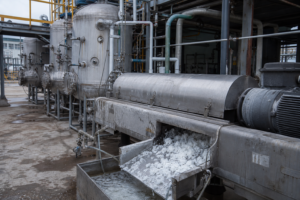
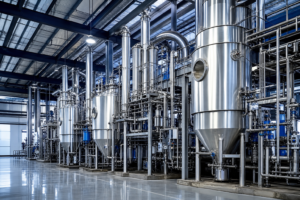
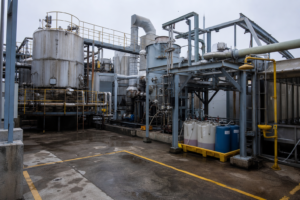
Acid mine drainage (AMD) — the acidic, sulfate-rich, metal-laden water that forms when sulfide-bearing rock meets air and water — is one of mining’s most persistent environmental liabilities, and one of its most treatable. For decades the default answer was lime neutralization, which works chemically but leaves a legacy of its own: vast quantities of gypsum-and-metal sludge that must be impounded forever. Evaporation and crystallization offer a different endgame. Applied to AMD, controlled crystallization converts the sulfate load into commercial-grade gypsum instead of sludge, mechanical evaporation recovers water instead of discharging it, and the residual salts — magnesium, sodium, and chloride species — emerge as separated, characterizable products rather than an anonymous hazardous residue. For mines facing closure obligations, water scarcity, or zero-discharge permits, this thermal route has moved from curiosity to a practical strategy. This article explains the chemistry that shapes AMD treatment, where evaporation and crystallization fit, and what the key engineering decisions are.
Where Acid Mine Drainage Comes From — and Why It Decides the Flowsheet
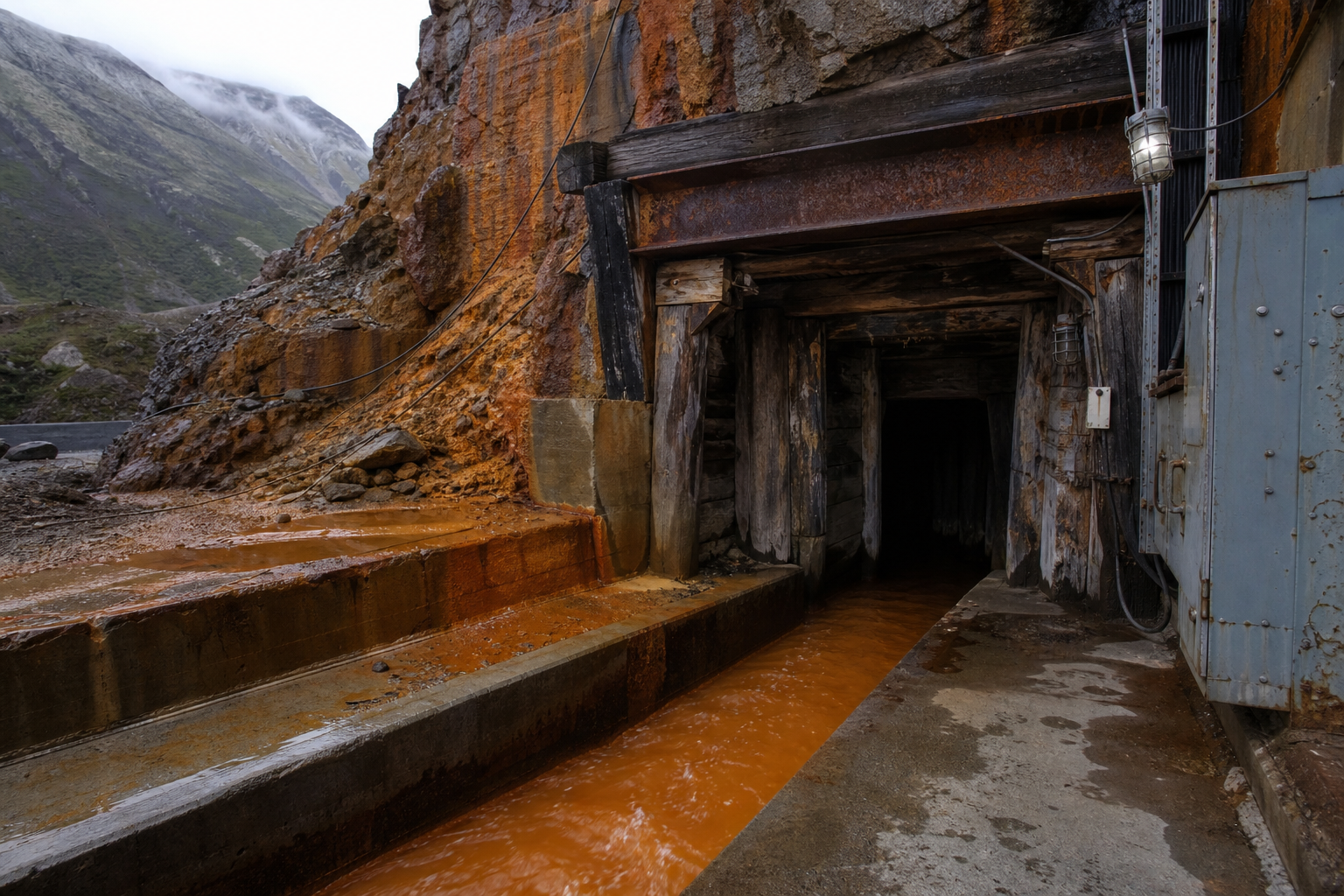
AMD originates in the oxidation of pyrite (FeS₂) and other sulfide minerals, exposed by mining and accelerated by water and oxygen. The chemistry is self-reinforcing: pyrite oxidation produces sulfuric acid and ferrous iron; ferric iron, regenerated from ferrous by bacteria-catalyzed oxidation, attacks more sulfide. The result is water with a signature composition that treatment designers can almost read blind:
| Parameter | Illustrative AMD Range | Process Consequence |
|---|---|---|
| pH | ~2 to 4.5 | Material selection; neutralization demand |
| Sulfate | ~1,000 to 10,000+ mg/L | Exceeds discharge limits many times over; drives crystallization load |
| Iron (Fe²⁺/Fe³⁺) | Tens to thousands of mg/L | Precipitation staging; color; sludge volume |
| Aluminum, manganese | Commonly significant | Co-precipitation behavior; product purity control |
| Heavy metals (Zn, Cu, Ni, Pb, As, Cd) | Site-specific, µg/L to mg/L | Regulatory drivers; toxicity of residues |
| Flow pattern | Perennial, weather-driven peaks | Equalization; decades-long treatment horizon |
Illustrative feed envelope, not customer or project data: the ranges are compiled from published AMD geochemistry literature and stated design assumptions; site-specific water chemistry governs every actual design.
Two facts follow from this composition. First, AMD is fundamentally a sulfate problem — neutralize the acidity and the sulfate remains, often above discharge limits on its own. Second, the stream is perpetual: an AMD source can flow for decades or centuries after mining ends, so any treatment chosen must be operable and financeable over a horizon far beyond normal plant economics. Both facts push toward solution architectures that recover rather than merely store.
The Treatment Landscape: Four Routes Compared
| Route | What It Does | Strengths | Limitations |
|---|---|---|---|
| Lime neutralization | Precipitates metals as hydroxides, sulfate as gypsum | Cheap, simple, proven at every scale | Large wet sludge volume; long-term impoundment liability; sulfate only partially removed |
| High-density sludge (HDS) | Recycled sludge neutralization variant | Denser sludge, better settling than basic lime | Still a storage strategy; same fundamental endpoint |
| Passive / natural evaporation ponds | Solar evaporation of impounded water | Minimal energy and operation | Land and climate dependent; permitting of new ponds increasingly difficult; no water recovery |
| Evaporation-crystallization (thermal ZLD) | Controlled crystallization of salts plus mechanical evaporation of water | Commercial gypsum product; recovered water; volume-minimized final residue | Energy cost; requires chemical staging and scale control discipline |
The routes are not mutually exclusive. A typical thermal project sits downstream of staged neutralization, which removes iron and aluminum and conditions the liquor; evaporation-crystallization then does what neutralization never can — separate the remaining sulfate into products and return the water to the mine.
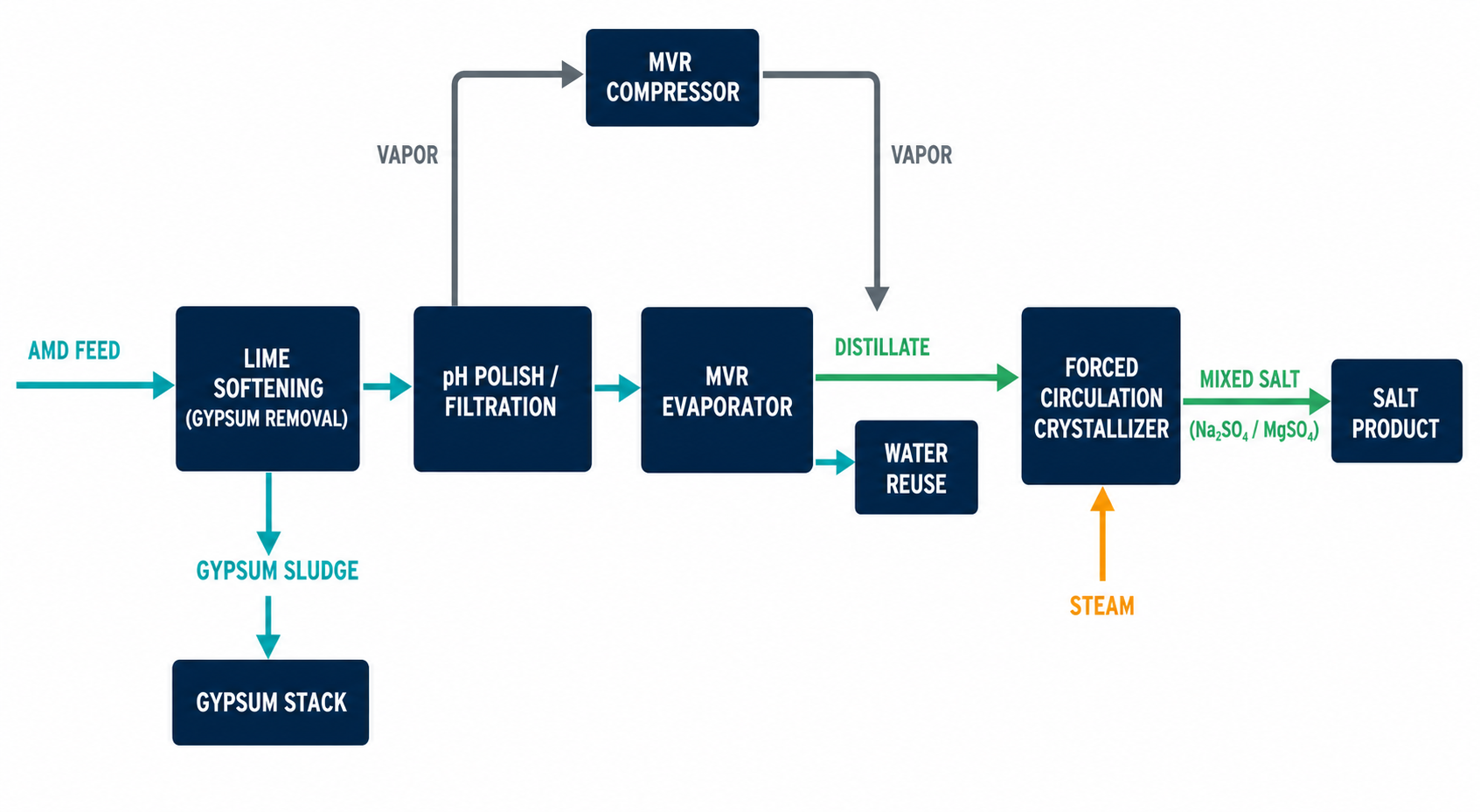
The Evaporation-Crystallization Flowsheet for AMD
Stage One: Selective Precipitation as Controlled Crystallization
The first separation is essentially free chemistry: raising the pH in stages precipitates iron and aluminum hydroxides first, then, with lime addition, the bulk of sulfate as calcium sulfate. The engineering difference between this stage done well and done badly is the difference between sludge and product. Neutralization performed as uncontrolled dumping produces a fine, contaminated, hard-to-dewater gypsum sludge; performed as controlled crystallization — correct pH staging, adequate residence time, seed recycling, and attention to metal co-precipitation — it produces a coarser gypsum with realistic markets in cement retarder, plaster, and soil amendment. The moral is simple: the crystallizer designer’s mindset belongs in the neutralization step too, because every impurity tolerated there follows the gypsum downstream.
Stage Two: Mechanical Evaporation of the Conditioned Liquor
The clarified liquor after gypsum removal is a magnesium-, sodium-, and residual-sulfate brine, and its water is best recovered by mechanical evaporation. In the established logic of zero liquid discharge systems — the same architecture used across zero liquid discharge applications — mechanical vapor recompression (MVR) evaporators consume an industry-reported 20–40 kWh of electricity per tonne of evaporated water and require no steam infrastructure, which matters at remote mine sites where the AMD plant may be the only thermal installation for kilometers. The distillate, condensed from what is essentially clean water vapor, returns to the mine as process water — a real asset in the arid mining districts of Australia, Chile, South Africa, and the western United States, where AMD discharge and freshwater extraction are both constrained.
Stage Three: Crystallization of the Residual Salts
As the brine concentrates, its dissolved salts crystallize in a sequence fixed by their solubility behavior: magnesium sulfate typically as Epsom salt (MgSO₄·7H₂O) in cooled crystallizers, sodium sulfate as Glauber’s salt or thenardite depending on temperature, and chloride as halite where chloride entered the system. The sequence is not incidental — it is the salt-separation strategy. Designing the crystallizer train to harvest salts in order of crystallization is what separates saleable products from a mixed salt residue, a discipline covered in detail on our salt separation and crystallization systems page.
The flowsheet above maps onto standard equipment modules; the table below summarizes, at type level, what each module may consist of and why it is selected.
| Process Module | Candidate Equipment Types | Selection Rationale | Indicative Operating Envelope |
|---|---|---|---|
| Staged neutralization & gypsum crystallization | Agitated staged reactors; gypsum crystallizer with seed recycle | pH staging turns iron/aluminum removal and bulk sulfate capture into coarse, marketable gypsum instead of sludge | Feed liquor typically pH ~2–4.5 (illustrative AMD range) |
| Clarification & conditioning | Clarifier; polishing filtration | Protects the thermal train from suspended solids | Set by site solids load |
| MVR evaporation | Falling-film or forced-circulation MVR evaporator | Recovers distillate without steam infrastructure at remote sites | Industry-reported ~20–40 kWh per tonne of evaporated water |
| Sequenced salt crystallization | Cooled forced-circulation crystallizers | Harvests MgSO₄·7H₂O and following salts in solubility order | Cut temperatures set by the Mg–Na–SO₄–Cl phase behavior |
Configuration, materials, and operating ranges depend on actual feed, temperature, pressure, corrosion review, fouling behavior, utilities, and project capacity.
The Scaling Problem: Why Calcium Sulfate Shapes the Equipment
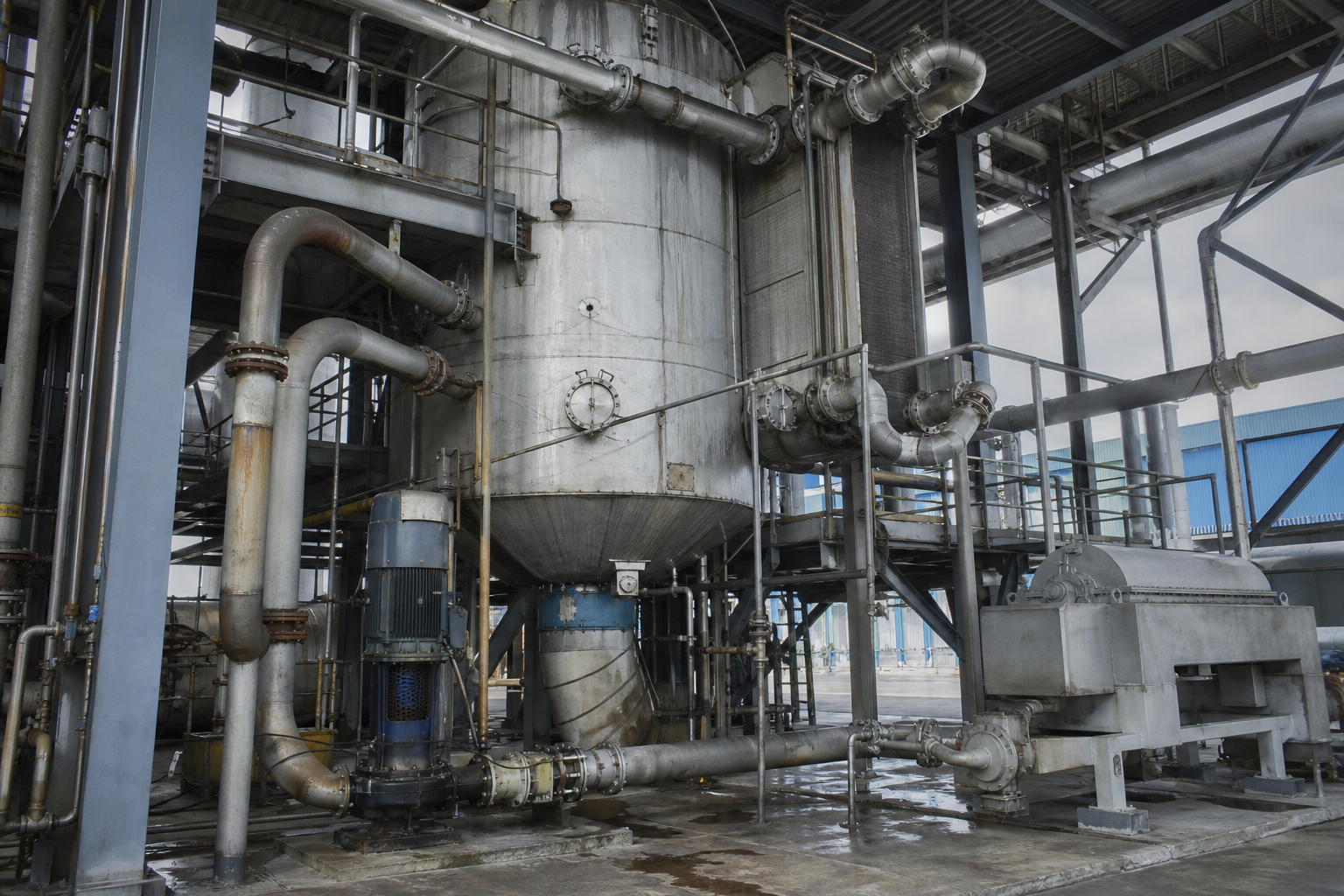
Every engineer who has designed an evaporator for sulfate water learns the same lesson early: calcium sulfate is the antagonist. Unlike most salts, CaSO₄ is retrograde in solubility — its solubility falls as temperature rises — which means that in a heat exchanger, the hottest surface in the process is exactly where the scaling-driving force peaks. Add evaporation concentrating the liquor, and tube walls become preferred crystallization substrates unless the design actively prevents it.
The defenses are established practice, but they must be designed in, not added later:
- Forced circulation with high tube velocity, keeping suspended crystals moving and the thermal boundary layer thin;
- Seeded slurry operation, maintaining a deliberate bed of suspended gypsum crystals so supersaturation deposits on existing particles instead of on the metal;
- Gypsum removal upstream, executing the bulk of CaSO₄ crystallization in dedicated, cleanable vessels before the liquor ever reaches the main evaporator;
- Temperature and ΔT discipline, limiting the heating-medium approach so wall temperatures stay within the window where scaling kinetics are manageable.
This is why the forced-circulation crystallizer is the standard thermal workhorse for AMD and metallurgical sulfate waters — the same configuration that dominates the wider family of hydrometallurgy evaporation and crystallization duties, of which AMD treatment is the mining-side branch.
Water Recovery: The Quiet Economic Engine
AMD treatment is usually justified environmentally, but in water-scarce mining regions the recovered distillate is a genuine economic product. Mines consume water at every stage — ore beneficiation, dust suppression, hydrometallurgical processing, camp and site services — and freshwater allocations are increasingly contested. An evaporation plant that returns a large share of the AMD flow as clean condensate does three things at once: it eliminates a discharge, it displaces freshwater withdrawal, and it stabilizes the tailings-facility water balance that otherwise swells in wet seasons. Where mine planners face simultaneous discharge limits and water shortages — a common combination — the thermal route is often the only single investment that addresses both.
The natural comparison is with the evaporation pond it replaces. Ponds work where land is cheap, climates are hot and dry, and regulators permit them; they fail on all three counts in many modern jurisdictions, and they return no water. Mechanical evaporation decouples water management from climate and land-use politics, at the price of energy — a price MVR technology has spent a decade reducing.
Closure, Bonding, and the Long-Horizon Case
A distinguishing feature of AMD projects is duration. A process plant designed for a 20-year mine life may inherit an AMD obligation that outlives the mine by generations. Long-term liabilities of this kind are increasingly secured by financial bonds and scrutinized in closure plans, and perpetual sludge impoundments are exactly what regulators are least willing to accept. Volume-minimizing treatment — gypsum to market, water to reuse, final salts to controlled storage or sale — shrinks both the physical and the financial legacy. Operators planning closure should evaluate thermal AMD treatment not against the operating cost of lime alone, but against the total liability of storing sludge indefinitely.
Related Pages
- Chemical and agrochemical solutions — sulfate-water and salt-recovery projects across the chemical industries.
- MVR evaporation systems — the electrically driven evaporator technology suited to remote mine sites without steam.
- Forced-circulation crystallizers — the scaling-tolerant crystallizer configuration behind sulfate-water processing.
- Drying and packing systems — downstream handling of recovered salt products.
Conclusion
Acid mine drainage is a sulfate problem with a water-recovery opportunity attached. The thermal route — staged selective precipitation delivering clean gypsum, MVR evaporation returning distillate to the mine, and sequenced crystallization harvesting the residual salts — converts a perpetual storage liability into products and closed-loop water. Its engineering demands are real, led by calcium sulfate’s retrograde solubility and the scaling discipline it imposes, but the underlying configurations are mature, and the regulatory and water-scarcity pressures that favor them continue to strengthen. For mines weighing closure obligations against water strategy, evaporation-crystallization deserves a place on the short list.
When This Route May Not Fit
Thermal treatment is not automatically the right answer. Where AMD flows are small and sulfate loadings modest, staged lime or HDS neutralization delivers compliance at a fraction of the capital cost, and evaporation-crystallization economics never close. Where land is available, the climate is hot and dry, and regulators still permit ponds, solar evaporation remains the low-cost default. If the recovered gypsum fails product specifications — because of heavy-metal co-precipitation — and local disposal is cheap, the product route loses its anchor. At sites without reliable grid power or affordable delivered energy, an electrically driven MVR plant can be untenable regardless of chemistry, and low-strength waters that never reach crystallization strength may justify concentration plus secure storage rather than a full salt-separation train.
What Must Be Verified
Validation focus starts with a full, seasonally resolved water chemistry — sulfate, iron, aluminum, manganese, chlorides, and heavy metals across wet- and dry-season flow peaks — because the flowsheet is written by the ions. The gypsum stream must be tested against target product specifications (cement retarder, plaster) including metals leaching, since off-spec gypsum reverts to a waste liability. The Mg–Na–SO₄–Cl phase behavior and crystallization sequence should be confirmed by evaporation modeling or bench concentration tests. A corrosion review across the pH 2–4.5 chloride-bearing envelope dictates materials of construction, calcium sulfate scaling tendency warrants fouling-factor or pilot verification, and remote-site power availability must be confirmed before MVR is selected.
Frequently Asked Questions
What is acid mine drainage composed of?
AMD is typically pH 2–4.5 water carrying sulfate (commonly 1,000 to over 10,000 mg/L), iron, aluminum, manganese, and site-specific heavy metals such as zinc, copper, nickel, arsenic, and cadmium, produced by the oxidation of pyrite and other sulfide minerals exposed by mining.
Can evaporation replace lime treatment of AMD?
Not replace — complete. Staged neutralization remains the first step, removing iron, aluminum, and the bulk of sulfate as gypsum. Evaporation-crystallization then treats the conditioned liquor: it recovers water as clean distillate and crystallizes the remaining salts as separated products, eliminating the discharge that lime treatment alone never could.
Why is gypsum scaling the main problem in AMD evaporators?
Calcium sulfate has retrograde solubility — it becomes less soluble as temperature rises — so the hottest surface in the evaporator, the heat-exchanger wall, is where it deposits most readily. Forced circulation, seeded slurry operation, upstream gypsum removal, and controlled temperature approach are the standard countermeasures.
Is recovered AMD water fit for reuse?
Yes. The distillate from mechanical evaporation is condensed water vapor, essentially free of the metals and salts that characterize AMD, and is routinely reused as mine process water — for beneficiation, dust suppression, and hydrometallurgical circuits — displacing freshwater withdrawals.
What salts are recovered from AMD crystallization?
In the order the brine’s chemistry dictates: calcium sulfate as gypsum from the neutralization and conditioning stages, then typically magnesium sulfate (Epsom salt) from cooled crystallization, with sodium sulfate and sodium chloride following depending on the source water’s ion composition. Separation quality determines whether these are products or residues.
Planning an AMD closure or water-recovery study? Send the full water chemistry (sulfate, metals, chlorides), the flow range, and your treatment goals — in exchange you will receive a first-pass screening of the evaporation-crystallization route, including which salt products your water chemistry supports.